

Salesforce marketers stand at a crossroads. On one hand, Salesforce is encouraging every marketer to adopt an agentic way of working, where AI assists with planning, creating, and improving campaigns. Meanwhile, experts across the ecosystem warn that AI used on poor‑quality data can do more harm than good. While there’s no better time to get started with agentic marketing, reckless adoption will only lead to disjointed customer experiences and angry calls from the IT department.
So, given this dilemma, how should you get started with AI in marketing? Marketers have long been led to believe that adding more data would solve their problems, but opinions are shifting. Many teams now see better results by focusing on a few strong use cases and smaller, more reliable datasets. This is reassuring for marketers who have to make the most of limited and imperfect data. You don’t need all the answers, just a general sense of where you are and a rough map of where you’re headed. In this piece, we answer why Salesforce marketers need a data strategy, not just better data.
The Hen and the Egg
When AI is fed poor data, poor decisions are bound to follow. Fears of hallucinations and unpredictability have led some to delay AI adoption indefinitely. This point of view, which I like to call “data nihilism,” suggests you shouldn’t pursue progress because of poor data, rigid processes, or legacy baggage. Why even bother with “fancy AI” if your foundations are wonky?
Frankly, I find this kind of narrative jarring and unproductive. Refusing AI because your data quality is poor is about as useful as telling yourself not to exercise because you get winded after five minutes. If you never start your AI journey, you won’t fail, but by doing so, you only delay the inevitable. By the time you realize that, your customers and competitors will set the pace, and you will have lost control.
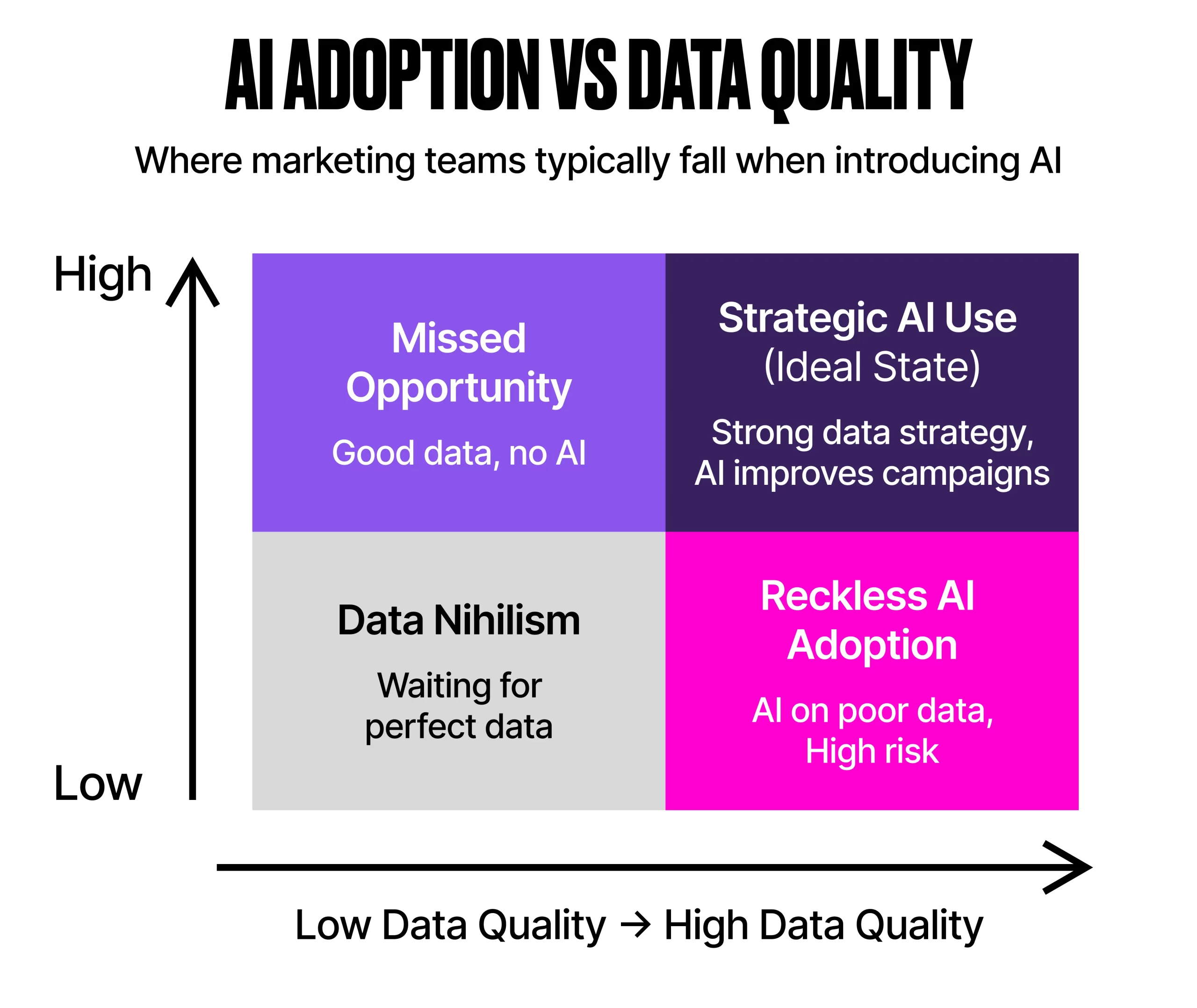
I like to view AI as a part of the solution. AI exposes gaps you did not see before and gives you the chance to address them. It reflects the state of your data and helps improve it. Many organizations would never have uncovered issues in systems, processes, or data without letting AI agents shine a light on them.
It’s Not Only About Data
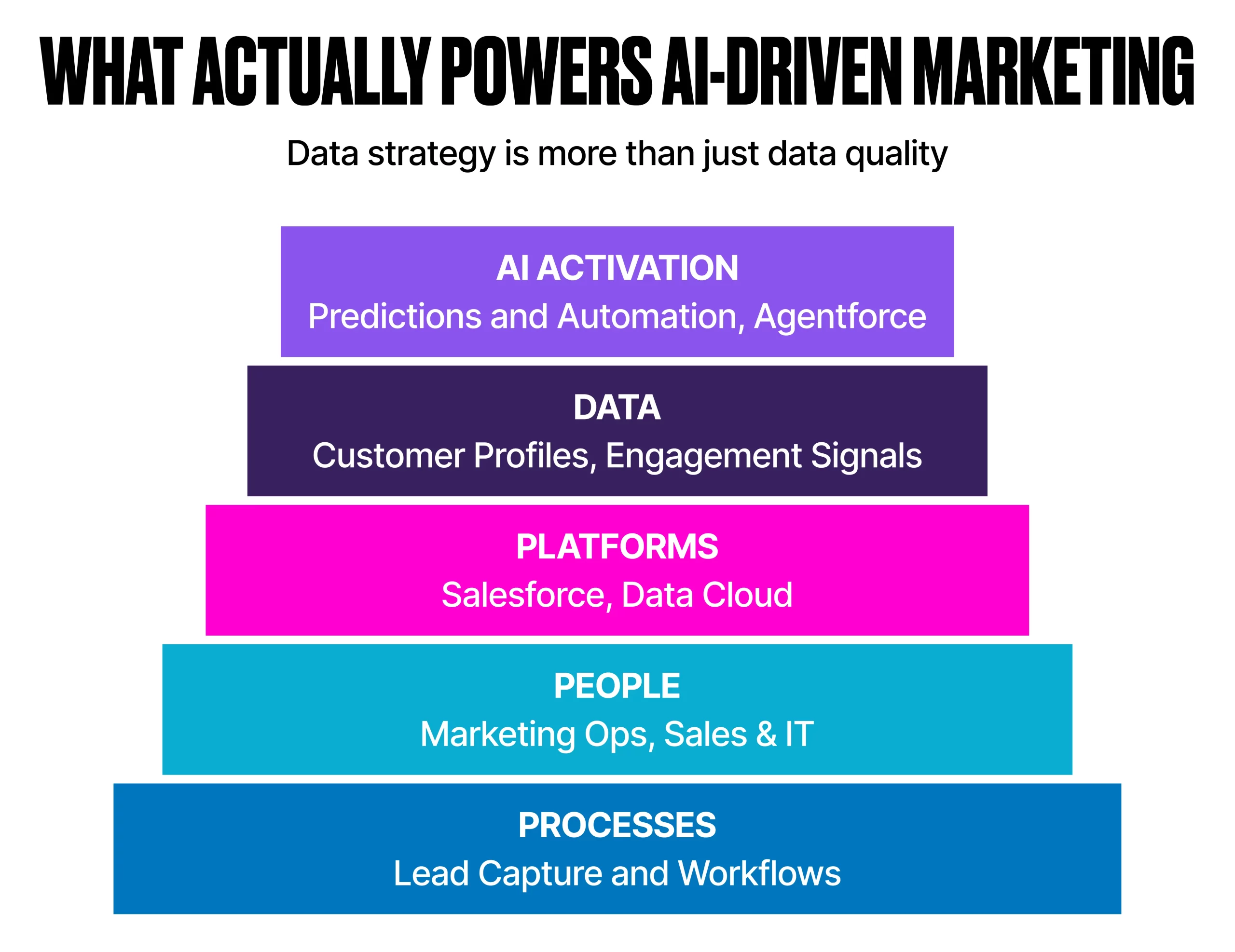
Autonomous AI cannot function without trusted real‑time insights. However, data quality is only one part of a successful data strategy. Data quality tells you how to reach your destination, not where to go or why. Too many marketing teams operate without a clear strategy, then wonder why platforms like Data 360 or Agentforce feel underwhelming. Without a clear strategy, you cannot expect to unlock the full value of your tech stack.
A good data strategy is less about data itself and more about the people, platforms, and processes that shape it. I have worked with marketing ops leaders who blamed sales for poor data quality, when the real issues were misaligned incentives, weak validation processes, and siloed ways of working. Rather than blame sales, address the underlying design of the process. If leads are only updated weekly, no amount of real‑time AI segmentation will fix the lag.
Think of data strategy as a transformation roadmap – it paves the way to build business architecture that leads to more efficient processes and better outcomes. Data becomes both the vehicle and the evidence of that transformation. When the quality and actionability of data improve, it signals that the background processes are improving as well.
Framing the Right Problem
A good data strategy forces trade‑offs: which use cases to focus on, which segments to ignore, and what “good enough” data looks like. Those decisions separate wishful thinking from executable plans. Every organization has more potential use cases than capacity to deliver them, so strategy becomes the art of focus. Done well, the result is not a long list of aspirations but a coherent story about how data will help the business win.
Proper use case design is as much about the use cases you reject as the ones you select. Take the classic “next best offer” use case. On paper, it sounds valuable: let AI pick the perfect product to recommend in every email. In reality, most teams lack the unified purchase data, product metadata, or real‑time feeds needed to make it work. It is a sophisticated‑sounding use case that is difficult to deliver and unlikely to pay off.
Let’s face it – most Data 360 or Agentforce use cases are weak. The requirements are hard to define, the value to the end user is questionable, and there is little indication that the returns would exceed the total cost of ownership. When the list of use cases to choose from is short, the odds of picking the wrong one go up. At its core, this is a facilitation problem.
In facilitation, quantity precedes quality. When you brainstorm use cases, you want to aim for as many as 40 raw ideas per person. After the first 20 ideas, magic starts to happen – you get ideas that are wildly creative and potentially transformative. It’s tempting to start developing a promising idea once you hear it – but resist this urge. Postpone refinement until you’ve moved past the obvious and into the genuinely creative.
Guiding Principles for Use Case Selection
- Works with minimal data: Choose use cases that thrive on a few reliable fields rather than requiring a perfect 360° customer view.
- Doesn’t require operational change: Pick scenarios that slot into today’s processes instead of demanding new cadences, ownership, or workflows.
- Has a clear success metric: Select use cases where you can measure impact within weeks, not months, and tie improvement directly to the AI intervention.
- Creates value for a specific audience: Good use cases solve a real problem for a real person – a marketer, a customer, or a sales rep – not an abstract idea like “personalization.”
- Is feasible to pilot quickly: Aim for use cases that can be tested in a single journey, campaign, or segment before scaling across the org.
Common Marketing AI Pitfalls and How to Avoid Them
- Dilution of originality: AI often defaults to familiar patterns, which leads to content that sounds generic or repetitive.
- Confidently false insights: If you use AI to summarize your marketing analytics, build guardrails to avoid accidentally relying on wrong insights.
- Overestimating data readiness: Teams assume their data is real‑time or unified when in reality it’s outdated, siloed, or incomplete.
- Solving the wrong problem: Marketers choose shiny personalization use cases that require perfect real-time data, instead of targeting high‑impact scenarios that work with what they actually have.
- Automating too early: Teams automate workflows before the underlying process is stable, which amplifies errors instead of removing them.
Taking the Path of Least Resistance
People sometimes mistake difficulty for ambition. There is no glory in deploying the shiniest AI tools if the results do not follow. What matters is scalable business impact. Use AI where it makes sense from a results perspective. If a traditional campaign or a rule‑based automation achieves the outcome, that is perfectly fine.
One lesson from architecture is to prefer simplicity and composability over complexity. With all else equal, choose the solution that is easiest to build, maintain, and replace. The same applies to data strategy. If two approaches achieve the same customer experience, pick the one that requires less data or is easier to set up.
Final Thoughts
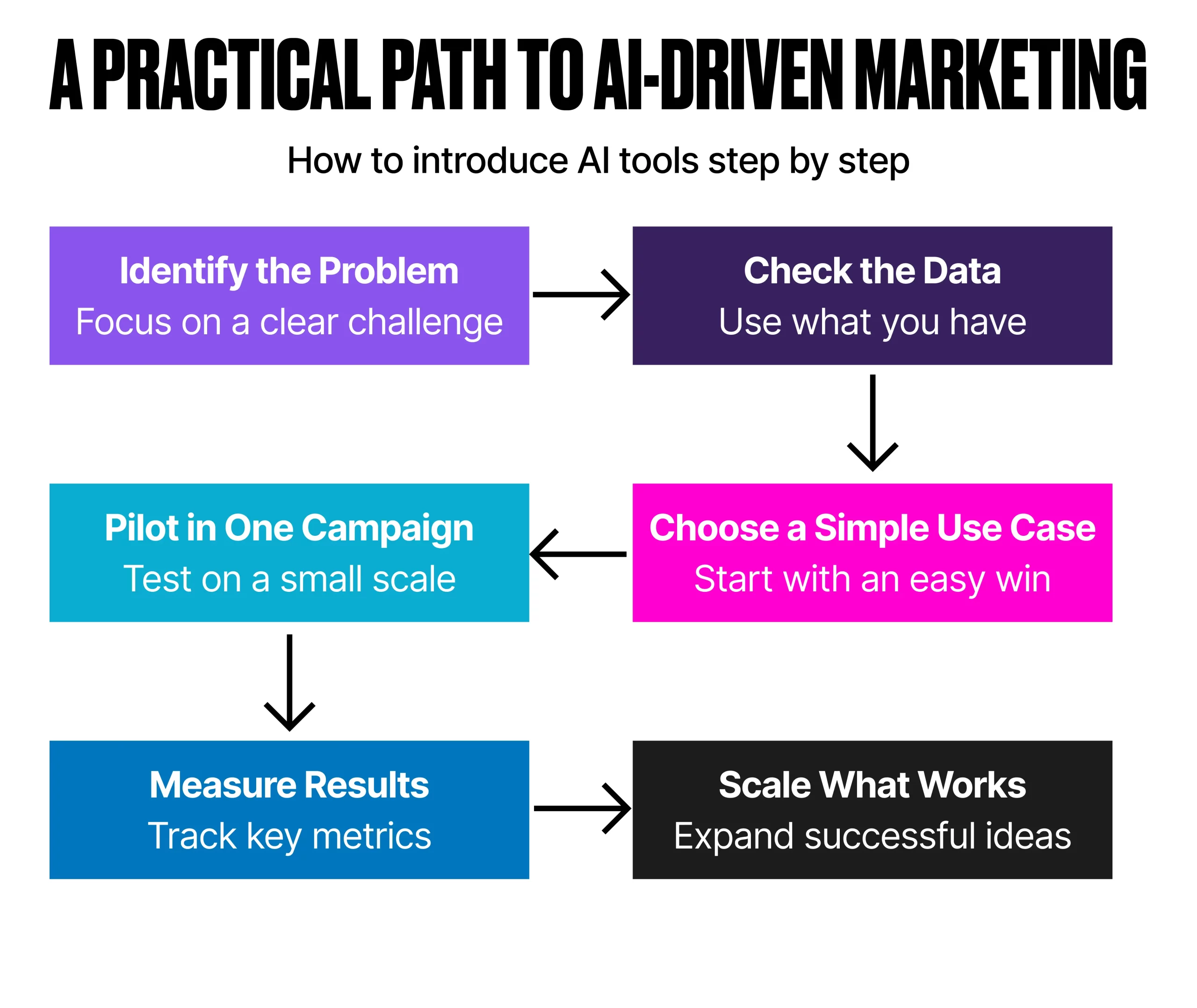
Introducing AI into marketing is neither about diving head-first into the most advanced features nor fixing every data issue up front. It’s about choosing the right problems to solve and applying AI to meet one challenge at a time. AI is great at exposing your strategic blind spots, so make the most of the learnings along your journey.
Start where the impact is obvious, validate that the data supports the task, and deliver value quickly. Agentic marketing works best when AI augments marketers rather than overwhelms them. By starting small, staying focused, and iterating based on real results, you build both capability and confidence. Do that consistently, and AI stops being a risky experiment and becomes a trusted helper.
For more conversations and insights from across the Salesforce ecosystem, watch the latest episode of the Picklist podcast below.