

As far as Salesforce releases go, the winter release is always one to watch. As the ecosystem gears up for Dreamforce, the Winter ‘27 Release offers an early glimpse into the announcements to come. Many of the updates introduced now lay the groundwork for the more transformational changes that will take center stage in San Francisco.
From a marketer’s perspective, several themes stand out in the Winter ‘27 Release. One is undoubtedly the deeper entrenchment of Agentforce within the marketing domain. Another is a renewed focus on the core foundations of Marketing Cloud Next, with enhancements to campaigns, flows, and audience management. While previous releases concentrated on closing feature gaps with Marketing Cloud Engagement and Account Engagement, this release shifts attention toward more forward-looking capabilities.
One of the most anticipated areas of improvement, however, is content management. Salesforce’s CMS has long felt lackluster in both scope and practicality, but the conversation shifted in June 2026 when the company announced its acquisition of CMS powerhouse Contentful. As a result, content management features prominently throughout the Winter ‘27 Release.
In this article, we’ve rounded up our picks for the most impactful updates across the Salesforce Marketing Cloud suite. Let’s get started.
Marketing Cloud Next (Agentforce Marketing)
If I had to pick one business domain most disrupted by generative and agentic AI, it would be marketing. What began as a vision of generating vast amounts of one-to-one personalized content has evolved into automated decision-making and fully autonomous workflows. Salesforce has followed suit, adapting its products to meet the changing needs of the agentic marketer.
As one of the world’s leading martech providers, however, Salesforce serves a vast customer base with widely varying levels of data and AI maturity. The company knows it cannot go all in on agentic AI overnight. Doing so would risk alienating customers who are looking for a more incremental path to transformation. In the Winter ‘27 Release, we see signs of a more balanced product strategy, one that caters to both ends of the maturity spectrum.
1. Agentforce Marketing Goals Agent
Winter ‘27 introduces two new Agentforce agents dedicated to marketing. The first, the Marketing Goals Agent, helps marketers translate business objectives into actionable marketing strategies. Users define a goal, budget, and eligible audience, after which the agent generates a recommended strategy for review and approval. Once activated, it operates autonomously within those guardrails, continuously optimizing activities and decisions toward the desired outcome.
2. Agentforce Marketing Content Agent
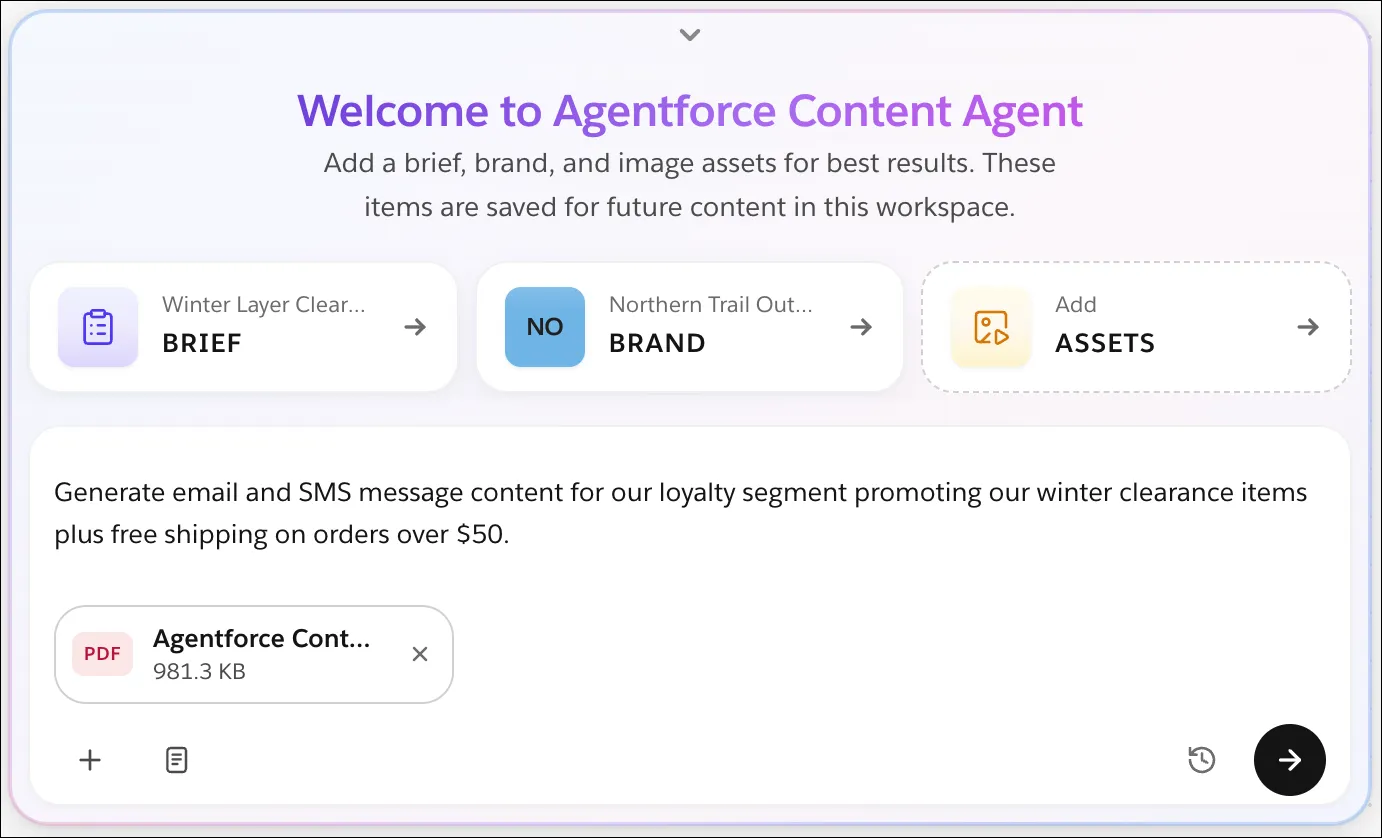
The second new marketing-focused agent in Winter ‘27 is the Agentforce Content Agent, which helps marketers create campaign content at scale while maintaining brand consistency. Marketers can describe their campaign objectives in natural language, and the agent generates on-brand content for email and SMS based on brand guidelines, campaign briefs, and media assets sourced from Salesforce or uploaded documents. The experience supports both AI-generated and user-provided imagery, includes inline editing for rapid iteration, and enables direct publishing to Salesforce CMS.
For marketing teams facing constant pressure to launch campaigns faster, produce more variations, and maintain brand consistency, the ability to automate repetitive tasks is a welcome productivity boost. At the same time, governing content quality and brand alignment still requires human oversight, meaning the agent is more likely to reduce operational bottlenecks than eliminate content creation challenges altogether.
3. Marketing Completion Actions
Previous Account Engagement (Pardot) users may raise an eyebrow at this one. Completion actions are making a return as one of the new core capabilities of Marketing Cloud Next. I, for one, welcome the addition, as completion actions were among the most versatile features in Account Engagement. With this new iteration, marketers can bypass the need to build a dedicated flow every time they want to notify a user, send an autoresponder email, or assign a lead. It’s both a significant time-saver and a welcome nod to users making the transition to the new platform.
4. Updated Campaign Overview
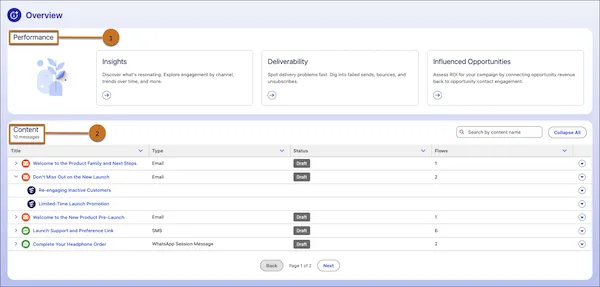
With Winter ‘27 Salesforce strengthens one of the core building blocks of Marketing Cloud Next: campaign optimization. The latest enhancements make it easier to manage campaign planning, execution, and performance in a single place, reducing the need to switch between different workspaces. While not the most exciting update in the release, it’s a practical improvement that should make day-to-day campaign management more efficient for marketers.
5. Post-Send Link Editing
Every marketer has been there. You build the audience, create the content, run the tests, make the final checks, and click send. Then, moments later, you realize you accidentally pasted a funny link from a friend’s DM into a corporate newsletter that’s now on its way to thousands of paying customers. Until now, these situations have typically called for a humble apology and some quick damage control.
With post-send link editing, however, no apology may be necessary. Salesforce Customer Support can now retroactively update the destination URL of a tracked link after an email has been sent, ensuring recipients are none the wiser. Crisis averted, reputation intact, and job well done.
6. Email Deliverability Health
While marketing technology has evolved a lot in the past five years, email deliverability remains a constant pain point for marketers. With Winter ‘27, Salesforce adds several capabilities that make identifying and reacting to deliverability issues easier. New monitoring capabilities show how emails perform across different mailbox providers and message types. These allow you to spot failures and reputation-related issues before they affect campaign performance at scale. The system assigns your email program a 0-100 Email Deliverability Health Score and sends you automated alerts when a critical threshold is reached.
7. Distributed Marketing and Alerts
Distributed Marketing is one of those features that, when it first launched in Marketing Cloud Engagement, showed a lot of promise. The value proposition was clear: make in-brand communication easier and more efficient across the enterprise, not just within marketing. However, many practitioners found the reality to be far more complex, with adoption often hindered by usability and reliability challenges.
With Marketing Cloud Next, Distributed Marketing and Alerts seem much better aligned with that original vision. Marketers can now enforce required phrases and character limits within templates, making it easier to maintain brand and compliance standards. Salesforce has also introduced a scheduled flow template for recurring sends, expanded bulk-send capabilities, and added Agentforce-powered template recommendations to help users select the most appropriate message for a given scenario.
8. Cross-Channel Content Personalization
Content management gets a boost in Winter ‘27, with Salesforce introducing capabilities that should be particularly welcome for teams managing content across multiple channels. Marketers can now reuse personalization logic instead of recreating the same rules and expressions for each message, improving consistency and reducing maintenance effort. Additionally, Handlebars and AMPscript get expanded support in SMS, WhatsApp, RCS, in-app, and push notification messages, allowing you to apply and reuse personalization strings across various channels with ease.
9. Landing Pages and Forms
Salesforce now supports Handlebars and AMPscript in landing pages, making it easier to reuse existing personalization and scripting logic instead of rebuilding functionality from scratch. In addition, marketers can use custom HTML forms on landing pages, providing greater flexibility over form design and user experience. Together, these updates give teams more control over how landing pages are built and personalized, while helping reduce the effort involved in migrating and maintaining marketing assets.
Marketing Cloud Engagement
Salesforce has made it clear that Marketing Cloud Next is both the present and the future of its marketing portfolio. At the same time, the company has acknowledged that customers need to transition at their own pace. Many mature Marketing Cloud deployments have years of content customizations, automation pipelines, and data extension architectures behind them, and those aren’t assets you can simply “lift and shift” to a platform with a fundamentally different DNA.
Against that backdrop, it’s perhaps no surprise that updates to Marketing Cloud Engagement and Account Engagement are relatively modest. Most of the enhancements focus either on maintaining existing capabilities or helping customers prepare for an eventual move to the next-generation platform.
10. Connect Marketing Cloud Engagement to Data 360
Winter ‘27 introduces a more guided setup experience for connecting Marketing Cloud Engagement with Marketing Cloud Next through Salesforce Go, helping organizations establish Data 360 integration required to access next-generation capabilities. While this is primarily an administrative enhancement rather than a marketer-facing feature, it aligns with Salesforce’s commitment to ease the friction between the previous marketing platforms and Marketing Cloud Next.
Summary
Whether you consider yourself an agentic marketer or a traditionalist, there should be something for you in the Winter ‘27 Release. Personally, I find most of the enhancements refreshingly practical. There are a few headline-grabbing features built for flashy demos, yes, but the majority of the updates seem focused on addressing real marketer pain points: campaign performance tracking, email deliverability, cross-functional collaboration, and operational efficiency.
Which updates caught your eye? Join the conversation on LinkedIn and come say hello at Dreamforce, taking place September 15-17, if you’re heading to San Francisco. The Salesforce Ben team will be there, and we’re always up for a good conversation.
Read More
- 17 New Salesforce Flow Features in Winter ‘27
- Top 10 Salesforce Winter ’27 Features for Developers
- Top 12 Salesforce Winter ’27 Features for Admins
- Sales Cloud: Top 7 Salesforce Winter ’27 Features
- Service Cloud: Top 8 Salesforce Winter ’27 Features