

Highlights
- AIforce is a new custom interface layer that sits on top of the Salesforce platform.
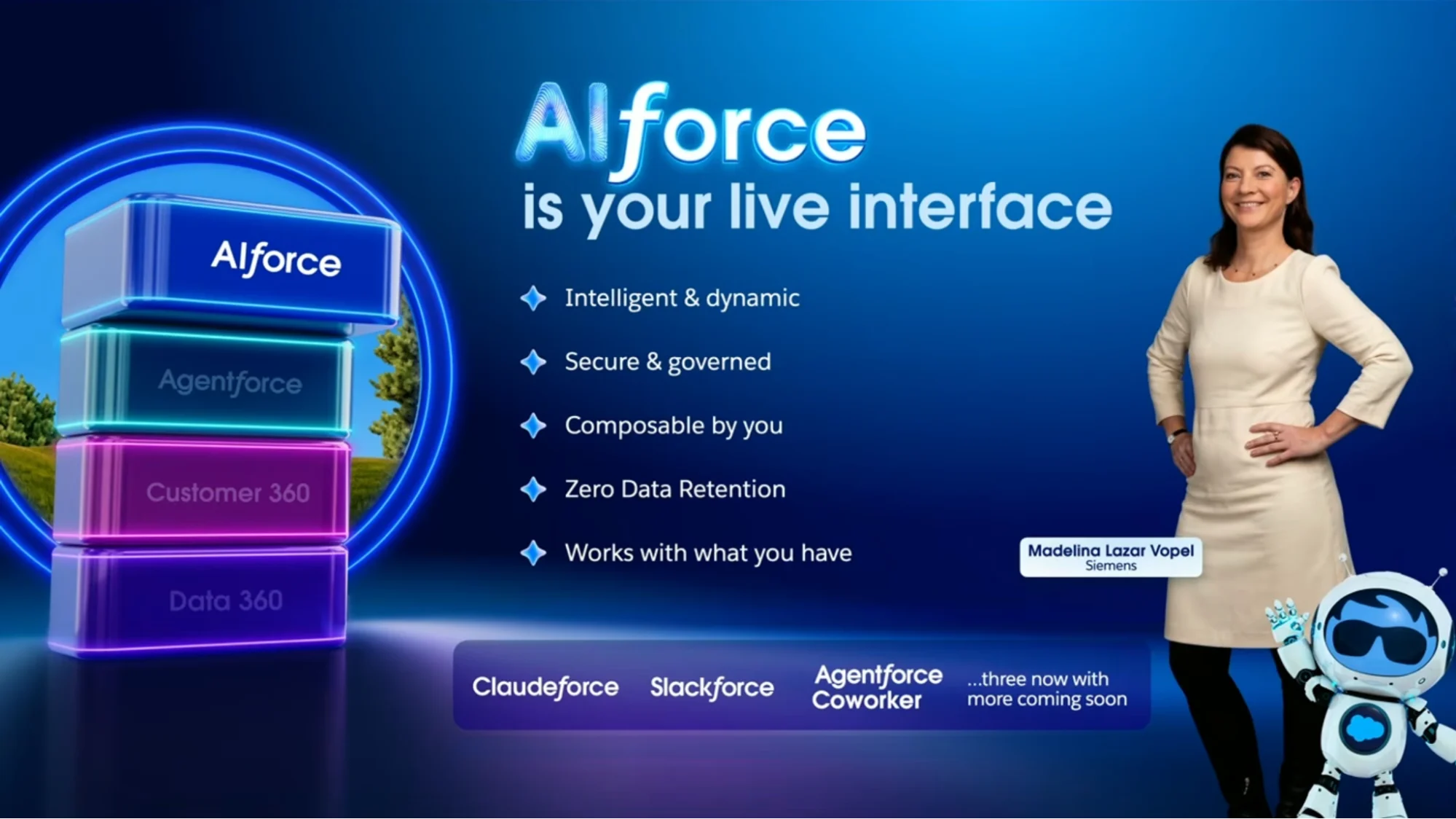
- It is made up of Claudeforce, Slackforce, and Agentforce Coworker.
- It is powered by the Headless Toolkit, an open architecture that exposes the Salesforce platform to be used by other products.
- Zero Data Retention (ZDR) is a critical claim that Salesforce is making about AIforce. No customer data will be retained by the models, nor will it be used to train the models.
One of the stars of the show at Dreamforce ‘26 is the all-new AIforce. Salesforce touts it as a new interface layer that sits over the top of the metadata-driven Salesforce platform and allows users to interact with Salesforce in Claude, Slack, Lightning, or wherever they prefer to work.
This new suite of tools offers a whole new paradigm in terms of how users can work with Salesforce. Gone are the days of having to log in to the user interface (UI) that Salesforce provides and learning to work within its constraints. Now, the UI belongs to the user, and they can work with Salesforce however they please.
What Is AIforce?
AIforce is made up of three main components: Claudeforce, Slackforce, and Agentforce Coworker. It is powered by the Headless Toolkit, an open architecture that exposes every element of the Salesforce platform so that MCPs, APIs, and other tools can interact with it. This empowers humans and agents alike to work with Salesforce in any way that they see fit.
Trying to simplify this as best I can, think of AIforce as a friendlier wrapper over the previously announced Headless 360 offering. Headless 360 created a clear distinction between the UI and the platform functionality in the application layer. Historically, the UI was required to leverage many of the platform’s capabilities. Headless 360 opened brand new doors for developers to leverage the capabilities without needing to use the UI. AIforce takes this a step further by allowing agents to interact with the platform as well.
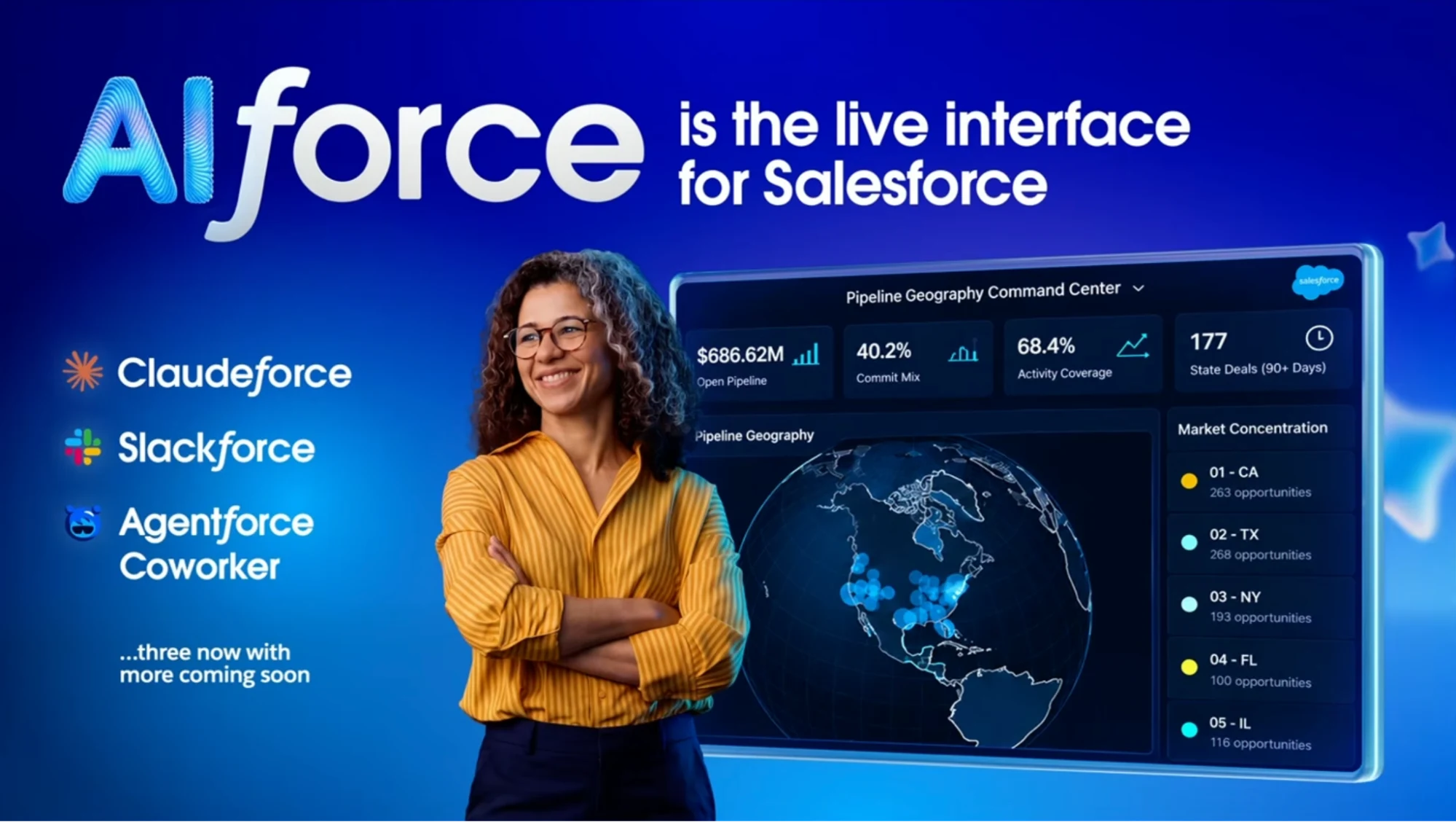
In addition to the above, AIforce can be extended through use of the AgentExchange (formerly known as the AppExchange). This is a directory of partners that are using headless to build integrations, agents, apps, integrations, and more.
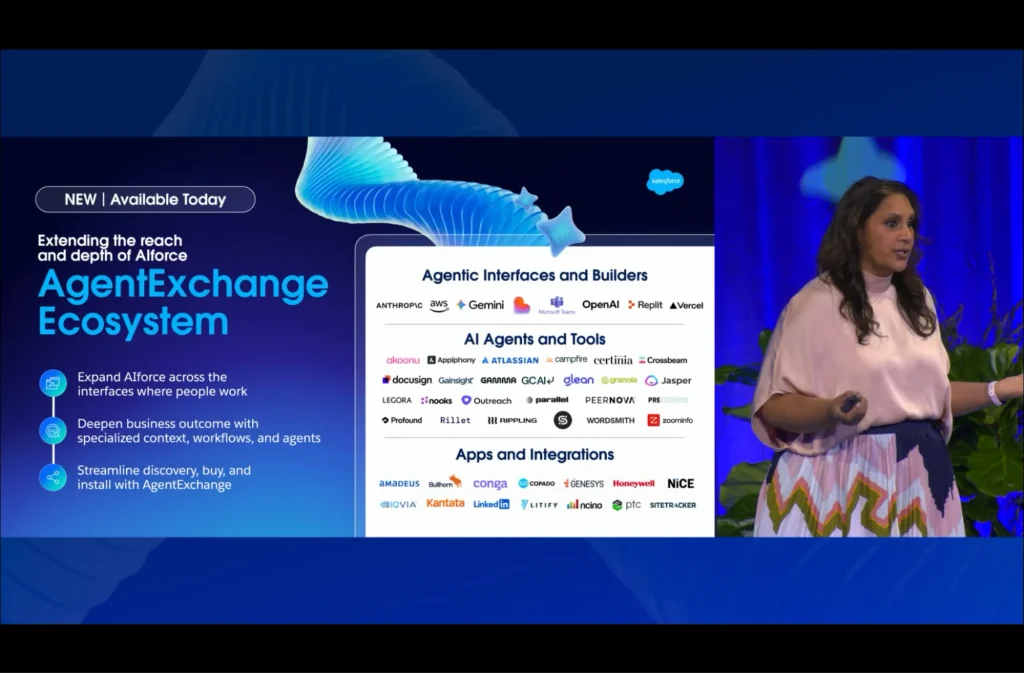
Salesforce makes it very clear in their official news post that you can use your agentic AI layer of choice to build and bring your own interface to Salesforce. They list Anthropic, AWS, and Google as agentic interfaces, Lovable and Vercel as AI agents, and DocuSign, Gamma, Jasper, Ramp, and Rippling as tool offerings.
Salesforce’s messaging isn’t that their tooling isn’t important anymore – it certainly is; that part doesn’t change. Ultimately, it’s about which party does the outreach. Until now, if your end users wanted to use Salesforce, they had to access it and log in. They had to go to Salesforce. Now, with AIforce, Salesforce comes to them in whichever UI they prefer to work in.
The AIforce Keynote at Dreamforce
Salesforce announced AIforce at their main Dreamforce keynote, but it also got its own spotlight sessions and a dedicated keynote.
Claudeforce
The AIforce Keynote at Dreamforce began by recapping what Salesforce had already announced about the new suite at earlier Dreamforce keynotes and sessions. Shannon Mathews (VP, Product Management, Salesforce) reminded attendees that they could sign up for the Claudeforce open beta, and flashed a QR code on the screen.
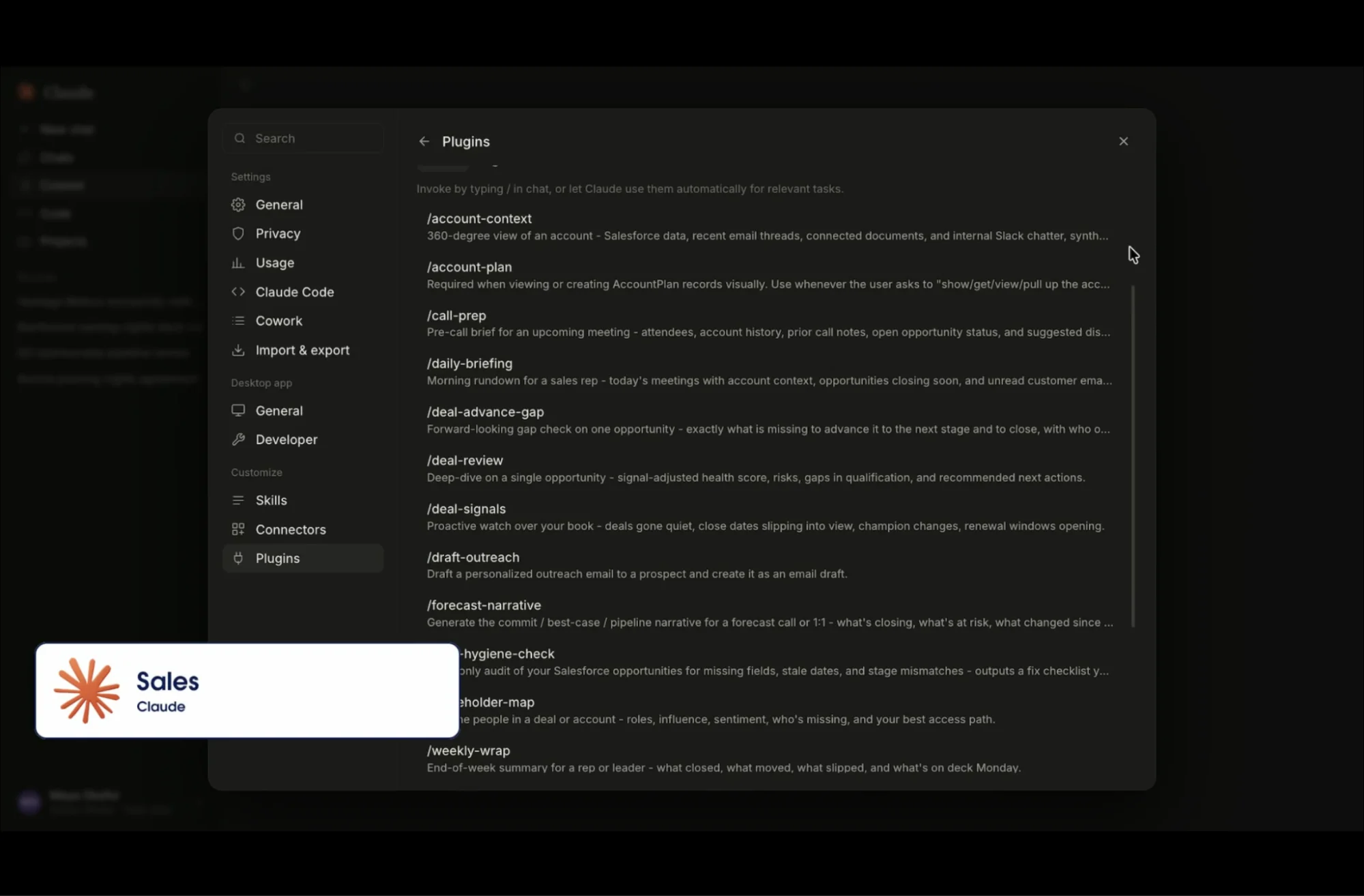
She then introduced the first use case customer: Stellar Media. The demo team ran through the new plugin for Claude that powers the Stellar Media sales rep’s Claude interface.
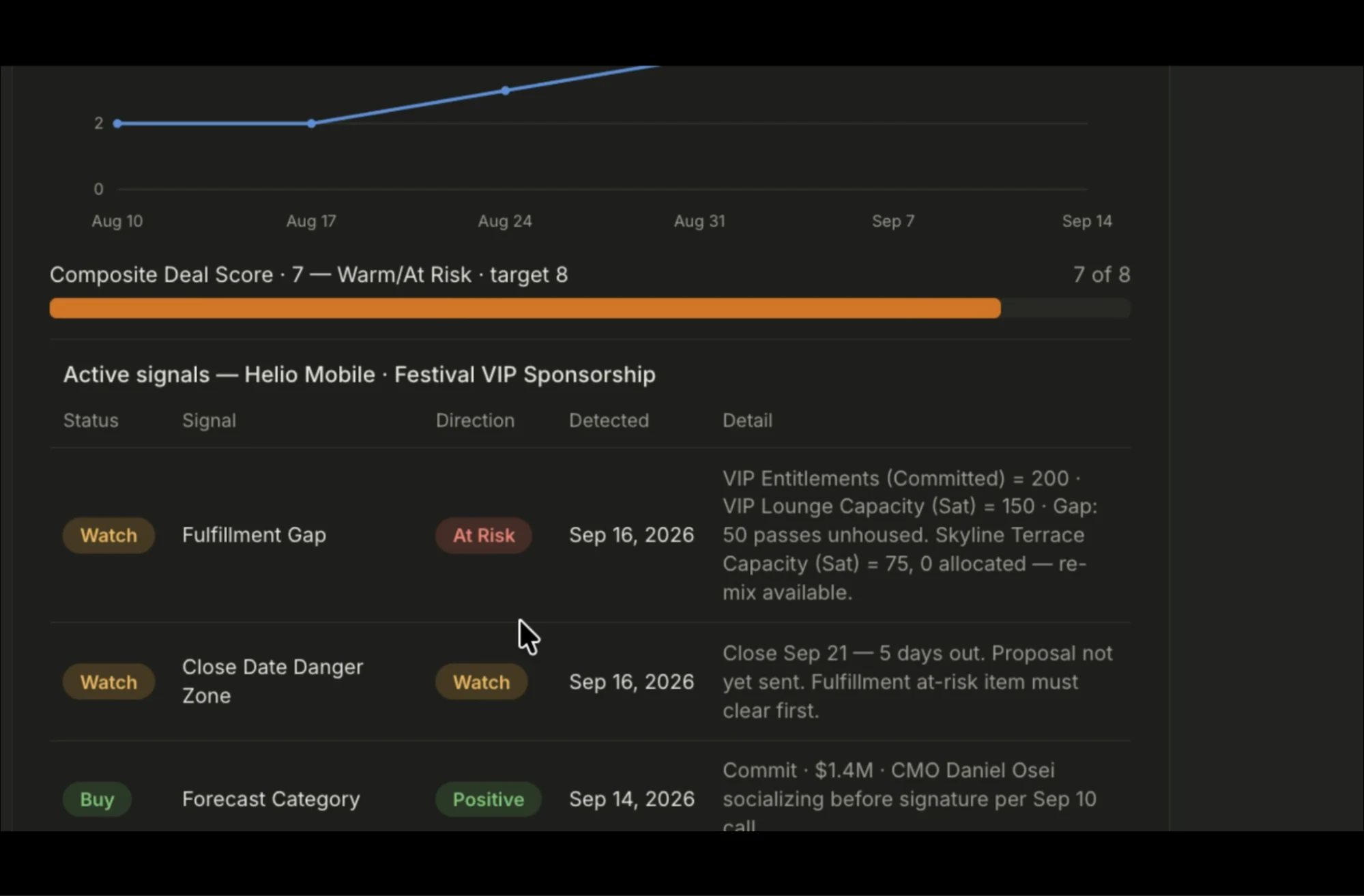
Shannon then reminded attendees that they could connect other tools like Gmail as well, for additional context. She then pointed out that there was a deal that was at risk, as seen in the Claude UI. The rep asked Claude for more detail, which it promptly provided and drafted an email as a recommended action.
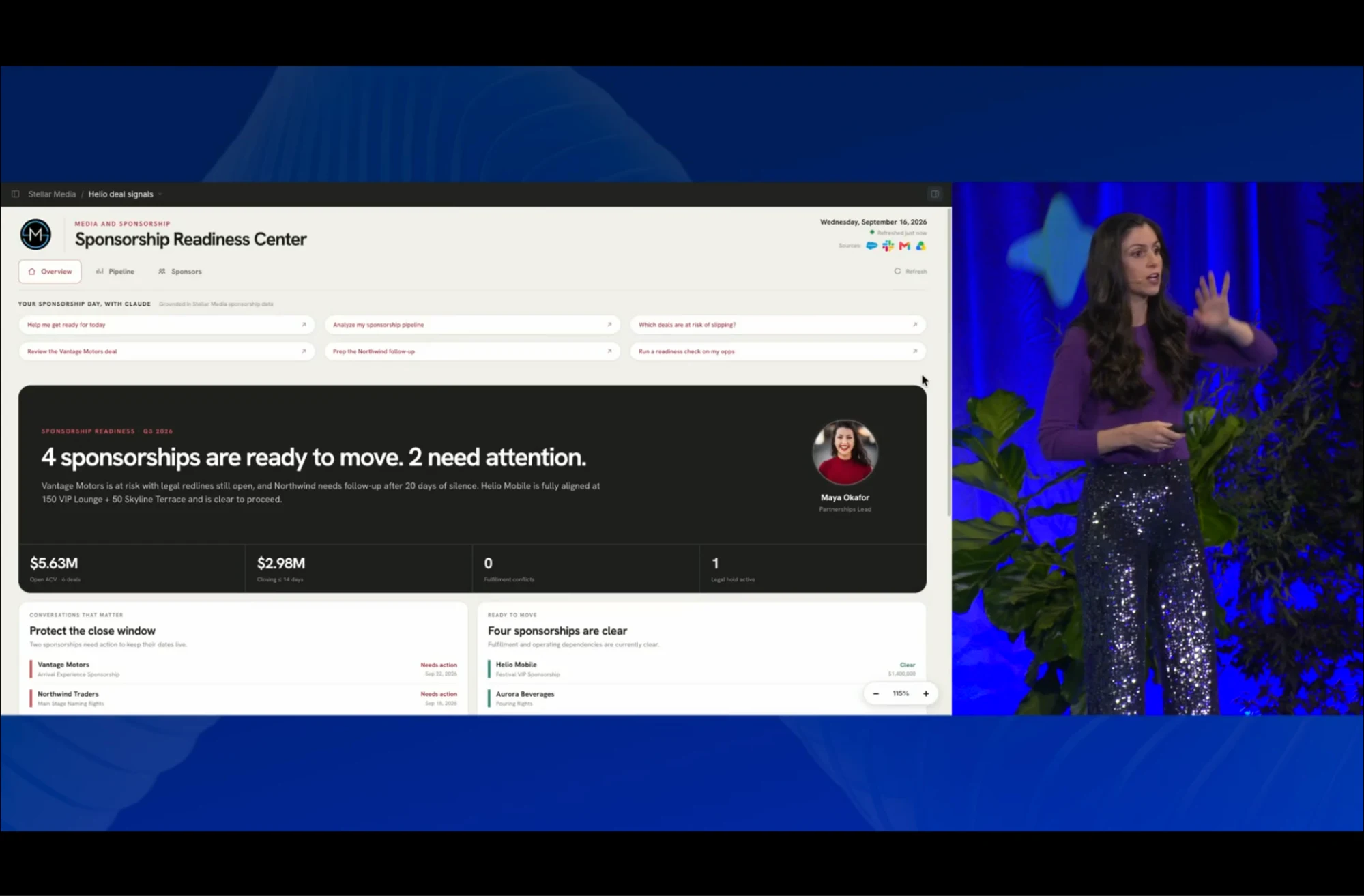
The sales rep then gave Claude a detailed prompt asking for a holistic view of their book of business, which Claude delivered in the form of a detailed mission control-like interface.
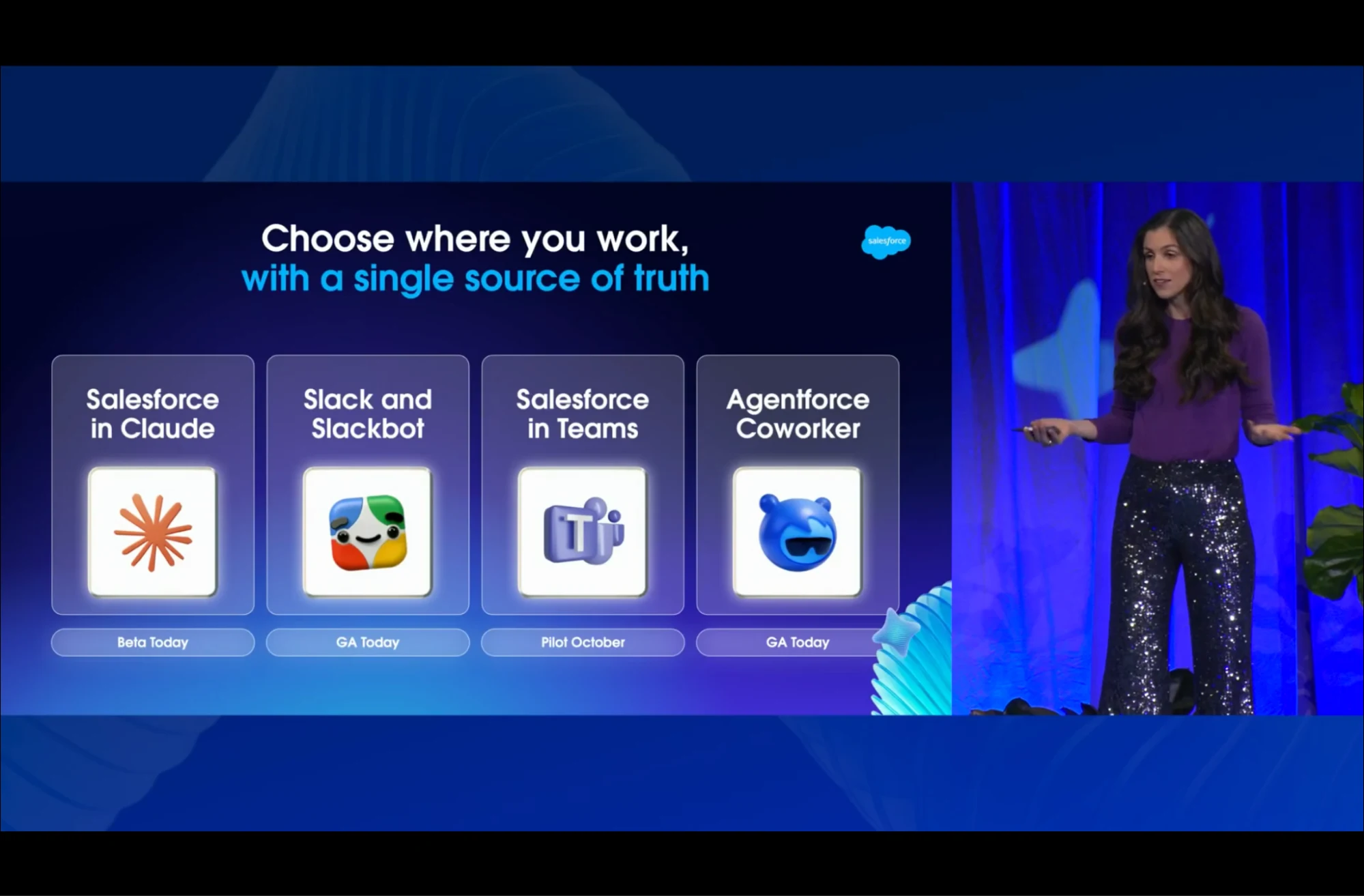
Shannon reiterated that Claude wasn’t the only surface that AIforce brings to the table. She highlighted in particular that it empowers users to connect Salesforce to Microsoft Teams, among the other interfaces that have already been discussed today.
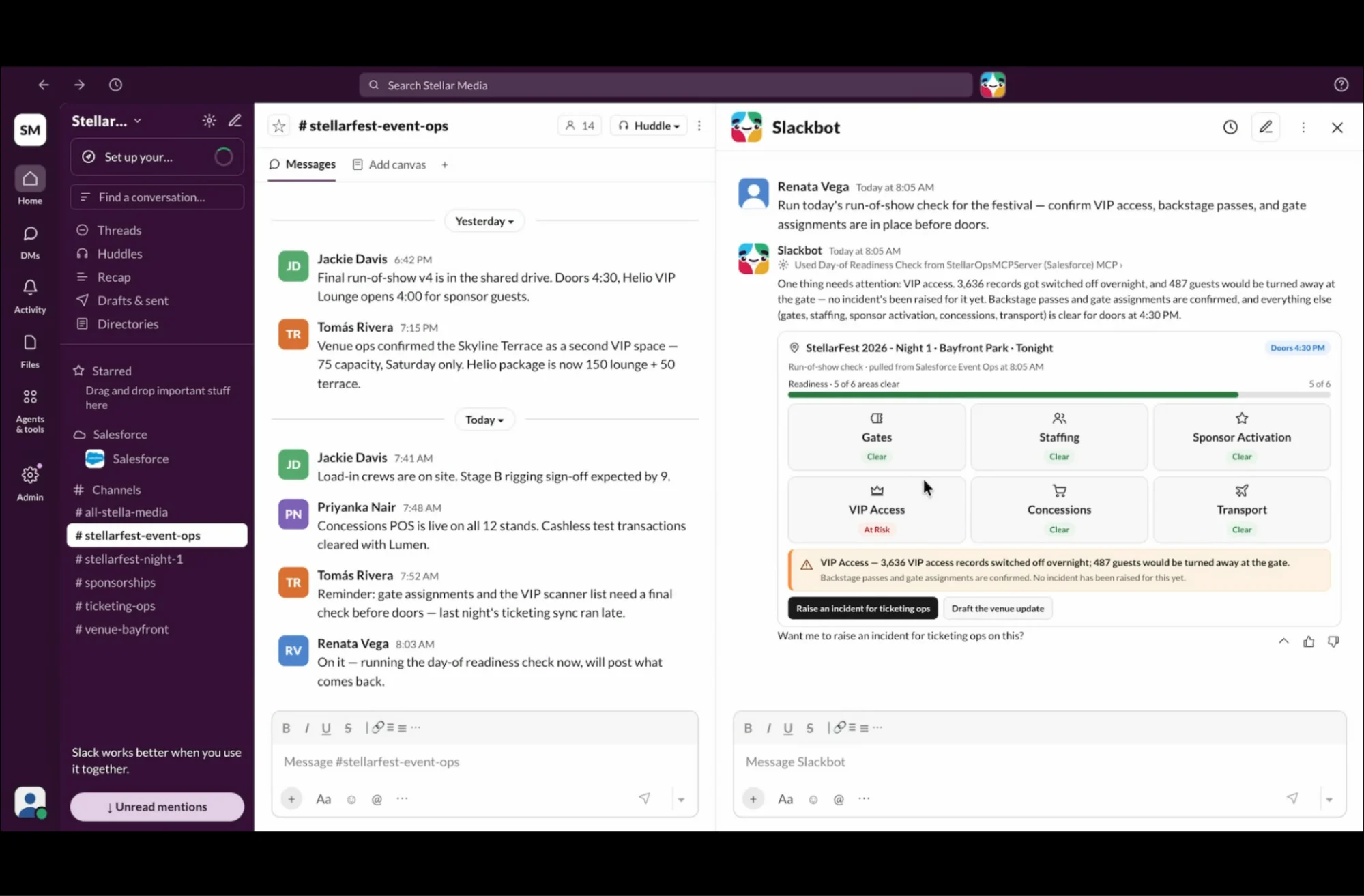
Next up, the Slackforce demo. The hypothetical rep asked Slackbot to run their “day-of-event readiness checklist”. Similar to the prior demo, there was an issue that needed to be solved, and Slackbot surfaced the solution to the user within the Slack interface that they were already using.
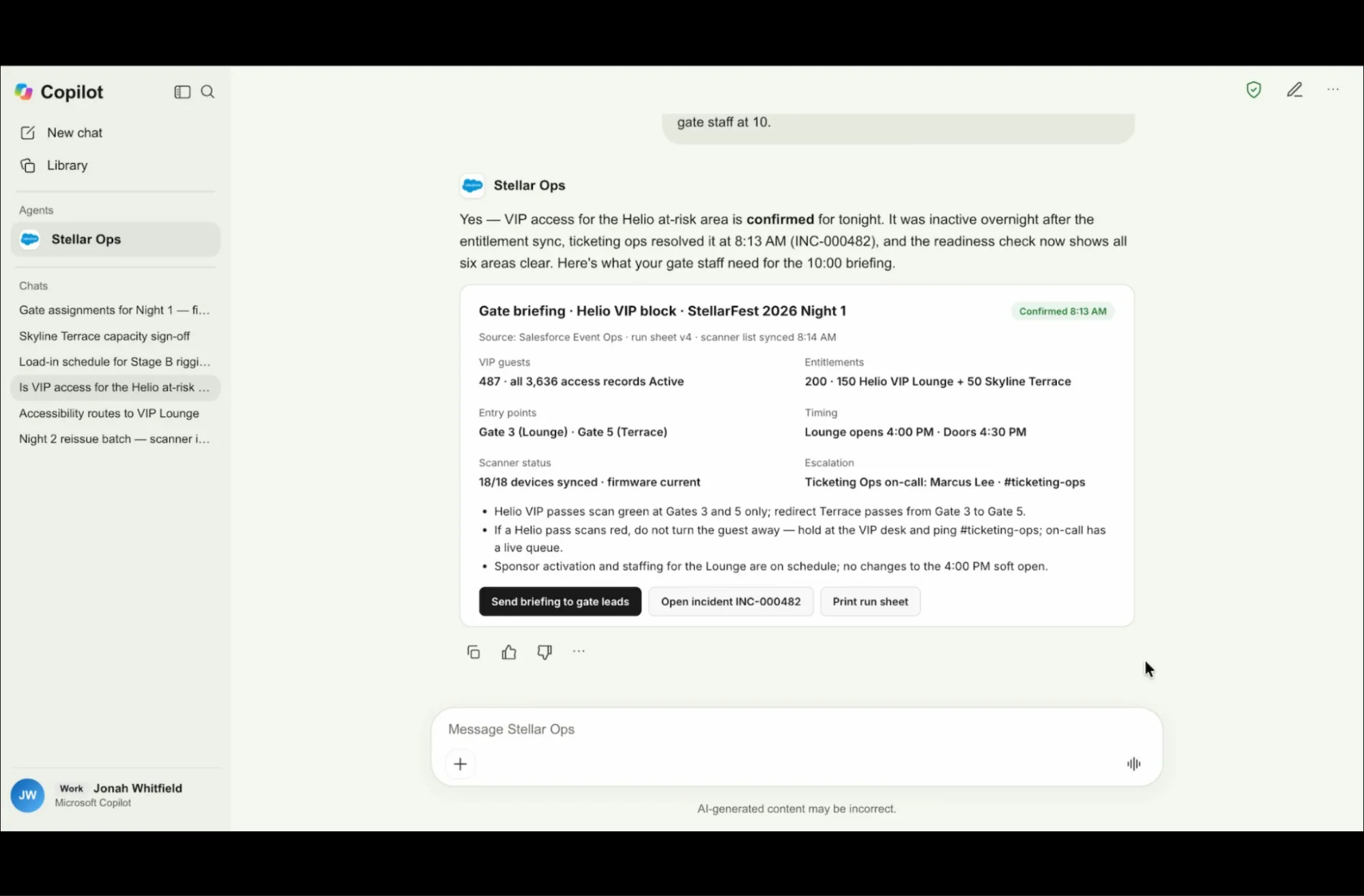
The user logged a ticket for the ticketing ops team to resolve the problem, all without leaving Slack. The demo was fast and solved multiple different stages of the issue in Slack before handing over to the venue crew in Microsoft Copilot.
Similar to Slack, Copilot was able to reach into Salesforce and surface the relevant information to the user without leaving the current interface. Lastly, the program lead user was accessing that same data from within a familiar Salesforce interface: Agentforce Coworker in Lightning Experience.
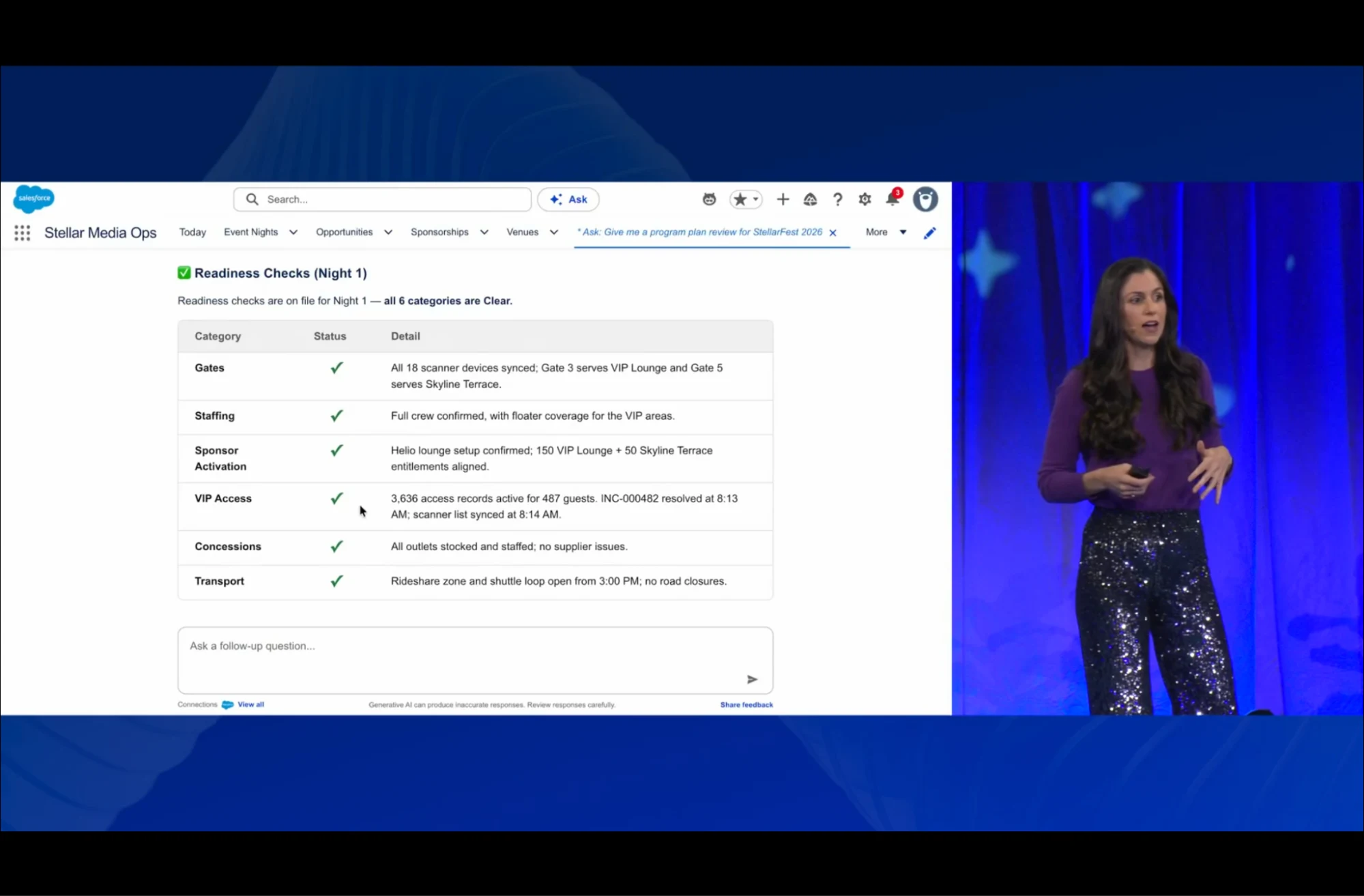
Just like the other interfaces, Agentforce Coworker was able to surface all the relevant information and show that the readiness checklist had been completed from their perspective as well, once again without having to shift between different interfaces.
Shannon Mathews then wrapped the demo and reiterated that AIforce empowered each of these teams to collaborate together on the same data and platform, but each from their own interface of choice. She then invited Jay Hurst (SVP, Product Management, Salesforce) to the stage to take things a step further.
Headless Toolkit
Jay promptly introduced the Headless Toolkit, which gives developers and AI agents the ability to connect the Salesforce platform wherever they need to.
“Everything you’ve invested in for the last 20+ years is instantly available to the Headless Toolkit,” Jay said. All of the permissions, metadata, workflows, and data structure that have been built in Salesforce could now be leveraged and put to use through the Headless Toolkit.
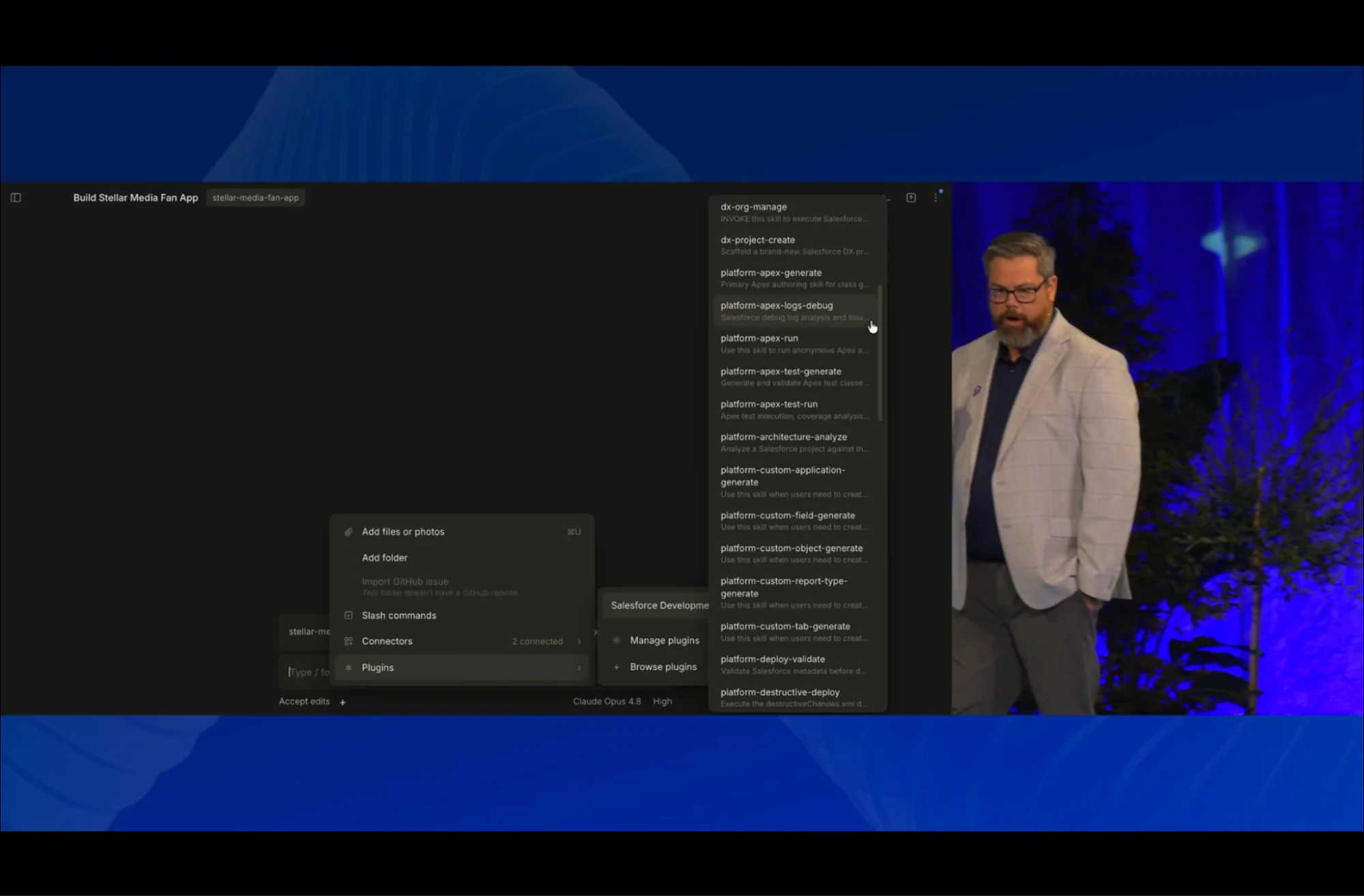
Jay began a demo from the perspective of a Salesforce Developer, and showed off all the new toolkit functionality within Claude.
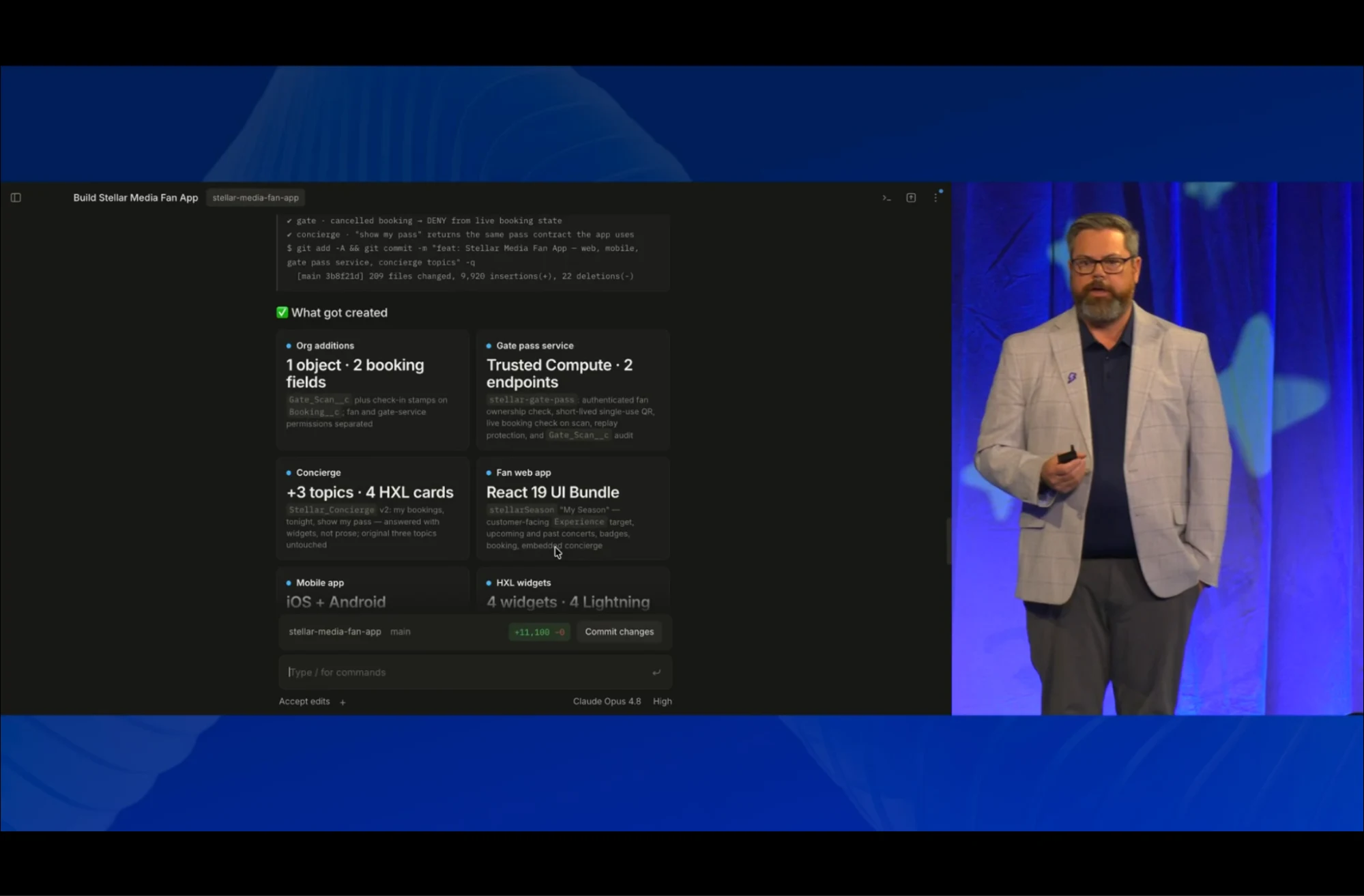
The developer in the demo then provided Claude with all the context it would need, and prompted it to build the new additions to the org.
“When I’m ready, all I have to say is, ‘Claude, let’s build it’.”
Once Claude had finished the build, the developer was presented with a list of all the things it had created.
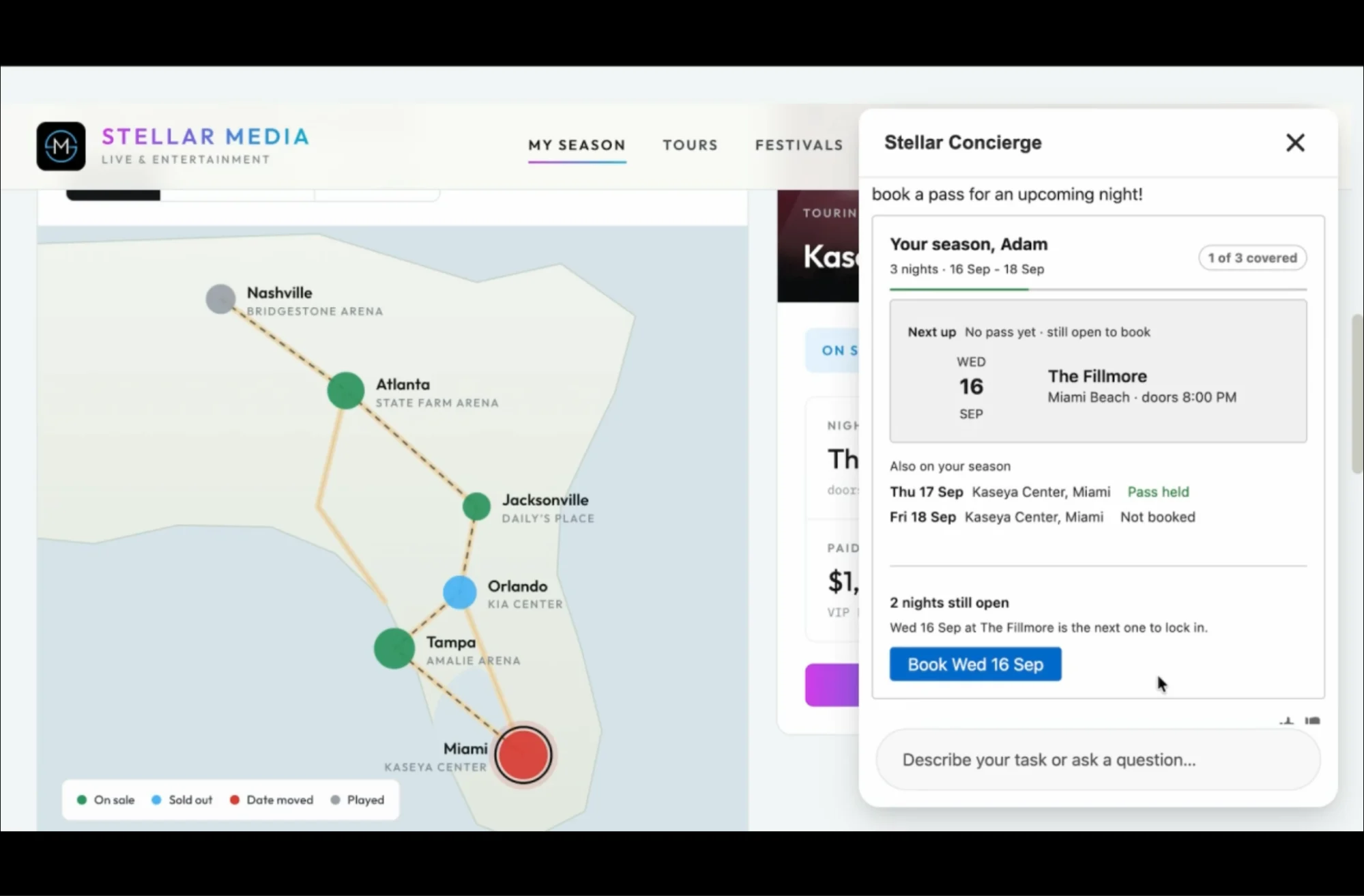
Next, they were able to preview what was built exactly as the users would see it.
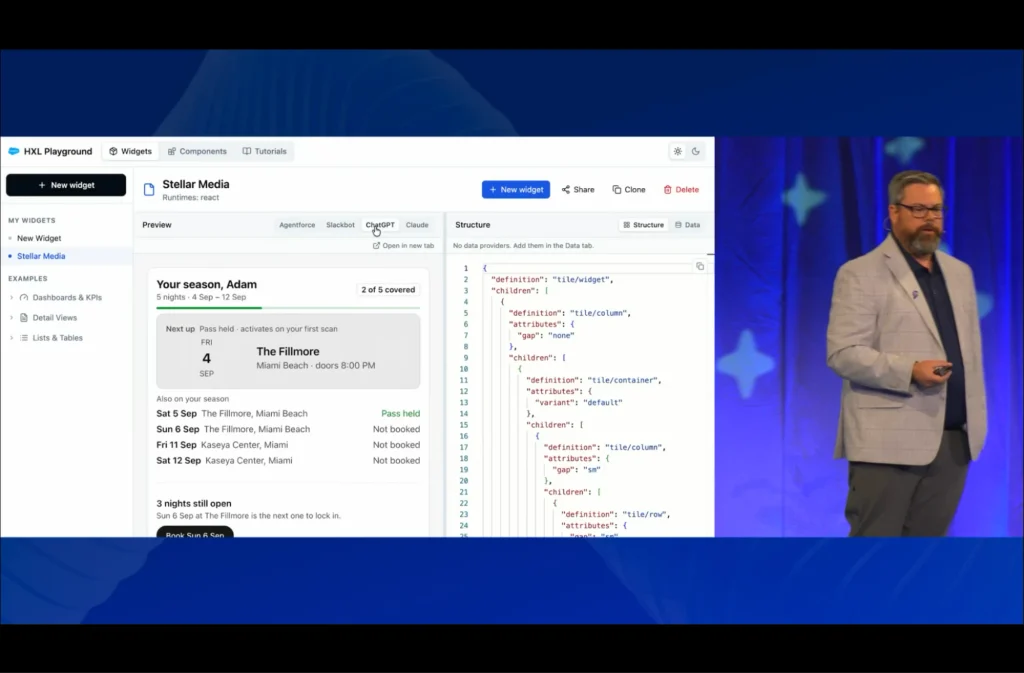
Next up, Jay reintroduced the Headless Experience Layer (HXL) and the HXL Playground, which allows developers to work with the Headless Toolkit and preview what the end result would look like for their users.
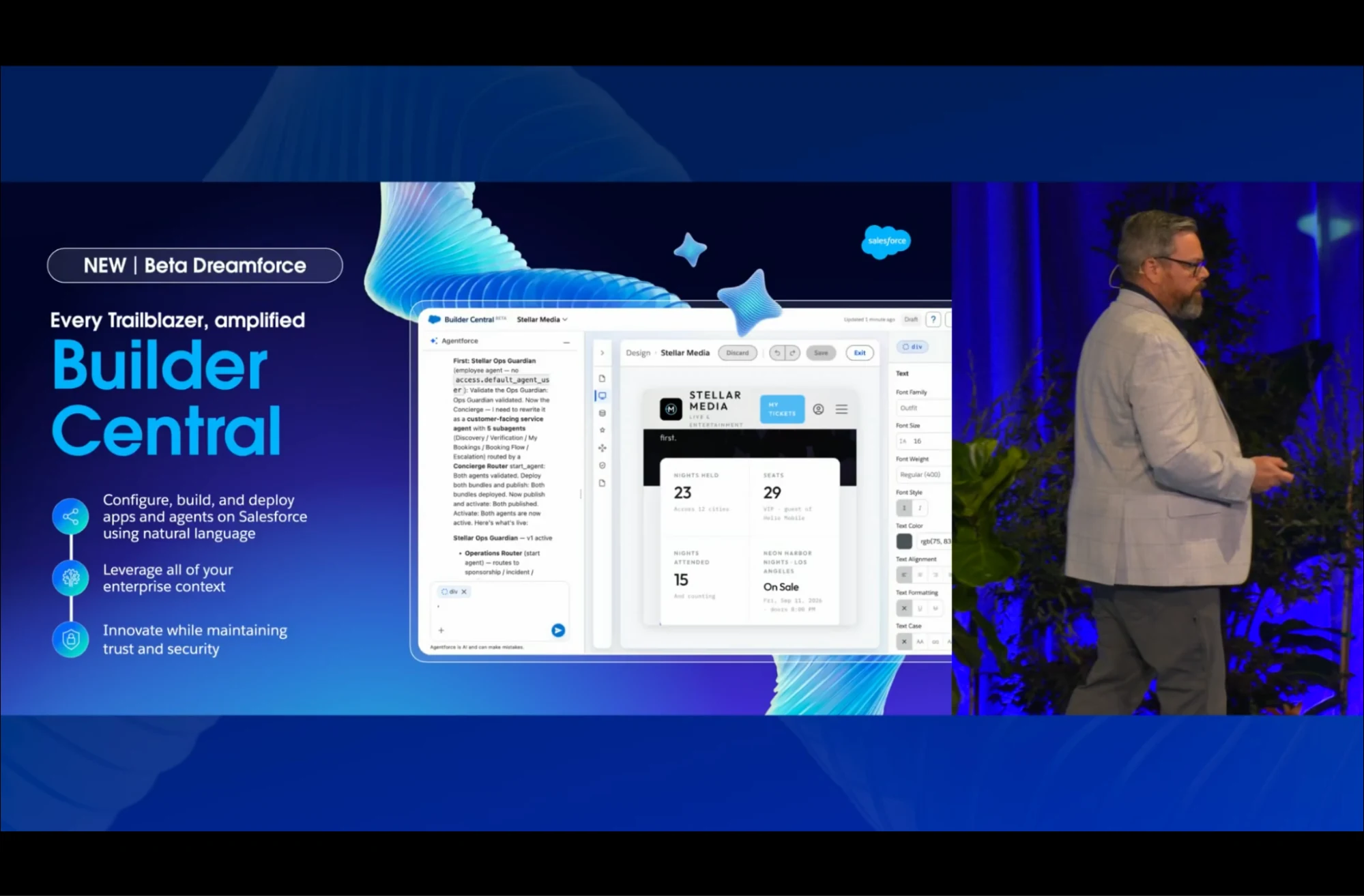
Finally, we got to see a new feature coming to HXL – Builder Central, which was now in beta as of Dreamforce. This was a tool that builders could use to build directly on the Headless Experience Layer.
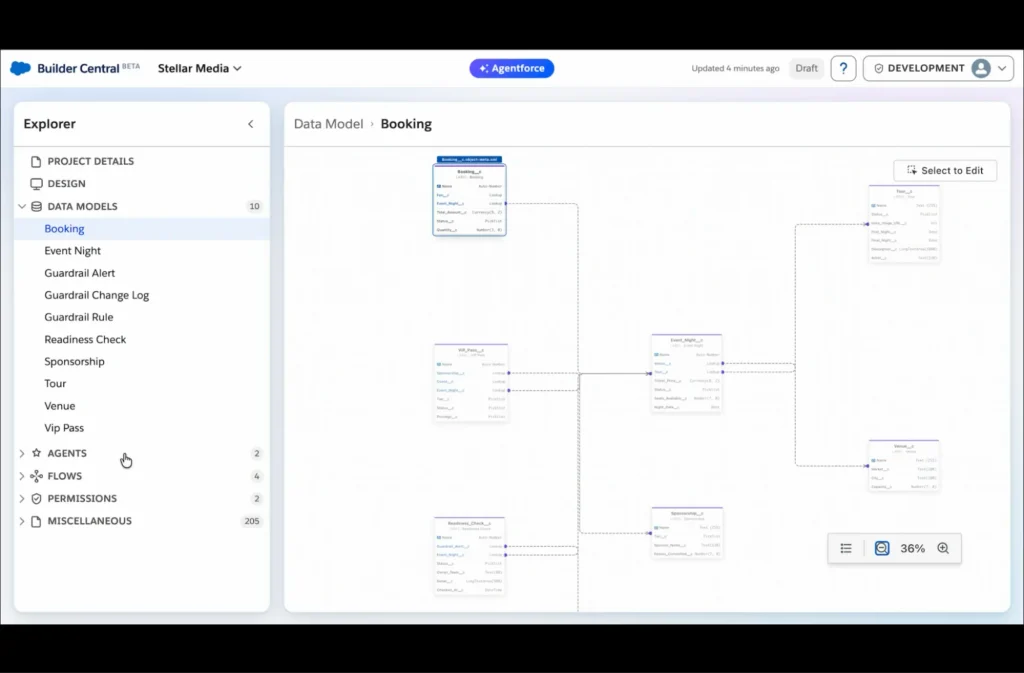
There was a quick demo showing how the builder works, all still within the context of Stellar Media. This time, the demo was from the perspective of a Product Manager. Jay, as the Product Manager, explained that his job was to document what needed to be built, not build it himself directly. That changes, of course, with Builder Central.
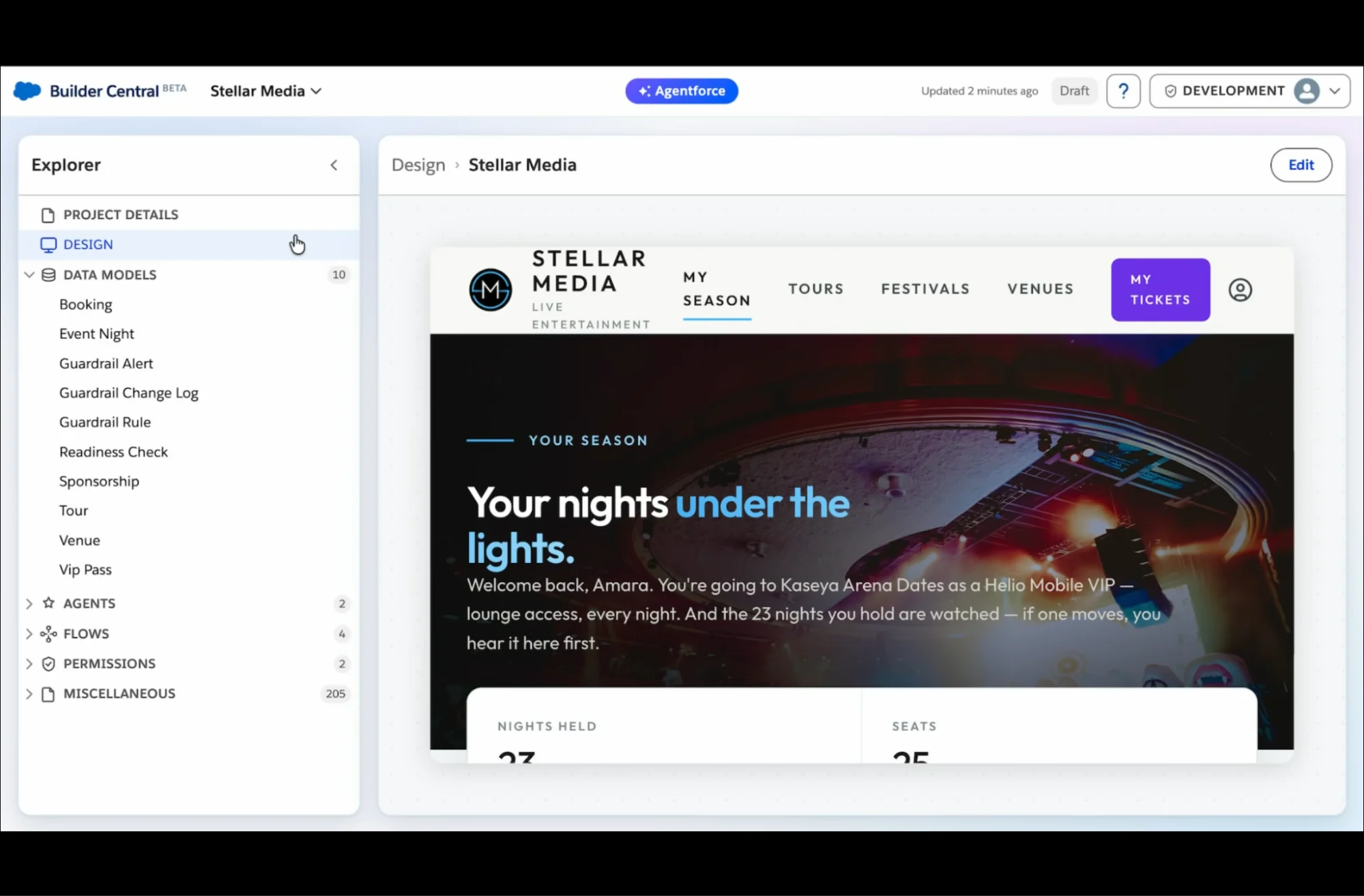
After a few clicks, the Product Manager was able to see what Builder Central had built, live in the builder.
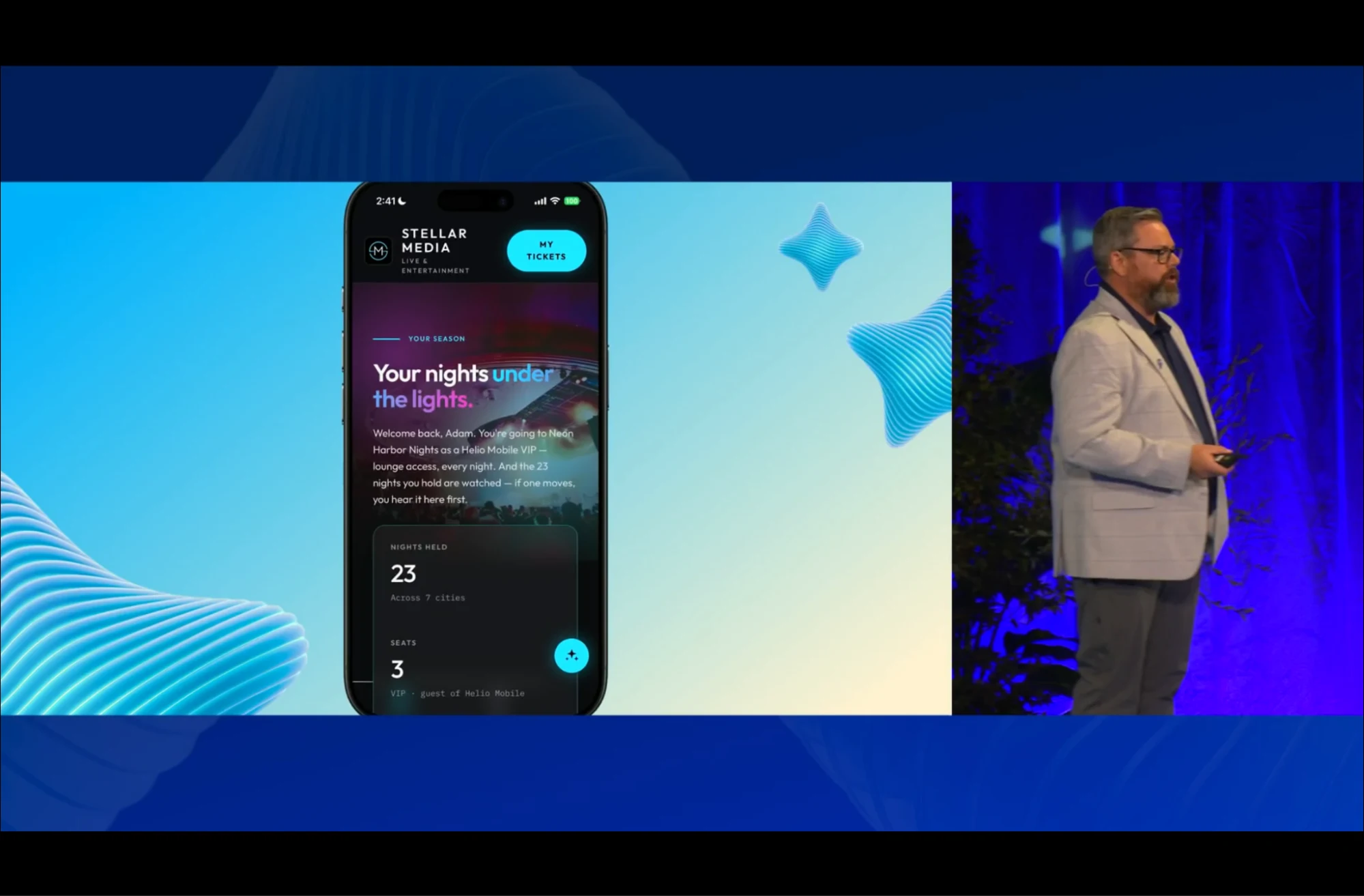
He then showed that it could make changes to branding on the fly, and supported a mobile build alongside a desktop one.
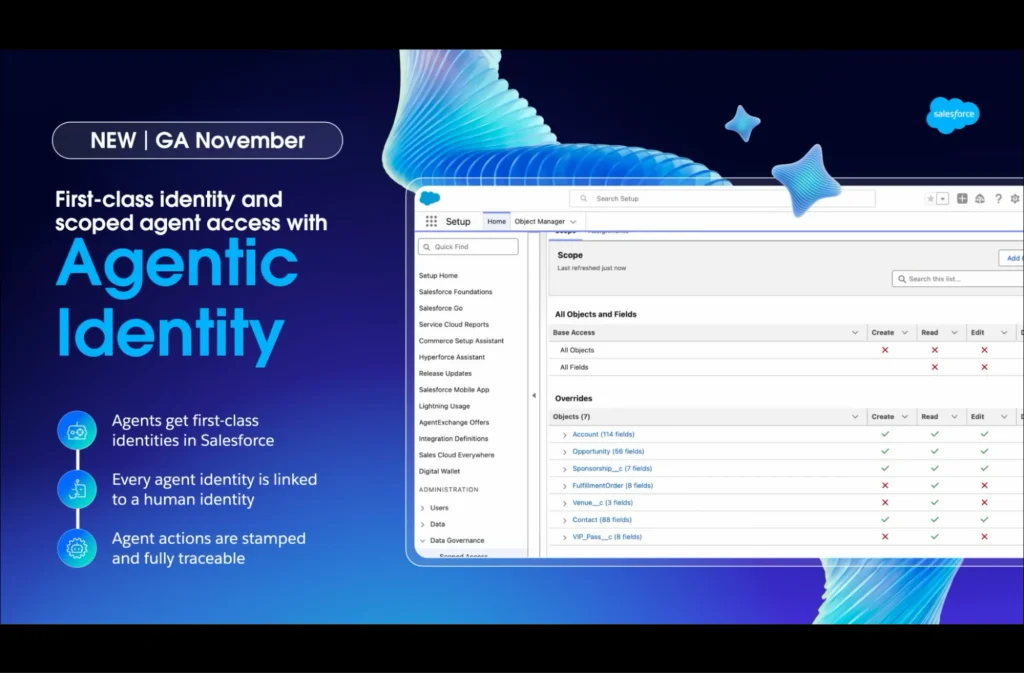
Jay, as Jay again, reminded the audience that all of this could be done without needing to reinvent the wheel in terms of governance and security. He wrapped this section by introducing Agentic Identity, GA in November.
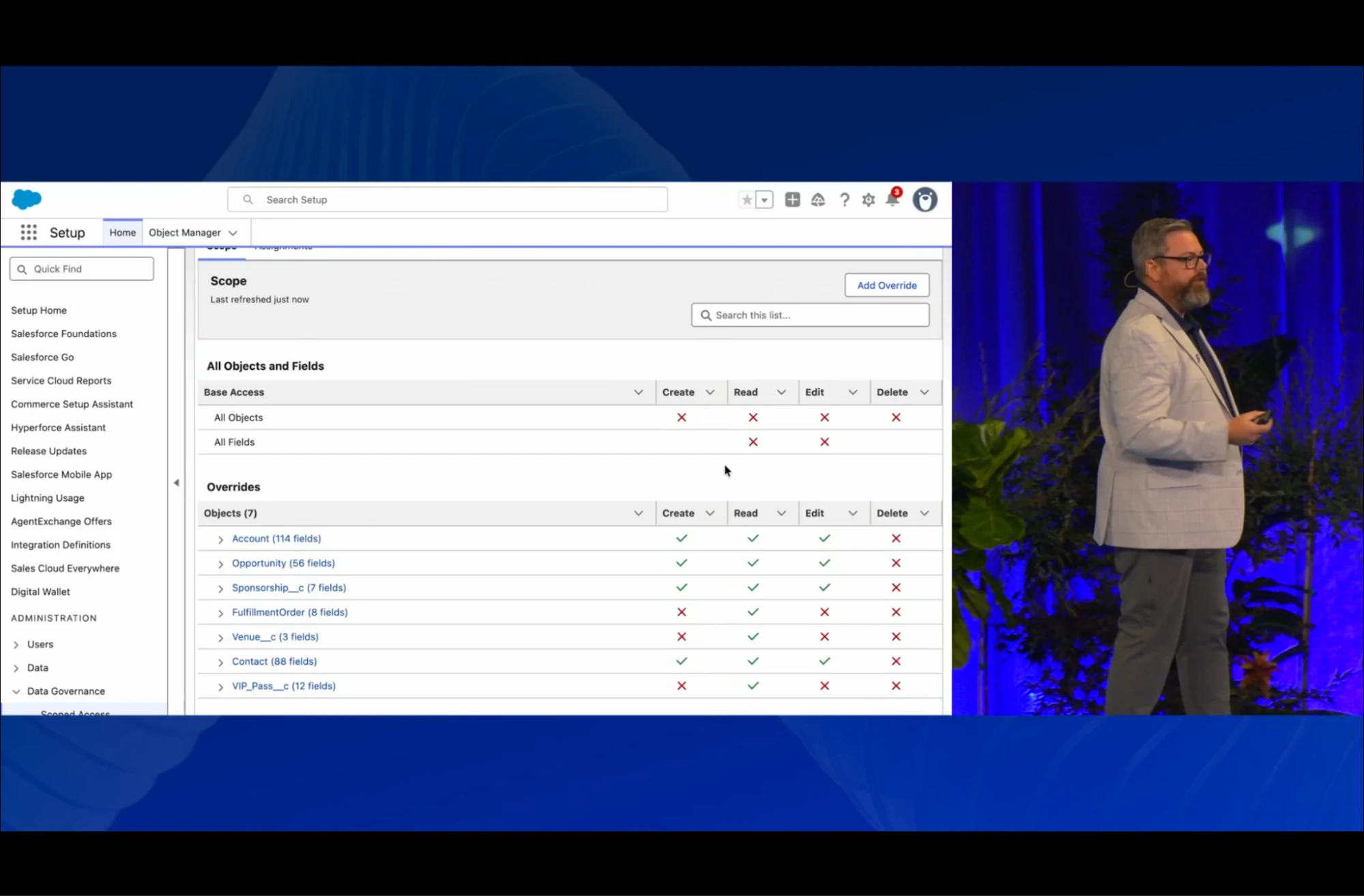
This will be the identity tool that ensures everything users do is tracked, traced, and monitored, and only gives users and agents access to what they need to do their job.
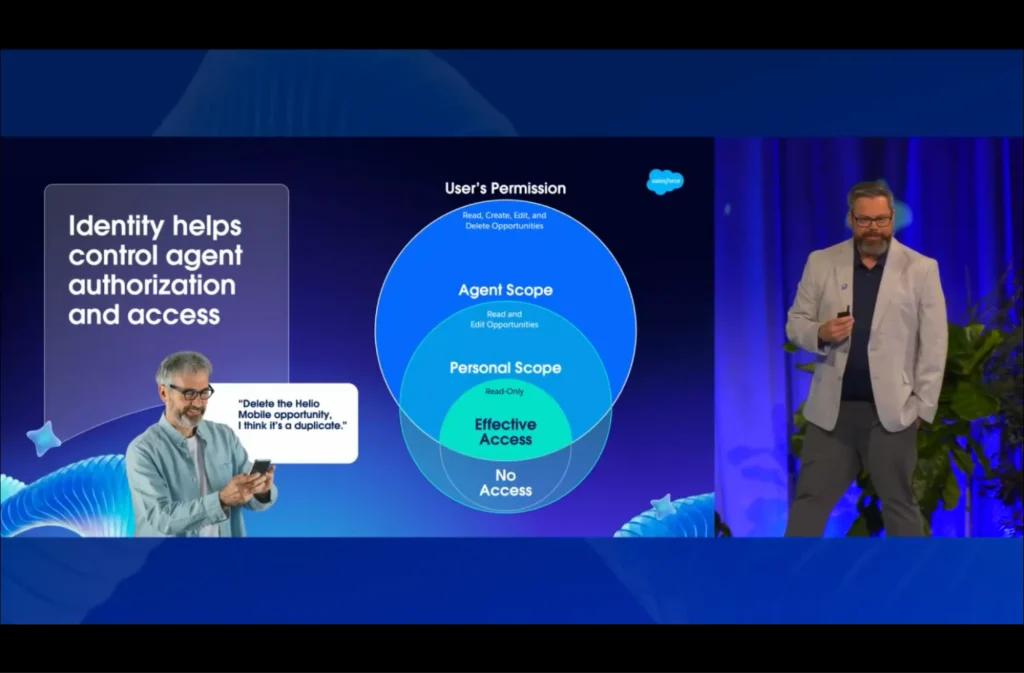
He made a special note that agents may only need a subset of the permissions that a human would have. The example he gave was that while a user may need full read/write/delete access, the agent may only need a subset of this.
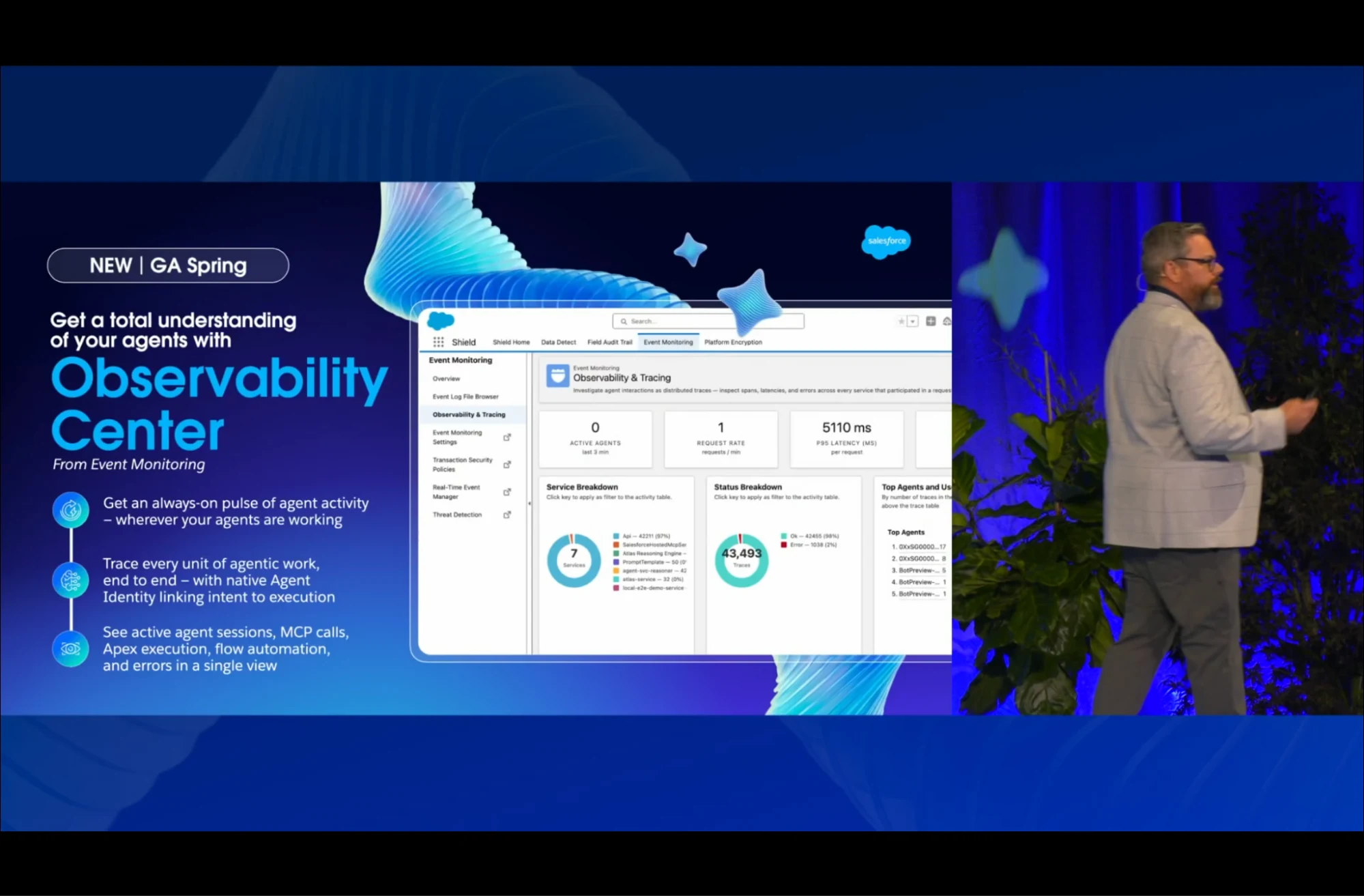
Jay introduced Observability Centre, a tool designed to give Salesforce builders more visibility and control over their agents and what they’re doing.
A quick demo showed what this would look like to the end users. Essentially, it’s an easy-to-understand interface that gives users full visibility as a bird’s-eye view, and allows them to make changes on the fly if required.
Finally, Jay pointed out that it was critical not only to see the technology in use, but also to know for sure that customers were getting value out of it. For the ROI section, he introduced Natala Menezes (CMO, Platform, Salesforce) to the stage.
AI ROI
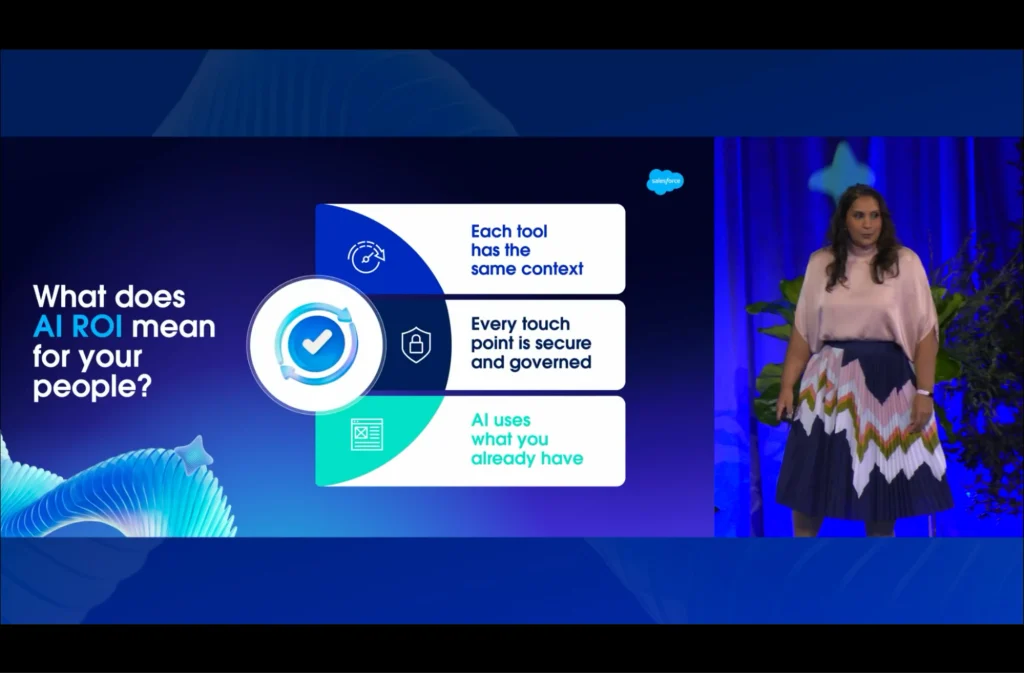
Natala explained that it was through carefully designed implementations that true ROI could be achieved, and AIforce was the key to delivering that.
She explained that each tool needed to have the right context to do its job properly. She mentioned that security and governance were critical to ensure nothing was happening that shouldn’t be. Finally, it needed to work with what had already been built (i.e. the Salesforce platform).
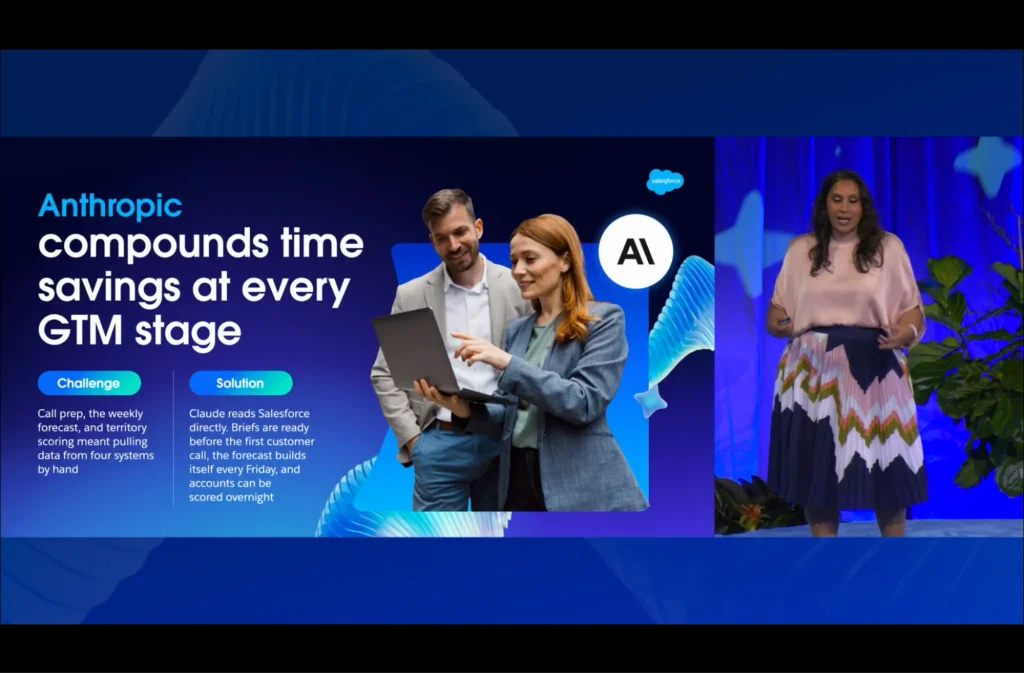
She then introduced some real-world customer examples who had been benefiting from AIforce, the first of which was unsurprisingly Anthropic.
She introduced Scott White, Head of Enterprise at Anthropic, to discuss how they had been pairing the #1 AI with the #1 CRM. Scott explained that it was critical for teams to use Salesforce, but they also spent a lot of time in their own tool: Claude. The two went back and forth a bit, explaining how Claudeforce had been crucial to their success.
“People don’t use the UI anymore, they just talk to Claude”, he said. This simple sentence was a powerful statement that really drove home the point of Claudeforce. The Salesforce platform now comes to the end users, wherever they happen to be – in this case, Claude. He pointed out also that day-one sellers could now be “almost as productive” as their more experienced counterparts by using Claudeforce.
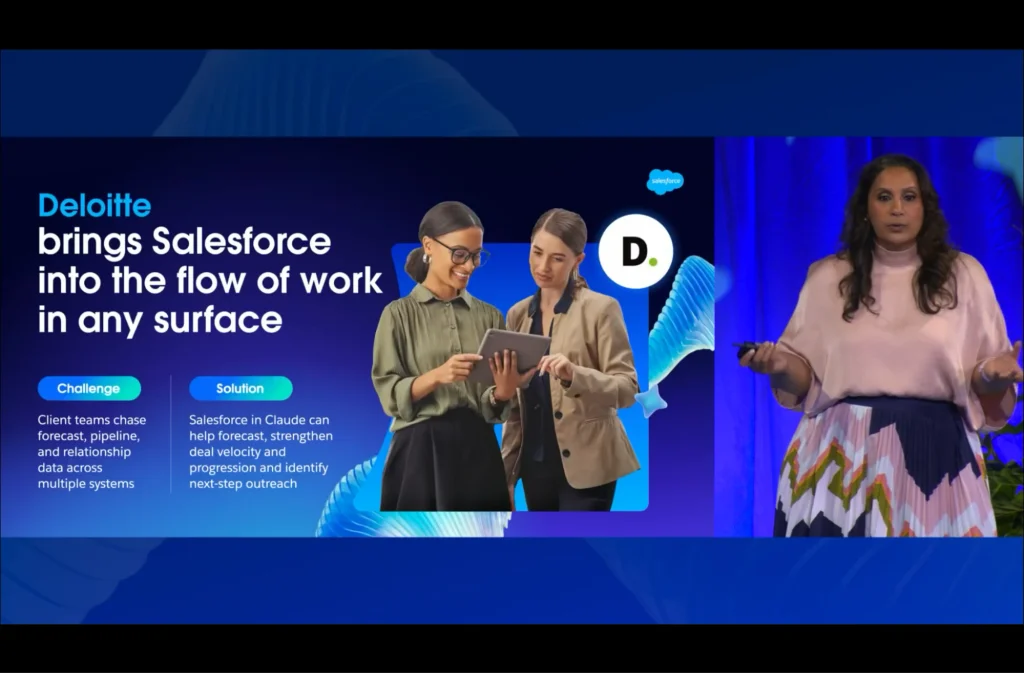
Next up, Deloitte was invited to the stage. Harry Datwani (Global Salesforce Chief Commercial Office, Deloitte) talked about how AIforce had been empowering Deloitte’s teams across all of their various interfaces, including outside of Salesforce (Teams, Copilot).
“The front office runs on Salesforce […] This was an opportunity for us to advance our headless strategy, without having to start over”. He explained that Deloitte was given early access to AIforce to test it out across multiple personas in their business. Each listed persona had their own unique benefit from AIforce, all of which focused on bringing information together and surfacing it where their users were.
“No one wants to get up and log in to another system. No one wants to click on another tab […] The opportunity to meet our people where they do their work […] that was the value.”
Natala then introduced an expansion of the AgentExchange, which allowed partners to build and share on AIforce. She then thanked all the partners who had already been building, and invited customers to check out the AgentExchange offerings.
Natala wrapped up by saying that she returned to Salesforce after a five year hiatus because she knew that there were new and exciting ways to connect people to their tools. This came to a head with AIforce.
The Architecture of AIforce
For two years in a row now, the primary slogan at Dreamforce has been “Welcome to the Agentic Enterprise”. Last year, it was Agentforce 360. This year, it’s AIforce. So where exactly does AIforce fit into this Agentic Enterprise vision?
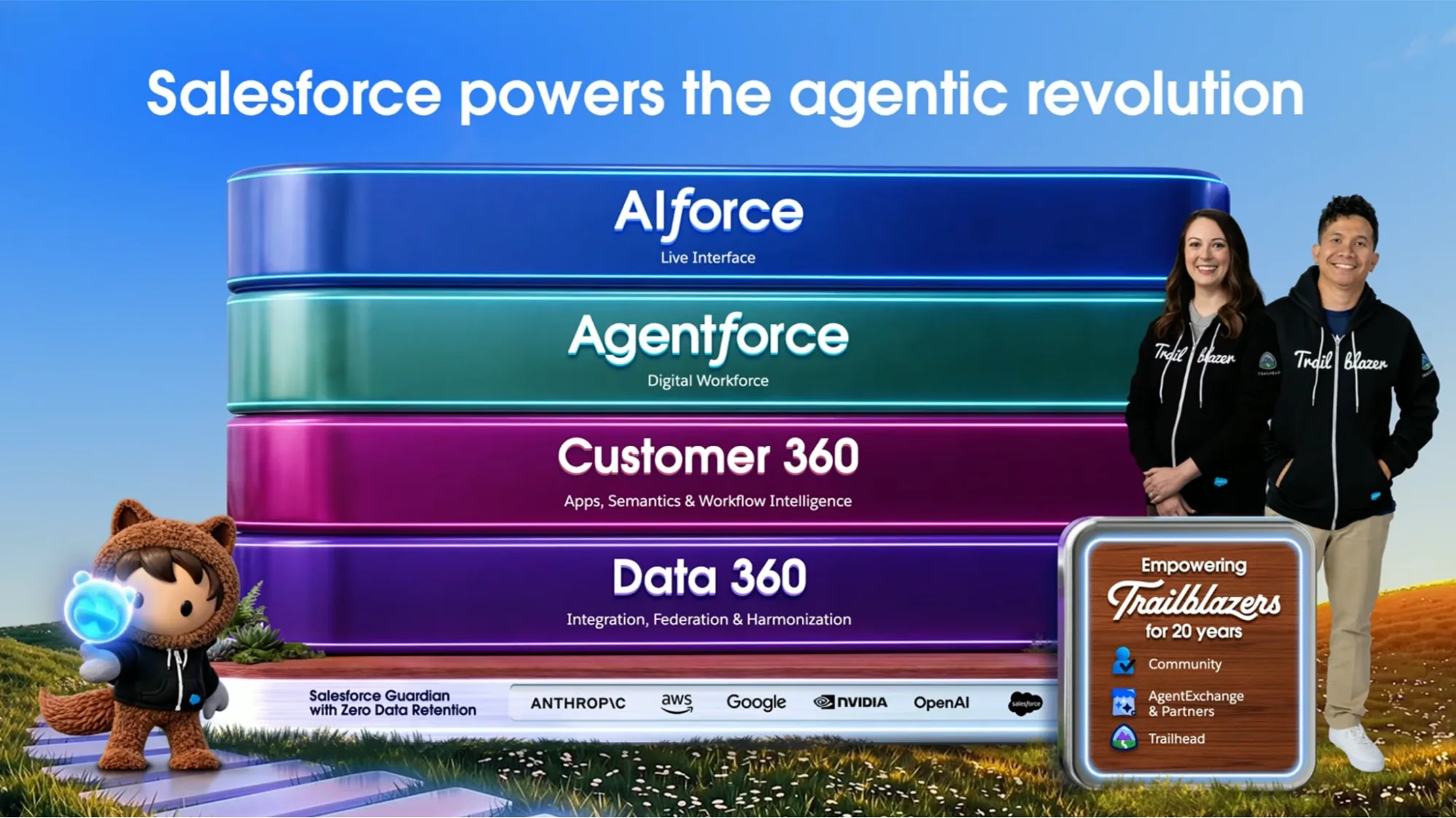
Salesforce has explained that AIforce is a new layer that sits on top of what they’ve already built in the platform. Data 360 unites your data across your entire tech stack. Customer 360 sits on top of that and handles automation, semantics, and apps.
Agentforce, which has been the focus for the last two years, is the next layer up and empowers Salesforce customers to build a digital workforce on the first two layers. Finally, the new AIforce layer sits on top of all of it and allows users to interact with the lower layers through their interface of choice.
One major question that came up with the announcements of Claudeforce and what happens to Agentforce? I saw many people asking this question on LinkedIn, or a variant of it: if Claude is being pushed front-and-centre, is focus going to shift away from Agentforce and towards Claudeforce instead?
Salesforce has directly addressed these questions in their opening Dreamforce keynote. Agentforce is still its own thing, not rolling into Claudeforce or the AIforce layer, but totally separate. Agentforce is the digital workforce layer, and AIforce is the new interface layer that sits over the top. Claudeforce and AIforce are not here to replace Agentforce, but supplement it.
Trust
Marc Benioff spent a fair bit of time in the Dreamforce keynote talking about how AIforce has zero data retention. When he first spoke on it, he made it clear that business data was not going to be used to train any AI models.
“That means this”, he said, “when you’re working in Salesforce apps, and when you’re working on our platforms, your data is your data. It does not go in the models. We’ve audited it, we’ve tested it, we’ve tried it. Regardless of what you’ve heard in the media, or from other vendors, let me assure you that Salesforce products are built with zero data retention, tested over and over again by our security teams.”
Salesforce understands the importance of data privacy and security. It’s something that the company has been working on for a long time, with trust being its number one value. It knows that its customers care deeply about keeping their data safe and don’t want it used in ways that they haven’t consented to. This is why Benioff spent a significant amount of time clarifying that Salesforce is not allowing other companies’ models to be trained using Salesforce customer data.
“Your data is your data. You’re not training any other model when you’re using our products. This is extremely important, having ZDR built in.”
An Introduction to Claudeforce
Anthropic and Salesforce have been working very closely in recent history, with Claudeforce being the most recent product to come out of this partnership. As I wrote earlier, users no longer have to go to Salesforce to work with the platform – Salesforce now comes to them where they work. A clear example of this is the new Salesforce in Claude tools that Claudeforce offers.
Claudeforce boasts 37 prebuilt sales skills will be available in Claude, which are now in beta after having been in pilot with customers like Deloitte, GitLab, and Legora. Salesforce builders aren’t left out either, with more than 40 skills available as part of the Salesforce Development plug-in for Claude Code.
While still in its infancy, there are already some planned upgrades coming to Claudeforce. Notably, there are planned skills for service, marketing, commerce, and industries, and it will soon also include analytics with Tableau.
An Introduction to Slackforce
Slack was purchased by Salesforce in 2021 for over $27B, and it has become more central to the Salesforce ecosystem ever since. The recent announcement of Slackforce is the latest evolution and forms a core part of the AIforce offering. Slackforce comprises a few major components, namely Slackforce Surfaces, Slackbot, Slack CRM, and Slack Code.
Slackforce Surfaces allows for live, collaborative interfaces to be exposed within Slack. These interfaces are driven by data within Salesforce, Slack, and other connected systems. A holistic view of all the necessary business information can be accessed by a user in an application that they’re already using to communicate with their team every day: Slack.
Slack CRM directly connects Slack to Salesforce by allowing users to perform actions and access data from Salesforce within the Slack interface. Users can create and update records, record call notes, and more, just by prompting Slack in natural language.
Slackbot is the personal assistant that lives in Slack. It leverages the context from your Slack environment, as well as the context of Salesforce and other connected systems, to provide you with the information you need when you need it. Slackbot reasons with this context to deliver valuable insights, and users can interact with it in natural language to get recommendations and take action.
Last but not least is Slack Code. Think Agentforce Vibes, but for Slack. This tool lets builders interact with code in natural language, directly from the Slack interface. It also makes development a multiplayer experience. Teams can work together with a single session of Slack Code to guide agents on a single task together. Users will be able to see what code the agent is working on, preview the output of that code if it has a visual output (like the button example on the Slack Code site), and collaborate with their team and the agent on the task at hand.
An Introduction to Agentforce Coworker
Jumping back into the Lightning Experience, Agentforce Coworker forms part of the AIforce offering as well. Agentforce Coworker is an AI teammate that lives in Lightning, reasons across records, surfaces information and insights to the user, and takes action where it makes sense. It’s like giving your business users their own virtual assistant that uses the same tools and data as the user does.
Coworker behaves almost like a router by pulling the specific Agentforce agents that have been deployed and putting them to work where it makes sense. In this way, it expands upon your existing fleet of agents and makes them more accessible to your end users.
An Introduction to the Headless Toolkit
The Headless Toolkit forms a core, connective part of the AIforce offering, and is essentially a rebranded Headless 360. This is the open architecture that opens every element of the Salesforce platform up to be used by AI agents or developers.
This suite gives builders and developers access to MCPs, APIs, plug-ins, skills, and other developer tools that can be used to even further customize the Salesforce experience. If you think about it, these are the tools that are making Claudeforce, Slackforce, and Agentforce Coworker possible: opening the platform up to be used by more than just the Lightning interface. It’s the same concept that drives Agentforce Vibes, too.
The Governance and Trust Model
I’ve touched on it already, but zero data retention was a key theme when it came to AIforce. Salesforce wants its customers to know that their data is safe and secure, even while they leverage this new toolset. Benioff was very clear about this during the main keynote: Customer data is never used to train other models. In other words, when you use the various AIforce tools, you can be confident that you are not also contributing to the training of the underlying models.
In another session, Salesforce doubled down on the idea of the shared responsibility model. It was explained that while Salesforce takes pride in its security and governance measures, it’s up to the customer to leverage the tools that are available to them and to do their part to keep their data secure.
One thing to note: as of the time of writing, these claims are purely announcement-driven, and the independent verification of these claims is yet to be published, as far as I’m aware. It will be interesting to revisit this topic in the near future as real-world deployments are documented.
The AgentExchange Ecosystem
Salesforce has always been a pro-developer marketplace, and the AI revolution hasn’t changed that one bit. In fact, it seems to have had the opposite effect. Salesforce rebranded the AppExchange as the AgentExchange, and is once again reminding customers that they can expand on AIforce rapidly using third-party tools from AgentExchange partners.
The AIforce announcement also offers some explanation as to why the various other marketplaces were consolidated earlier this year. While it may seem that there weren’t a lot of “Dreamforce exclusive” new announcements this year, the reality is that this was more about reorganizing and consolidating the various efforts that Salesforce has been working hard on into a cohesive whole.
AIforce Evolution Timeline
While AIforce is a new title as of Dreamforce ‘26, the individual components have been announced before the main event. This isn’t necessarily a bad thing, as it shows Salesforce is really working to make sure its platform is ready for the next wave of the AI evolution, while ensuring its offerings aren’t too confusing for customers.
In May 2026, Salesforce officially announced Agentforce Coworker, which is now one of the three major components of AIforce.
The term ‘Slackforce’ showed up on our radar back in June 2026, when Salesforce began looking to hire for a new role: Senior Director of Slackforce. This was the first sign that things were ramping up for a big new announcement at Dreamforce, which we now know was the Slackforce element of AIforce.
Claudeforce was officially birthed during Salesforce’s Q2 earnings call in August 2026, a month before Dreamforce. It expanded on the partnership between the world’s #1 CRM company and the world’s #1 AI company, and was the first major announcement of the Dreamforce ‘26 pre-season.
A lot of the AIforce release is a shift in positioning, which can inadvertently add to the confusion that Salesforce is trying to mitigate.
AgentExchange
This is the marketplace and partner network for all things Salesforce, including AIforce. It’s where Salesforce customers can go to find pre-built AI agents, apps, connectors, integrations, workflows, actions, and more.
Partners that are looking to build using the Headless Toolkit can now publish their solutions directly to AgentExchange for other Salesforce customers to use. This empowers Salesforce customers to leverage the power of AIforce without having to build everything from scratch.
AIforce launch partners include Anthropic, AWS, Google, Lovable, Vercel, DocuSign, Gamma, Jasper, Ramp, and Rippling.
Agentforce
Agentforce is Salesforce’s AI product line. At Dreamforce ‘26, they said this was the digital workforce layer and offers ready-to-deploy agents as well as the Agentforce Builder for making custom ones. It has a deep understanding of the business’s functions, because it’s layered on top of the Customer 360 and Data 360 layers.
Agentforce Coworker
An AI teammate that is built directly into the Lightning Experience, readily available for quick access. It reasons across records, learning from activity and history for more accurate responses and actions.
It operates entirely within the existing permissions and security model, and follows all the same business rules that the rest of the Salesforce org does – no migration or rebuild required.
AIforce
This is the new interface layer that Salesforce is building on top of their existing stack. Unveiled at Dreamforce ‘26, it brings Salesforce’s data, workflows, business logic, permissions, and governance into any supported AI interface (Claude, Slack, even Lightning Experience, etc.).
This means that Salesforce comes to the end user, wherever they happen to be, instead of users needing to log in to Salesforce.
Claude
This is Anthropic’s family of AI models and tooling. Under the Claudeforce partnership, Claude is also the default model across Salesforce’s AI offerings, with an Amazon Bedrock option for regulated industries.
Claudeforce
First and foremost, Claudeforce is the name of the brand partnership between Salesforce and Anthropic. There are two halves to this partnership: Salesforce in Claude, and Claude in Salesforce. Salesforce in Claude brings 37 prebuilt sales skills and over 40 Salesforce builder skills into Claude.
Customer 360
This is the application and semantic intelligence layer of the Salesforce architecture. This is where the CRM data is stored, and all the metadata that drives the org (business logic, automations, permissions, etc.).
Data 360
The unified data layer that sits underneath Customer 360 and brings data from beyond the CRM together with it to build a complete picture of the customer.
Headless 360
Headless 360 is the former name of the headless toolkit offering that has been folded and rebranded into AIforce.
Headless Toolkit
The open architecture that opens up the Salesforce platform to be used by builders and agentic AI, without needing the Salesforce UI. Essentially, all of the platform power but none of the Lightning Experience.
Slack
Literally “Searchable Log of All Communication and Knowledge”, Slack is the workplace messaging and collaboration platform that Salesforce has acquired and evolved into the digital headquarters. It’s a space for humans and agents alike to communicate, collaborate, and get things done. It’s also the home of the Slackforce UI.
Slackforce
The new branding that makes up one third of AIforce, notably the Slack portion. It consists of Slackforce Surfaces (interfaces surfaced within Slack), Slackbot, Slack CRM, and Slack Code.
Trust Boundary
Used in the Claudeforce release, the trust boundary applies to all regulated industries customers and uses Amazon Bedrock as the underlying foundation model.
Zero Data Retention (ZDR)
The core trust claim used across a number of Salesforce’s AI offerings. The claim is simple: business data used with AI tooling is not retained by the model provider, nor is it used to train the models.
Summary
AIforce is the new umbrella brand for Salesforce’s AI-everywhere strategy. One metadata-driven platform, multiple surfaces (Lightning Experience, Claudeforce, Slackforce, and Agentforce Coworker), all built on the back of the existing stack of Data 360, Customer 360, and Agentforce.
This is all made possible by the fact that “AI anywhere” doesn’t mean that you need to rebuild a lot of the foundation for each new interface. With the Salesforce platform, you’ll have the same permissions and security model, the same business rules and workflows, all driving whichever interface your users are accessing Salesforce through.
That, in addition to the ZDR promise, means that Salesforce customers are getting all the benefits of the Salesforce platform, all the convenience of Salesforce data meeting them where they are, but a significantly lower risk of data breaches.
The future of AIforce is bright, and one to watch closely as it inevitably continues to evolve following Dreamforce ‘26.