

You’d think that after the chaos of tech layoffs from the past few years, things would have leveled out by now. But according to our latest Salary Survey, they haven’t…or at least, not for everyone. More than a third of respondents (89% to be exact) say that finding a job is harder than it used to be.
But this leaves us to wonder, is the struggle universal? The ecosystem isn’t shrinking, but it seems that certain roles are getting flooded while others remain scarce. This article will dig into the 2025/26 SF Ben Salary Report to show which roles have too many people chasing too few openings and what that means if you’re trying to figure out your next move.
The Market Recovered, But Not for Everyone
After experiencing declines, the 10K job report indicated that 2025 was all about the cautious recovery of the Salesforce job market. Global demand grew 8%, which was a welcome improvement. However, looking closer at the numbers, that recovery seems selective.
The demand for technical architects surged 27%, as did the demand for solution architects, which rose by 21%. On the other hand, developer demand suffered a sharp decline, down 12%.
This data signals that companies are changing their mindset when it comes to hiring – fewer builders (perhaps), and more architects of systems.
Admin, developer, and consultant roles are heavy on execution, classifying them as builders. These are the roles that seem to be facing the most pressure, while experienced architect-level talent remains scarce relative to rising demand.
Are We Oversupplying Builders?
When job changers were asked how their salary changed in their most recent move, most reported a decrease:
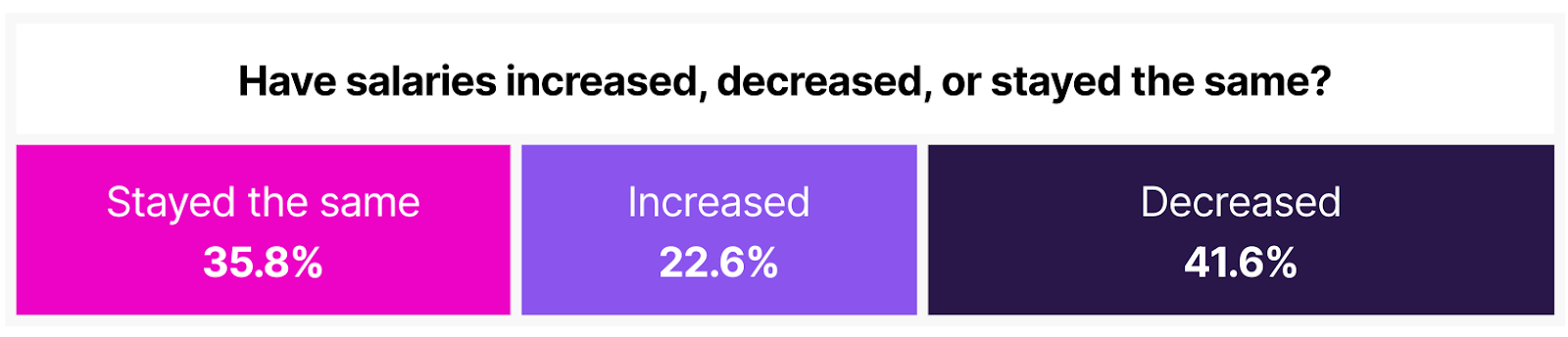
But looking closer at the numbers, the pain isn’t spread evenly. Among the most common Salesforce roles, it was admins and functional consultants who had some of the highest rates of pay decreases, while the technical architects and consultants were the most likely to see increases.
When we layer in the data that admin and business analyst supply surged 47% and 33% respectively, it paints a picture of classic market pressure. When supply grows faster than demand, salaries flatten or fall – especially during job transitions, where employers have leverage.
If you want a clearer picture of what this looks like in practice, think of when there are 10 qualified admins for an open role. Employers can lowball offers and still fill the position!
Now, the survey didn’t ask for reasons why the job changers are doing what they do, but someone who just got laid off (or someone desperate to leave a toxic workplace) will take less money just to land somewhere stable. And once people accept lower offers, it sets a new baseline. Everyone else interviewing now has to compete with that.
The Job Changer’s Problem
The people reporting salary decreases didn’t get pay cuts at their current jobs. In fact, the survey shows that 65% of people who stayed in their current roles got raises.
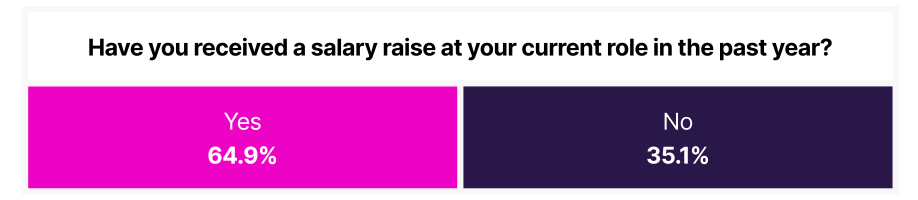
It was the people who switched companies reporting salary decreases. This gap explains a lot, because if you’re comfortable where you are, the market probably looks fine. But if you’re out there going to interviews and looking for a new job, you’re running into a wall of competition – and employers know it.
If experienced professionals are struggling, I think this should tell you something about the entry-level landscape as well. Admin, BA, and even consultant roles tend to sit closer to the entry point of the Salesforce ecosystem; not because their work is any less important or technical, but because these are often the first roles people pursue when breaking in. The largest share of professionals in these roles falls within the two- to five-year tenure range.
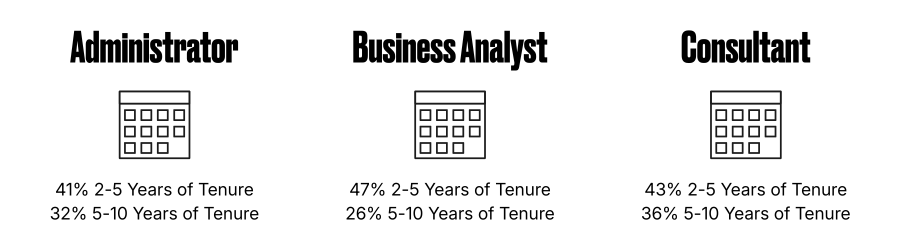
For years, this created a steady inflow of new talent. Stories of career switchers earning a certification, building a small portfolio, and landing a well-paying Salesforce role in months were common. Some were even “accidental admins,” or people who inherited Salesforce, learned it on the job, and built a career from there. The survey data suggests that this dynamic is shifting.
When you hear experienced admins with years of experience reporting longer job searches and pay cuts, what does that mean for someone fresh out of a boot camp with two certifications and no real-world, hands-on experience yet? The math currently isn’t encouraging.
If the market is already saturated with qualified candidates who have track records, adding more entry-level talent to that same pool only intensifies the competition, because you’ll find yourself competing not only with the newcomers but also with people who got laid off from established companies and are willing to take a step back to stay employed.
And for the newcomers, that means the stories that once made Salesforce feel like a fast on-ramp may no longer reflect today’s reality.
AI Made Execution Cheaper, While Strategy Got More Expensive
The survey results point to a clear pattern. While admins, consultants, BAs, and generalist developers are reporting higher rates of pay decreases, architects, specialized technical consultants, and DevOps/release engineers are still scarce and are therefore seeing some of the highest salary increases. So what’s the difference?
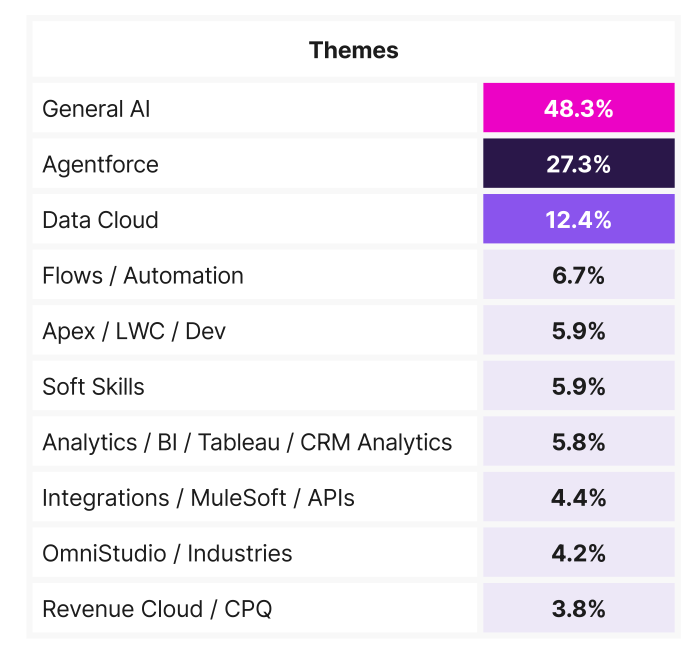
When asked to share what skills they’re investing in, nearly half of survey respondents said they’re actively investing in general AI skills. 27% are learning Agentforce, and 12% are diving into Data Cloud – all of which are nice additions to a resume but not necessarily what’s moving the needle on salary right now.
In fact, AI specialist/engineer roles reported the highest proportion of salary decreases in the survey, with 85.1% saying they had lower pay after moving roles.
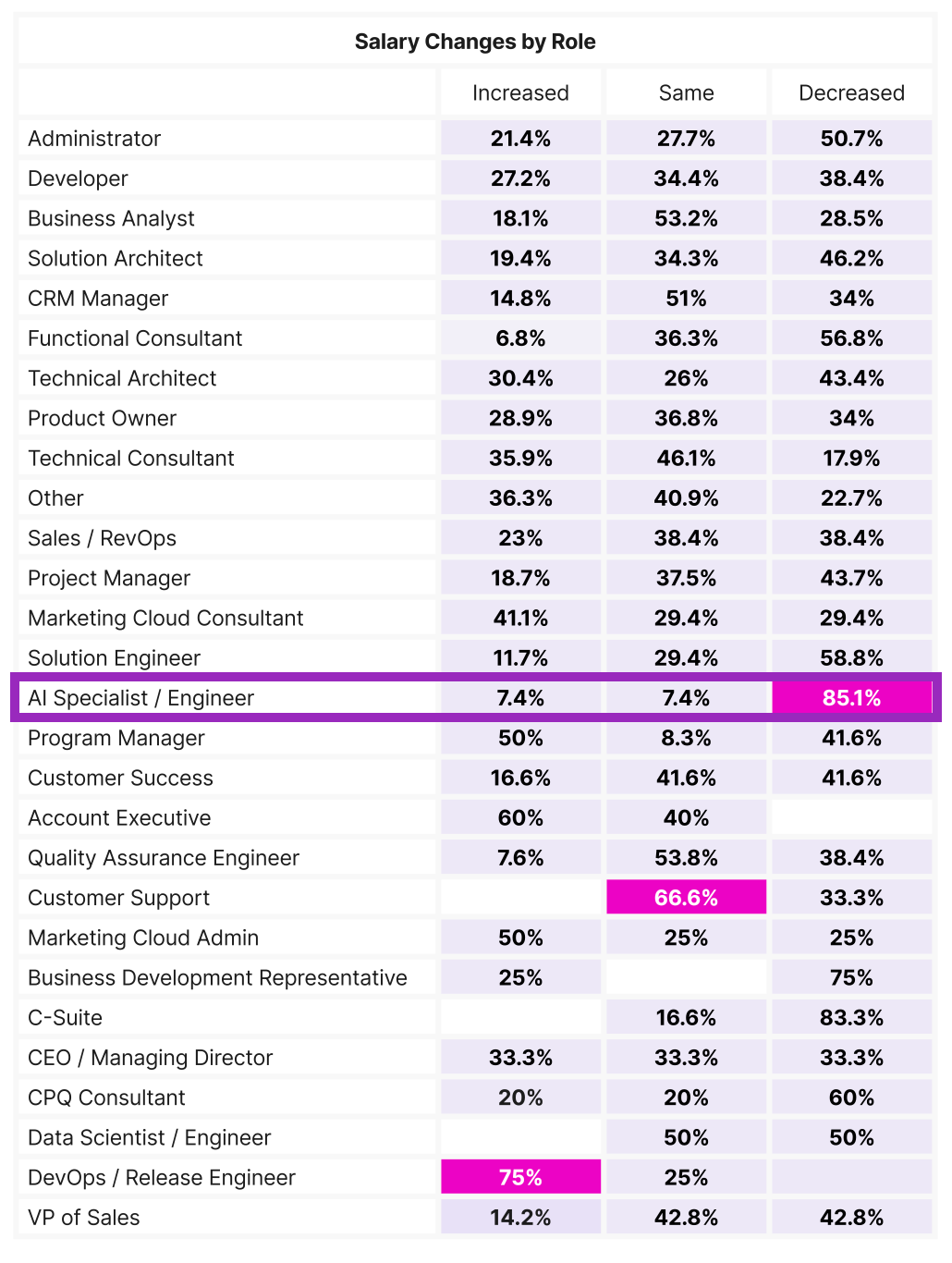
Everyone’s rushing to upskill in AI, but among respondents who changed roles, those who moved into AI specialist/engineer positions were far more likely to receive lower pay in their new role than higher pay.
We start to see an obvious pattern: the market rewards people who architect, integrate, and think strategically. Execution is only part of the equation. It matters, but it’s no longer enough to be excellent at configuring flows or managing user requests. The roles that are holding their value are the ones that combine platform knowledge with systems thinking.
We can theorize that this may largely be due to the increasing use of AI. It has changed the balance of responsibility. With its help, weight has been taken off execution by speeding up builds and reducing manual effort.
But at the same time, it’s introduced a new burden by broadening the roles that are expected to connect what they’re building to business outcomes, governance, and long-term design decisions. Responsibilities that once sat primarily with architects or senior specialists are now increasingly extending to execution-focused roles like admins and devs. Because in the end, humans still have the edge.
Yes, AI can help you build faster, but it cannot replace the experience, judgment, and context needed to decide what should be built, why, and how it fits into the bigger picture. That nuance – which is earned through time, exposure, and decision-making – is actually what the market is increasingly paying for.
So Are Admins and Consultants Doomed?
Not really! No, but let’s be honest – you’re in a tougher spot than you were years ago. With all that being said, if you’re an admin or consultant right now, don’t think that you’re losing value because your work doesn’t matter.
Admin and consultant roles are critical to how Salesforce functions in the real world. The issue is not about value, but leverage. When too many people can do what you do, the barrier to entry keeps getting lower, and employers have more options. Those options give them power.
As AI and automation absorb more execution tasks, the shape of daily work for Salesforce admins is evolving. In other words, the question has shifted from “Can you build it?” to “Should it be built this way, and what would be the outcome in relation to our business processes?”.
At this point, it’s time to accept the current state of the market. Despite it being harder these days, maybe it’s time to reflect and think about whether you’re doing anything to separate yourself from the hundreds of other people with the same title and certifications.
That might mean specializing in high-demand products like Revenue Cloud or Data Cloud. It might mean developing architectural thinking even if “architect” isn’t in your title. Either way, it entails recognizing that your current role has a ceiling, and it’s time to make a strategic move before the market gets even more crowded.
Final Thoughts
As with any problem, this “oversupply” issue isn’t going to fix itself. Waiting for things to “go back to normal” assumes normal is coming back. The data is clear: supply has outpaced demand when it comes to builder roles, while the pool of strategic and architectural professionals remains scarce relative to demand.
This sends a message to Salesforce professionals. If you’re stable in your current role, it’s time to shift focus to becoming indispensable. If you’re job hunting, understand that generic qualifications won’t separate you from the crowd. And if you’re trying to break into Salesforce, be realistic about what the entry-level landscape actually looks like right now.
The market has spoken…the question is: what are you going to do about it?