

When Salesforce professionals are asked the question “what drives salary?”, most point to certifications, technical depth, or years on the platform. All these are straightforward and valid, but data from our recent Salary Survey tells a more interesting story.
This year’s results came out at a time when many practitioners are feeling the pressure. Despite a recovering job market, 89% of respondents described it as more challenging than in previous years, and more than half reported fewer opportunities within their role. In this kind of environment, salary becomes more than a number – it becomes a signal. But what exactly is it signaling? Read on as we dive into what the data reveals about specialization and the shifting dynamics of the Salesforce job market.
Architects at the Top
If you scanned the salary tables by country from our Salary Survey results, you’ll notice a common pattern – technical architects and solution architects sit at the top of every market. In the US, the median salary for a Technical Architect is $190,000. In the UK, £103,000. In Australia, AUD $237,500. In Germany, €104,000.
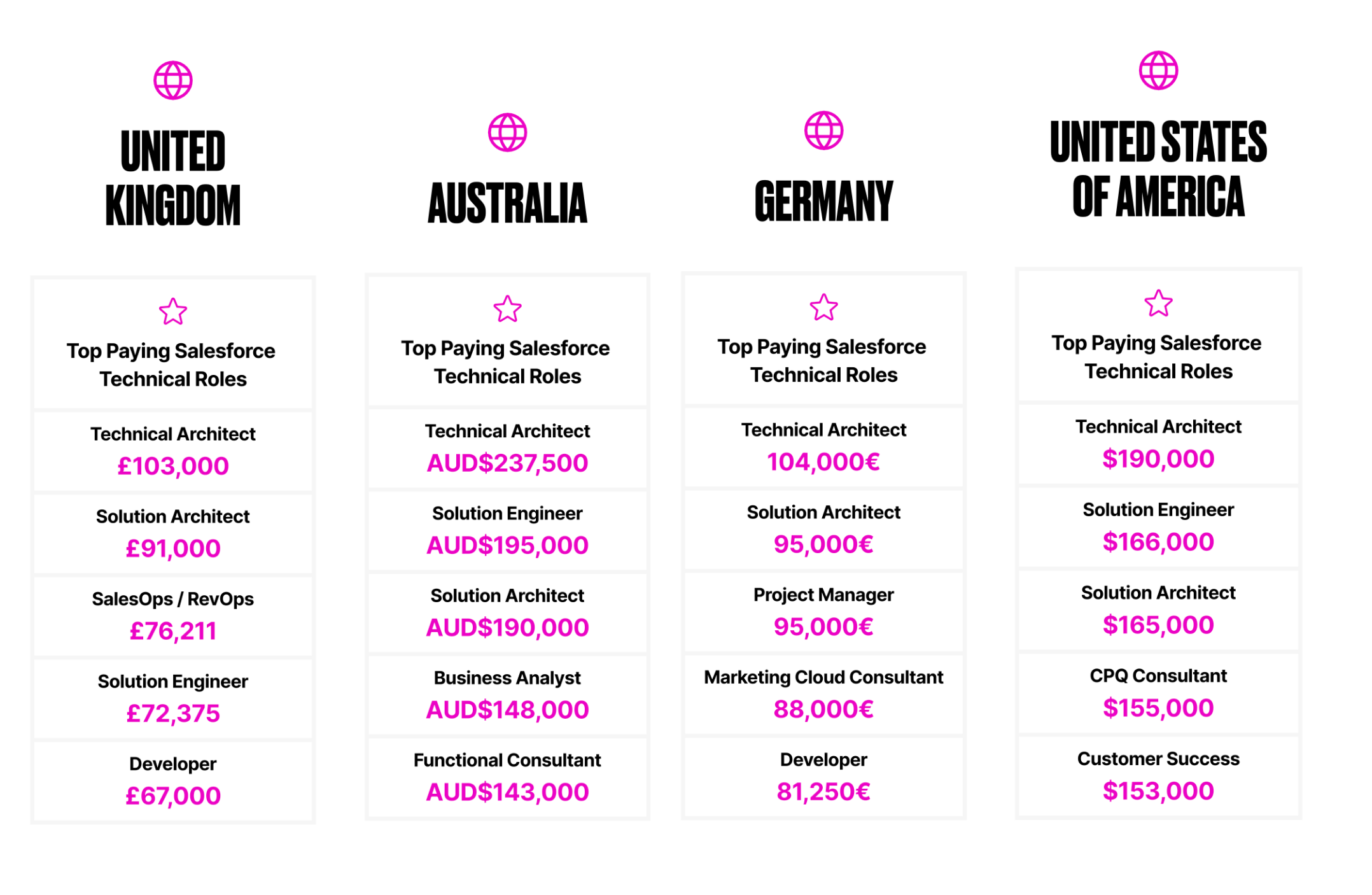
This doesn’t apply only to the locations mentioned above. The pattern repeats across India, Canada, and nearly every region represented in the data. It’s no longer an assumption at this point, nor is it a regional anomaly.
When you sit down and think about what separates an architect from other roles in the industry, you’ll see that aside from the requisite technical expertise, it’s the ability to design systems that map to business outcomes.
This skill also requires a person to know which trade-off to make in any given business scenario, not just technically, but strategically. It’s this contextual layer that the market now rewards more generously. Meanwhile, Developer demand declined 12% in 2025. Administrator and Business Analyst supply surged 47% and 33% respectively, creating buyer’s market conditions in those segments.
How Much Do Salesforce Certifications Really Impact Salary?
Certifications are still meaningful, and they definitely still correlate with salary. Each certification taken is a step up the ladder, corresponding to a 6-18% salary increase, and professionals with 21 or more Salesforce certifications have a median salary of $185,000 compared to $105,000 for those with absolutely none.
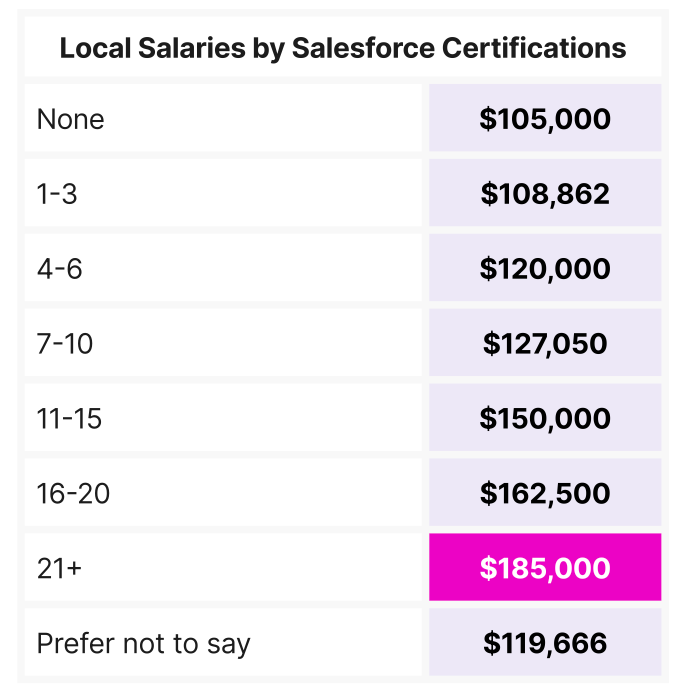
$105,000 is in no way insignificant or small. I’d assume many professionals in this bracket are what the ecosystem often calls “accidental admins”, or those who were introduced to Salesforce by their employer and eventually learned on the job, building their expertise through real-world problem solving rather than the traditional “study-review-certify-practice”. That pathway has built the backbone of the ecosystem.
So if you already have that experience, I know you’ve been in the trenches, seen through a wide variety of cases/problems, and know how it actually is when things break in prod. For many experienced professionals, certifications may even introduce some brand-new concepts. Certs are there to provide structure by connecting the dots, reinforcing best practices, and validating what you already know. They formalize that knowledge and experience.
And according to the data, the market will pay you accordingly. Think of it as an investment!
Developing a Wider Vision: Are Non-Salesforce Certifications Worth Your Time?
If you’ve already climbed the Salesforce certification ladder and are wondering what’s next, the data has another suggestion for you: look outside the platform. Having any non-Salesforce certification can correlate with a 13-14% increase in salary on average. That’s a remarkable finding, and I think the kind of non-Salesforce certification you take is less about what the credential itself is, but more about what pursuing it means. Let me explain.
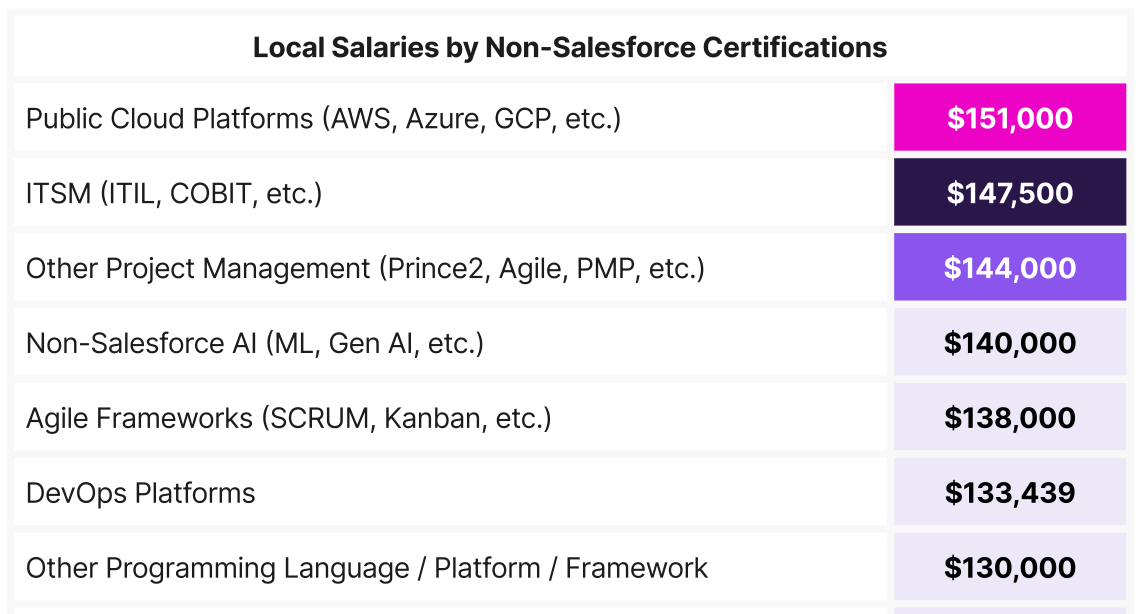
Again, it all boils down to contextual skills. Having substantial (that you even have a cert for it) knowledge outside of the Salesforce world means that you’re not just operating within the platform, but also designing how it fits into broader systems.
Salesforce doesn’t exist in a vacuum; it integrates with systems. “Integration Architect” is also an actual role. Any employer who sees that you can operate in the broader world of business and delivery is bound to offer you better pay.
The thread running through all of this is that certifications that have an effect on salary (Salesforce or otherwise) go beyond just knowing more. It’s about being able to see more! More of the business, more of the system, more of what the people in management actually need to see. In a market that’s paying architects more because of that wider vision, it’s a trend worth following.
Does Your Degree Impact Your Salesforce Salary?
In the tech industry, there’s a long-standing belief that a Computer Science (or IT or similar) degree is the ultimate head start. In a platform ecosystem like Salesforce that’s full of automation, integrations, and evolving functionality, that assumption feels even more applicable, right?
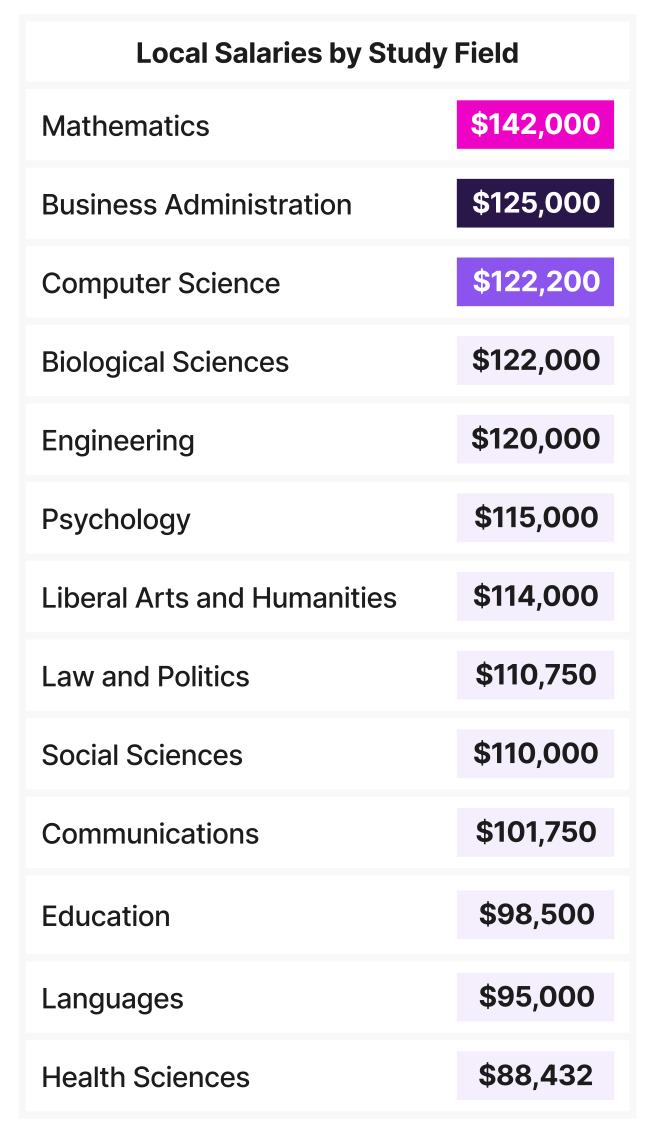
Looking at the median salary by degree field, Mathematics comes out on top, with Business Administration following it. Computer Science, the degree I would’ve expected to come out at the top, comes in at third. The order in which the results came out suggests that pure technical grounding isn’t the only (or even primary) driver of higher compensation in the ecosystem. Analytical depth and business fluency appear to command just as much (if not more?) value.
When you come to think of it, the Salesforce ecosystem has never been an industry that’s dominated solely by traditional developers. While technical depth is still very important, it’s being reframed. Your foundation may come from either mathematics, business, or the humanities, but the common denominator among higher earners is the ability to translate complexity into decision-making.
These educational backgrounds may all be different disciplines, but at their best, they cultivate the kind of thinking that architects and senior Salesforce professionals rely on daily: seeing the system as a whole and weighing trade-offs.
Strategy Over Syntax
When new technology as significant and groundbreaking as AI arrives, there’s a temptation to treat it as a “skills race”. Learn the tool, get the cert, and update your resume. The survey data suggests the Salesforce ecosystem is (mostly) resisting that temptation.
When respondents were asked which skills they’re focusing on and prioritizing, general AI skills topped the list at 48.3%, followed by Agentforce at 27.3% and Data Cloud at 12.4%.
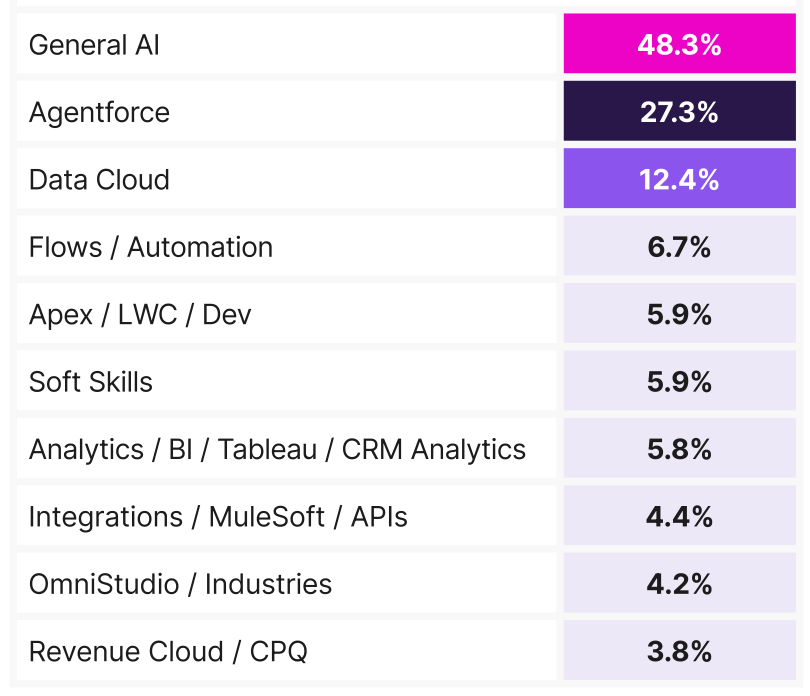
On the surface, these are all pretty recent technologies, and at first, it just looks like professionals are chasing the next shiny thing.
However, let’s dig into how people are thinking about these skills. The survey also captured which skills respondents mentioned in combination, and the pairings actually tell us far more than the individual rankings.
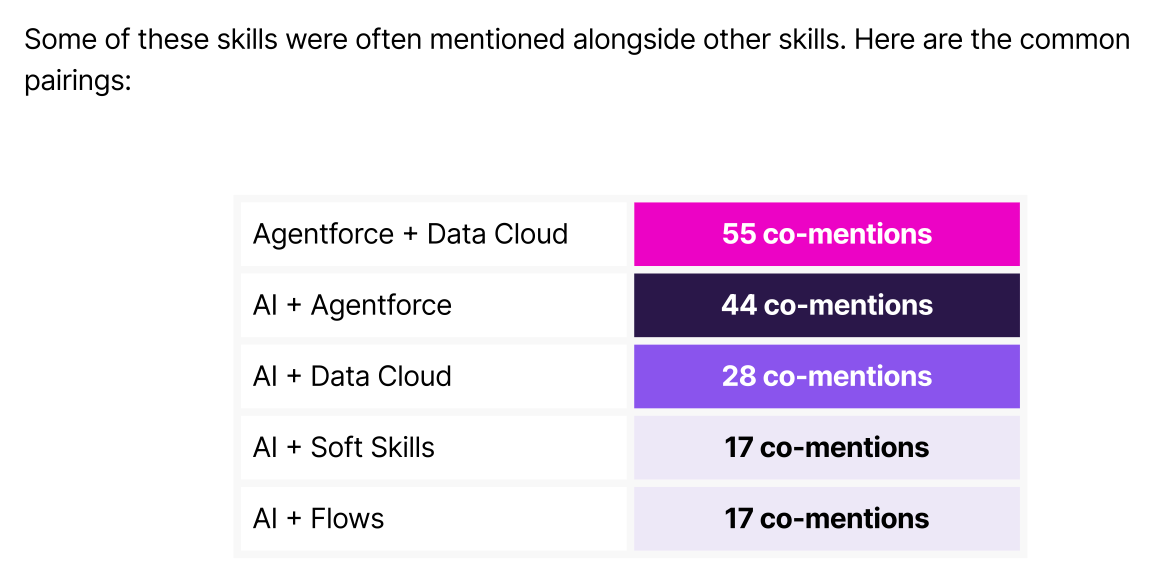
These people aren’t just ticking boxes on a skills checklist or learning things because they’re new. This data shows they’re thinking about how everything connects, because an agent that isn’t fed good data or isn’t plugged into the right business process is just an expensive novelty.
AI + Soft Skills appearing in the exact same frequency as AI + Flows is also telling, because in an ecosystem that focuses a lot on the technical side of things, this equivalence suggests that communication is becoming just as critical to AI success as configuration itself.
“How do I build this?” isn’t the only important question now. It’s equally important to ask: “How do I explain this? How do I lead this, and make it land with a business that isn’t sure it’s ready?”
Final Thoughts
Salesforce has been around for more than two decades. You can’t consider it a niche platform anymore, as it’s grown to a global enterprise ecosystem. Early on, the advantage belonged to those who could configure, build, and implement.
However, all ecosystems mature, and Salesforce is not an exception. A maturing ecosystem like this starts rewarding not just who can build, but also who can design and advise. The salary data reflects that shift clearly. Execution skills are foundational, but context determines how far you go. The most valuable skill you can invest in these days is developing a wider vision.