

Still Struggling with DevOps? You’re not alone. If you’ve ever stared at a failed deployment and thought, “Maybe I’m the problem,” don’t worry – you’re in excellent company. The dream of smooth, automated Salesforce deployments feels closer every year…and yet somehow still out of reach.
Despite all the progress we’ve made as a community, new survey data from last year shows that DevOps adoption across the Salesforce ecosystem remains patchy at best. Let’s take a tour through the data, shall we? It’s a journey worth taking.
Why Is DevOps So Uncomfortable?
As a Salesforce Admin, DevOps gives me the “ick”. It feels awkward, unnatural, and not in my lane. That’s why I’m not surprised that DevOps tops the list of least confident skills and most challenging tasks in Salesforce – across every role. I know the Salesforce DevOps Center exists, I’ve watched the demos, but do I actually use it? No. And, judging by the survey results, hardly anyone else does either.
So, before we get too deep into the numbers, let’s talk about why DevOps adoption has been such an uphill climb, especially for admins (and yes, even for some architects).
Salesforce was originally sold on its “No Software” promise, a low-code, declarative platform where you could build powerful apps with clicks, not code. Admins could design, automate, and configure everything right from the UI, and see the results instantly in production. It was meant to be simple, empowering, and visual.
DevOps, however, comes from a very different heritage. It’s not just pipelines and tools – it’s a culture of version control, testing, collaboration, and continuous delivery. Traditional CI/CD tools were designed around file-based systems: source code, YAML, JSON, and configuration files that behave predictably in Git-based workflows. None of this maps neatly onto Salesforce’s metadata-driven, API-dependent architecture. For admins, being told to suddenly master Git, branching strategies, and CI pipelines isn’t just a skills gap; it’s a paradigm shift. The cultural leap is as big as the technical one.
And it’s not all rosy for developers either. Even with their technical background, DevOps in Salesforce is simply harder than in most other platforms. In typical DevOps ecosystems such as Java, .NET, or Node, you’re dealing with pure code: files that can be versioned, tested, and deployed predictably. In Salesforce, “code” also means metadata, configuration, and interdependent components that behave more like a web of relationships than neat code blocks. A single Flow or validation rule can depend on dozens of other items, making deployments fragile, unpredictable, and often… uniquely Salesforce.
To make matters worse, we are all completely dependent on how well Salesforce maintains the Metadata API and the layers built on top of it: packaging, the Dependency API, and DevOps Center itself. And Salesforce doesn’t update these consistently across products. Data Cloud is a prime example: incredible capabilities, but not fully covered by the same metadata and DevOps tooling admins and developers rely on. That inconsistency makes DevOps harder, regardless of your role or experience level.
So, between cultural misalignment, tooling designed for code-first systems, and the quirks of Salesforce’s own metadata layer, it’s no wonder DevOps feels uncomfortable across the board.
Ok, now we’ve cheered ourselves up by establishing it’s not us, it’s DevOps, let’s explore what the data shows about the state of DevOps in Salesforce today.
Automation: Everyone’s Doing It… Kind Of
Let’s start with the good news: 77.1% of Salesforce Developers are now using some form of automated deployment tool. Most have accepted that moving metadata between environments shouldn’t involve tears, prayers, and a 12-tab spreadsheet.
But before we start high-fiving, let’s peek under the hood. Among developers, 37.8% are using open-source CI pipelines, 30.8% rely on third-party DevOps vendors, and just 8% have adopted Salesforce’s own DevOps Center. And, in case you thought they’d left the “click, pray, and deploy” era behind, a fearless (or foolish?) 19.4% of developers are still using Change Sets.
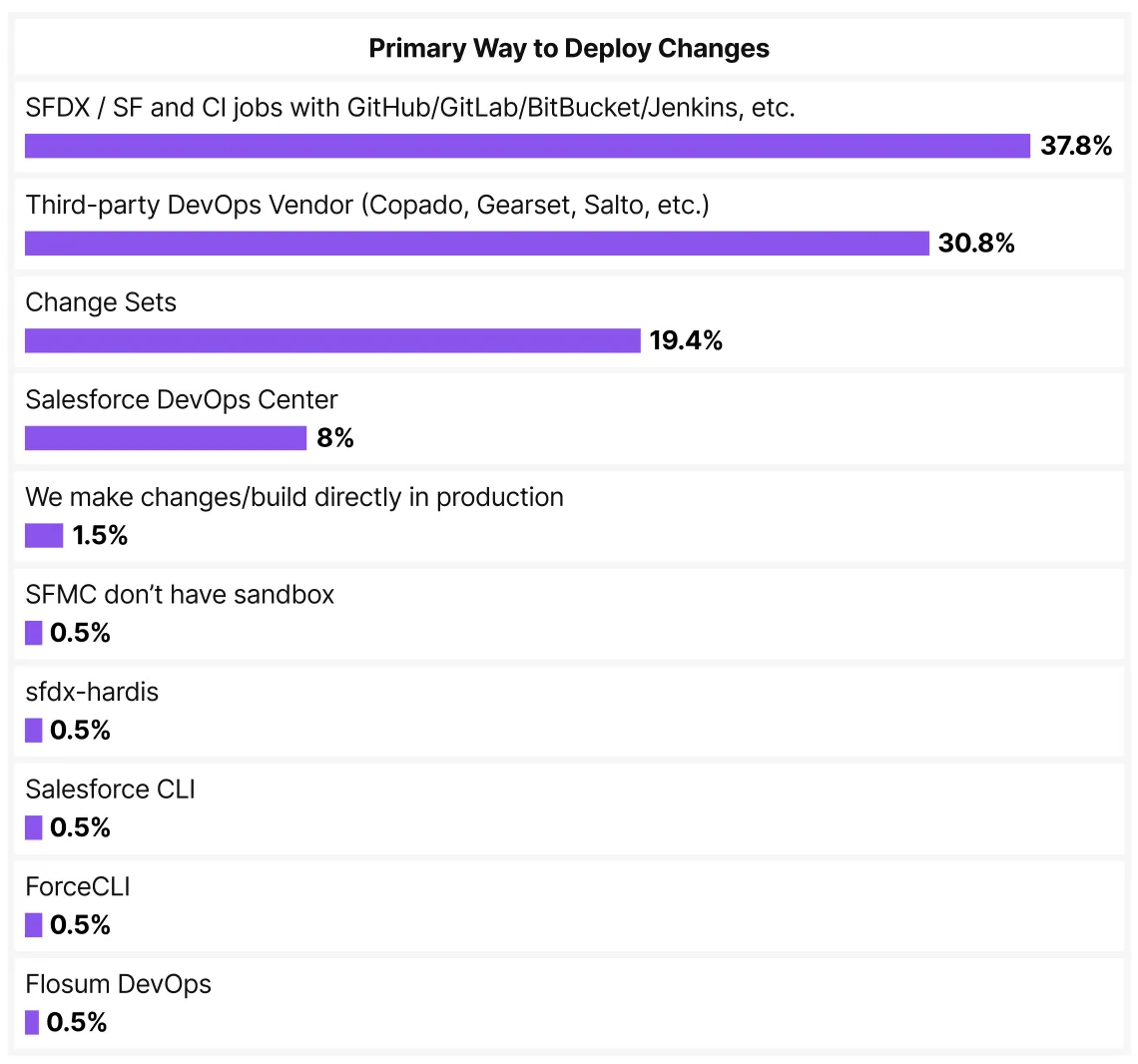
As Ellie Matthewman, Lead Salesforce Engineer at LendInvest, put it perfectly:
“Nearly one in five developers still deploy with Change Sets. In 2025, that’s a red flag – it shows just how uneven DevOps adoption really is.”
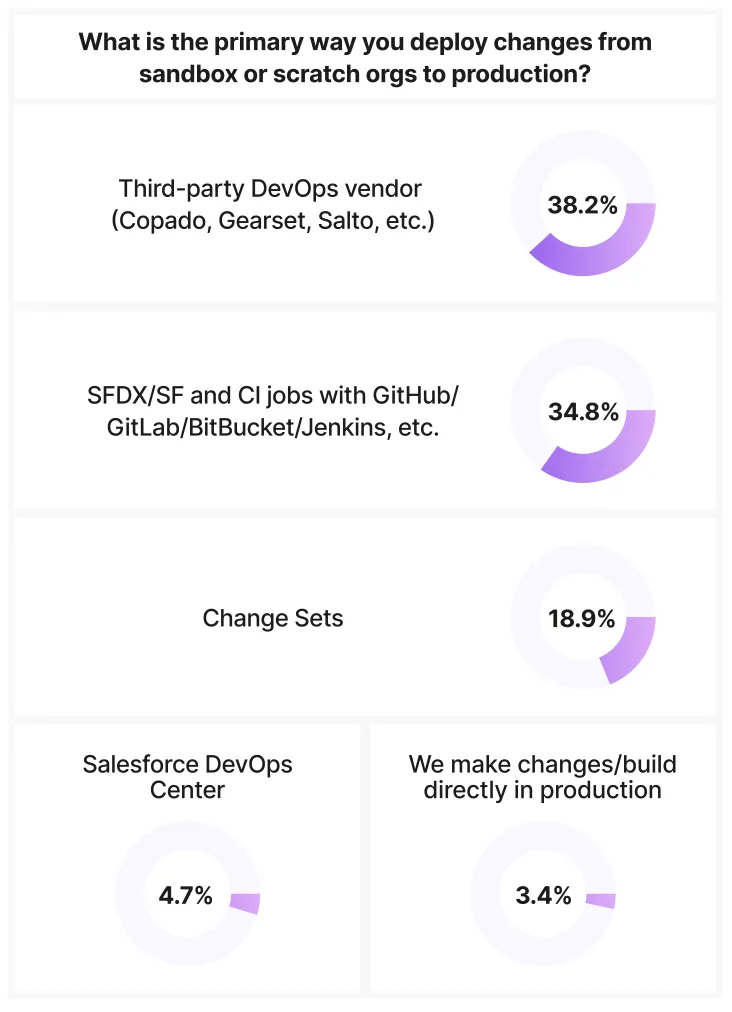
Architects tell a similar story, but with their own twist. The most common approach among them is third-party DevOps tools (38.2%), followed by open-source CI pipelines (34.8%). A surprising 18.9% of architects still deploy with Change Sets, proof that even the big-picture thinkers aren’t immune to old habits. Only 4.7% report using DevOps Center, suggesting that confidence in Salesforce’s native option remains low at the highest levels.
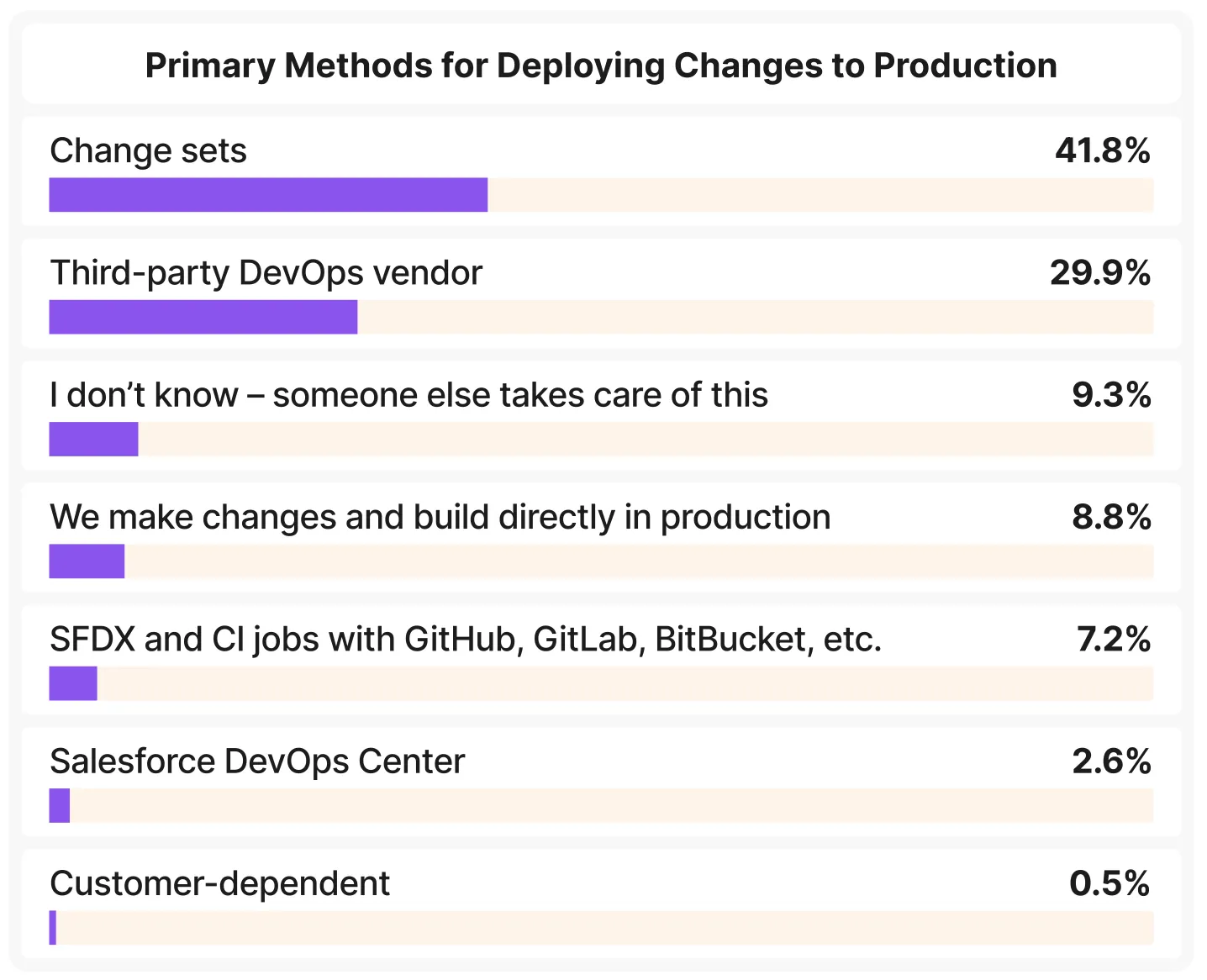
And then there are the admins, still holding down Change Set City, where 41.8% rely on them as their primary deployment method. 29.9% use third-party DevOps vendors, while 9.3% admit they don’t really know because, well, “someone else handles that” (likely their developers). A mere 2.6% is using DevOps Center.
So yes, deployment automation is happening. But consistent, ecosystem-wide adoption? Not quite yet.
Developers: Certified, But Still Cautious
Developers have traditionally led the charge on DevOps, but even they aren’t entirely at ease. While 77% use some form of deployment automation, only 25.2% hold a DevOps certification – though our surveys show developers tend to place less value on certifications overall.
When asked where their confidence dips, DevOps still ranked third on the “least confident” list. In other words, even the people building your solutions sometimes find themselves searching for answers during late-night deployment troubleshooting sessions. Confidence does improve with experience: 45% of entry-level developers report low confidence in DevOps, compared with 33% of intermediate and just 15% of advanced respondents.
Confidence isn’t the only hurdle. Developers also named Deployment, DevOps, and CI/CD as one of their most challenging tasks, with 27% ranking it third overall – just behind technical debt and balancing standard versus custom solutions. The data makes it clear: even the experts who live closest to the code are still wrestling with the complexities of getting it safely into production.
It’s not all doom and gloom, though. Developers remain the group most likely to experiment with modern tooling, from open-source CI pipelines to third-party DevOps platforms. They’re driving much of the innovation – even if their skills and confidence haven’t fully caught up with their ambition just yet.
Admins: Still in Change Set City
A hefty 41.8% of Salesforce Administrators still rely on Change Sets as their primary deployment method. They’re familiar, they’re comfortable, and while no one would call them reliable, they are at least predictable. The downside is that this reliance means many admins have yet to fully join the broader automation movement sweeping through the ecosystem.
Confidence plays a big part in that. 33% of admins report low confidence using DevOps Center, and it’s not hard to see why. The tool is promising but still feels like a work in progress, and without accessible training or clearer guardrails, most admins stick to what they know.
Their other least confident areas, Revenue Cloud (35.8%) and Salesforce AI (32.4%), point to a wider trend. Admins are being asked to manage increasingly complex and technical systems, yet they are often left without the upskilling opportunities or practical support needed to keep pace.
Architects: Confident Strategists Except When It Comes to DevOps
Architects usually have the big-picture view; they see everything from the integration landscape to the data model to the governance framework. But even they aren’t immune to DevOps anxiety.
Survey data shows that 37.3% of architects feel least confident in DevOps, second only to programming (41.1%). Interestingly, 38.2% use third-party DevOps vendors for deployments – the highest of any role – while only 4.7% use DevOps Center. In other words, they know what “good DevOps” looks like, but they don’t necessarily trust Salesforce’s native tools to deliver it.
The DevOps Center Dilemma
Salesforce’s own DevOps Center was supposed to be the hero of this story: the great equalizer that finally brings admins, devs, and architects together in perfect CI/CD harmony.
Unfortunately, the data tells a different tale. Only 8% of developers use it, adoption among architects drops to 4.7%, and a tiny 2.6% of admins say they use it at all.
So, why is adoption so low? There are several factors at play.
First, many teams have already invested years building reliable pipelines or adopting third-party DevOps tools. Asking them to abandon those proven systems for a still-evolving Salesforce solution is like asking someone to trade in their dependable car for a shiny prototype – exciting, yes, but not necessarily practical.
Then there’s the skills and confidence gap. For many, the DevOps Center still feels unfamiliar and under-explained. The learning curve can be steep, and the supporting resources haven’t yet caught up. When confidence is low and documentation thin, it’s no surprise that people hesitate.
And let’s be honest: Salesforce professionals aren’t immune to the very thing we help our users through – resistance to change. Change Sets have been part of the Salesforce DNA for years. They’re clunky, yes, but familiar. And while few will admit it out loud, some still make tweaks directly in production just to avoid the hassle. Old habits die hard.
So, Where Do We Go From Here?
Across all three roles, the patterns are strikingly similar: low confidence in DevOps skills and tools, fragmented approaches, inconsistent adoption, and a clear desire for more training and guidance from Salesforce itself.
If there’s one thing Salesforce professionals have in abundance, it’s resilience. We’ve survived UI overhauls, the introduction of Flow Builder (some of us just about), and the great MFA rollout… with these in mind, I’m pretty sure we can survive DevOps, too.
Here’s what the data suggests we need next: more accessible DevOps education for all roles; better integration between DevOps Center and the tools teams already use; and empathy for where people are starting – especially admins.
Because the truth is, DevOps isn’t just about pipelines or version control. It’s about people, process, and patience. And in the Salesforce ecosystem, that means bringing admins, devs, and architects together, not leaving anyone behind.
Summary
Salesforce DevOps in 2025 feels a lot like Lightning adoption in 2016: everyone knows it’s the future, we’re all moving in that direction, but progress is uneven and sometimes reluctant. Until skills, confidence, and tooling truly align, deployments may remain a little messy around the edges. What matters is that the ecosystem continues to learn, adapt, and build the confidence to make DevOps a standard part of how Salesforce teams work.
Resources
- SF Ben Salesforce Developer Survey Results 2025
- SF Ben Salesforce Architect Survey Results 2025
- SF Ben Salesforce Admin Survey Results 2025