
What do the stock market and horoscopes have in common? Well, if you put them both in a Venn diagram, you could see “predicting the immediate future” as the mutual space in the middle. A horoscope might tell you that you will meet a handsome stranger within the next week. The stock market might tell you that SaaS could very well be back in style.
The dawn of the SaaSpocalypse brought with it fears about the future of SaaS as we know it, and endless predictions about how factors such as artificial intelligence could flip it all on its head. Salesforce CEO Marc Benioff recently called the SaaSpocalypse “nonsense” and said it was “time for it to stop”, but when you have stakes in the game, this is easier said than done.
However, now that Salesforce has unveiled Claudeforce, and the top AI companies are buddying up with your favorite SaaS companies, the landscape is beginning to shift – and the stock market might be the first place to witness it.
Dissecting the SaaSpocalypse
For just over six months, we’ve been covering the SaaSpocalypse – a phenomenon that has taken the tech world by storm. The possibility that AI vendors could render traditional SaaS providers obsolete was enough to get people talking, and it put the futures of SaaS giants like Salesforce into question.
We’ve explored nearly every side of this argument, examining how unsteady financial results have ignited fresh worries, how customer spending habits have tipped the scales, and how Salesforce’s strong results have almost been enough to quell the concerns of investors and analysts.
For the professionals most at risk, we’ve also considered how they can future-proof their careers in this time of uncertainty and illustrated how the wider tech market has been adjusting amid company restructuring and shifting goals.
The SaaSpocalypse debate now stretches further than just examining whether AI is enough to replace traditional software vendors. It now considers what a future with AI-powered SaaS solutions might look like, and most importantly for investors and analysts, how well it could perform in the market.
Before this point, the fairly unanimous perspective was that the SaaSpocalypse still had legs, but was gradually dying down. Now, we could be witnessing the revival of SaaS – does that mean the apocalypse is well and truly over?
Enter Claudeforce and AI Partnerships
The turbulent performance of Salesforce’s stock this year has been no secret. From hitting a new three-year low in June to rebounding last month, the company’s performance has undergone extreme scrutiny, particularly when the shares fell.
However, the announcement of Claudeforce – a new way to use Salesforce through Claude – and Salesforce’s impressive Q2 earnings have seemed to have given the market a new lease of life.
Immediately after the earnings call, CRM stock shot up by 14% in after-hours trading. It’s now up nearly 30% in the last five days, 33.77% in the last six months, and 2.08% year to date. In fact, the stock’s performance has nearly hit that of its last peak in early January 2026.
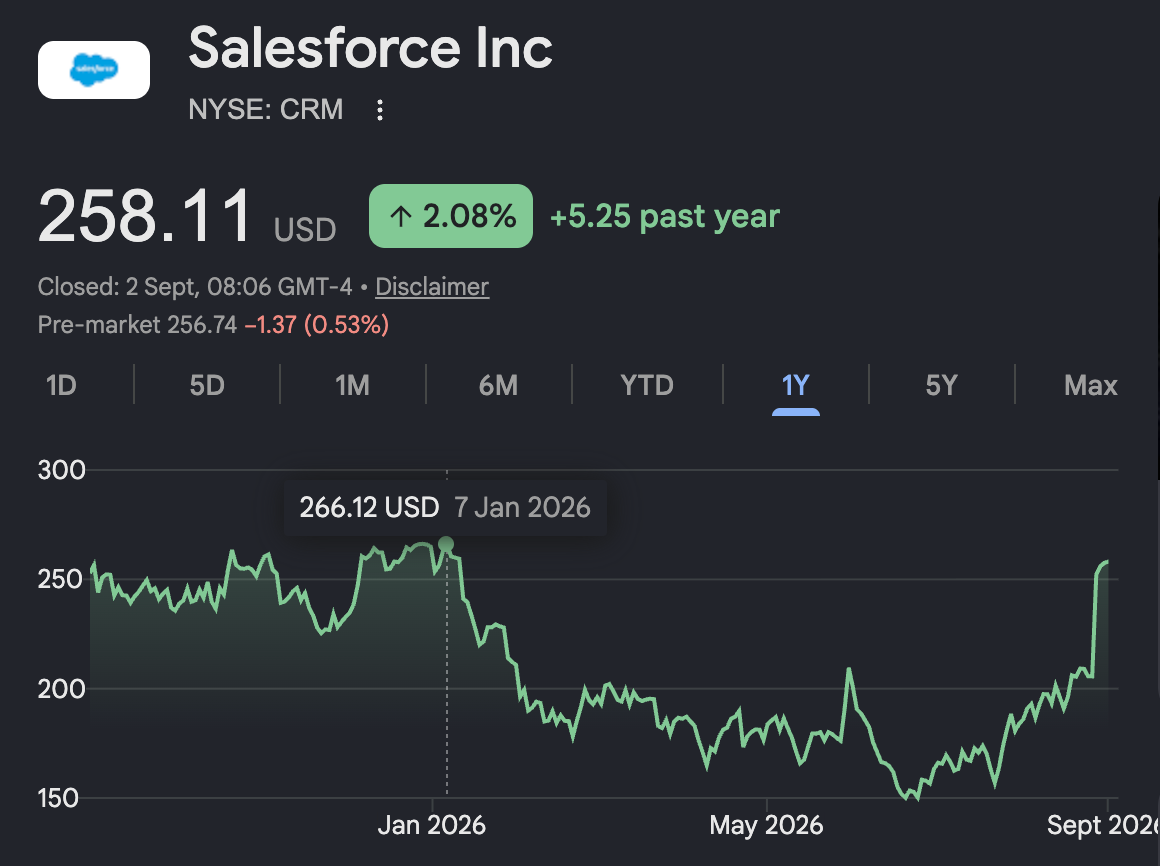
It is not uncommon for other stocks in the space to follow suit, and they have. ServiceNow stock is up 16.80% in the last five days, Microsoft stock is up 2.62%, and Workday stock is up 5.31%. Oracle’s, however, is down 3.81%.
This also coincides with the fact that most big SaaS household names now have significant partnerships with the top AI companies. Salesforce’s most notable one is with Anthropic, and both Microsoft and ServiceNow now have deep partnerships with OpenAI and Anthropic. Not only that, Salesforce is expected to engage in similar partnerships with other frontier models, indicating we could see the company further embed itself within the AI space, acting as an enterprise layer or operating system.
Did SaaS Ever Really Leave?
Deciding whether SaaS is “back” can be a difficult one, especially if you don’t think it ever, well, left. Robert Sösemann, the Director of Engineering & AI Lead at Aquiva, told SF Ben that he thinks the framing around this question isn’t quite right, as SaaS “has never been away, nor is it back.”
“What you’re describing is a fear that SaaS is becoming less and less important with the arrival of AI – and that fear holds true,” he said. “But stock markets always exaggerate and go crazy. Nothing that has happened since then has re-evaluated SaaS or made it more valuable. SaaS isn’t back. It’s dying slowly enough that people mistake it for stable. It might just take some time for each individual business to actually die.”
He explained that now, AI replacements for SaaS tools and ecosystems are desperately needed, and that some vendors might manage it on their own by getting AI into their platform. However, for the majority, this scenario will likely look like what we’re observing right now: “an unbundling disguised as a partnership.”
“Existing SaaS vendors are bolting AI onto their platforms and calling it reinvention,” he told SF Ben. “Most of them are out of hope. What else should they do?”
Robert admits to being skeptical, comparing Salesforce’s partnership with Claude to IBM’s outsourcing DOS to Microsoft in 1981. “Everyone reads Claudeforce as a win for both sides,” he said. “Anthropic gets enterprise data and governance. Salesforce gets frontier AI without building it. Great deal; stock went up. What I actually see is Salesforce voluntarily handing over its interface.”
“Nobody needs the complicated data model. Nobody needs the UI. Nobody needs the tools. It could happen quite soon that Anthropic doesn’t need Salesforce anymore, and instead helps customers leave it.”
Nick Hamm, the Chairman of research company 10K, has much more of a positive outlook, calling the fact that SaaS is back “even bigger news than the announcement of Claudeforce”.
“We have seen firsthand that AI provides the most value to businesses when it has access to their structured (and unstructured) data, when it can help facilitate their deterministic processes, and when all of it happens on the same plane as their human counterparts,” he wrote on LinkedIn. “This is exactly what hundreds of thousands of companies have codified into Salesforce.”
“On the whole, companies who focus their resources on building the proprietary intelligence layer of their business will outperform those who divert resources to building the data infrastructure that can be purchased.”
Final Thoughts
With stocks on the rise and the partnerships between SaaS companies and AI companies seemingly only getting stronger, it does seem like SaaS could be back. However, as Robert surmised, this could also be a reinvention – something that seems good for both sides now, but could turn out to work in the favor of the world’s top AI companies.
Evidently, the conversation about whether or not Anthropic will acquire Salesforce is still not off the table, but for now, many will just be happy that the stocks are not continuing to slip – at least for the time being.