








After a brief uplift period during Salesforce’s TrailblazerDX conference last week, CRM stock has taken a nosedive, dropping nearly 9%.
This comes after competitor ServiceNow witnessed a 15% drop in its own stock after missing Q1 estimates and triggering analyst price target cuts, as well as ongoing disruptions as a result of the war in Iran.
A Brief Uplift
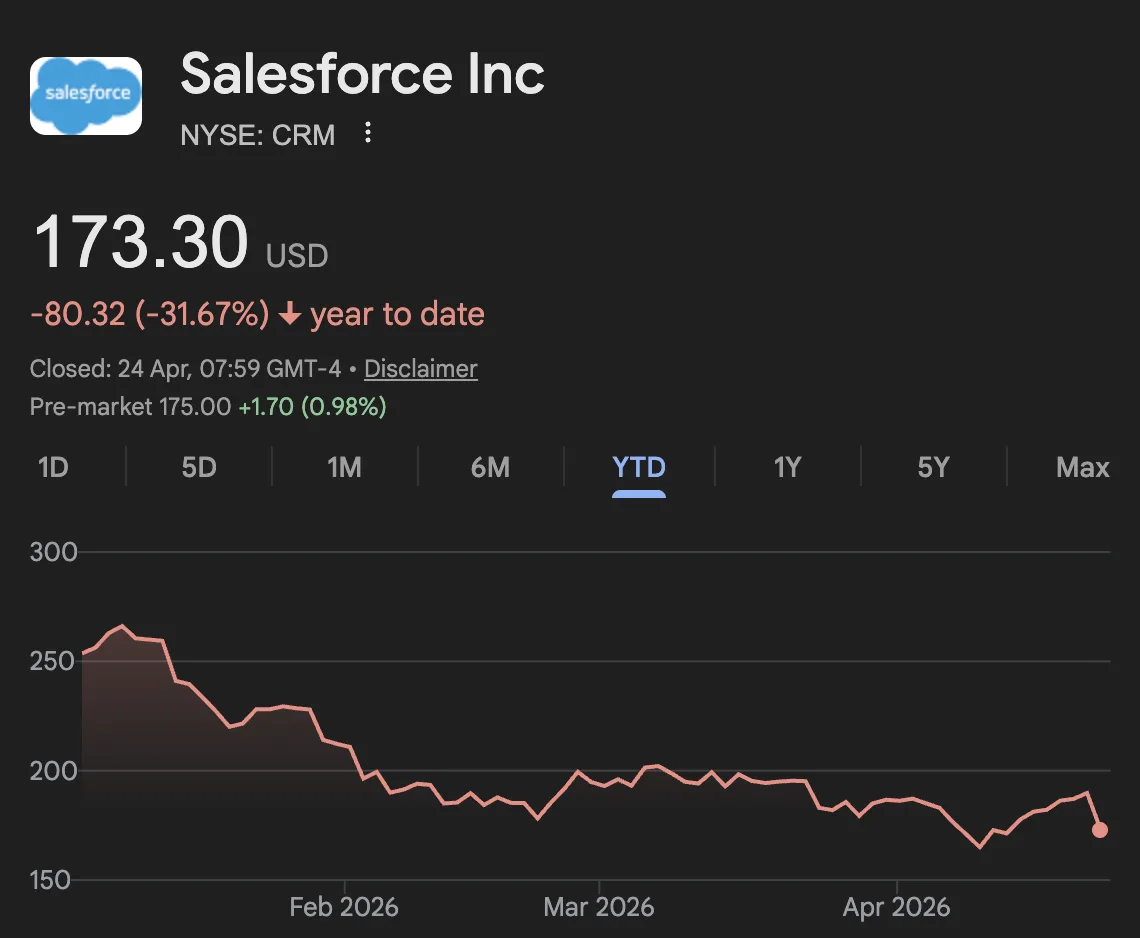
Salesforce’s stock has experienced a turbulent start to the year after experiencing a 25% year-to-date drop amid persistent SaaSpocalypse narratives.
By the time TDX had rolled around, the stock finally experienced an uplift of 7.8%. The event’s strong announcements within AI, including Headless 360 and Agentforce Vibes 2.0, likely contributed to the rise, with Salesforce showcasing its latest and greatest advancements within the AI enterprise space.
CRM Stock Plunges 9%
At the time of writing, Salesforce’s stock has dropped 8.69% in a day. This forms part of a larger drop of nearly 32% in the last six months.
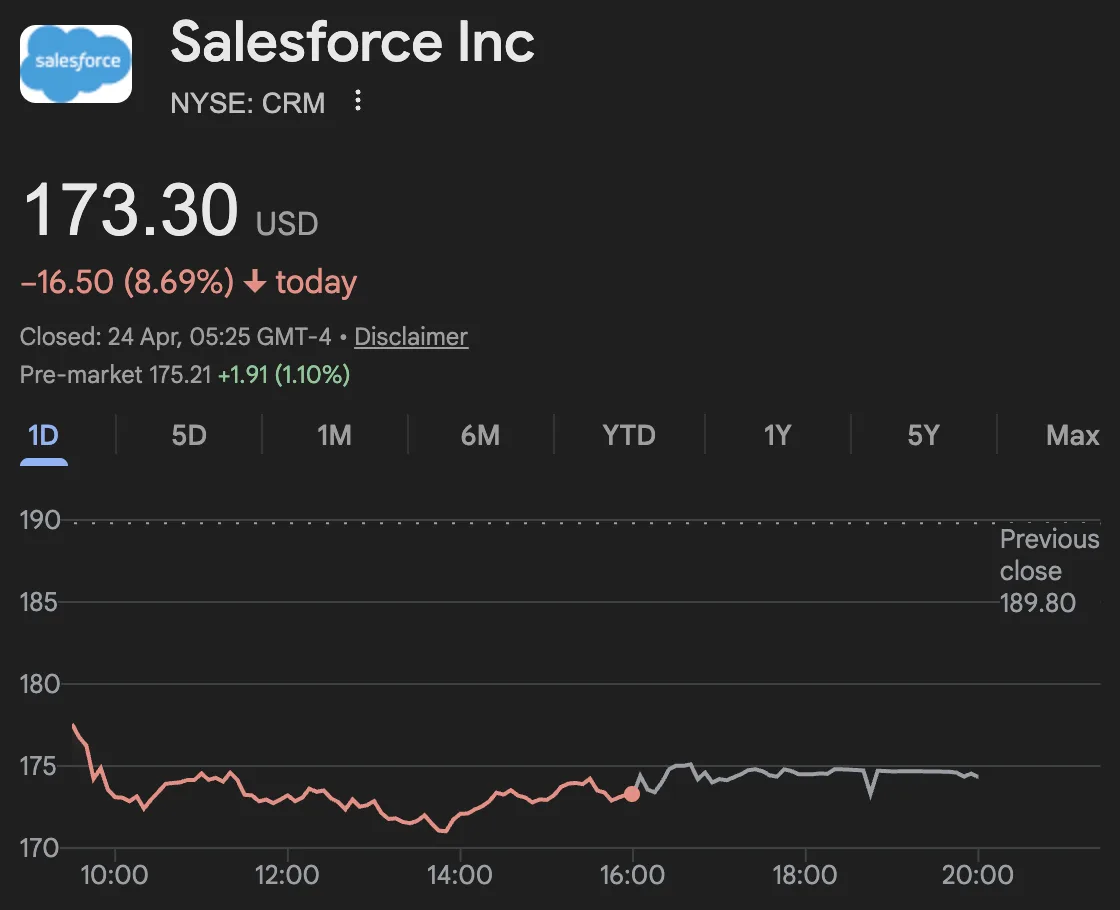
Although it is natural for software stocks to experience periods of significant drops and rises, this time around, there are likely two major forces at play: the ongoing conflict in the Middle East and ServiceNow’s latest earnings results.
ServiceNow’s Struggle and The Ongoing War
The US-Iran war has managed to impact multiple sectors, and the tech industry has not come away unscathed. At the beginning of April, Iran threatened several major American tech companies as possible targets in retaliation for US-Israeli attacks, including Amazon, Palantir, Microsoft, and Oracle. Amazon and Oracle were subsequently attacked.
Although this has not impacted Salesforce directly, it has impacted ServiceNow, one of Salesforce’s most notable competitors. The ITSM leader recently announced its latest financial results, roughly in line with expectations for a slight earnings beat. However, the results failed to meet Q1 Wall Street estimates, triggering analyst price target cuts and sending the stock plummeting 15%.
ServiceNow CEO Bill McDermott directly referenced the conflict as a reason behind the slightly muted earnings, clarifying that the results include “about a 75 basis point headwind from delayed closings of several large on-premise deals in the Middle East due to the ongoing conflict in the region.”
Gina Mastantuono, ServiceNow’s CFO, also attested to this, explaining that the guidance took this into account.
“Our guidance captures that momentum while taking a prudent view of the geopolitical environment, particularly the conflict in the Middle East and its potential impact to deal timing,” she said.
These results also marked the latest stage in a long-running trend in ServiceNow earnings, where, despite a slew of good numbers, the stock still falls. This time around, it has seemingly directly impacted Salesforce’s stock, with analysts and investors scrutinizing the state of the enterprise software market and how the biggest players in the game are influencing each other.
Salesforce’s Drop Is a Consequence, Not a Driver
By now, it is evident that the performance of one SaaS provider – good or bad – will influence the others within the space, and this latest drop for both ServiceNow and Salesforce forms part of a long-standing battle to come out on top.
This time, it appears as if Salesforce’s stock drop is a consequence of ServiceNow’s latest results, causing investors to rethink, with the CRM giant simply caught in the crossfire.
As investors weigh up the AI disruption risk against the growth of enterprise software providers, Salesforce, as the trend leader, has taken the brunt of sector-wide selling despite no company-specific catalyst.
Alecia Wall, Industry Analyst at Keenan Vision, affirmed that ServiceNow’s results were having a wider enterprise landscape impact, with a large majority of NOW investors currently navigating significant portfolio rebalancing.
“Between geopolitical uncertainty, the broader SaaS repricing, and shifting AI narratives, fiduciaries are making hard choices about what to hold, and even strong performers get trimmed in that environment,” she said.
Why Is ServiceNow Struggling More?
However, there is one lingering question that remains here: why does ServiceNow appear to be struggling more than Salesforce?
In this particular scenario, ServiceNow is the provider that just delivered the mixed earnings results, making it understandable that its stock dropped 15%. However, year-to-date, Salesforce stock has dropped by 31.67%, whilst ServiceNow’s stock has dropped by 42.50% – more than a 10% difference.
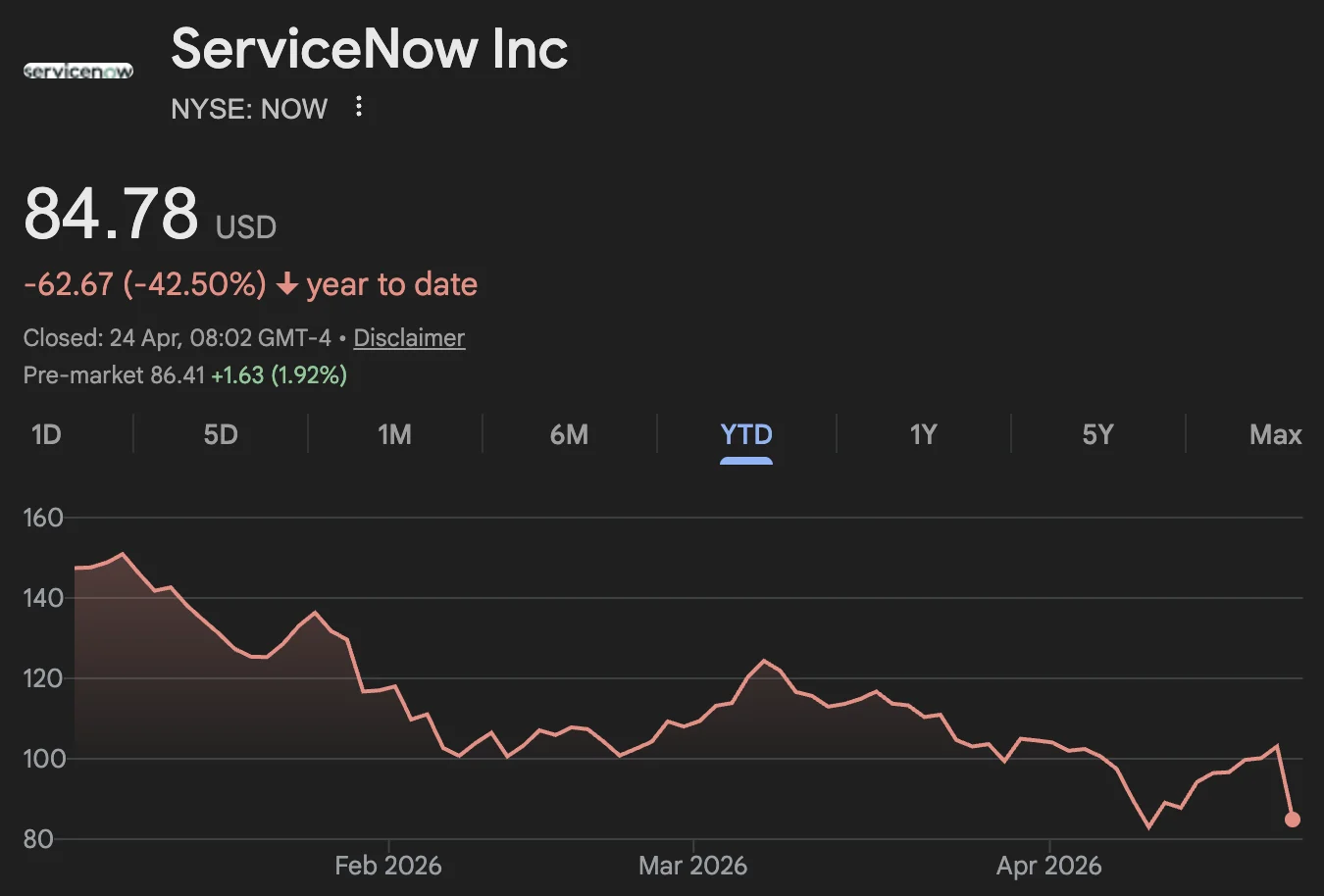
Salesforce remains an industry leader, justifying its higher buy price, but ServiceNow has by no means had an unsuccessful year, at least operationally. Its revenue growth is 22% YoY according to its latest results, and it is also seeing strong traction within AI, with its AI revenue forecast increased to ~$1.5B for 2026.
However, Alecia explained that ServiceNow is also experiencing a modeling problem that the market hasn’t solved yet.
“ServiceNow now generates 50% of net new business through non-seat-based pricing – consumption-driven, usage-tied models that are likely the future of enterprise software,” she said.
“But there aren’t enough comps for analysts to benchmark against yet. Financial modeling has to balance consistency over recency, so quarter by quarter these results will build into forecastable trends, but right now the market can’t responsibly reward what it can’t yet model with confidence.”
Salesforce, on the other hand, also has investors curious but cautious about its future, but it has also spent the last 12-18 months building credibility with said investors. This has been done by aggressively pivoting to higher margins, cost discipline, and shareholder returns, for example, through its latest buyback scheme.
In this market, profitability comes before growth, even if the growth is strong, and Salesforce appears to be telling a clearer profitability story right now.
Final Thoughts
As we progress through Q2, it is likely that we will see more turbulence from both stocks, and it will be interesting to see how they continue to impact each other.
Both companies have a lot to prove to analysts and investors alike, and it takes just one wrong move to send stocks crashing down.