

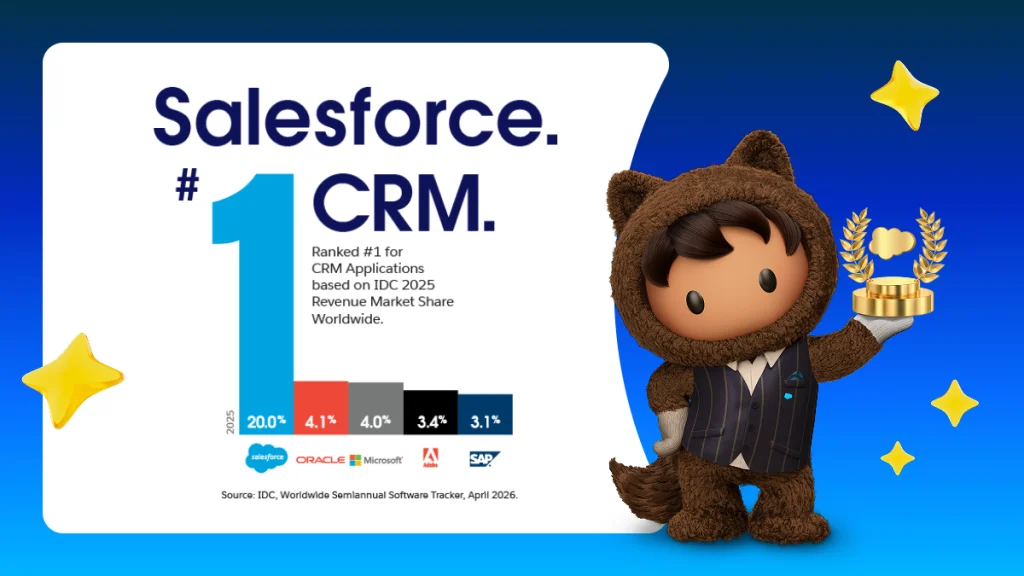
No matter your opinions on Salesforce, it’s difficult to downplay its sheer platform dominance. The SaaS giant has been named the number one CRM provider by IDC since 2012, surpassing the market share and revenue of several considerable competitors, including Oracle and Microsoft.
In 2025, Salesforce led all CRM vendors with a 20.0% market share. On paper, there doesn’t seem to be anything that can slow the behemoth of a CRM down, but within its user communities, a change is stirring that may prove the platform may not be the dominating presence it has been for much longer.
Salesforce’s Rise to the Top
Salesforce has come a long way since its humble beginnings all the way back in 1999. Emerging as one of the first leading SaaS offerings, Salesforce has since launched its own app store, created multiple clouds for multiple industries, entered the mobile market, and broken into the vastly expanding world of AI.
It has not always been a smooth rise to the top, though. Salesforce has had to reckon with exec shakeups, faltering financial results, pressure from activist investors, and criticism around its CEO and company direction, especially over the last two to three years. Despite all this, its platform dominance has remained seemingly unchallenged, with competing CRMs trailing considerably behind.
Is Salesforce Really Unbeatable?
Salesforce, at least in this aspect, seems almost unbeatable. However, even the leading players have weaknesses, and for the Mothership, the cracks may be beginning to form at the heart of its professional user base.
According to our latest Salesforce Architect survey, 24.8% of Salesforce Architects say that Salesforce is losing platform dominance. Not only that, but when asked what percentage of their work involves technologies outside of Salesforce products, respondents indicated that almost half of their time is spent using external technologies (45.1%). On average, only 54.9% of their work takes place within the Salesforce platform.
These are certainly not alarming numbers, and definitely not on their own. Salesforce has arguably been engineered, at least over the last few years, to be worked with in tandem with other tools and as part of a wider tech stack. The CRM giant’s notable “land and expand” strategy, alongside its growing set of tools and capabilities for specific verticals, has made it easier to use only Salesforce, but this is likely not the case for most of its customers.
Its AI strategy also solidifies this. Agentforce and Headless 360 have been designed to give Salesforce’s users choice and flexibility when it comes to their chosen models and agents, with a clear “plug-and-play” approach that many of its customers have been appreciative of. For architects especially, who we know are responsible for more than ever in their roles, it is not surprising to see that many of them are spending a lot of time working on external technologies.
Sticky Technology and Vibe Coding
If there is one thing that is going to be influencing Salesforce’s platform dominance perhaps more than anything else, it’s the fact that Salesforce is notoriously sticky. Long regarded as an expensive technology, it’s also one that is difficult to leave behind to move on to something else, especially if your org has multiple integrations or holds a lot of important customer data.
“Salesforce is super sticky – no one is looking to replace it in a hurry,” SF Ben founder and CEO Ben McCarthy said. “[Salesforce] has to continue innovating, of course – they can’t just sit there and do nothing, but I don’t think the SaaSpocalypse or anything like that suggests that Salesforce is losing platform dominance.”
Now, there is a cheaper alternative to Salesforce currently making the rounds, and that is, of course, vibe coding. Theoretically, with a solid vibe coding strategy, you can create a customized alternative to a SaaS offering like Salesforce – and it already has been done – but it comes with infamously mixed results.
Whether you think vibe coding presents a strong use case against Salesforce, or it’s just a load of wishful thinking, it’s created enough of a shift to remind businesses that they have other options. Sometimes, that can be enough of a catalyst for change – the awareness (or illusion) of choice.
Should Salesforce Worry?
So, it appears that Salesforce may not have anything to worry about in the near future, but what about a few years down the line when cheaper, more customizable solutions get better and better?
Ben told SF Ben that if there’s anything Salesforce should be concerned about, it’s that very possibility.
“That is what Salesforce needs to watch out for,” he said. “If there is a way to move to another platform, and it’s much easier and much cheaper, then it will be like what Salesforce was doing, selling to people with on-premises servers back in 1999. Then, I think they would need to be worried.”
“However, people are always going to need a CRM unless there’s a better replacement out there.”
Sumit Mattey, the VP of Genpact, told SF Ben that Salesforce’s biggest threat was not another CRM vendor but the “changing definition of what a CRM platform needs to be.”
“The interesting battle over the next 3–5 years may therefore not be Salesforce vs. another CRM. It could be platform-centric enterprise IT vs. AI-native, composable enterprise architecture.”
Krishna Paruchuri, a freelance technology manager, told SF Ben that he’d personally be watching the shift from systems of record to systems of action.
“Salesforce owns a significant portion of the record layer,” he said. “But AI agents increasingly operate across applications, APIs, and data sources. That could fundamentally change where platform value sits.”
A few other professionals questioned whether Salesforce was prioritizing the right things when it came to its future direction, citing a lack of core updates, support, and training in place for the majority of its customers – not just its AI customers.
The Growing Salesforce and Anthropic Situation
Perhaps the biggest question when it comes to Salesforce’s platform dominance is what its relationship will look like with Anthropic in the future.
The two have gradually been expanding their partnership over the course of the last year, with ChatGPT integrations for Slack and Salesforce, the introduction of Claude Tag, and now the announcement of Claudeforce.
Back in June, my colleagues Ben and Tim debated whether or not Anthropic would eventually acquire Salesforce, and after this week’s Claudeforce announcement, it is natural to go back to that conversation.
It is likely now that, at least in the near future, Anthropic will not acquire Salesforce, and instead focus on strengthening that strategic alliance. It is also possible that Salesforce could become the enterprise operating system for frontier AI models, meaning that Salesforce would accept its conversational interface would belong to models like Claude over time.
This is certainly not something likely to transpire in the near future, especially with Salesforce putting so much strategy focus on Slack. However, that is likely what the next big step in Salesforce’s efforts to retain platform dominance would look like – establishing how necessary it will be to enterprise AI over the next few years.
Final Thoughts
So, Salesforce is arguably not losing or at risk of losing platform dominance any time soon, and for a multitude of reasons.
However, this does not render it entirely untouchable, as it still needs to establish its worth in the AI future and ensure it delivers tools and features that will benefit all of its customer segments, not just the big enterprise AI spenders.