

The Salesforce job market is tough right now – and not just for entry-level developers and admins looking to land their first roles. Even senior Salesforce professionals with a decade of experience under their belts are struggling.
Last year, we wrote about how some of the most experienced Salesforce experts were finding it hard to get work. So, has this situation really changed in 2026?
‘It’s Brutal Out There’
Beech Horn, Technology Engagement Manager and Architect at Banham Patent Locks Ltd, told SF Ben that a lot of people in the ecosystem are struggling to find work.
He mentioned that even those with more than 10 years’ experience are having a hard time. He knows people who have been away from work for six months or more and are applying for hundreds of jobs – something which would have been unthinkable until recently.
“It’s been brutal out there,” Beech said. “Certainly in terms of people that are in university right now wanting to be developers, wanting to be computer scientists, it’s looking very bleak in terms of employability.”
In terms of what’s looking positive right now, Beech said that Business Analysts are doing particularly well, and are in a good place in terms of future employment due to the rise of vibe-coding.
It’s Who You Know
Will Turner, Salesforce Application Manager & Agentforce lead at Arjo, said that there has historically been more job seekers than positions that need filling, but currently, it appears that imbalance is even higher than normal, contributing to a more saturated – and challenging – market than ever before.
Will hosts the Salesforce London Admin User Group – a very handy resource for Salesforce professionals looking to meet their peers, learn new skills, and, yes, look for work. The user group often involves a segment where the group administrators ask that people who are looking for work raise their hands – followed by people whose businesses are currently hiring.
We asked Will if it was normal that more people would put their hands up to show they were looking for work than the number of those putting their hands up to say they are hiring. He told SF Ben: “I’d say, from memory, there’s always been more people looking than hiring. It does seem maybe now there’s probably more people looking than normal.”
Will added that we don’t know the exact reasons behind that, whether people are just looking to move on, or they’re not satisfied with where they are at the moment, but in his experience of being in the ecosystem for 12 years, demand has “significantly dropped off” over that time.
While there still are vacancies out there, it appears to be “more saturated with candidates than it probably ever has been”, Will said.
But, dear reader, you don’t have to be a LinkedIn celebrity. You do, however, need a professional network. Without one, you’ll inevitably reach a plateau in your career, especially for those aiming at credentials like the $6,000 Certified Technical Architect (CTA) credential.
Senior professionals need to stay up-to-date with the latest industry developments, and the Salesforce ecosystem has a great reputation for having a strong community. Professionals are constantly sharing problems and solutions, seeking and receiving advice, and generally sticking up for one another.
Beech Horn notes that a solid network is necessary to find quality senior job roles. This echoes comments made by Founder & CEO of Groundwork Apps (and Salesforce MVP Hall of Famer) Paul Battisson, who told SF Ben last year that he gets a decent amount of work through knowing people in the ecosystem.
When we spoke to Paul more recently, he told us about a number of small projects he has taken on, free of charge, because there’s a decent chance this goodwill will be repaid. And, besides it being a simple kindness which is good in and of itself, it’s also a good business practice.
“If nothing comes from it, great, nothing comes from it,” Paul said. “But if I ever need something in the future, that person will remember me and be far more likely to come back to me.
“It’s one of these trite things to say – be nice to people and people will be nice to you back – but you can’t just expect things to land in your lap in the world. You have to have a reason for people to reach out for you.”
Certs Are Still Worth It – Even for Senior Professionals
There’s been a lot of debate in the Salesforce ecosystem about whether certifications are still relevant. It would be ridiculous to say that no one should bother getting any certifications, but it’s still debatable whether more is better when it comes to certs. This is especially true for senior Salesforce professionals.
Beech said that the CTA certification was an “obvious win”, even though it comes with a considerable price tag and time investment requirement. He said: “It’s a trial by fire. It really hones your skills, whether you pass or fail.”
Beech added that, in order to attend exclusive events like Architect Dreamin’, you have to have certain qualifications – like the CTA certification.
“Salesforce support, I hear, treat you differently,” Beech added. “It’s just cutting past that initial layer of bureaucracy by having it. Plus, you’ve gone through the trial of fire to have earned it in the first place.”
The Rise of the Niche Role
It’s a tough market out there for Salesforce professionals, it’s true. But, at least according to the 10K Salesforce Talent Ecosystem Report, Technical Architects are in a considerably better position than many other roles.
The report, released in late 2025, shows a change in global demand for Technical Architects rising by 27%, and Solution Architects by 21% – the sharpest demand gains of any role.
As Salesforce programs become increasingly complex and technical debt piles up (while AI adoption accelerates), the need for experienced talent grows.
Supply for Technical Architects grew by just 4% globally, so the imbalance for this role is “extreme, creating ample opportunity for qualified professionals”, the 10K report authors write.
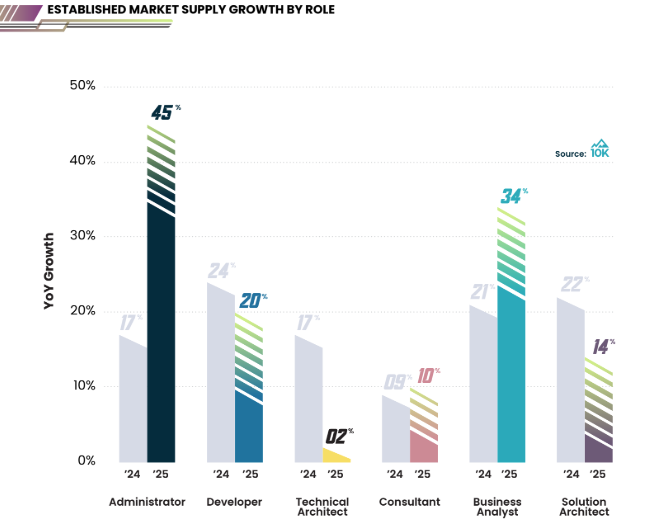
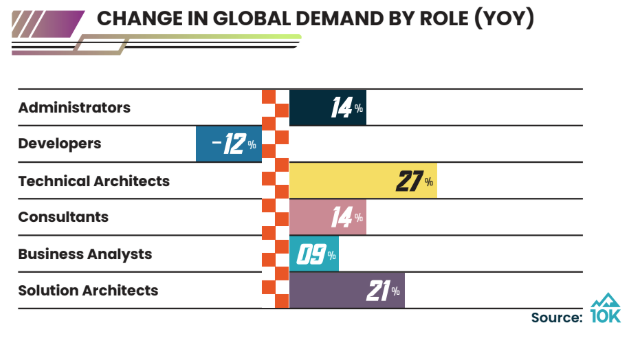
And the future might hold even greater things for architects and business analysts, thanks to Agentforce. If Salesforce keeps applying an agent-first design to industry verticals, as it has done with life sciences, the need for architect roles will grow exponentially.
This could also mean that long-standing BAs with domain experience can move into those roles as well.
Will Turner mentioned the increase in Salesforce products and certifications over the past 12 years, which has led to a “rise of the niche role”. Will noted that in the past, one person could be a platform expert with just Sales Cloud and Service Cloud knowledge, but the introduction of multiple clouds – like Marketing Cloud, CRM Analytics, and Industry Clouds – has made it necessary for professionals to become either core experts or niche product experts
He said: “It was possible that one person could be a Salesforce expert. They could learn two products, you got certified, you passed the consultant exam in both products, you were high in demand. That’s going back to 2014.”
Then, Will says, with the emergence of Marketing Cloud, CRM Analytics, Field Service, and a range of new products coming in, that “shifted the margin” on people being able to be the platform expert.
“You now had to be a core expert, or maybe a niche product expert,” Will said. “Certainly over the last couple of years, demand started to shift to more niche multi-cloud roles, AI, or industry-specific stuff. So people who have been in Salesforce for 10 plus years or more, people who are quite senior in terms of their experience, they have a broad but maybe shallow sort of experience.”
People who have worked with lots of products, but maybe not within one specific niche, might now find it harder to secure roles – even senior professionals – thanks to product proliferation.
Diversify Your Ecosystems
Knowing Salesforce inside and out is great, but senior professionals might want to consider other options. Beech told SF Ben that some senior professionals, especially those skilled in the old SteelBrick CPQ, are pivoting to ServiceNow.
“I’ve seen a fair few people turn their heads now at what ServiceNow are doing,” Beech said.
We asked Robert Sösemann, Senior Principal Architect at Aquiva Labs, whether he believes that tech professionals can no longer afford to just stick with one system, like Salesforce, and should diversify into other areas, like ServiceNow.
On diversification, Robert said: “Absolutely – and I see that shift on the customer side too. I’ve been asked things like ‘Can we bring in some AWS capability?’ or ‘Can you add predictive AI to the mix?’ It’s not just engineers broadening their skills – customers are actively demanding a wider range of expertise.”
On the topic of vibe-coding and differentiation, he told us: “With tools like AI-assisted coding becoming mainstream, the baseline for what makes a ‘good engineer’ is rising fast. Everyone will be able to write decent code.
“So you need a second pillar – domain knowledge, industry context, the ability to connect technology to real business problems. If you’re the person who deeply understands the food industry and can bring Agentforce into that world, that’s where the real value is.”
Regarding the job market, Robert said there were different segments: “There’s the junior – they know they don’t know much yet, and that’s actually a strength. They’re open, they want to learn, and you can point them in the right direction.
“Then there are the experienced folks – myself included – who’ve built up decades of instincts and pattern recognition. The risk there is assuming that experience alone stays relevant. It doesn’t, not for long – not in this market.”
Final Thoughts
In 2026, it’s not about how long you’ve been in the Salesforce ecosystem. Harsh as it might sound, the more important factor is how relevant your skillset is today.
With such a competitive job market, even for the most senior Salesforce professionals, standing still is no longer an option. This appears to be a structural shift in the entire ecosystem, rather than just a temporary blip.
The influx of AI, an explosion of Salesforce products, and rising customer expectations have fundamentally changed what it means to be a senior Salesforce professional.