

Getting into the tech industry right now might seem like a gamble. AI tools can boost productivity, but for as long as these tools have existed, there has been debate about whether they will reduce the need for human labor.
In a positive sign from early May, Salesforce committed to hiring 1,000 ‘AI-native’ graduates. The company said in a statement that AI was “upending every industry”, citing predictions that artificial intelligence could replace “50% of entry-level jobs”.
At the time of the announcement, Salesforce CEO Marc Benioff wrote: “They said AI would kill entry-level jobs. Meanwhile, these grads & interns are building it – powering Agentforce & Headless360 at Salesforce.”
The message of ‘humans and agents working together’ has been a consistent one from Salesforce ever since the launch of Agentforce. The hiring announcement certainly goes some way to underlining that argument, and against notions that AI is killing work entirely for grads.
But, if we take a step back from Salesforce specifically for a moment, and look at the broader tech sector as a whole, we might consider whether it’s still worth getting into – or staying in – the technology industry, when so often it seems to be the frontline of layoffs.
What then should the approach of tech sector professionals be in the face of AI?
‘If You Don’t Change, AI Will Replace You’
CEO of Cornerstone OnDemand, Himanshu Palsule, told SF Ben at Agentforce World Tour New York: “I don’t want you all to sit there fearing whether your job is going to go away, nor do I want to be plotting over here on how I can replace you. At the end of the day, what you do has to be amplified.”
He added that this would not be easy, whether we look at making people “fluent in AI” or at changing jobs.
“There is no guarantee that jobs are not going to go away,” Himanshu added. “Of course, jobs are going to be replaced. They were replaced by the internet. They were replaced by mobility. They were replaced by computers. They were replaced by the Spinning Jenny, the wheel, whatever.”
People should be aware that they can move up the value chain by reskilling and upskilling, but fear, uncertainty, and doubt arise with employees who are unwilling to accept agents because “they feel they’re picking on something that’s going to effectively replace them”, Himanshu said.
“The harsh reality is, if you don’t change, it will,” he added. “If you’re a BDR and all you’ve done is pick up the phone, read a script, and answer a call from a customer, your job will go away. If you’re a QA tester who all you do is come to work, and you have these thousand lines of code you’ve got to read, Claude is going to do that a hundred times better.”
But, he added, jobs aren’t going away – tasks are. If your job is to build products, that’s not going away, but if your job is to code in Python, it probably will, Himanshu said.
“So as long as people understand and culturally accept this thing, I think agentic will make progress. If you get stuck in the mud, then you’re going to struggle.”
We asked Himanshu which jobs, in his opinion, were the most insulated from the threat of AI.
“I keep getting asked this,” he said. “Look, I have three kids, one is in tech, the other is a doctor, and the third one is in cognitive science. I told the girl who is a doctor, ‘You’re going to take care of this family for the rest of our lives – especially if you become a surgeon, your job is not going away’.”
He added that there is going to be a “period of reckoning”, with AI getting exponentially smarter over the coming years, but jobs are moving up the value chain.
Himanshu said that instead of being a business development representative (BDR), you could be a customer manager. “Things like judgment, things like emotion, things like decision making are always going to be there,” he added.
He later said: “All I say is, don’t fight it. Vibe-coding is very real. You will get vibe-coded out if you stay static. Accept that.”
But Himanshu added that there’s a lot of fear right now, but he has always been optimistic about humanity. “I think once again for every 100 jobs that go away, a thousand are going to be created,” he said.
But Is He Right?
Salesforce’s hiring of 1,000 graduates is a company-specific hiring effort, not proof in itself of a healthy entry-level job market.
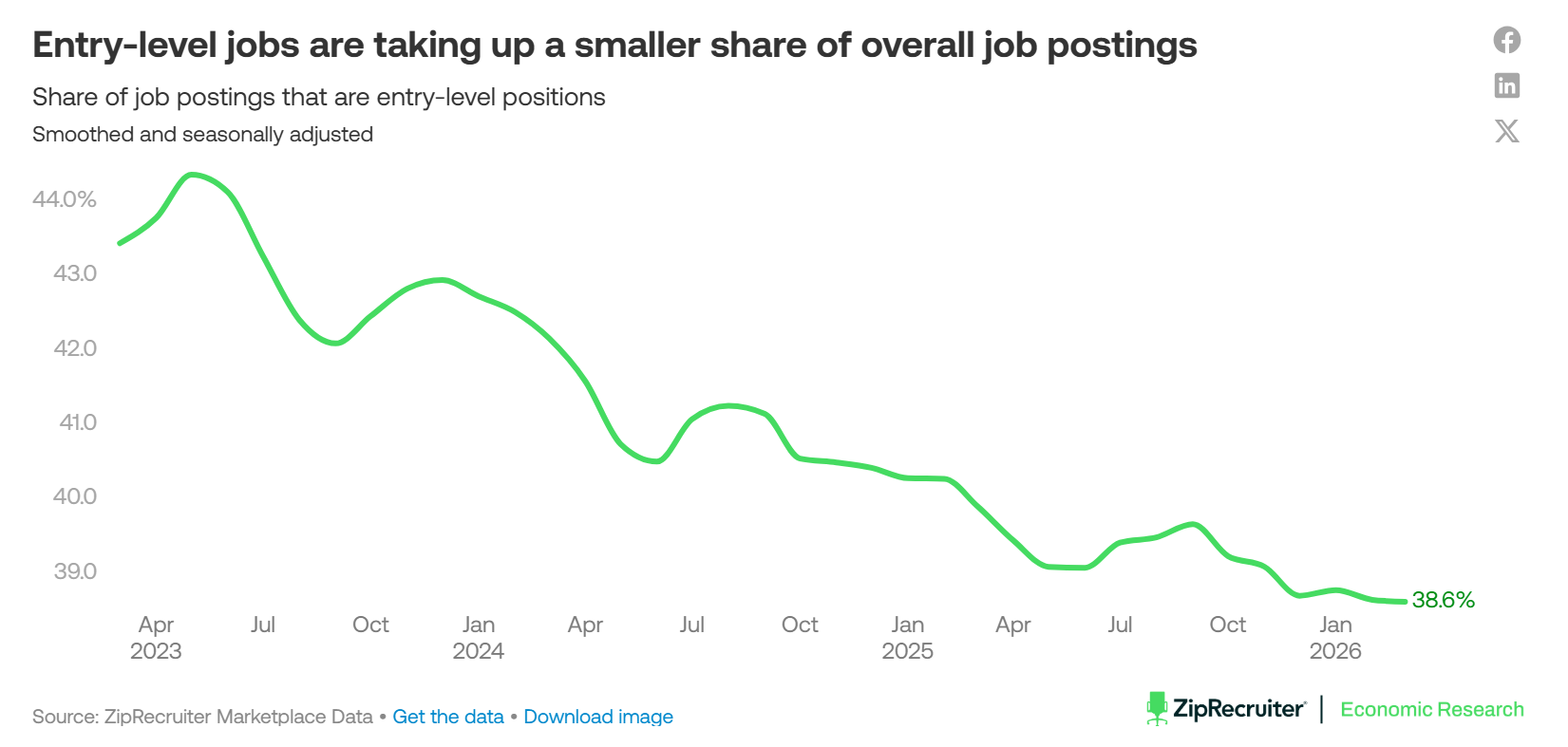
ZipRecruiter’s 2026 Graduate Report reveals that today’s grads face even steeper competition than previous years, with entry-level positions making up a smaller share of jobs – and attracting more interest. “Grads fear AI is limiting entry-level jobs, and most schools aren’t preparing them for it,” the report’s authors write.
And, while recent graduates are landing jobs faster (77.2% within three months), this is attributed to “determination and adaptability”: submitting more applications, applying for different kinds of jobs, and taking on different types of work to get a foothold.
“Despite working harder and securing roles faster, only one in four grads is on their dream career path,” the report states.
Anthropic CEO Dario Amodei warned last year that half of entry-level white-collar jobs could disappear because of AI, and spike unemployment to 10-20% over the next one to five years. That’s scary stuff, and while Amodei plainly has expertise in AI, there is a clear interest in advancing certain narratives.
The point is made with the following quote tweet about Microsoft AI CEO Mustafa Suleyman’s claims about white-collar work being fully automated:
In fact, Anthropic’s own research seemingly takes another stance – or, at the very least, suggests that the signs have not been seen quite yet.
In their economic research paper, Labor market impacts of AI: A new measure and early evidence, the company writes: “We present a new framework for understanding AI’s labor market impacts, and test it against early data, finding limited evidence (based on their own research paper) that AI has affected employment to date.” .
But they do go on to say that the impacts of AI might be less like COVID – that is to say, immediately felt – and more like “the internet or trade with China”.
“The effects may not be immediately clear from aggregate unemployment data; factors like trade policy and the business cycle could cloud interpretations of trend lines,” Anthropic wrote.
Himanshu’s framing that it is tasks, not jobs, that are going away, appears to have merit.
The International Labour Organization wrote in a 2025 update to their generative AI and jobs research brief: “One in four workers across the world are in an occupation with some degree of GenAI exposure, but because of the continued need for human input, most jobs will be transformed rather than made redundant.”
They add that there is a need to make sure that the transition is managed through “social dialogue, to enhance both working conditions and productivity”.
Additionally, according to a report by the Strada Institute for the Future of Work: “Employers indicate that AI tools are more likely to increase than reduce entry-level hiring in their organization. Nearly three times (2.7 times) as many senior talent leaders expect AI use to increase entry-level hiring in 2026 as to decrease it, indicating a mixed and often positive near-term outlook.”
They added that greater use of AI is the “most frequently cited significant positive driver” of increased entry-level hiring.
And, according to the World Economic Forum Future of Jobs Report 2025, job disruption will “equate to 22% of jobs by 2030, with 170 million new roles set to be created and 92 million displaced, resulting in a net increase of 78 million jobs”.
The report, which draws on data from more than 1,000 companies, found that technology skills in AI, big data, and cybersecurity are expected to see rapid growth in demand, but human skills, like creative thinking, resilience, flexibility, and agility, will remain critical.
“A combination of both skill types will be increasingly crucial in a fast-shifting job market,” the organization says.
Final Thoughts
Nobody knows for certain what the future holds for the job market, but the word of the era appears to be ‘transformation’, not ‘extinction’. At least, that appears to be the case for now. Human skills are still needed. The role of a developer is not simply writing code, but it’s hard to argue against the case that AI has fundamentally changed how developers work.
Himanshu’s advice of “don’t fight it” might have wisdom in it. Those most at risk might not be the people who have roles that AI can’t touch – rather, those who are unwilling to adapt.
But we would also do well to remember the International Labour Organization’s plea to make sure the transition is managed through “social dialogue”. After all, if Amodei’s 10-20% unemployment prediction has a hint of truth to it, the repercussions will be so severe that the consequences are difficult to imagine. And, quite frankly, more than a little frightening.