






Salesforce is having one of those years where two things may be true at once. Its latest earnings showed that revenue was up, Agentforce ARR hit $1.2B, and overall revenue came in at $11.13B, up 13% year-over-year. On paper, this does not look like a company being quietly replaced by AI. The stock market, however, is a lot less convinced.
Salesforce stock is down roughly 37% in 2026, trading near a 52-week low and becoming one of the worst-performing large-cap software stocks of the year – MarketWatch described it as a “record losing streak”. The concern is that if AI agents can do more of the work, what happens to the traditional SaaS model built around seats, subscriptions, and expanding user counts?
But asking “Will AI replace SaaS?” or throwing “SaaSpocalyse” into conversation may be the wrong way of looking at this. Arguably, a better way to observe the situation is that SaaS has reached the top of its current S-curve – the old model is flattening, the next one is forming, and Salesforce is caught in the messy gap between the two.
The Old Curve and the New One
As most are aware, the reason Salesforce’s stock has struggled so badly this year is that investors are questioning whether the traditional SaaS model can survive an AI-first world.
In May, Bank of America reinstated Salesforce with an Underperform rating and a $160 price target, describing the current climate as an “AI-driven structural reset”. The firm’s concern is that AI agents could eventually reduce the number of people interacting directly with the enterprise software. If fewer people need to log into applications to complete work, the thinking goes, then the per-seat licensing model that has powered SaaS growth for decades comes under some pressure.
It’s very important to remember, however, that Salesforce is far from alone. Across the entire software industry, investors are wrestling with the same question.
Oracle has spent aggressively on AI infrastructure while cutting thousands of jobs and warning that AI could lead to even more workforce reductions. Meanwhile, Microsoft is investing billions into AI models, data centers, and cloud infrastructure while facing mounting pressure to prove those investments will generate meaningful returns.
Even ServiceNow – often seen as one of the strongest AI stories in enterprise software – remains well below its recent highs despite continuing to position itself as “a platform for autonomous work”.
All of this current uncertainty is what makes the notion of an S-curve more important. In essence, most technologies follow a pattern where adoption may start slowly, accelerate rapidly as the market matures, and eventually begin to flatten as growth becomes harder to sustain. At that point, investors often become nervous because the next wave of growth has not fully arrived yet.
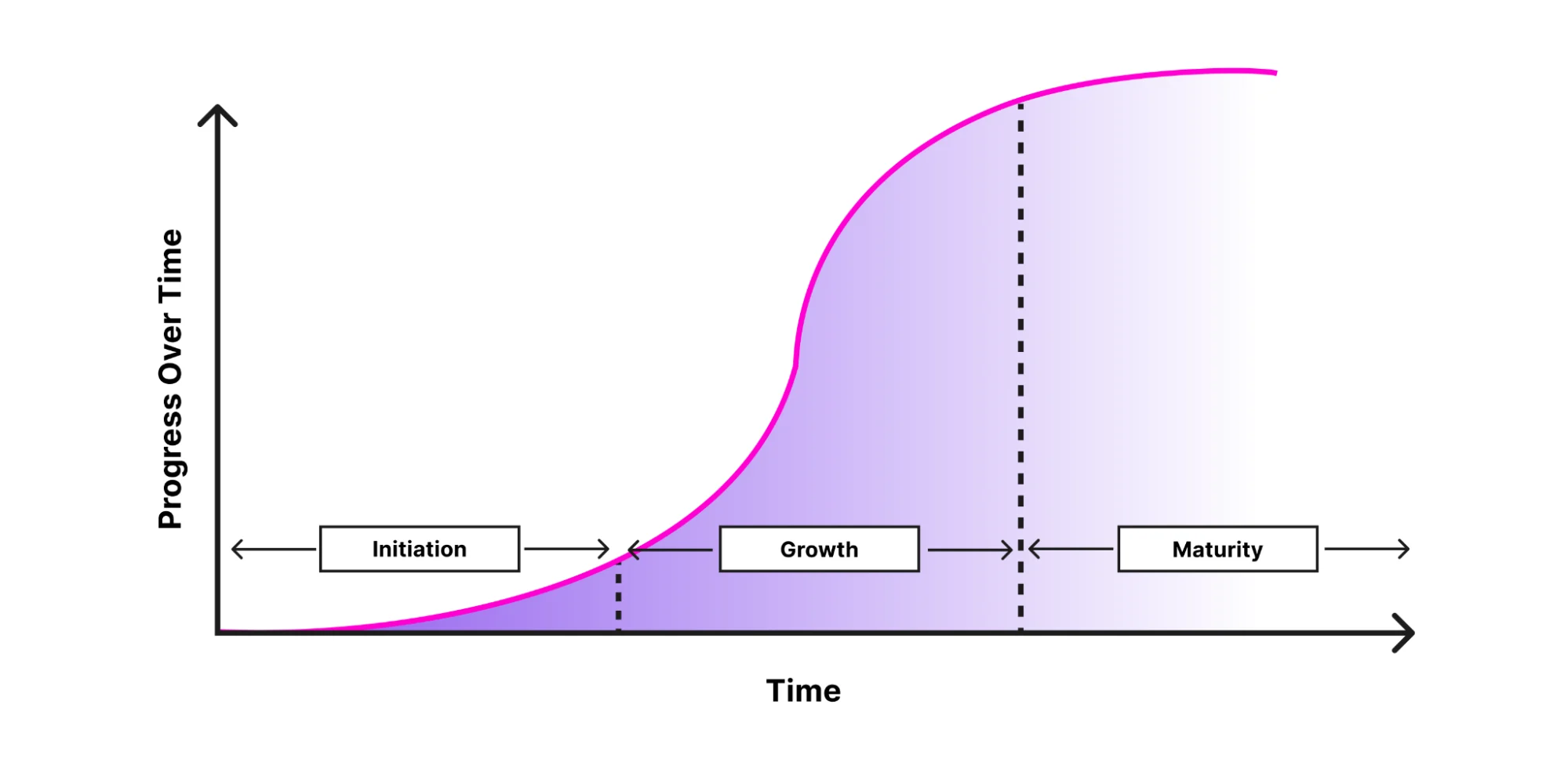
The transition from on-premise software to cloud computing followed a very similar pattern. Growth in traditional software slowed, uncertainty increased, and many questioned whether businesses would trust critical systems to the cloud. The next curve eventually arrived, and companies like Salesforce benefited hugely.
This appears to be where SaaS finds itself today. The market is acting as though slower growth must mean the model is broken, but Salesforce’s recent numbers counter that. As mentioned, Agentforce ARR surpassed the billion mark, AI and Data Cloud products also generated more than $2.9B in ARR, and seven of Salesforce’s ten largest deals last quarter included seat expansion.
“This isn’t Salesforce’s first rodeo. The company that invented enterprise cloud doesn’t get disrupted by the next platform shift, it sells it.”
Ben McCarthy, Founder and CEO, SF Ben
The old curve may be slowing down, but customers are continuing to buy software while also investing in AI – both can happen at the same time. So rather than a full collapse taking place, it looks as though the market is attempting to navigate between one technology curve and the next.
As Founder and CEO of SF Ben, Ben McCarthy, puts it: “Every S-curve flattens before the next one lifts. We’re in the gap. The gap always feels like the end, and it never is.”
Salesforce Might Be Better Positioned Than People Think
The “AI replacing SaaS” narrative assumes that the winners of the next era will be the AI labs and startups rather than the software companies that came before them, but history suggests that’s extremely unlikely.
This is because the AI opportunity is simply too large to be captured by a handful of model providers. While companies such as OpenAI, Anthropic, and Google can provide an intelligence layer, businesses still need a moat – somewhere to store their data, manage their customer relationships, enforce security policies, and so on. And where better to do that than Salesforce?
For more than two decades, Salesforce has been convincing enterprises to centralize customer data in the cloud. Today, that data is one of the most valuable assets a company can own.
AI agents can only be effective if they have access to accurate information and clear instructions about what they can and cannot do, and as we know, Salesforce provides that moat for its customers.
“Salesforce spent two decades convincing enterprises to move their data to the cloud. AI agents are worthless without exactly that data. Read that again.”
Ben McCarthy, Founder and CEO, SF Ben
This is also why Marc Benioff has repeatedly pushed back against the idea that businesses will simply “vibe code” their way to replacing enterprise software. I’m sure building a prototype may be straightforward enough, but besides the obvious dangers of vibe coding anything right now, replicating decades of controls, frameworks, integrations, and so on, is considerably harder to pull off.
“The AI pie is too big to be carved up by three labs and a handful of startups. The incumbents with the data, the distribution, and the trust get a seat at that table, and Salesforce has all three,” argued Ben.
The behaviour of Salesforce professionals also appears to support this view. According to SF Ben’s 2026 Admin and 2025 Developer surveys, a lot of admins use AI daily or regularly (43.6%), and have noticed productivity gains (91%). Developers are further ahead, with around 90% using AI in some form.
This does not automatically translate to Salesforce pros abandoning the platform, however. More than 71% of admins are not using vibe-coding tools, while 88.4% of developers continue to work with a combination of clicks and code. It looks as though the evidence points to augmentation rather than replacement.
In essence, AI may continue to change the work, but unlikely to remove the need for people overseeing it. Likewise for Salesforce, AI may have its say on the business model, but won’t remove the need for the platform underneath to bring it together.
Final Thoughts
Recently, I was in a pub when a friend asked me what he should do with his Salesforce stock. He’d seen the share price fall, read some headlines around AI, and was understandably wondering whether it was time to cut his losses. It was the first time someone outside the Salesforce ecosystem had asked for an opinion on the company, and it made me realize just how widespread the narrative around AI replacing SaaS has become.
The more I thought about it, though, the more simplistic the real narrative felt. AI is undoubtedly changing Salesforce and the wider software industry, but it’s very different from just replacing SaaS altogether.
While vibe coding is impressive and will no doubt continue to apply pressure on enterprise software, there’s still a huge gap between building an application and replacing a platform entirely.
That’s why I believe the market may be confusing a transition with a collapse – so I told him to stick with it. The winners of the next curve will be those who learn how to work alongside AI rather than compete with it, and Salesforce looks better positioned than many people currently give credit for.