

ServiceNow has just hit a significant milestone – $1B in AI revenue ACV (Annual Contract Value). This comes after the company disclosed its Q2 2026 financial results, which also saw 24% revenue growth and a strong renewal rate.
This also comes just two months after Salesforce’s Agentforce hit $1B in revenue as well, indicating that the two companies still appear to be in fierce competition. However, does this achievement from ServiceNow mean that Salesforce should be worrying about its own metrics?
The Growth Stories of Salesforce and ServiceNow
The rivalry between software competitors Salesforce and ServiceNow is not a new one. ServiceNow, primarily known as an ITSM (IT Service Management) provider, is only a few years younger than Salesforce, having been founded in 2003, but for many years, it had largely sat on the periphery of the market. That changed in early 2025, when the company declared itself a CRM, placing it directly into Salesforce’s playing field.
Since then, it has not been uncommon to see the two pitted up against each other or in the same headline. Although their product offerings do differ, and their customer bases are scattered across different verticals, the Venn Diagram of their markets has slowly become more intertwined.
Both companies have poached talent, stepped into each other’s territories, and have seen their stocks rise and crash, sometimes simultaneously. At the time of writing, both stocks have performed similarly year-to-date, with Salesforce stock down 35.47% and ServiceNow stock down 33.01%.
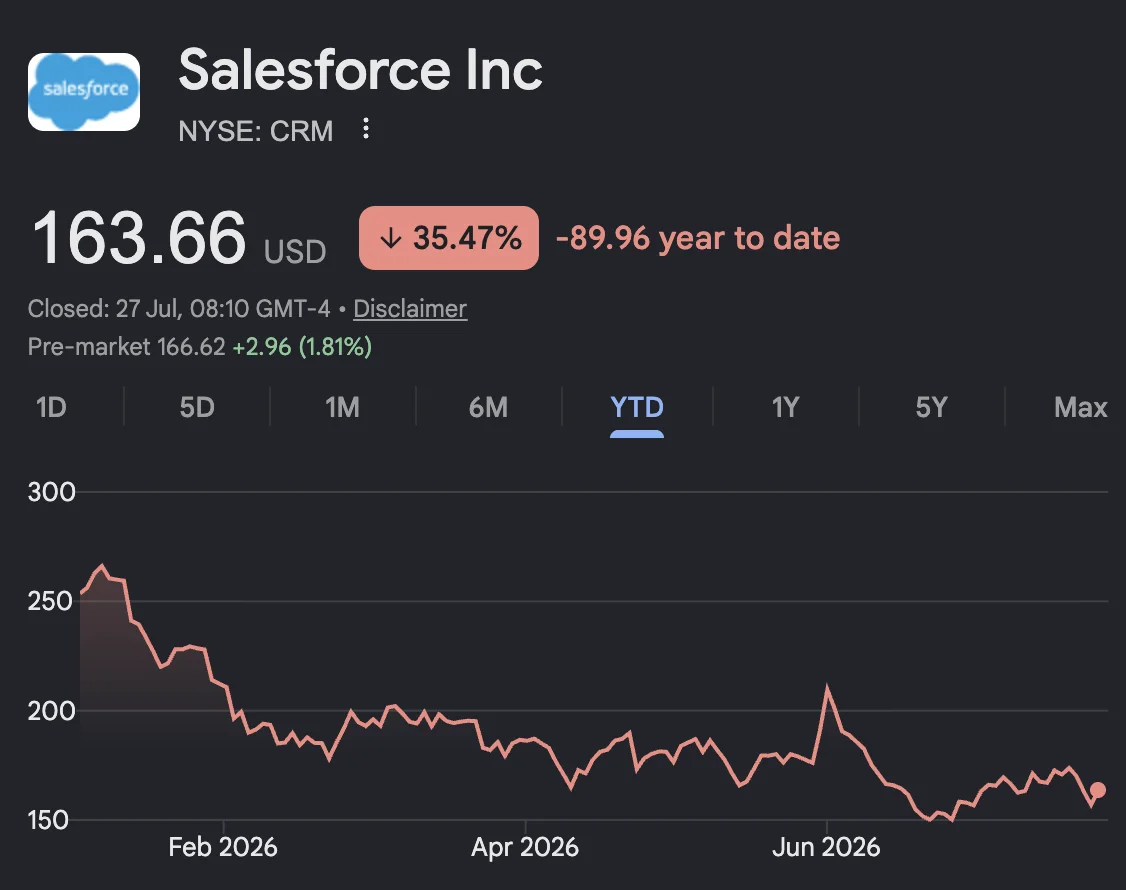
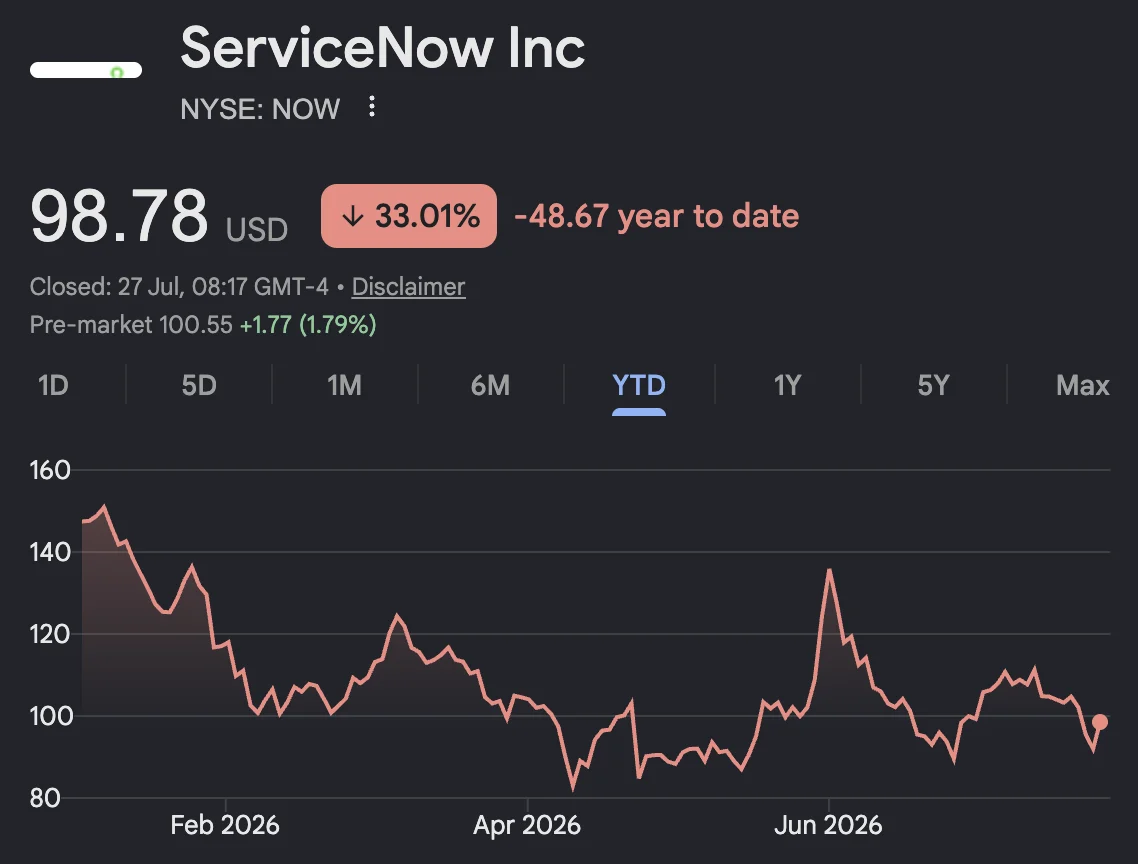
Not only that, but the two have also been battling it out when it comes to their AI offerings. ServiceNow’s AI platform and Salesforce’s Agentforce come with their own unique strengths and weaknesses, with both their customers and Wall Street holding mixed opinions. But it now appears that the AI software market is much cosier than perhaps originally thought.
ITSM vs. CRM
Before diving into the specific AI metrics of these two companies, it’s important to understand their individual turfs and where they overlap. As aforementioned, at the beginning of last year, ServiceNow made the official step into CRM territory, adding a new player to the long-standing field of tech titans like Salesforce, Oracle, and Microsoft. Toward the end of last year, Salesforce also made the step into the neighbouring ITSM territory with the release of Agentforce IT Service.
At the time of its release, Kishan Chetan, EVP & GM, Service Cloud at Salesforce, said that the company would be “running into” ServiceNow with this innovation, but that they felt confident in the product’s abilities and general market demand.
Agentforce IT Service and ServiceNow ITSM both manage incidents, requests, problems, and changes using automation and AI. The main difference is that ServiceNow offers a mature, broad ITSM ecosystem built around ITIL workflows, while Agentforce IT Service is newer, more conversational and agent-focused, with tighter integration into Salesforce, Slack, and existing customer data.
AI Offerings Go Head to Head
Now, let’s take a look at how both Salesforce’s and ServiceNow’s AI offerings have actually been performing.
ServiceNow’s Now Assist, its primary AI offering, was launched in late 2023, integrating generative AI capabilities across IT Service Management (ITSM), Customer Service Management (CSM), HR Service Delivery (HRSD), and Creator workflows within the Now Platform Vancouver release. Salesforce’s Agentforce was unveiled in late 2024, enabling organizations to build and manage autonomous agents for tasks across various business departments.
Since then, the two offerings have grown, adapted, and learned from certain mistakes, adjusting to the demands of their customers, investors, and Wall Street alike.
ARR vs. ACV
It must be noted that Salesforce reports on its AI growth in terms of ARR, and ServiceNow reports on its AI growth in terms of ACV. ACV measures the average annual revenue per customer contract, while ARR measures the total predictable recurring revenue for the company annually.
For this article, I am referring to ServiceNow’s ACV, which encompasses the specific revenue upsell or price premiums (often 20% to 30% price increases) tied strictly to its AI products. This means that if every customer using ServiceNow’s AI capabilities stayed for exactly the next 12 months, that AI software footprint alone would generate $1B – it is the total for its entire AI portfolio.
Traditionally, while ARR would technically make sense here, large enterprise software companies often prefer aggregate ACV for product-line milestones due to how enterprise purchasing works. And in this scenario, tracking AI portfolio contract value like this shows how ServiceNow’s AI customer base has collectively committed to paying $1B per year specifically for its AI capabilities.
It may seem like ARR and ACV cannot traditionally be compared, but in this instance, it is reflective of the progress the two software companies have made in terms of their AI achievements. To hit the $1B figure – in ARR or ACV – remains significant, and we’ll dive deeper into how the two got there now.
The Figures
Agentforce had a rocky start, with Salesforce finding it difficult to prove the product’s value, but the ARR trajectory has seen an upward trend. In February 2025, Salesforce reported a Data Cloud and AI ARR of $900M, of which Agentforce is a part. In May 2025, Data Cloud and AI ARR hit $1B, and then in September of the same year, it hit $1.2B.
Agentforce’s specific ARR has also increased, climbing from $500M in December 2025 to $800M in February 2026, before hitting $1B in May.
Now Assist has been notably harder to track, as ServiceNow has not typically disclosed standalone Now Assist ARR or ACV figures. By mid-2025, ServiceNow said it was on track to reach $1B ACV during 2026, and by the end of 2025, Now Assist had surpassed $600M ACV. In Q1 2026, external reports suggested that ACV had surpassed $750M, although the earnings release itself focused on customer and deal growth. Then this month, ServiceNow AI as a whole crossed $1B in ACV.
What Does This Mean?
If we look at the metrics alone, Salesforce appears to have reached $1B in Agentforce ARR around 15 months faster than ServiceNow’s AI portfolio reached $1B in ACV, although the companies use different metrics and product scopes. This is perhaps to be expected with the differences in market dominance, but it doesn’t illustrate the timelines in enough detail.
By May 2025, Data Cloud and AI ARR for Salesforce had hit $1B, over a year before ServiceNow’s comparable AI portfolio metric had done the same. This does signify that Salesforce is perhaps in a better AI position than its competitor, but the fact that ServiceNow was able to hit $1B ACV for its AI portfolio within three years is still a significant milestone for the ITSM leader.
However, it is unlikely that this will stoke any real concern in Salesforce. The two remain unique offerings within their markets, and it appears that Wall Street doesn’t necessarily trust one over the other anyway. The competition continues; let the innovations follow suit.
Final Thoughts
Salesforce and ServiceNow continue to battle it out on multiple fronts – CRM, ITSM, and AI capabilities.
By the end of this year, we should get an even clearer picture of how the two are faring against each other, especially after the announcements at Dreamforce.