

Salesforce entered its Q1 FY27 earnings call under more pressure than usual. While much of the software market has rebounded from this year’s AI-driven selloff, Salesforce stock has struggled to recover, with investors such as Bank of America questioning whether the company can turn its aggressive Agentforce push into durable long-term growth.
Concerns around slowing SaaS expansions (also known as the ‘SaaSpocalyse’), AI disruption, and uneven customer adoption have continued to follow the company into this year, making this quarter less about hype and more about proof.
But Salesforce ended the quarter with stronger numbers than many expected. The company reported $11.13B in revenue – up 13% year-over-year (Y/Y) – while Agentforce surpassed the $1B mark for the first time.
Salesforce CEO Marc Benioff leaned heavily into usage metrics throughout the call, revealing that Salesforce customers have now processed 28.6 trillion tokens and generated 3.8 billion Agentic Work Units (AWUs), Salesforce’s metric for measuring work completed by AI agents.
Alongside some new, fresh customer case studies from companies like PenFed and UCLA Health, Salesforce used the quarter to show that Agentforce may finally be moving into real operational development. But will Wall Street buy it?
Salesforce Q1 Results in Full
Salesforce’s headline Q1 FY27 numbers gave the company plenty to shout about amid ongoing questions around its AI strategy and broader growth strategy. Meanwhile, revenue came in at $11.13B, up 13% year-over-year and 12% in constant currency (C/C).
The CRM giant also posted a non-GAAP operating margin of 34.8%, up 250 basis points Y/Y, alongside a GAAP operating margin of 21.1%, up 130 basis points. Operating cash flow reached $6.7B during the quarter, continuing Salesforce’s recent focus on profitability and operational efficiency alongside growth.
Robin Washington, Salesforce’s Chief Operating and Financial Officer, described the results as evidence that the company’s “durable growth drivers” are beginning to show through financially, particularly across Salesforce Cloud, Service Cloud, Slack, Agentforce, and Data 360.
She also stressed that more than 60% of key net-new ACV during the quarter came from Sales, Service, and Slack products, which Salesforce increasingly sees as the core of its “Agentic CRM” strategy.
However, not every part of the business showed the same momentum. Washington noted that while Agentforce, Data 360, and Slack continued to perform strongly, growth was partially softened in Tableau and Commerce, alongside ongoing weakness in parts of the marketing business.
This does then raise questions – potentially to investors – if Salesforce’s AI products are accelerating overall platform growth like they’re hoping for, or potentially causing slower performance elsewhere in their portfolio.
The company also continued leaning heavily into shareholder returns, including a $25B accelerated share repurchase program during the quarter, representing half of Salesforce’s newly authorized $50B buyback program.
According to Salesforce, this helped reduce diluted share count by 10% Y/Y.
Agentforce Crosses the $1B ARR Mark
The biggest talking point from Salesforce’s Q1 results was Agentforce crossing the $1B ARR threshold for the first time. After reporting Agentforce ARR of $540M in Q3 and $800M in Q4, Salesforce is now using the latest quarter to truly showcase that its AI strategy is scaling meaningfully.
Combined with Data 360 and Informatica Cloud, Salesforce said its AI and data ARR has now reached $3.4B. Marc Benioff described agentic AI as “the biggest growth opportunity for our customers and for us at Salesforce”, while repeatedly emphasizing that Agentforce is actively being embedded across customer 360 applications.
Usage metrics were again a major focus point. Salesforce revealed that customers have now processed 28.6 trillion tokens – up a monstrous 152% quarter-over-quarter (Q/Q) – which the company says have been converted into 3.8 billion Agentic Work Units (AWUs). According to the company, AWUs grew 111% Q/Q.
This is massively important given that Agentforce has spent much of the last year facing criticism and subsequent skepticism around how deeply customers are actually deploying it. Earlier Salesforce figures showed strong early traction among large enterprises, but also suggested that overall penetration across Salesforce’s wider customer base remained relatively limited. Much of the debate was not whether Agentforce had momentum, but whether adoption was more concentrated among a relatively small group of major customers running pilots.
Salesforce was driven to challenge that narrative in this earnings call. Washington said Agentforce customers are expanding spend across the wider Salesforce ecosystem, while more than 50% of Agentforce and Data 360 bookings during the quarter came from existing customers expanding deployments.
Salesforce also revealed that its top ten customers had increased their total AWU usage sales spend by 1.5x in the last year.
Benioff also used the call to position Salesforce itself as one of Agentforce’s biggest proof points, telling analysts that the company is “using it ourselves more than ever before” and adding: “In every aspect of my business, agents are transforming how I operate my business.”
In short, Salesforce wants investors to view Agentforce as meaningful and monetizable, which contributes to the ecosystem as a whole – and now, it has the figures to back it up.
Slack Is Becoming More Central to Salesforce’s AI Strategy
Salesforce has spent the last few months putting Slack much closer to its AI strategy, steadily introducing new AI capabilities while positioning the platform as increasingly critical to the company’s future.
This was made very visible in the earnings call, with Benioff revealing that Slack was involved in nearly half of Salesforce’s million-dollar-plus wins during the quarter, up 80% year-over-year. Benioff also described Slack as the operational layer increasingly powering AI-native businesses, specifically naming OpenAI and Anthropic among the companies using the platform.
“In two years there will be more agents using Slack than people,” Benioff said during the earnings call – one of several comments aimed at reinforcing the growing role of Slack within Salesforce’s strategy.
This messaging is important because one of the biggest questions surrounding enterprise AI adoption is whether the agents that are getting built by companies can actually operate inside day-to-day workflows, and Salesforce seemingly appears to believe the answer to this is Slack.
The company also continued highlighting deeper integration between Slack, Agentforce, and the wider Salesforce platform. Benioff pointed to Slackbot acting as an MCP client capable of interacting with external systems like Jira, while Washington named Slack alongside Sales Cloud and Service Cloud as one of Salesforce’s biggest growth drivers during the quarter.
The strategy also strengthens Salesforce’s wider argument that Agentforce is not being positioned as a standalone AI product. Instead, Salesforce is increasingly presenting Slack, Data 360, and Agentforce as connected parts of a larger “agentic CRM” platform designed to sit closer to where work actually happens.
How Did Markets Respond?
Despite the strong quarter on paper, Wall Street still appeared unconvinced.
Salesforce stock has seen a volatile start to trading today, with investors seemingly unable to make up their minds on the company’s latest results. After opening at $178.43, the stock briefly fell to a low of $171.65 before sharply rebounding to around $178.45 – putting it back above its previous close of $177.51 and into positive territory for the day.
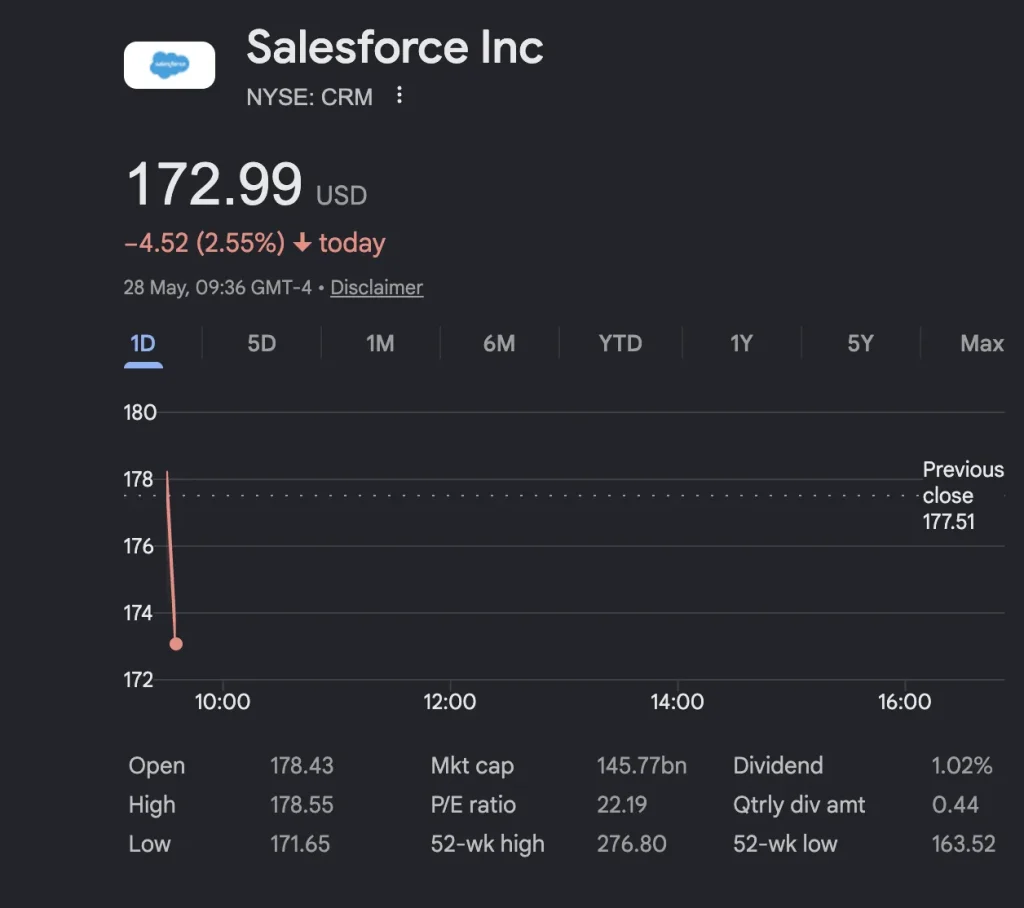
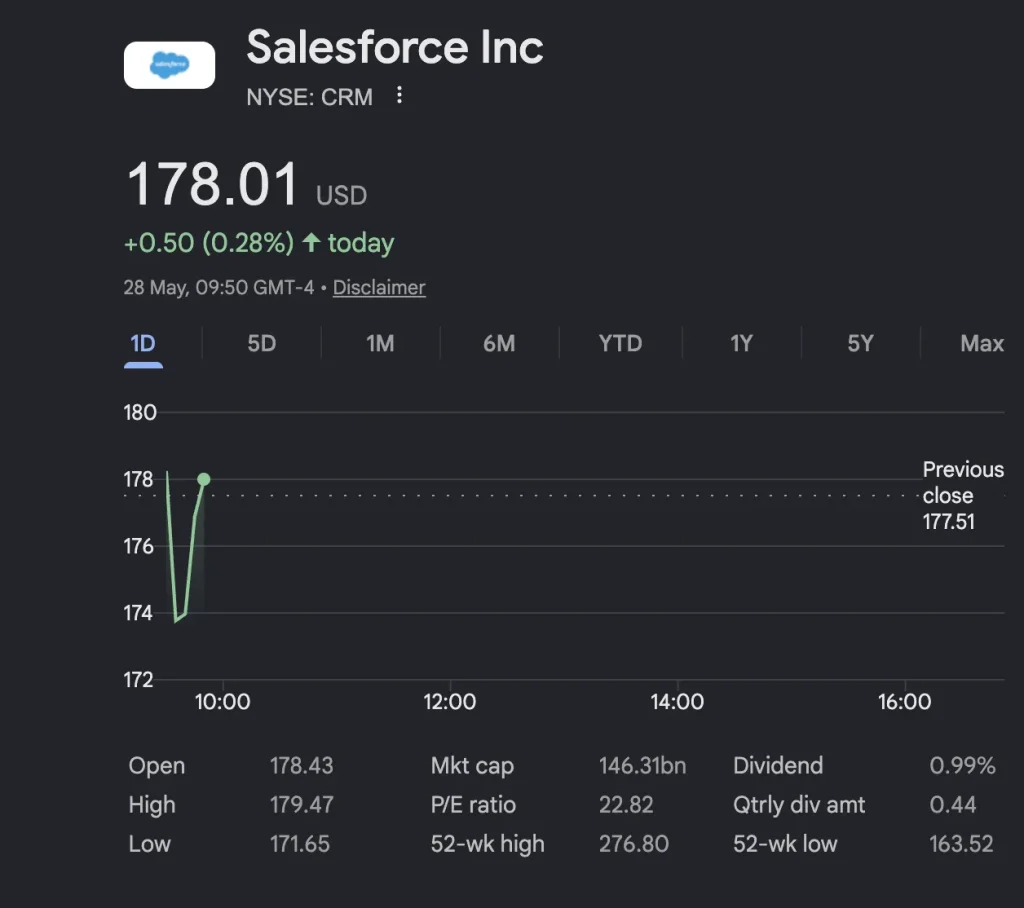
Much of the reaction seems to center less on the quarter itself and more on investor concerns around what comes next. Salesforce’s slightly weaker-than-expected revenue outlook for the current quarter, remaining performance obligations (RPO), and continued struggle with Tableau and Commerce appear to have tempered enthusiasm around the otherwise strong Agentforce momentum swing.
More broadly, it’s no secret that Salesforce is also being pulled into the wider uncertainty currently surrounding the SaaS market. Investors are increasingly questioning how AI agents could reshape enterprises, particularly for larger vendors that still heavily rely on seat-based licensing and cloud expansion growth.
This reaction is not unique to Salesforce, with ServiceNow also experiencing a fall in share after recently reporting strong earnings. They also beat expectations and raised guidance, but investors seemed more focused on the long-term AI disruption risks.
Snowflake, however, received a far more positive response after posting stronger AI and data-related growth, suggesting that the market is still willing to reward software companies even when the AI monetization story feels clearer and more immediate.
Final Thoughts
So the Q1 results feel like a very important quarter in the wider Agentforce story. For the last year, much of the conversation around Salesforce AI in general centered around skepticism, but things are starting to feel a little different.
Crossing $1B in Agentforce ARR gives Salesforce a much stronger story to tell, especially alongside the sharp growth in tokens, AWUs, and customer case studies presented throughout the call. At the same time, Salesforce still has some work to do to convince investors that the AI momentum can translate into longer-term platform growth, particularly as other parts of the business are seemingly facing more pressure.
But as the company continues to reshape its entire platform around AI agents and workflows between Slack, Data 360, Headless 360, and Customer 360, this is a strong showing for the CRM giant.