






Anthropic’s AI models are the reason businesses are vibe-coding their own software instead of buying it from companies like Salesforce. At least, that’s how the theory goes.
Is it then a little ironic that Anthropic is now looking to hire a Salesforce Developer, expanding its footprint with the CRM? ‘Ironic’ might not be the word, for (non-pedantic, I promise) reasons I’ll explain in this article, but it’s certainly telling of more of a symbiotic relationship between SaaS and AI than some cynics might claim. So, let’s examine why.
What Salesforce Role Is Anthropic Hiring for?
Anthropic posted an advertisement for a $270,000 USD Salesforce Developer, Partnerships role at the company. The winning candidate will design, build, and maintain the Salesforce platform which powers Anthropic’s Partnerships business.
Perhaps unsurprisingly, Anthropic says in the advertisement that they are an “AI-first systems team”, and the successful candidate will be “expected to use Claude and our in-house AI development tooling as a core part of how you write, review, and ship code”.
This means using Claude as a coding assistant to speed up Salesforce development – not outright replacing the platform itself.
The AI company also caused a bit of a buzz earlier this year when it advertised for a $190,000 USD Salesforce Administrator role, where the successful candidate would “build and maintain world-class CRM systems” for their Go-To-Market (GTM) team.
This came as CEO of one of Europe’s most valuable AI companies, Arthur Mensch, made headlines by claiming that “more than half of what’s currently being bought by IT in terms of SaaS is going to shift to AI”. As I wrote at the time, the CEO of an AI company has a vested interest in making such claims – but the idea of AI replacing white-collar work certainly has some merit to it.
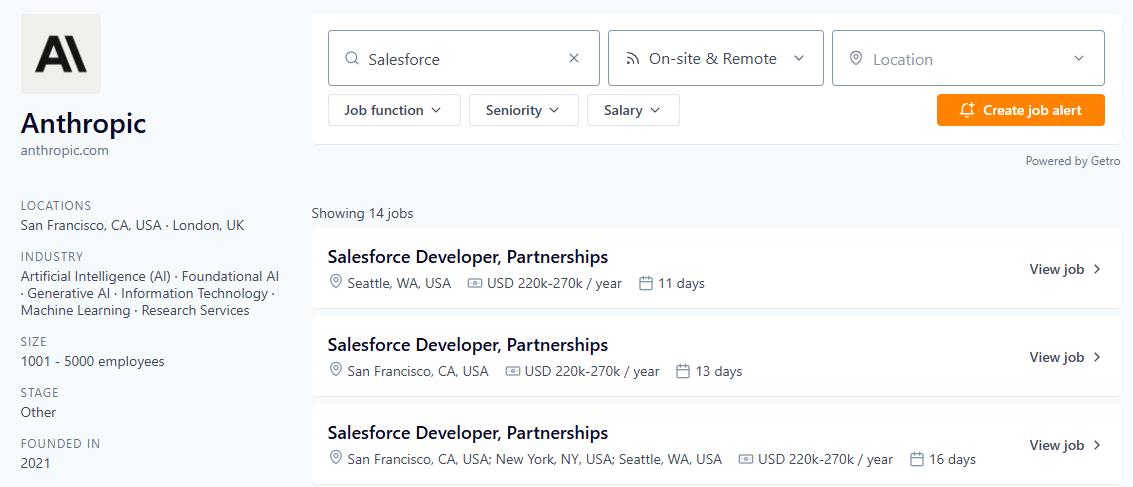
But the Salesforce Admin job posting also raised questions around claims that AI would replace SaaS. The argument goes: if AI is going to replace SaaS, then why do the AI-makers themselves use SaaS products – when they would seemingly be the very first ones to vibe-code their own solutions?
One Salesforce Admin role being advertised was an anecdote, but Anthropic is widening its Salesforce footprint now. The plural of anecdote is not data, as any STEM graduate reading this will probably rush to say, but it is still telling that Anthropic is still investing in its Salesforce stack.
Has the SaaSpocalypse Been Called Off?
Over the last year or so, technology giants like Salesforce and ServiceNow have been battling narratives of the so-called ‘SaaSpocalypse’, where legacy software vendors will supposedly have their solutions vibe-coded out of existence by AI tools. After all, why pay for Salesforce when you can just build your own CRM in-house?
My colleague Sasha Semjonova covered this ongoing debate recently in her article, Salesforce SMB Customers Switch to Vibe-Coded CRMs. In it, she addresses claims that several smaller businesses have already started turning their backs on SaaS providers in favor of vibe-coded solutions using AI tools including Claude. Some firms saw software costs lowered by 40% to 80% by doing this.
Anthropic is the company that is perhaps best positioned, technically and philosophically, to prove that the SaaSpocalypse is real by vibe-coding its own – well, everything. But therein lies the problem with this idea.
Firstly, it isn’t doing that. Anthropic being a Salesforce customer goes some way towards making the point that AI has not (yet) brought about the end of SaaS.
Secondly, let’s suppose that Anthropic could vibe-code its own CRM, and wants to do that. Once again, opportunity costs come knocking. Doing so would mean diverting resources away from other, more important tasks.
The second point is particularly relevant to SMBs as well. Whether you’re Anthropic or a fresh young startup, you’re going to have to maintain your vibe-coded CRM. That’s a drawback, whatever size your business is.
If the SaaSpocalypse is real, then it certainly hasn’t been called off just because Anthropic would rather pay for a service which it could, theoretically, perform itself. The timeline for its occurrence does appear to have been pushed back a little, though.
Isn’t It Ironic? Not Really
But now it’s time for that examination of the word ‘irony’, which I promised in this article’s introduction.
A little thought experiment for the reader: would it be ‘ironic’ if materials for the first ever motorcar were being transported to the factory by horse and cart? I would say no. In that example, the technology which will replace the horse and cart is not yet widely available enough to be used as part of the infrastructure for creating it.
Bringing it back to our current-day example here: even a titan like Anthropic only has so many resources, and time spent vibe-coding and maintaining its own CRM is time not spent perfecting its own vibe-coding software – which can be used to vibe-code CRMs.
What This Means for SMBs
Small- and medium-sized businesses will no doubt be tempted to vibe-code as much as they can, making as much use of AI tools to focus everything they can into getting their products to market, and competing against other, better established services.
But writing the first version of a CRM with an AI coding assistant is the easy part. The hard part is everything else:
- Security patching
- Data model changes
- Integrations with billing and support tools
- Backups
- Compliance
- Hosting and managing infrastructure capacity and cost
- Onboarding new staff onto a vibe-coded system without extensive documentation
One of the most well-resourced AI companies in the world still finds it worthwhile to hire dedicated Salesforce staff, instead of running its GTM stack on self-built tooling.
An SMB, with considerably less engineering capacity to spare, takes on a much larger burden maintaining a custom-built CRM, long after any initial celebrations about vibe-coding their own version of an expensive product.
The upfront cost of building may well appear like it’s dropped to zero, but the ongoing cost of ownership is not going anywhere.
Another metaphor, if you’ll indulge me: Two people, who are not legal experts, are locked in a legal dispute over finances, and one of them decides to fire their lawyer and represent themselves. What would you think of such a person when they boast that they’ve “drastically cut legal fees” while still managing to have legal representation? You might think something like, you have cut your legal fees for now, but when you lose this legal battle, the bill will outstrip any savings you might have made.
Just a simple thought experiment, for the sake of argument, of course.
Final Thoughts: What This Means for Salesforce
Salesforce can be somewhat reassured by all this. The company whose entire commercial identity is built on AI changing how software gets built is, in reality, not choosing to rebuild its own systems of record from scratch. Why not? Opportunity costs.
Anthropic’s core business is training and shipping frontier AI models and agents that use them. It has only so many engineering hours to spend, and each hour spent on reinventing the CRM wheel is an hour not spent on model capability, safety research, or product development.
Salesforce has solved CRM reliably, at scale. It has a mature ecosystem, partner network, and community, along with a vast hiring pool of people who know the platform extremely well, with certifications and decades of experience to back them up. Up to 90% of Fortune 500 businesses are Salesforce customers.
Anthropic is making the same calculated decision every business has to make, whether it’s “AI-native” or not. Do you buy the time-tested, proven platform at a premium? Or do you build and maintain a bespoke one?




Comments: