

Salesforce careers are in a state of flux. Disruption from AI, a so-called ‘SaaSpocalypse’, a crowded job market, and global instability are all factors in making the life of a typical Salesforce Admin much more complicated than it used to be.
Supply and demand seem radically mismatched for many Salesforce roles at the moment, and people are wondering what the next few years will hold for them if they stay in the ecosystem. So, if current rates continue, what will Salesforce careers look like at the dawn of the next decade?
Salesforce Careers in 2026
Let’s start where we currently are. The 10k Salesforce Talent Ecosystem Report last year revealed some concerning statistics about saturation in the job market. Global talent supply grew by 27% in 2025, following 19% in 2024 and 28% in 2023. Admins were up 47% globally last year – the highest growth among all roles. Simply put: the demand is not there to meet it.
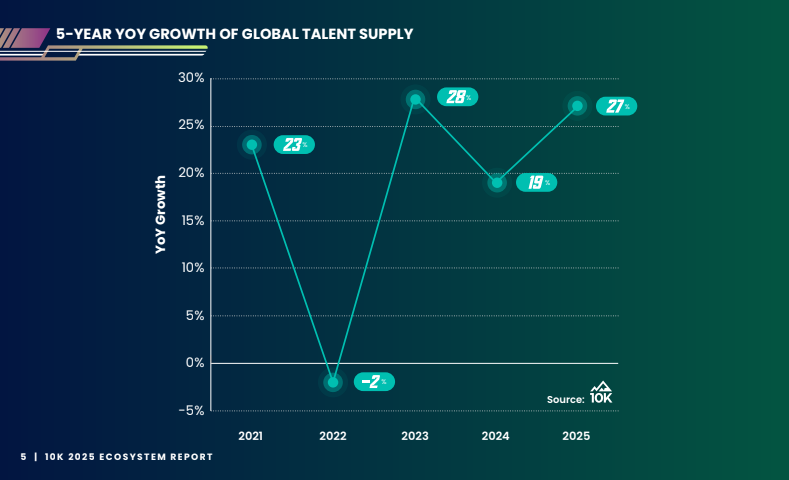
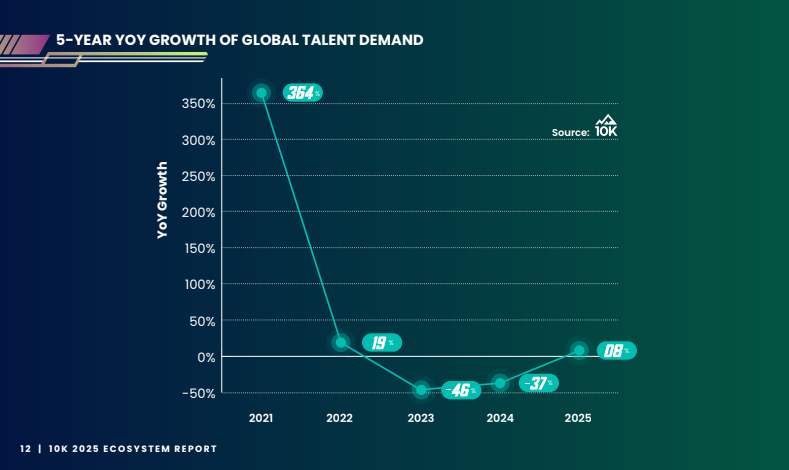
Supply is high – and growing – while demand is low. Demand may have grown by 8% in 2025, but an interesting picture emerges when we look at supply and demand per role.
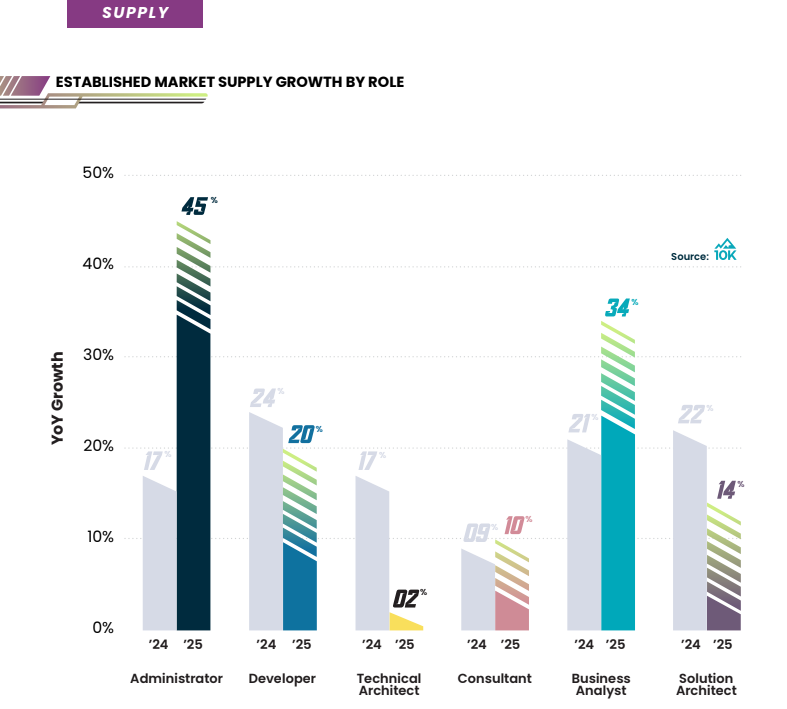
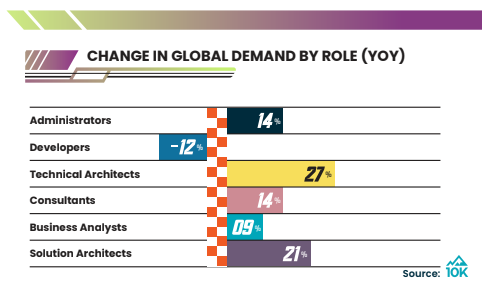
Demand for admins grew by 14%, which is, on the surface, great news. But supply grew by 45%. What that means is a lot of newly qualified Salesforce Admins facing an extremely difficult job market right now.
For developers, it’s also pretty bleak. Supply grew by 20%, but demand actually shrank by 12%. It was the only role to see negative growth in demand. There will be many reasons for this, but AI is the elephant in the room – it’s tough out there when AI tools can write code as quickly and effectively as they can now.
Technical architects, on the other hand, are more needed than ever. Salesforce is 27 years old now, and managing technical sprawl has become an all-encompassing challenge for many businesses. Customer needs are becoming more sophisticated, with project-based expertise and deeper architectural oversight required to ensure scalability, integration, and long-term ROI.
Supply for Technical Architects grew by just 2%, but demand skyrocketed by 27%. This makes it the role with the smallest growth in supply, and the highest growth in demand.
Bearing these trends in mind, what might the future hold?
Table Stakes Are Rising
The COVID boom is over. If you look at the global talent demand growth graphic from the previous subsection, you’ll see 2021 had a 364% spike in demand. Those days are long gone.
Salesforce careers will not disappear by 2030, but simply being able to configure Salesforce screens and automations will no longer be enough.
If you are solely a Salesforce Admin or Salesforce Developer, you might want to consider branching out into the worlds of data, Agentforce, governance, or business domain knowledge. For Salesforce Administrators, tasks like routine setup, troubleshooting, reporting, and workflow creation will be heavily assisted by AI. The outlook seems weak for generic admins, unless and until they upgrade their skill sets with something extra.
For developers, AI coding tools have already been compressing basic Apex/LWC/config work – and the results are visible in the above supply and demand data. But the role isn’t going away.
Senior developers – who have been around since the early days of CRM – have told me that, in those early years, they would be asked why they’re working with Salesforce, which, due to its “clicks-not-code” ethos, was “replacing the developer”. That position has been proven wrong, in the fullness of time. Salesforce did not “replace” the developer. In fact, it created many new opportunities for them.
The parallels with AI today are striking, but it’s not an apples-to-apples comparison. We can always look to the past for similar instances of something disruptive happening, and the arguments made at the time.
To put it perhaps somewhat dramatically: people have been predicting the end of the world for millennia – that doesn’t mean that it can’t one day happen, just because those previous predictions were all wrong.
And for job market entrants who only have a certification or two to their name, the outlook going forward looks very weak. The COVID boom days, where employers would seemingly throw money at anyone with the word ‘Salesforce’ in their resumé, are long gone.
A Two-Track Job Market
The job market is already bifurcating. The 27% growth in talent supply vs the meagre 8% growth in job listings leaves supply at around 3.4 times demand. The demand is still there – Salesforce isn’t dead (or dying). It just means that generic Salesforce skills are no longer enough, and employers can afford to be much pickier with who they hire.
Cross-functional roles – technical architects, solution architects, and to some extent consultants – see the strongest demand signals. Traditional entry paths are the weakest. Architects are thriving, while those who are more junior are suffering.
So, going into 2030, we are contending with this simple reality: the ecosystem is bursting with people versed in clicking around in Salesforce – but it’s short of people who can make Salesforce valuable in complex enterprises, which are looking to leverage AI as best they can.
The Agentforce Question
How have we come this far into the article without a section on Agentforce?
Jokes aside, Agentforce is already becoming a crucial part of Salesforce’s offering – and the company is baking it into its existing portfolio. There may come a time – let’s say, 2030, for the sake of argument – when it isn’t even possible to be paying for a Salesforce product which doesn’t include Agentforce, to some degree.
Salesforce is positioning Agentforce 360 around the Agentforce platform, Data 360 (formerly Data Cloud), Customer 360 apps, and Slack. Salesforce calls this combination the “platform behind the shift” towards the ‘agentic enterprise’.
With the introduction of ‘Agentforce 3’ in June 2025, Salesforce brought in Command Center observability, MCP support, and partner actions through AgentExchange – along with more governance/monitoring features. This is a clear signal that Salesforce expects customers to manage AI agents as operational assets, not just side experiments. How will this affect traditional Salesforce roles by 2030?
Salesforce Admins
Admins will face a lot of pressure. By 2030, a lot of tasks that justify junior Admin positions will be heavily AI-assisted – or automated entirely. Creating fields, building basic Flows, drafting reports, explaining error messages, writing validation rules, and generating documentation can be handled or expedited by AI tools.
But the admin role isn’t going away. By 2030, it might simply become more like a business systems operations role with AI governance elements. A 2030 admin who only knows basic Flow and page layouts will not excel. But those who understand data integrity, security, and Agentforce will be valuable.
Salesforce Developers
Basic Apex and LWC tasks will increasingly be handled by AI tools, weakening the market for junior developers. The introduction of ReactJS and the multi-framework frontend functionality may create opportunities for developers not traditionally part of the Salesforce ecosystem. But code generation is not the only tool in the kit of the skilled dev.
APIs will still need to be designed, workflows will need to be debugged, legacy systems will need managing – as will DevOps pipelines. Besides, all that AI-generated code will need to be reviewed, and agents will need to be managed to make sure they are behaving appropriately.
Like with admins, the Salesforce Developer who can see the bigger picture outside of basic tasks will have more of a future in the ecosystem.
Salesforce Consultants
There will be a squeeze for generic implementation Consultants. You might be sensing a theme – that theme being bad news for those whose skills remain solely within one box. The Consultant is much the same.
If Agentforce and AI tools make configuration faster, customers will not want to pay large teams for extensive build work.
Those who sell desirable outcomes, like reduced case handling time and improved pipeline conversion, along with designing compliant AI operations, will thrive.
Architects
If current rates of supply and demand continue, architects stand to be the biggest winners by 2030. More complexity means more need for architects – and who can really argue at this point that things are becoming less complex in Salesforce?
Having the strategic knowledge to piece together complex individual pieces like Data 360, Slack, Customer 360, and others will be more needed than ever.
This Is All Rather Bullish… What About The Other B-Word?
The other b-word isn’t bearish – it’s ‘bubble’. The above predictions have one assumption baked into them: that there will be no great readjustment in the market surrounding either software-as-a-service (SaaS) or AI.
There is a reason to be bullish on Salesforce. It’s still a global powerhouse, clearly the number one CRM (with no real close competition), and the company is also leveraging itself as the AI layer for customer operations. If they are successful in this positioning, there would be a strong demand for Salesforce professionals.
But if we allow ourselves a touch of skepticism for a moment, AI agents from other providers like ServiceNow, Microsoft, OpenAI-style platforms, or vertical AI vendors that build industry-specific software become the main user experience, while Salesforce simply remains a system of record.
In this scenario, Salesforce jobs would still exist, but would shrink. We might see more generalists like ‘low-code admins’, rather than ‘Salesforce Admins’.
Salesforce professionals have already started branching out into other systems like Microsoft Dynamics and ServiceNow. Rather than seeing people double down on Salesforce, with more certs and Agentforce expertise, they use transferable skills learned through their time in Salesforce to diversify the number of systems they work with – rather than diversifying their skills.
Final Thoughts
In the world of Salesforce, the future seems to belong to those who can branch out from traditional career tracks – away from solely a Salesforce Admin or Developer – and into other areas of expertise.
Stepping away from Salesforce in particular for a moment, we might also wonder if there will be a global reset with AI. The word ‘bubble’ has been thrown around a lot, and comparisons have been drawn to the dotcom bubble of the late 1990s. Whether that’s the case or not is beyond the scope of this article, but it’s always worth bearing in mind that, by 2030, the job market could look a lot worse across the board – not just for Salesforce.