

Salesforce Architects are known for solving complex problems, designing scalable systems, and bridging the gap between technology and business. But what do they really think about their roles, their future, and the skills that matter most?
The SF Ben Salesforce Architect Survey Results 2025, supported by insights from over 600 architects across the globe, lifts the curtain on the trends shaping this critical role. From AI to certifications, team structures to job satisfaction, the survey delivers a comprehensive snapshot of today’s Salesforce Architect landscape. Here are the key insights every Salesforce professional should know…
1. Architects Are Satisfied, but Eyeing the Exit
It may seem paradoxical: nearly 76% of respondents are satisfied with their careers, yet almost 38% are considering leaving the architect role within two years. This disconnect hints at deeper industry turbulence, including uncertainty around AI, shifting Salesforce programs, and growing ecosystem complexity. Architects still love the work, but they’re unsure where it’s headed.

Actionable Insight: Leaders should proactively address these concerns. Career pathways, upskilling opportunities, and clarity on how AI will evolve the architect role are more important than ever.
2. Certifications? Useful, but Not the Whole Story
Salesforce certifications remain a hot topic. While 65.6% of architects hold one or more architect-level certs, 43.3% expressed mixed feelings about their value. Many view them as useful learning tools, but not an accurate reflection of real-world capability.
Why pursue them at all? The top reasons:
- To stand out in the ecosystem (33.5%)
- To build relevant skills (28.6%)
- To validate hands-on experience (23.2%)
Actionable Insight: If you’re early in your career, certifications can build credibility. But don’t stop there. Focus on practical experience, critical thinking, and soft skills.
3. Trailhead Isn’t Enough
Though 88% of respondents use Trailhead, it earned only a 6.6 out of 10 usefulness score among architects. The message? While it’s a helpful starting point, it often lacks the depth and complexity required for high-level architecture.
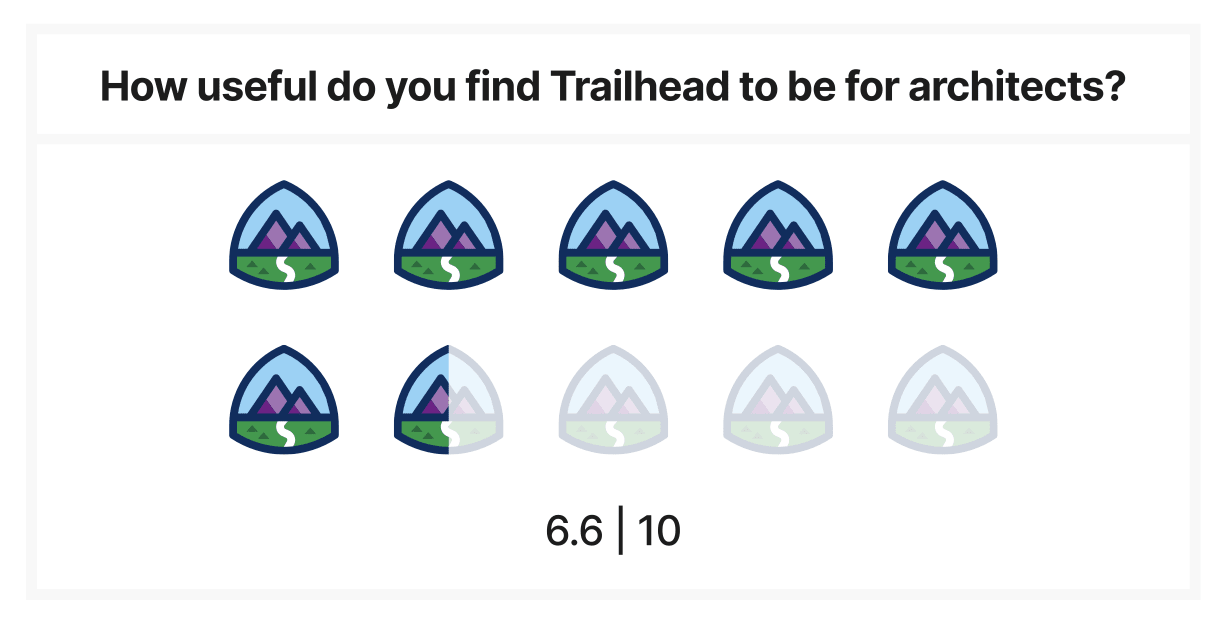
Actionable Insight: Pair Trailhead with deeper learning such as blogs, whitepapers, community events, and real-world experience. And call for more advanced, hands-on architect content from Salesforce.
4. And, What About Well-Architected?
Salesforce Architects are experiencing a significant gap in high-quality, advanced learning resources following the removal of the Well-Architected program (though it is set to relaunch at Dreamforce). While community-led blogs and personal networks offer some support, many architects struggle to find materials that match the complexity and real-world scenarios of their roles. There is a clear call for deeper, industry-specific content, hands-on project-based learning, better collaboration platforms, and access to full-feature dev environments, especially for products like Marketing Cloud and Tableau.
Actionable Insight: Salesforce and its community should prioritize creating architect-level resources that go beyond Trailhead, focusing on enterprise architecture patterns, real-world use cases, and access to full-stack dev tools for all major clouds.
5. Hands-On Experience Beats Everything Else
The #1 strategy for career growth? Gaining more hands-on experience, cited by 37% of respondents. This preference outpaced pursuing certifications, switching roles, or chasing trends.
Over 94% of architects do at least some hands-on work, and most decisions about what to learn next are driven by the requirements of their current job (54.7%) or personal interest (20%).
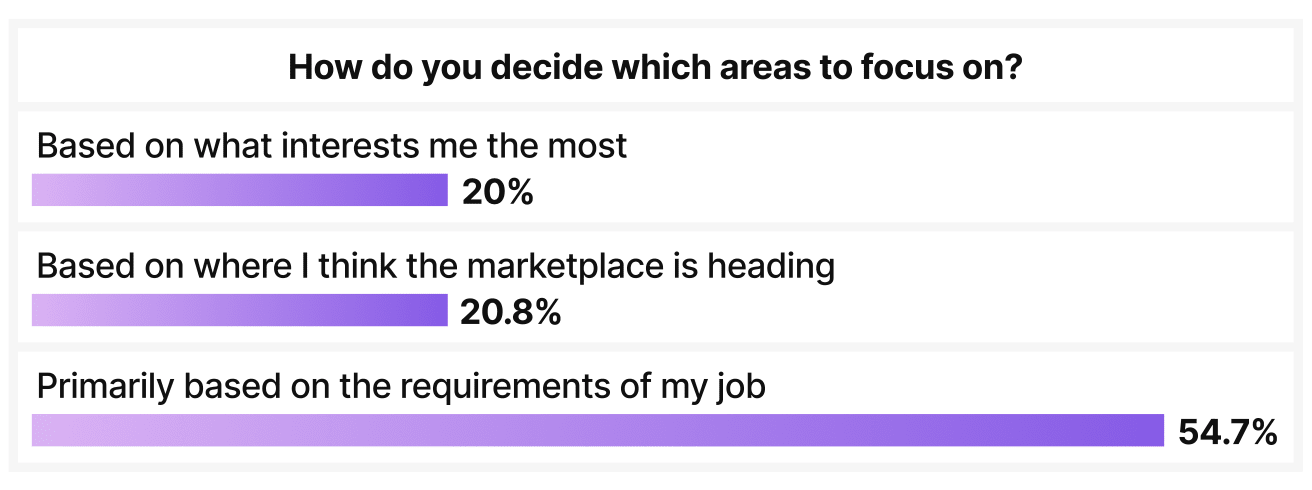
Actionable Insight: Practical experience drives growth. Architects learn by doing, not by watching.
6. The Build vs. Buy Debate Lives On
When solving a need, most architects answered, “It depends.” In fact, 59.7% say they have no strong preference between building and buying; it’s all about context. However, experience level influences opinion. Newer and highly experienced architects lean toward custom builds, while mid-career professionals often prefer AppExchange solutions.
Most architects (40.4%) said they “sometimes” search the AppExchange for solutions before building.
Actionable Insight: Build or buy is not a binary decision. Context, background, and business needs shape every choice.
7. Communication Is the Number One Skill
When asked to rank the most important skill for their role, architects chose communication above all else, even above technical depth. That might surprise some, but it makes perfect sense. Architects need to explain complex systems to diverse stakeholders, from developers to executives.
As Michael Spencer of Desynit said, “Being an architect is sometimes like being a teacher. We have to take complex information and present it in a way that is most easily understood by the audience.”
Actionable Insight: Practice turning tech talk into plain English. Whether it’s a capability map or a solution diagram, clear communication builds trust and influence.
8. Team Structures Are Incredibly Varied
Salesforce teams are not one-size-fits-all. About 33.2% of architects work in developer-heavy teams, often supported by a few admins. This contrasts with the admin-heavy teams reported in our SF Ben Salesforce Administrator Survey Results 2025.
Most common team sizes:
- 10-19 members (25.4%)
- 5-9 members (23.3%)
- 2-4 members (22.9%)
And while 42.5% of architects work for consultancies, an equal 42% are embedded in customer organizations. Interestingly, 71.7% said they’d prefer to work directly for a Salesforce customer.
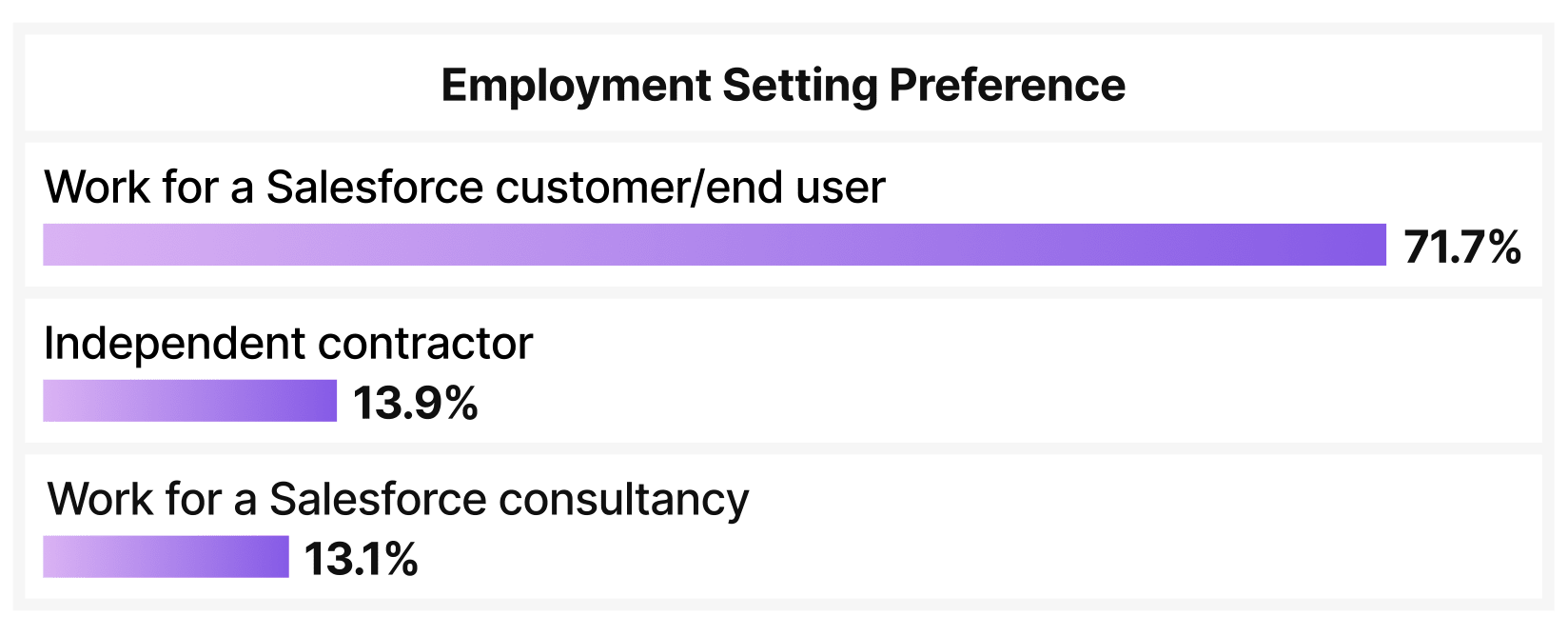
Actionable Insight: The architect role adapts to its environment. Team dynamics matter, and internal alignment may offer more long-term stability.
9. AI Is Here, But Agentforce Adoption Is Lagging
Nearly 89% of architects use AI in some capacity, and most believe it boosts productivity. However, native Salesforce AI tools like Agentforce aren’t the go-to. Architects are gravitating toward third-party tools like ChatGPT, citing cost, accuracy, and lack of Salesforce-specific best practices as key barriers.
Only 17.8% feel ahead of their peers when it comes to AI knowledge, while 32.6% feel behind. The biggest barriers? Cost, accuracy, and skills.
Top AI benefits cited:
- Increased productivity (73.1%)
- Finding information faster (65.4%)
- Greater efficiency (57.1%)
Actionable Insight: Architects should expect AI to become core to their role. Staying current and confident with AI will be a differentiator in the years ahead.
10. Architects Are Generalists With Strategic Depth
Gone are the days of single-cloud specialists. More than half of architects (50.5%) now span multiple Salesforce products, with only 12% focused on a single area. At the same time, most architects still prioritize learning based on the demands of their current job, not market trends or Salesforce’s roadmap.
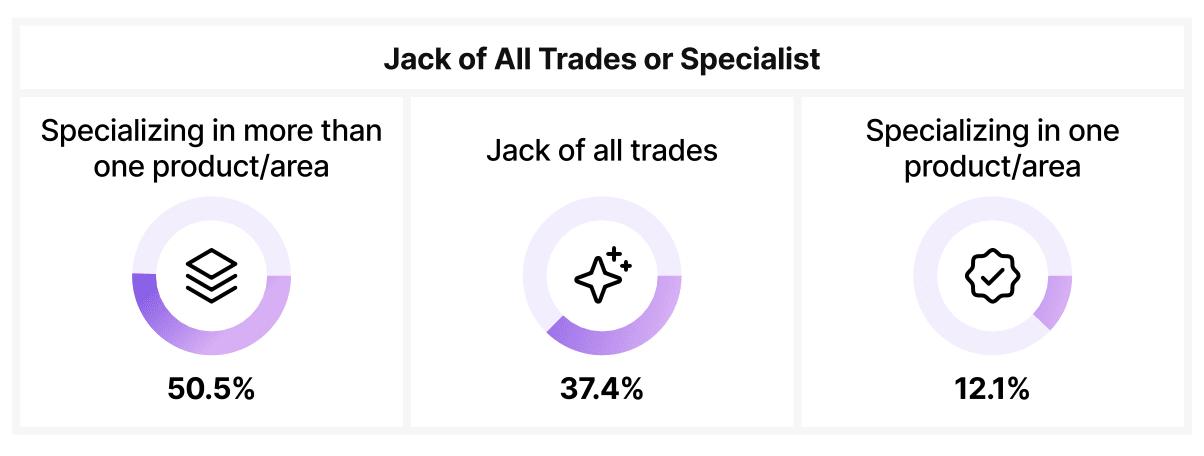
Actionable Insight: To grow, focus on adjacent skills and tools that solve business problems. This real-world relevance will always outlast hype-driven learning.
11. The Role Is Broadening and So Is the Background
The “typical” architect is anything but. Many transitioned from admin (25%), developer (28%), or consultant (33%) roles. Teams vary widely in structure, and architects increasingly span disciplines from security to integration to enterprise data strategy.
Actionable Insight: Don’t worry if your path isn’t linear. What matters most is your ability to solve complex problems, communicate effectively, and keep learning.
12. Diversity Is Improving, Slowly
While a gender gap remains (men outnumber women by 208%), the data suggests progress. More women are entering architecture roles, particularly as Solution Architects. Female respondents are most concentrated in the 1-2 year experience range, suggesting an early-career wave that could drive long-term change.
Actionable Insight: Representation is growing, but support, mentorship, and opportunity will be key to sustaining progress and developing diverse leadership pipelines.
Summary
Our 2025 Salesforce Architect Survey Report paints a clear picture: Salesforce Architects are evolving, adapting, and redefining their value. They’re not just technical experts. They are strategists, educators, and change agents. Yes, the landscape is complex. But as always, architects are rising to meet the challenge with empathy, resilience, and a relentless drive to make systems work better.
Whether you’re a seasoned architect or aspiring to become one, one thing is clear. Your impact has never been more vital.
Download the full report to learn more about how architects are growing, adapting, and making a difference.