

In the face of continued security threats, this article takes a deep look at three core trust pillars of Salesforce. These are tenant isolation, encryption, and compliance standards. Understanding these can give you a better grasp of where Salesforce’s part of the shared responsibility model lives, and where yours begins as a Salesforce Architect, Admin, or Developer.
In today’s digital-first world, businesses run on data, and increasingly, that data lives in the cloud. As organizations of every size and industry adopt cloud platforms, the question “How secure is my data?” remains constant. Platform-level security refers to the built-in architecture that protects all users, data, and applications within a cloud ecosystem. It is the invisible foundation ensuring that even when millions of users share the same infrastructure, every customer can trust the platform to keep their information safe.
Salesforce has woven security into the platform’s DNA, prioritizing trust as its number one value. Rather than treating security as an afterthought or a bolt-on, the platform relies on a comprehensive framework called “Defense in Depth.” This article explores the three core pillars of this framework – tenant Isolation, encryption, and compliance standards – and discusses how architects and admins can further enhance this security posture.
Understanding Multi-Tenant Architecture
Security in a multi-tenant environment is not achieved by a single wall, but rather by layers of defense. The Salesforce platform operates on a metadata-driven architecture. This means that while the underlying infrastructure (servers, network, storage) is shared, the logical application layer is strictly separated.
The architecture separates the runtime engine from the application data using a unique identifier for every organization. This ensures that a process running one tenant cannot access the memory or storage of another. This architectural decision allows for massive scalability without compromising the integrity of customer data.
The Foundation of Trust
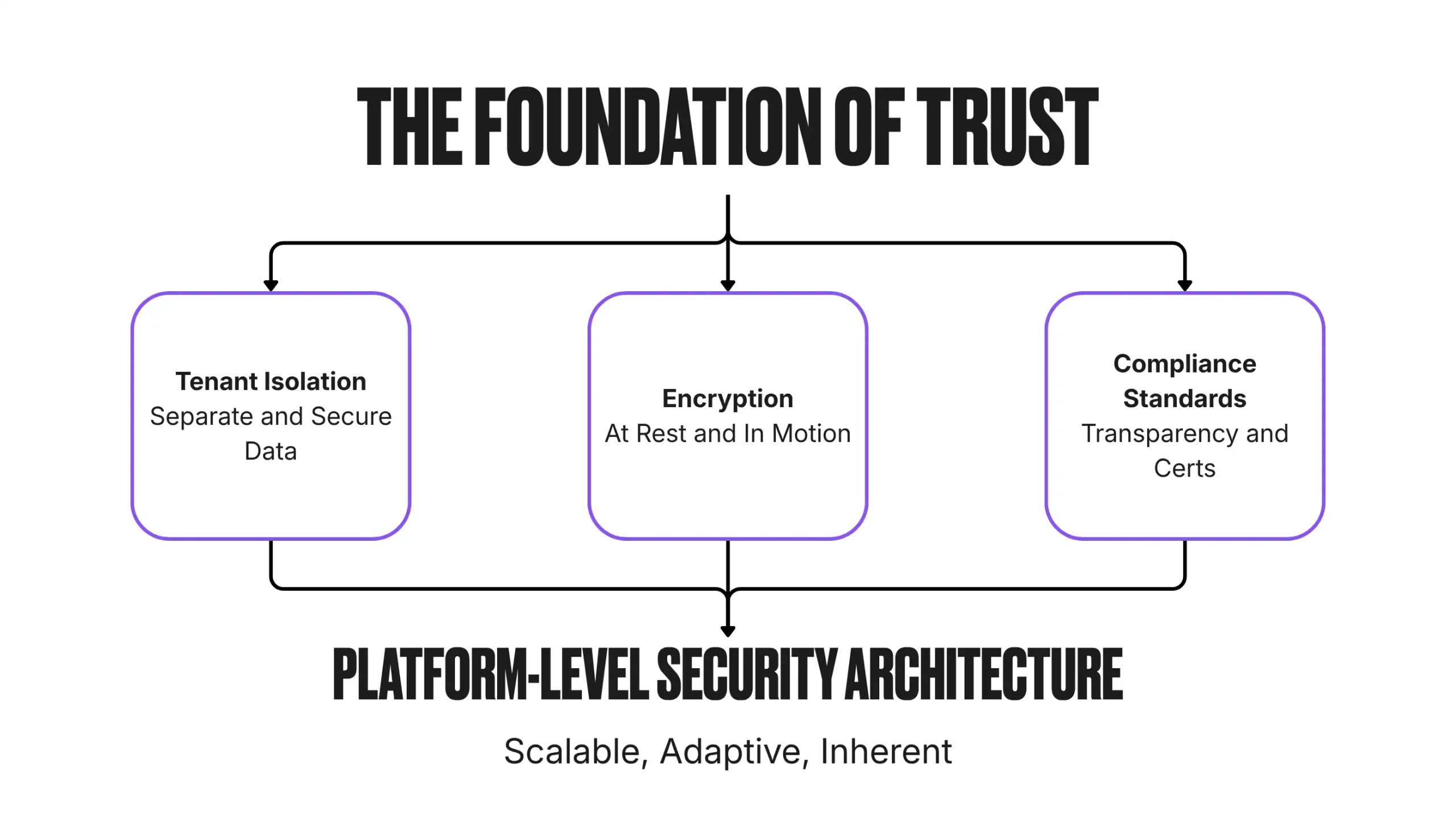
Platform-level security in Salesforce rests on three pillars: tenant Isolation, encryption, and compliance standards. These pillars work together to protect organizations at every level, ensuring that data, applications, and users remain secure in a shared cloud environment. Security isn’t just a feature – it’s an architectural foundation built into every operation, transaction, and data interaction on the platform.
Tenant Isolation
Keeping each customer’s data separate and secure is the most critical requirement of a multi-tenant cloud environment. To understand this, it is helpful to visualize the platform not as a single house, but as a secure high-rise.
One can visualize the platform as a massive apartment building where thousands of tenants live under one roof, sharing elevators and utilities, but each apartment remains private and locked. No tenant can access another’s space – this logical separation is how Salesforce ensures data remains isolated.
This separation goes beyond security – it creates virtual boundaries as effective as physical walls. No data leaks between organizations, no queries accidentally return to another tenant’s records, and security issues in one organization do not affect others.
The key benefits of tenant isolation are:
- Complete Data Privacy: Each tenant’s information remains confidential.
- Performance Independence: Activities in one tenant don’t affect others.
- Automatic Security Enforcement: Policies are applied at every layer of the platform.
- Scalability: Salesforce can add tenants without compromising isolation.
Metadata-Driven Isolation
Salesforce achieves tenant isolation through a metadata-driven architecture. Instead of providing every customer with a separate copy of the software, Salesforce stores each organization’s configurations as metadata. This metadata acts as a blueprint that determines what objects and fields exist, which security rules apply, and how data flows through the system.
The core principles of metadata-driven isolation are:
- Single Codebase: All customers run on the same underlying application code.
- Unique Metadata: Each organization’s configurations are stored as metadata blueprints.
- Logical Separation: Metadata defines isolated schemas and behaviors per tenant.
- Secure Execution: The platform enforces isolation during every operation.
Organization IDs and Data Separation
Every Salesforce organization receives a unique 15-character Organization ID at creation. This ID is the linchpin of the data isolation strategy. Every record, file, and metadata element is automatically tagged with its organization ID at the database level, creating an immutable association between data and the owning organization.
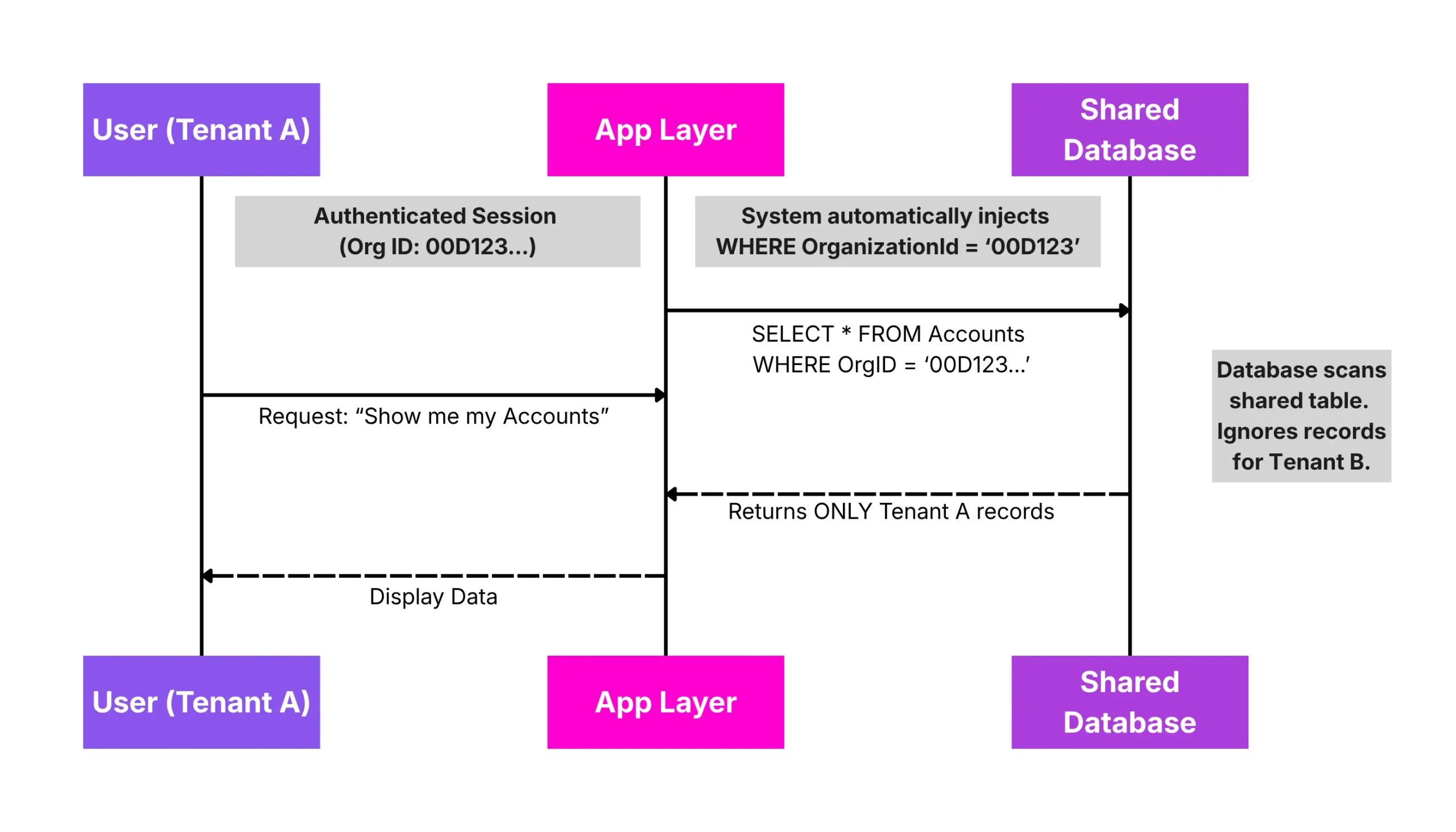
This design ensures that all operations – queries, API calls, or automated processes – automatically respect organization boundaries. The database layer enforces this separation through the following flow:
- User Authentication: User logs in, and the session is established with organization context.
- Request Processing: Every request automatically includes the organization’s ID.
- Database Query: Salesforce appends the organization’s ID filter to all queries.
- Data Retrieval: Only data matching the organization’s ID is returned.
- Response Delivery: Isolated data is securely delivered to the user.
Encryption: The Digital Lock
While tenant isolation keeps your data separate from others, encryption ensures that even if intercepted, the data remains unreadable without the correct encryption key. Think of encryption as scrambling your information into an unreadable code that only authorized users with the right “key” can unlock and view. Encryption is a fundamental component of defense in depth, providing protection even when other security layers are bypassed or compromised.
Encryption in Transit
When data moves between a user’s device and Salesforce’s servers, for example, when accessing Salesforce through a browser or mobile app, it’s encrypted using Transport Layer Security (TLS). TLS is the same industry-standard protocol that protects online banking, e-commerce, and all sensitive web communications. It creates an encrypted tunnel between the client and server, ensuring that any data passing through it is protected from eavesdropping, tampering, or interception.
Salesforce enforces strong TLS protocols and cipher suites, regularly updating configurations to address emerging cryptographic vulnerabilities. The platform supports TLS 1.2 and TLS 1.3, providing forward secrecy and robust protection against protocol downgrade attacks. This means that even if an attacker recorded encrypted traffic today, they couldn’t decrypt it later, even if they compromised the server’s private key.
All API communications, web interface sessions, mobile app connections, and integration of traffic are protected by TLS encryption. This comprehensive coverage ensures that sensitive information like passwords, session tokens, personally identifiable information, and business data is never exposed during transmission. For organizations connecting to Salesforce from internal networks or through third-party applications, TLS provides assurance that data remains confidential and unmodified throughout its journey.
Encryption at Rest
Once data reaches Salesforce’s servers and is stored in databases, it’s encrypted again “at rest.” This means that even if someone somehow accessed the storage layer, perhaps through physical access to hardware or a storage system vulnerability, the raw data would remain indecipherable without the proper encryption keys.
Salesforce uses industry-standard Advanced Encryption Standard (AES) with 256-bit keys to encrypt data at rest. This symmetric encryption algorithm is trusted by governments, financial institutions, and security professionals worldwide for protecting classified and sensitive information.
Encryption at rest protects not just active database records, but also backups, file attachments, and system logs. This comprehensive coverage ensures that data remains protected throughout its entire lifecycle within Salesforce infrastructure. Encryption is transparent to users, and application data is automatically encrypted when written and decrypted when read, with no performance degradation or operational impact.
The encryption keys used for data at rest are protected through a hierarchical key management system. Master keys encrypt data encryption keys, which in turn encrypt the actual data. This layered approach ensures that compromising a single key doesn’t expose all data, and it enables efficient key rotation without requiring re-encryption of all stored data.
Shield Platform Encryption
For customers needing to meet specific compliance or regulatory mandates, Salesforce offers Shield Platform Encryption. More often than not, the decision to use Shield is driven by the need to demonstrate adherence to industry regulations rather than the perceived sensitivity of the data itself.
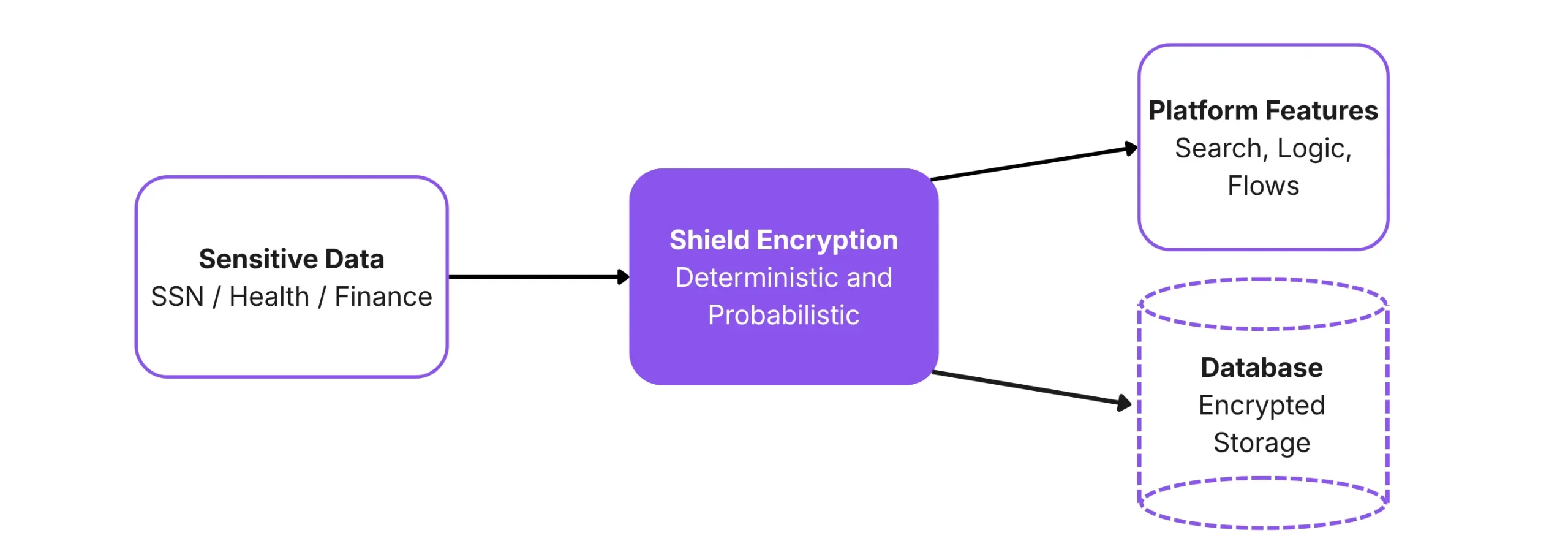
While standard encryption protects data at the storage volume level, Shield Platform Encryption provides an additional layer of protection at the application level. This allows organizations to selectively encrypt specific data fields at rest while attempting to preserve critical platform functionality.
While standard encryption occurs at the storage volume level, Shield Platform Encryption works at the application/field level within Salesforce itself. This means you can selectively encrypt specific fields containing sensitive information, such as Social Security numbers, credit card details, health records, or proprietary business data, while leaving other fields unencrypted for normal platform operations.
Key Capabilities:
- Field-Level Granularity: Encrypt only the most sensitive data fields, balancing security with functionality.
- Searchable Encryption: Search encrypted data using deterministic encryption schemes.
- Platform Features Preserved: Workflows, validation rules, and business logic continue to function.
Key Management and BYOK
Encryption is only as strong as the key management system protecting it. Recognizing that different organizations have different security and compliance requirements, Salesforce provides flexible options for managing encryption keys used by Shield Platform Encryption.
The BYOK and cache-only key options are particularly valuable for organizations operating under strict regulatory frameworks or data sovereignty requirements. By maintaining control over encryption keys, organizations can ensure that even Salesforce cannot access their data without explicit authorization. This architecture supports compliance scenarios where regulations require organizations to maintain the ability to make their data permanently inaccessible by destroying the encryption keys.
Key rotation is a critical security practice, and Salesforce supports both manual and automated rotation for Shield Platform Encryption keys. Regular rotation limits the exposure window if a key is compromised and meets compliance requirements for cryptographic key management. The platform handles the complex process of re-encrypting data with new keys while maintaining continuous availability.
Compliance Standards: Verified Trust
While technology like tenant isolation and encryption forms the backbone of Salesforce security, trust is built not just on capabilities, but on accountability and transparency. Salesforce demonstrates this commitment by adhering to the world’s most rigorous industry standards and regulatory frameworks, providing verifiable assurance that security controls are implemented effectively and consistently.
These compliance certifications are not marketing ornaments; they are third-party validations that Salesforce’s security architecture meets or exceeds international standards. They give organizations confidence that their sensitive data is protected and enable customers to leverage Salesforce’s compliance posture to meet their own regulatory obligations.
The Role of Compliance Frameworks
Compliance frameworks provide verifiable assurance by using external audits to confirm that Salesforce implements appropriate security and privacy controls. This enables customers in regulated industries such as healthcare, finance, and government to meet their own obligations through continuous accountability and regular monitoring of security practices.
Global Security Certifications
Salesforce maintains several global security certifications, such as ISO 27001, SOC 1/2/3, and PCI DSS. These act as independent, third-party validations that the security architecture meets international standards for risk management, data integrity, and operational security.
Regional Privacy and Industry Standards
The platform also adheres to regional privacy and industry-specific standards, such as GDPR in the EU, HIPAA in US healthcare, and FedRAMP for the US Federal government. These certifications provide a common language for discussing security requirements across different regulatory contexts and allow organizations to leverage Salesforce’s posture to accelerate their own compliance programs.
Each framework addresses specific privacy concerns, industry requirements, or regional regulations. Organizations can leverage Salesforce’s compliance certifications to accelerate their own compliance programs, reduce audit scope, and demonstrate due diligence in vendor selection. The certifications also provide a common language for discussing security requirements across different regulatory contexts.
Defense in Depth Strategy
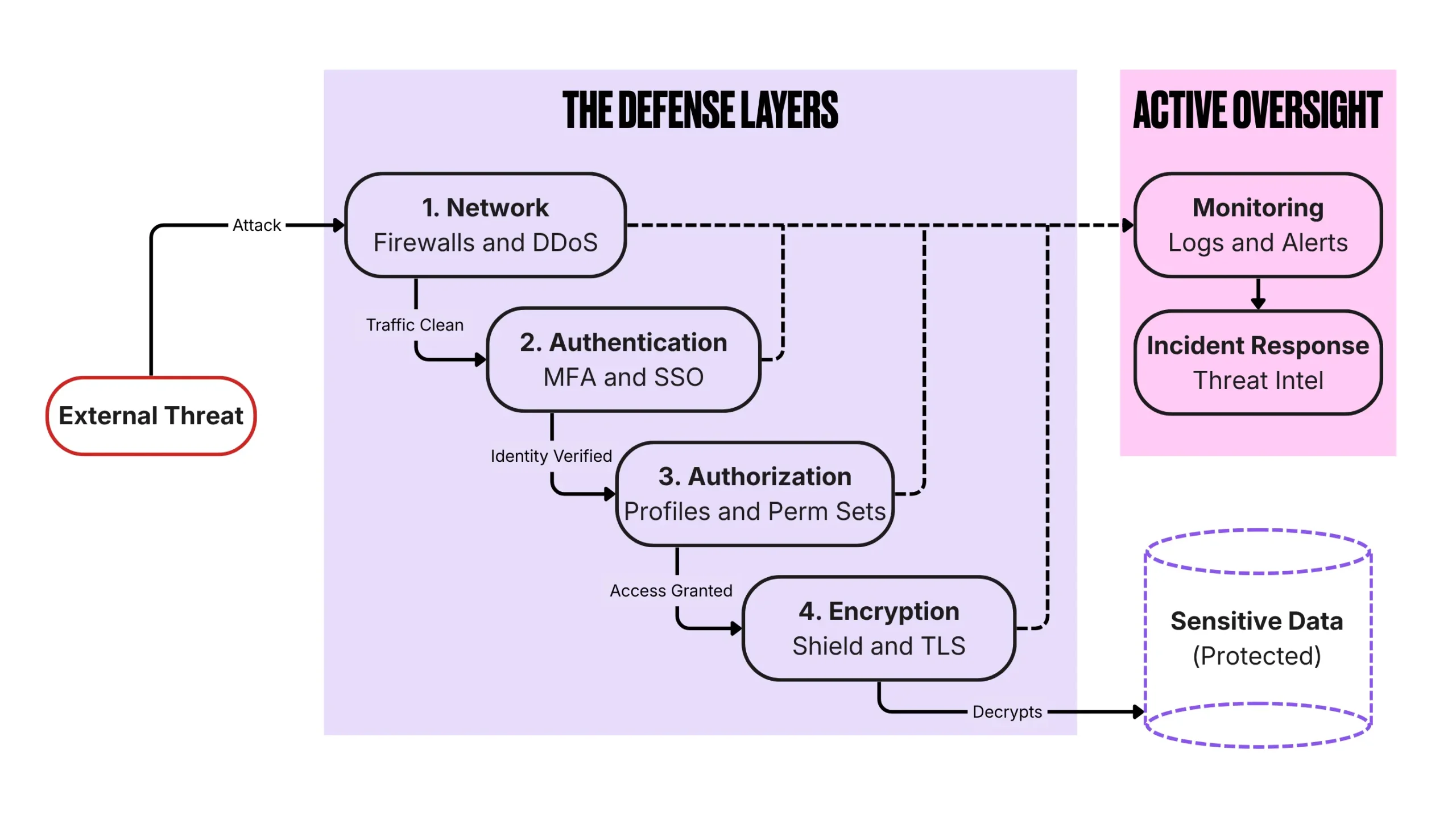
Encryption and isolation are components of a comprehensive Defense in Depth security model. This approach recognizes that no single security control is perfect, so multiple overlapping layers of protection ensure that if one layer is compromised, others continue to defend against threats.
Network security blocks attacks before they reach the application. Authentication ensures only legitimate users gain access. Authorization limits what authenticated users can do. Encryption protects data even if other controls fail. Monitoring detects suspicious activity. This layered approach means that an attacker would need to defeat multiple independent security mechanisms to access sensitive data.
Enhancements and Considerations
While Salesforce provides a robust security foundation through the “Shared Responsibility Model,” the customer is responsible for securing their specific instance. Architects and Admins should consider the following enhancements to strengthen their security posture beyond the default settings.
Multi-Factor Authentication (MFA)
MFA is one of the most effective ways to prevent unauthorized account access. By requiring users to provide two or more verification methods to log in, you add a critical layer of defense against credential theft and phishing attacks. Salesforce now contractually requires MFA for all direct UI logins.
Security Health Check
Salesforce provides a built-in Security Health Check tool that allows admins to identify and fix potential vulnerabilities in their security settings. It compares your organization’s current session settings, password policies, and network access configurations against Salesforce’s recommended baseline standards, providing a “health score” and actionable recommendations.
Salesforce Event Monitoring
Part of the Salesforce Shield trio, Event Monitoring acts as a “flight data recorder” for your organization. It gives granular visibility into user activity, allowing security teams to track logins, report exports, and API usage. This data is crucial for identifying anomalous behavior, investigating potential breaches, and meeting audit requirements.
Final Thoughts
In the cloud era, trust is everything. Businesses can only innovate and grow when they know their data is protected by comprehensive, verifiable security controls.
Through tenant isolation, Salesforce guarantees that every customer’s data remains private and independent. Through encryption, data stays protected from unauthorized access throughout its lifecycle during transmission, while stored, and when processed. Through compliance standards, Salesforce demonstrates an ongoing commitment to security excellence through transparent, third-party verified adherence to global frameworks.
These three pillars form the foundation of a secure, compliant, and resilient platform that empowers organizations across industries and geographies to digitally transform with confidence.
Resources
- Architecture Basics: Platform Multitenant Architecture
- Encryption Deep Dive: Shield Platform Encryption Concepts
- Compliance Hub: Salesforce Trust & Compliance Documentation
- Best Practices: Salesforce Well-Architected: Trusted System Design
- Technical Reference: Salesforce Core Services & IP Addresses
- MFA Requirements: Salesforce Multi-Factor Authentication FAQ
- Admin Tools: Using Salesforce Security Health Check