

It’s human nature to make decisions based on logical, safe, and known variables. When it comes to AI, we are in uncharted territory – it is, by nature, unknown.
This inevitably translates into organizational paralysis by analysis, and in the best-case scenario, a subsequent long experimentation phase.
In the paralysis by analysis stage, the organization typically runs in a loop around potential uses of AI. Ongoing meetings and discussions, and although some of the use cases sound “cool”, they lack real value or don’t have the required context to work.
During the experimentation phase, there is the underlying hope that perfection will show up. The promise of AI’s value is high, so the return must be high too. In this search for perfection, the ultimate reason is forgotten: Add value.
In this article, we will focus on Agentforce adoption, explore what makes a use case a “valuable” one, and how we can get the organization out of the paralysis by analysis stage, or the ongoing wait for perfection.
Technical Debt and How It Might Impact Where To Start
A lot has been said about technical debt and how the level of technical debt in an organization is inversely proportional to successful AI adoption.
Although there is a strong relationship between the two, it is important to understand in which AI use cases technical debt might be a show stopper, or simply add some extra steps to the adoption strategy.
Deterministic Use Cases
Deterministic use cases are often bounded-scope, context-light, input-output tasks. They tend to map cleanly onto a single topic with a handful of actions, often a Flow or Prompt Template.
In these use cases, there is no need for much context, other than understanding the input, passing it through a set of rules, and defining what the output should look like.
Although technical debt might impact the implementation of some deterministic use cases, generally speaking, the impact is low.
Some examples of actions that fall in the deterministic space are:
- Reading a document and summarizing it.
- Processing meeting notes.
- Automating the creation of records based on an image (OCR capabilities).
For organizations just starting the Agentforce journey, the recommendation is to always focus on deterministic use cases first. This not only isolates the technical debt concern but also allows users to gain confidence in the technology.
This last piece is key from a change management perspective. When people don’t trust an Agentforce response, they tend to either ignore it or spend more time double-checking it than they would have spent doing the task manually. Building that confidence is truly the “secret sauce” of adoption.
Probabilistic Use Cases
Imagine that you’re trying to predict customer churn in Data 360 (formerly Data Cloud). However, the Salesforce org has a large number of abandoned/repurposed fields, duplicated objects, orphan flows, poor data quality in standard and custom objects, stale knowledge articles, etc. This is where technical debt gets in our way… Probabilistic use cases almost always require grounded data in Data 360, which is where technical debt becomes a blocker.
Probabilistic use cases focus on pattern recognition, statistics, and mathematical models. They typically have predictive, inference-heavy, context-dependent tasks. In other words, they use existing data to infer outcomes. Without a clean data foundation, these use cases are infeasible.
Examples of probabilistic use cases are:
- Churn prediction.
- Customer sentiment analysis.
- Identify the probability of a deal closing.
- Validate the opportunity stage based on the deal conditions and prior similar deals.
- Resource utilization forecasting.
Tempted by the value of the use cases, most companies try to jump right into probabilistic use cases without even understanding the organization’s technical debt.
Identifying the First Agentforce Use Cases
1. Understand Your Technical Debt Level
We know now why technical debt has a strong impact on the decision about where to start. The first thing organizations need to do is understand what the Salesforce org looks like. Several tools can help here: Salesforce’s own Well-Architected Health Check, Elements.cloud, and Hubbl scans are common starting points. We’ve found Hubbl particularly useful because they go deep into the things we care about, and they not only diagnose but also propose corrections.
The output of this step should be a clear assessment and an action plan.
Remember: No matter where the org is in terms of technical debt, there is an Agentforce use case that is right for you.
2. Rethink Your Processes
This is the hardest part. The challenge is not necessarily to identify where to use Agentforce. The challenge is to unlearn what we know so far. You’ve been doing the same thing for years; it’s hard to imagine what it could look like if it didn’t look like that.
It is common to think of Agentforce use cases as “automations” on top of existing processes. This normally aligns with a function, somebody who does a specific task.
The most valuable use cases typically involve cross-functional activities and handovers from one team to another. Think bottlenecks, process friction, manual validations, approvals, delays, exceptions.
The output of this step should be a long wish list where Agentforce could help (aka, use cases). It’s OK if it’s not clear yet what all that means. That comes in the next step.
3. Identify the Value and the Ease of Implementation
Based on the technical debt state (step 1), the goal is to classify the identified areas (step 2) in terms of business value/impact and complexity. Yes, this is the hardest one. The question that often comes up is “How do we measure the value of a wish list item?”
To make this concrete, score each use case on two dimensions using a 1-5 scale.
Value score (1-5): Rate each use case across three sub-dimensions and take the average.
| Sub-dimension | What to evaluate | Example |
|---|---|---|
| Revenue impact | Does this directly grow top-line revenue, accelerate the pipeline, or improve win rates? | Churn prediction that triggers retention workflows. |
| Cost savings | How much manual effort does this eliminate? As the organization grows, this translates into deferred hiring and direct bottom-line impact. | Automated meeting notes processing that directly feeds the quoting process. |
| Risk reduction | Does this surface risks earlier or reduce exposure to errors, compliance issues, or margin erosion? | Early identification of at-risk projects before gross margin deteriorates. |
A use case that scores strongly on all three is a 5. One that only marginally helps on a single dimension is a 1 or 2.
Ease score (1-5): This is where the assessment from the first step pays off. Rate each use case on:
| Sub-dimension | What to evaluate |
|---|---|
| Data readiness | Is the data needed for this use case clean, complete, and accessible either in Salesforce CRM/PSA or through Data 360? Probabilistic use cases lean heavily on this. |
| Technical debt exposure | How much of the org’s technical debt does this use case touch? A summarization agent that reads a Knowledge article is low exposure – a churn predictor that depends on 40 custom fields across three objects is high. |
| Build complexity | Can this be delivered with a single topic and a few actions, or does it require custom Apex, new Flows, Data 360 ingestion, or new integrations? |
| Change management effort | How many teams are affected, and how disruptive is the new workflow? |
A 5 means all four are in good shape. A 1 means the use case is blocked on data quality, integrations, or adoption barriers that need to be resolved first.
Diagram the results: With a value score and an ease score calculated for each use case, place them on the 2×2:
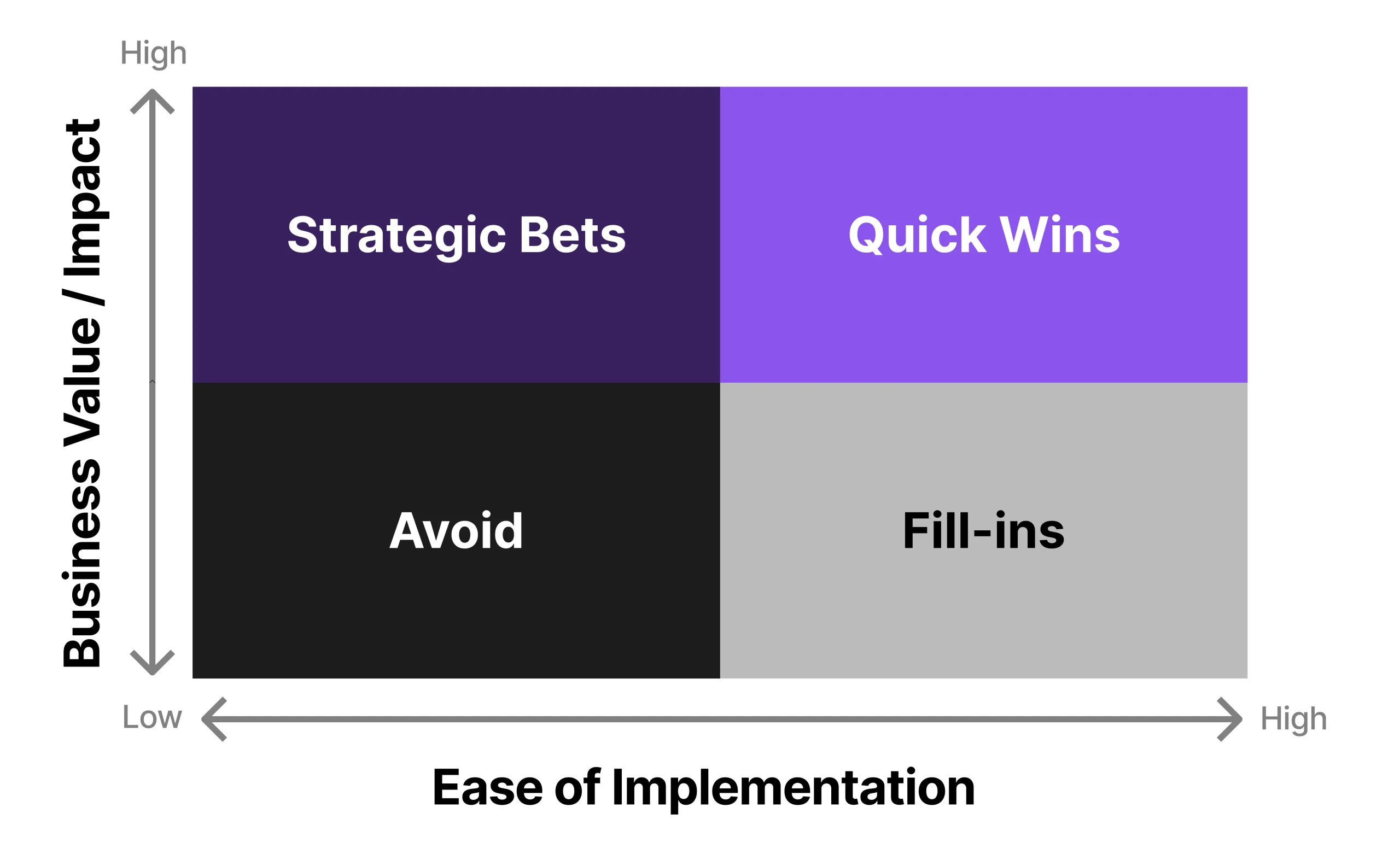
- Quick Wins (high value, high ease): This is your starting point! These are almost always deterministic use cases. Summarization, meeting notes, and invoice validation are good examples. They build user confidence and prove ROI quickly.
- Strategic Bets (high value, low ease): These are typically probabilistic use cases like churn prediction. They are definitely worth pursuing, but only after addressing the technical debt and data gaps uncovered in the first step. Plan them, but hold on, don’t start them yet.
- Fill-ins (low value, high ease): These use cases are easy to build but have limited impact. They might be good for newer team members to gain hands-on experience with Agentforce, but don’t expect much impact in the organization.
- Avoid (low value, low ease): These are the use cases that consume the most effort for the least return. Deprioritize… at least for now.
A quick sanity check: if a probabilistic use case is sitting in the “Quick Wins” quadrant, you’ve likely underestimated the data readiness work required. Re-score it honestly.
By classifying the use cases with a methodology like this one, it becomes easier to identify where to start and how to move forward.
4. Measure, Monitor, and Adjust
If the success of a use case can’t be measured, then pause. You can’t control what you can’t measure.
Establish a baseline, an end goal, and intermediate goals. Depending on the use case, checkpoints should happen weekly or monthly. At a minimum, review progress monthly so you can make adjustments. Read that again: so you can make adjustments. Expect adjustments. As the organization progresses in the adoption and the technology keeps evolving, adjustments are natural and necessary.
Examples of metrics to monitor include time saved per task, task completion rate, error rate, user override/edit rate (how often users change the agent’s output), cost per transaction, forecast accuracy, false positive rate, decision reversal rate, deflection rate, customer satisfaction, etc.
Also, adoption metrics are extremely important, especially at the beginning: weekly active users of the agent, session count per user, abandonment rate, etc.
Final Thoughts
The organizations that succeed with Agentforce aren’t the ones waiting for the perfect and shiny use case. They’re the ones shipping an agent on Monday, measuring it on Friday, and using what they learned to scope the next one. The framework above is designed to keep you in that loop: assess the org, rethink the processes, score the options, measure the outcomes, adjust, and repeat.
The harder part, and the part no framework can do for you, is staying disciplined after the first win. What sustains adoption is reliability: the user who trusts that Tuesday morning’s summary will be ready before their 9 AM meeting is a user who has made Agentforce part of how they work. Everything in step 4 exists to protect that trust.
Start small, measure honestly, and let the Quick Wins fund the Strategic Bets. The organizations that get this rhythm right end up with an AI roadmap that compounds, with each use case making the next one easier to justify, staff, and land.
This article was written by the team at CLD Partners, where we help organizations identify and implement AI use cases with measurable impact on revenue, cost, and risk. If you’re scoping your first Agentforce initiative, our AI Use Case Library and 4-week Agentforce Jumpstart are built around the framework above.