






For many, 2026 was the year Salesforce made some of its biggest ever industry bets. That, of course, trickled down to its job market, shaped by the accelerating rise of artificial intelligence, the need for specialization, and the dispersal of jobs across the ecosystem.
This year’s Salesforce Ecosystem Report from 10K has summarized the top trends in Salesforce’s job market over the past year, including how demand is currently faring and where the most viable roles sit. It also helps us answer the question: should you bother trying for a Salesforce job in 2027?
Salesforce Job Market Reset and Bounceback
To get a better understanding of how the market is currently faring, it’s important to understand its development over the last few years.
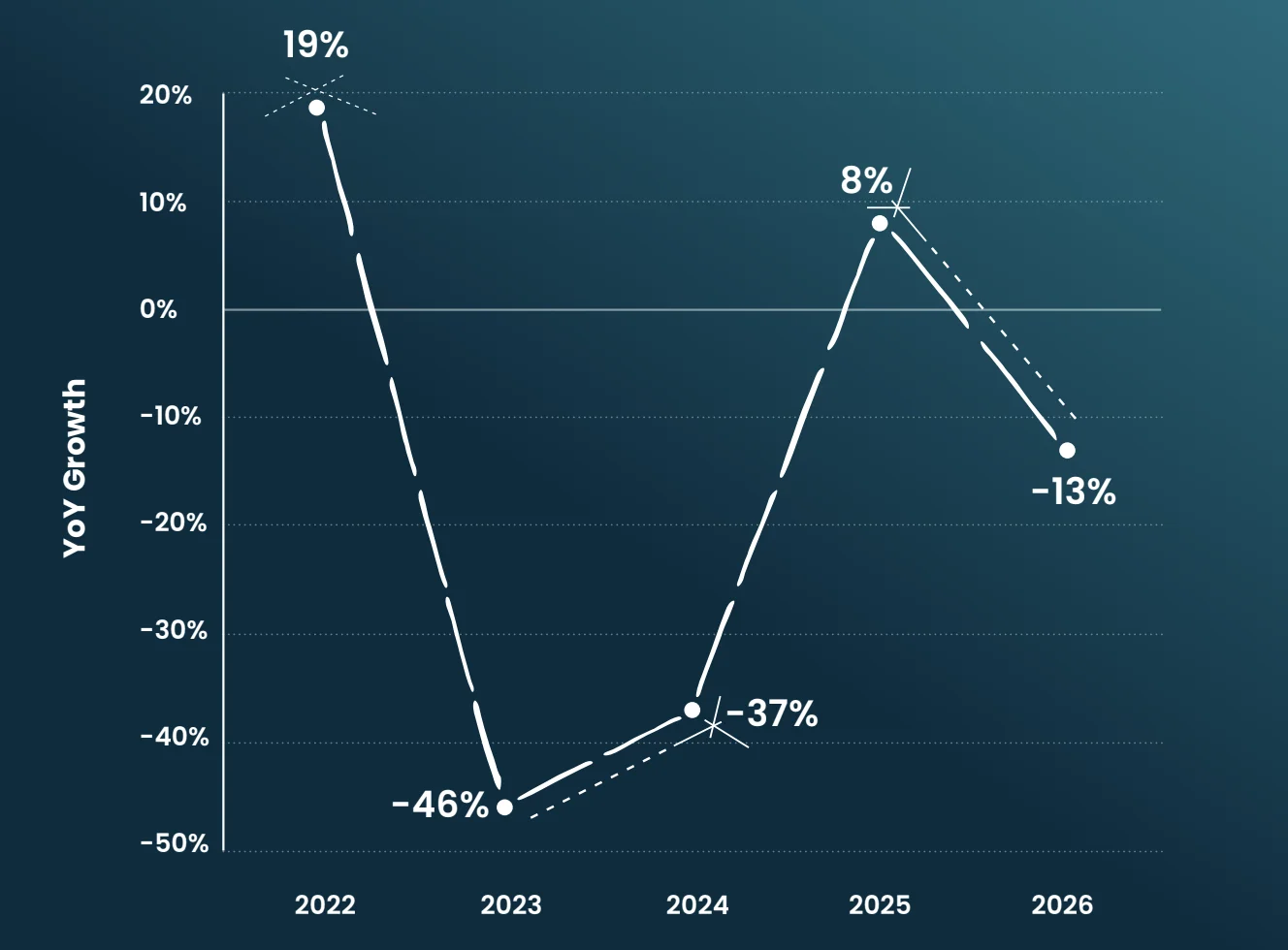
In 2023, after the digital boom caused by the COVID-19 pandemic, Salesforce and its ecosystem were forced to reckon with considerable overhiring. When “back to office” orders rang out, and the economy was shifting, layoffs came in waves, and the trough after the peak had fully set in. The job market faced the worst conditions since the recession of 2008-2010, and supply severely outweighed the demand.
Come 2024, the job market entered its reset period – firmly outside the realm of the pandemic tech boom, but was also no longer being so heavily dragged down by the crash. By this point, the booming popularity of artificial intelligence in mainstream tech and society was beginning to do a lot of heavy lifting, and we saw the first steps of the market adapting to accommodate this new technology.
Last year, it seemed that there was finally light at the end of the tunnel. Global Salesforce job listings were finally on the rise, with an 8% YoY increase in demand. This was a notable jump from 2024’s 37% decrease in demand, indicating that hiring was on the rise.
The saturation rate was still very high at 340%, but it was reassuring for many in the ecosystem to see that the demand for technical roles had not disappeared with AI, especially for architects.
Understanding the Job Market in 2026
This year, 10K’s report shows the market has unfortunately taken a step back in terms of demand, falling by 13%. Unlike previous reports, this year’s findings did not include supply figures; the number of “Trailblazers” exceeds 20M, according to Salesforce, and has increased year after year.
Note: 10K has also made the decision to switch from measuring role-based demand to product-based demand in anticipation of the changes AI would bring. A product-level view shows where decline is concentrated and where demand is still gaining traction.
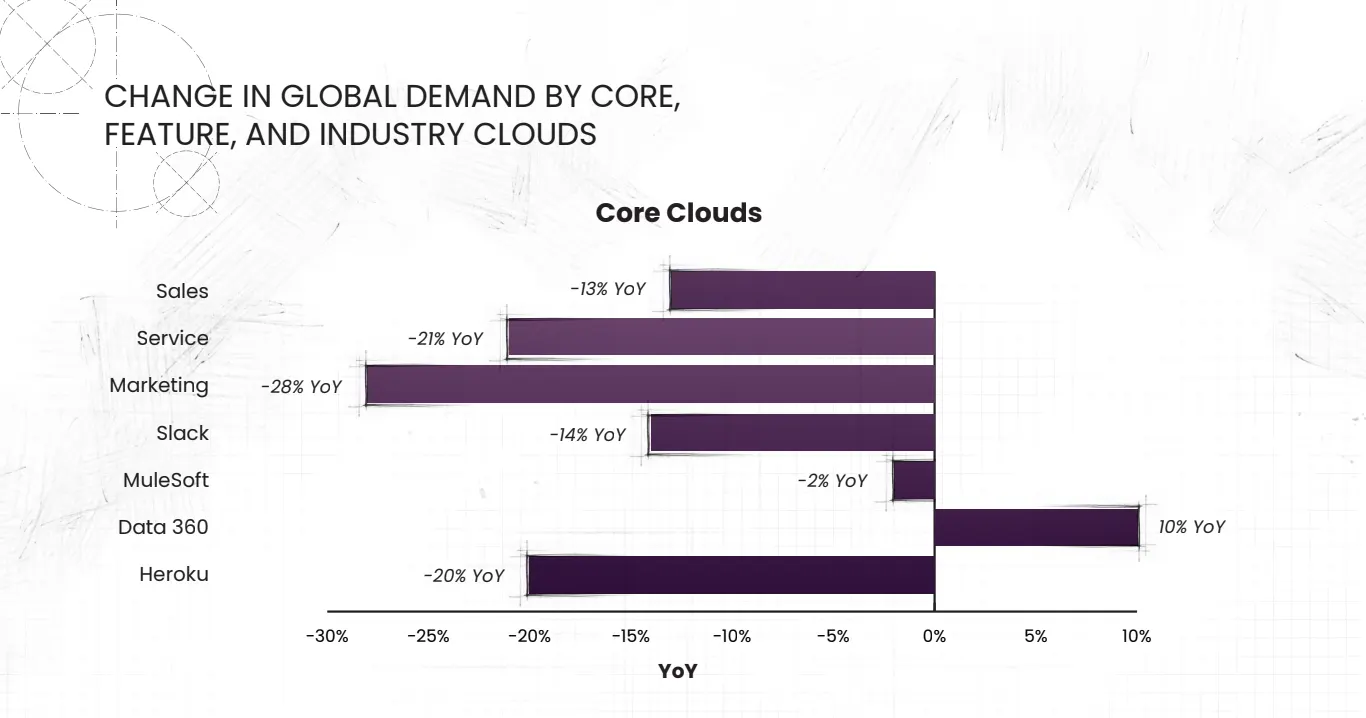
More specifically, AI, data, and specialized industry skills rose sharply in demand whilst the need for generalist skills dropped. This meant that demand for Sales Cloud roles is down 13%, demand for Service Cloud roles is down 21%, and demand for Marketing Cloud roles is down 28%. This further emphasizes the specialist versus generalist situation of the past few years.
Perhaps unsurprisingly, Agentforce skills increased in demand by 63% YoY globally, with an 87% increase in North America and a 132% increase in India. Nick Hamm, 10K’s Founder and Chairman, wrote that because of this, he believes that 2026 hasn’t been a “down year”.
“We think it’s just a different one,” he explained. “Though 2026 looks like the first year AI is substituting for labor in the Salesforce ecosystem, the need for talent isn’t going away.”
AI vs. Core
According to the report, the disparity between the demand for core skills and roles compared to AI skills and roles is a reflection of Salesforce’s own performance. Agentforce ARR exceeded $1.5B in Salesforce’s Q2 ‘27 earnings results, and combined Agentforce and Data 360 ARR is approaching $3.9B.
On the other hand, growth in Salesforce’s core Sales, Service, and Marketing offerings has lagged. One of the only areas where this isn’t as clear-cut is with Tableau. It remains the largest single demand category – appearing in 15% of job postings – but this is down 32% YoY.
Although you could argue this was always going to happen eventually, 2026 is the first year we are seeing the beginnings of the “true” impacts of AI on tech jobs. It may not be powerful enough for tech leaders to lay off entire teams, but it has transformed how certain jobs are done, what gets automated, and even the requirements of those roles.
Where Is Demand the Highest?
This year, North America was the only major region that saw growth, but it was only up 3% from last year. Today, it accounts for 50% of global demand, as every other region declined – including India at -11%. Africa saw the smallest decline of any region at 5%.
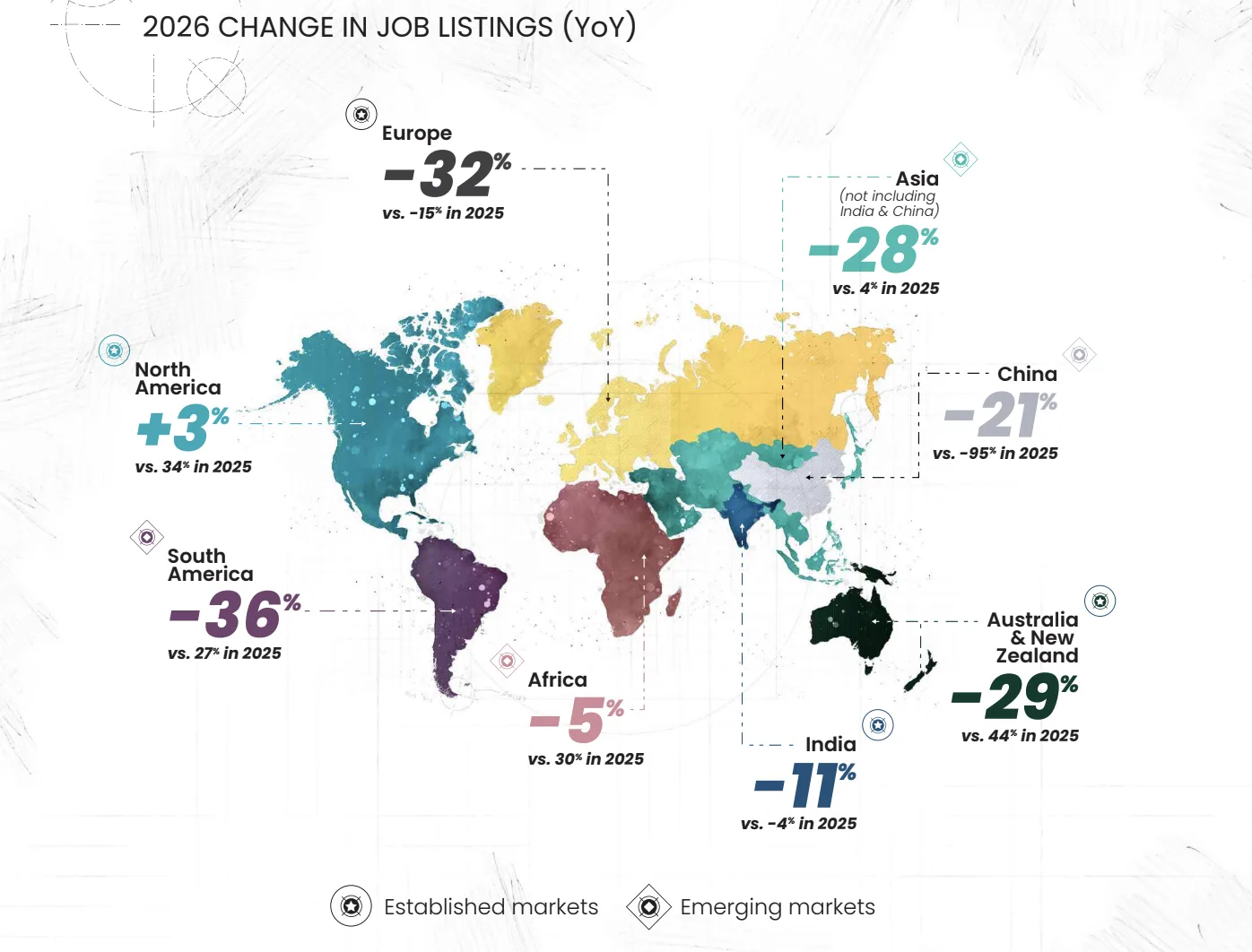
This is particularly interesting considering the offshoring trends we’ve been observing over the last two years. Offshoring to regions such as India sharply rose in popularity due to shrinking budgets, and although it is strong across LATAM, as the report details, “demand [has] snapped back toward the center.”
A New Dawn for Partners
Interestingly, 2026 also marks a record year for partners, as the number of consulting partners listed on the AppExchange hit 4,247, up 14% YoY. This is a 128% increase over the last five years.
The growth itself is almost entirely concentrated on smaller firms, too. Firms with 1-5 certified experts grew 32% YoY and now make up over half of all partners. Talent at the top five firms declined for the very first time.
Should You Try for a Salesforce Job in 2027?
This year’s report from 10K provides an interesting yet slightly bleak outlook on the current state of the Salesforce job market and what the future might hold for it. Demand has plummeted after a short spike of growth last year; it’s harder than ever to obtain a job without AI-specific skills, and it’s also harder than ever to get a Salesforce job outside of North America.
This alone would put many people off. That’s before you even consider the number of recent layoffs across Salesforce and the wider tech industry, the company’s shifting politics, and continual confusion and upset from its community.
However, once again, this does not mean it is impossible. 10K’s findings, although broad, only represent a certain segment of the ecosystem. The report highlights that AI skills are more in demand than ever before, and they might be, but many Agentforce projects still can’t make it past the pilot stage. It can feel like a really intense environment where everyone is racing ahead with their AI knowledge, but AI adoption was still one of the biggest barriers discussed at last month’s Dreamforce.
10K recommends that professionals should “move up the stack and into complexity”, suggesting that if you currently work in or plan to work in one of the declining areas, your focus instead should be placed on diversifying into agent design and governance.
This itself isn’t new, and it is advice you’ll hear across the ecosystem. What is interesting, though, is the call to make sure you know how to guide stakeholders through a busy landscape of solutions to find the right one for them – emphasizing the importance of business skills among technical ones.
Final Thoughts
Ultimately, you’re going to find yourself encountering different pieces of advice from different sources, and sometimes they will be totally contradictory. That’s why it’s so important now, more than ever, to make sure your finger is on the pulse if you want a career in Salesforce.
Understand (or at least try to) the direction Salesforce is taking. Listen to customers, ISVs, and community members about what they’re experiencing day to day. Consume a variety of different sources and learning materials to help you build a clear picture of the current state of the market, and then you should find making your decision a whole lot easier.