

It’d be naive to assume that the best talent for your business is only within a ten-mile radius of your doorstep. It is perhaps more naive to assume that in a market where every cent counts (and where AI is becoming an even greater priority), employers are not considering the best ways to reduce costs. Overheads are one thing, but what about staff?
In the Salesforce ecosystem, offshoring is not a new trend. But is it still growing in ways observed earlier this year, or have companies moved on to the next shiny business tactic?
Tech Sector Offshoring: A Market Trend
The global offshoring industry is valued at approximately $85B annually, and according to Growth Market Reports, the IT Services outsourcing market was valued at $525B in 2022 and is reportedly likely to reach $1.6T by 2031.
It is a business choice that promises enticing solutions to common business problems; lower costs, wider access to skilled labor, and the ability to operate across multiple time zones.
If staff in onshore markets are struggling with too much repetitive work, silos, or the inability to keep up with rising hiring costs, then offshoring can be a favorable option. Once that decision is made, it tends to stick too. Nearly 40% of offshoring companies have plans to expand their offshore operations within the next two years.
However, like any business practice that has the notion of, at least for employers, often feeling too good to be true, offshoring is not without its downsides. Obstacles like quality control issues, a lack of regulation, and security and intellectual property issues are all factors to keep in mind. Businesses need to decide whether the reward will be worth the risks, and without proper planning, it can definitely be achieved.
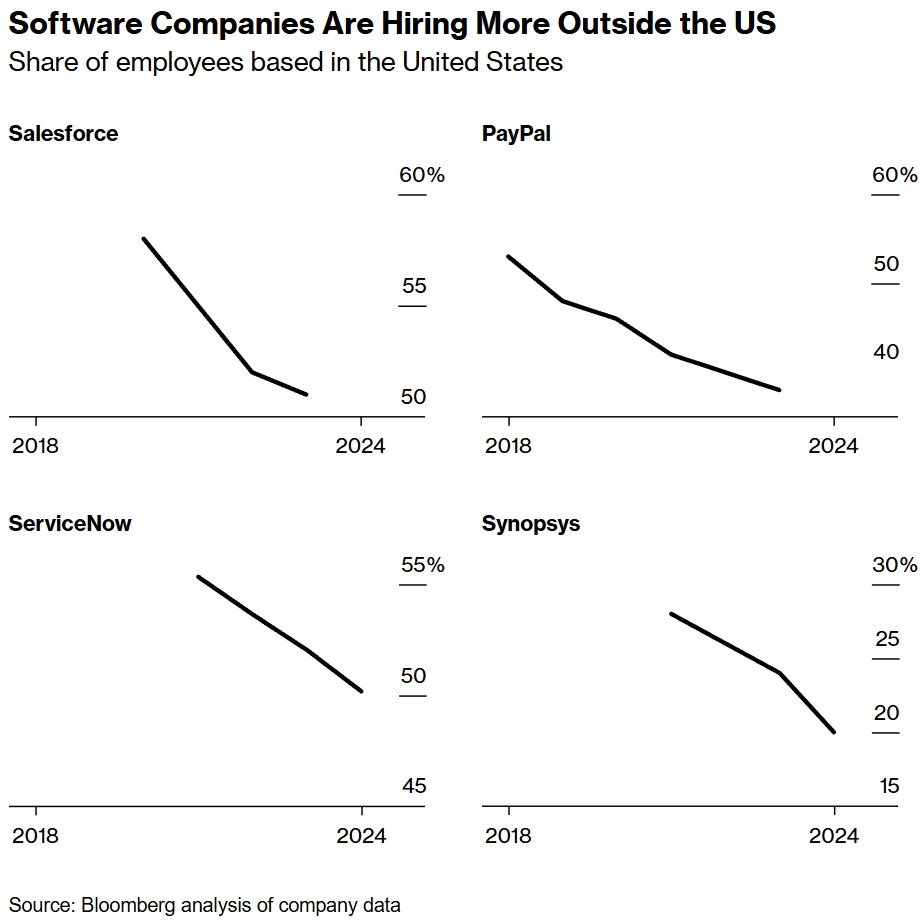
Offshoring also has political and PR implications for a company, which might get backlash if it’s perceived as moving jobs overseas.
State of Salesforce
In the world of Salesforce, offshoring is a well-embraced practice, and something I explored in detail in March, as well as August last year.
This year’s Salesforce Ecosystem Report by 10K revealed what many of us in the ecosystem had been expecting: the Salesforce job market remains saturated with global supply continuing to outweigh demand. Although this year’s numbers aren’t quite as bad as last year’s, the market currently faces a saturation rate of 330%, meaning that supply is 3.3 times the demand.
A number of factors impact how popular offshoring is, but market saturation is certainly one of them. It indicates that not only are employers able to be choosier with the wealth of talent out there, but they can also choose the options that are best for them cost-wise.
So with a few of the most popular offshoring markets being India, the Philippines, and Mexico – with salaries in India being potentially over 580% lower than in the US – the lower labor costs are enticing enough on their own.
Factor in some of the other benefits, and the solution speaks for itself, especially at a time when tech ecosystems like Salesforce’s are focused heavily on artificial intelligence in both time and money.
Is The Job Fight Still Fierce?
The offshoring discussion often brings the health of job markets under scrutiny, and for Salesforce’s job market, this is no different.
10K’s report indicates that the “job market is back in motion”, but as I covered, the disparity between supply and demand is still significant. However, does this mean that there is still fierce competition for jobs?
According to unseen data from our upcoming SF Ben Salary Survey (sign up for our newsletter to get the full report as soon as it’s live in January), the majority of respondents found their current role in just under two months. However, out of those searching for roles this year, 52.3% said they felt the market is more challenging than previously. A staggering 75.4% of respondents also said they had been looking for a role in the last 18 months, indicating a high churn of people looking for new opportunities.
That being said, the job application scene appears to have shifted from how it was even earlier this year. In March, you could consistently find Salesforce job listings on LinkedIn with more than 100 applicants. Now, I had to look for them.


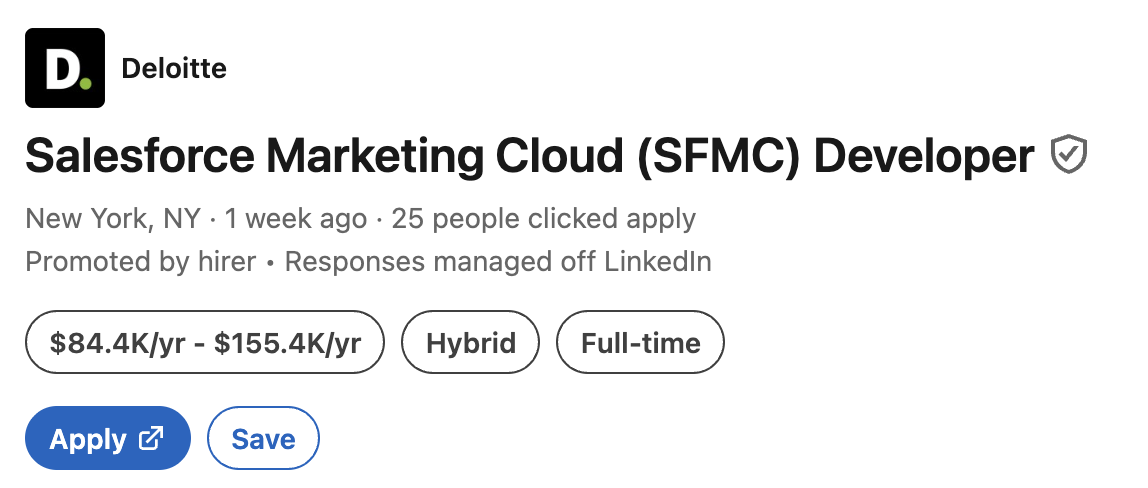

This is not to say that it is suddenly easy to find a job in this ecosystem or that the data is wrong. However, the data might be missing a crucial part of the full picture: where professionals go when the market doesn’t suit them anymore.
Across LinkedIn, Reddit, and even our posts here at SF Ben, the sentiment for at least a couple of years has been that finding a Salesforce job right now may not be the best solution. Market trends like saturation, a growing skills gap, and offshoring have had their parts to play in that.
So, does this now mean that professionals are no longer as eager to look for jobs within a sector that is constantly touted as insurmountable? This could indicate that professionals have abandoned ship and jumped to other technologies, because, realistically, when there is no other option, where do you go?
The Messaging Behind Offshoring
Despite the job market’s condition, there is no denying that offshoring is a practice that can and does positively impact a plethora of companies, but its messaging and the way it has evolved over time are something that should not be overlooked. A very particular message is being sent, but is it the right one?
Since the dawn of their inception, business ads have played on their prospective customers’ heartstrings, and campaigns in advocacy of offshoring are no different. Empata Global, one of these very companies, tells its customers that outsourcing can “unlock opportunities you may not even realize you’re missing.”
“If your team is stretched thin, if growth feels limited by time, cost, or talent availability, it might be time to rethink how your business is built,” they wrote on LinkedIn.
Another example comes from BoS Outsourcing: “What if businesses could reduce operating costs by up to 60% without sacrificing quality?”
“Rising salaries, overheads, and ongoing talent shortages often push teams into survival mode rather than growth.”
If you need one more, take Hire With Near. “Turnover is through the roof,” they wrote on LinkedIn.“Pipelines are drying up. The cost of hiring and training? Bleeding your budget.”
“Here’s the hard truth: you don’t need to fix it – you can replace it.”
The Digital Labor Problem All Over Again?
Think back to earlier this year at TrailblazerDX when Salesforce first introduced the concept of digital labor. Presented as a solution to the “global labor shortage” by partnering up human teams with artificial intelligence, although it did have that futuristic ring, it also got people worrying.
Many of those people who sat in that keynote audience or watched online were living a very different reality. They may have been in positions where they couldn’t find jobs that paid them enough or jobs at all, and here was another “solution” that could serve as an additional hurdle.
Now, the messaging behind offshoring appears to be veering down a similar path. The acknowledgement of lower costs and more choice was never the problem, but treating workers and their needs as commodities is not an effective way forward.
The cost-of-living crisis continues to affect regions, including the US and UK, resulting in the push for higher salaries. Within the Salesforce ecosystem, the disparity between the number of professionals compared and open roles continues to be significant, throwing the talent crisis into question. Are businesses really looking to solve pertinent problems, or is this just another giant cut-costs-at-all-costs exercise?
As Scott Vincent of technology services company Digital Futures puts it:“Although offshoring may seem financially attractive in the short term, this strategy has a steep, often overlooked cost. The narrative of a ‘skills shortage’ too often serves as a justification, masking an unwillingness to invest in nurturing local talent.”
Final Thoughts: The Future of Salesforce Offshoring
If there is one undeniable truth in this whole matter, it’s that offshoring is not going anywhere whilst it remains a more flexible, cost-effective solution. The age of opportunity and people over profit seems to be fading, and as more businesses set their sights on costly innovations such as AI, economizing has never been more important.
In fact, AI and its pace of development may be one of the only forces capable of reducing or changing the trend of offshoring. It is well-described by Financial Times writer John Thornhill in his piece: “How AI may become the new offshoring”.
“For the past few decades, private equity companies have followed a lucrative, if somewhat brutal, playbook of buying companies, firing employees and offshoring operations to China,” he wrote. “That game may now be ending, given the geopolitical tensions between the US and China and the renewed focus on the resilience of supply chains. Maybe AI will be deployed to transform corporate cost structures instead.”
Within the Salesforce ecosystem, this is just one more reason to keep all eyes on Agentforce. Fully AI-automated work or virtual employees may not be here yet, but we will likely know when they’re getting close. Especially if countries like India start feeling the sting first.