






The senior Salesforce professional stands at a crossroads. On the one hand, the AI era means many new opportunities to improve one’s technical skills and ride the wave of businesses rushing to implement new AI technologies. But on the other, the rise of vibe-coding tools means that people who aren’t necessarily skilled coders can put together solutions that (some claim) are almost as good as professionally developed ones.
All the while, business skills are still just as important. This poses a crucial and timely question for Salesforce professionals: when AI is disrupting the world, is it more important to improve your business or technical skills?
The State of the Job Market
According to 10K’s 2025 Salesforce Ecosystem Report, demand for Technical Architects grew 27% year-over-year, with supply up just 4%. Demand for Solution Architects grew by 21%. Meanwhile, developer demand actually fell by 12% – while supply grew 20%.
Business Analyst demand grew 9%, with supply rising by 34%. For admins, supply grew 45%, while demand grew by 14%.
What we’re seeing is execution becoming cheaper while judgment becomes scarcer. It’s not quite so simple as technical or business skills being necessarily more valuable or important than another, overall.
Like Jared Miller, Chief Operations Officer at 10K, says in 10K’s predictions post: “AI will narrow the gap in execution but widen the gap in design.”
This idea is backed up by our own SF Ben Architect Survey data. Communication was ranked as the most valuable skill for Salesforce Architects, with an average rating of 4.3 out of 5. Coding ranked dead last, at 3.3.
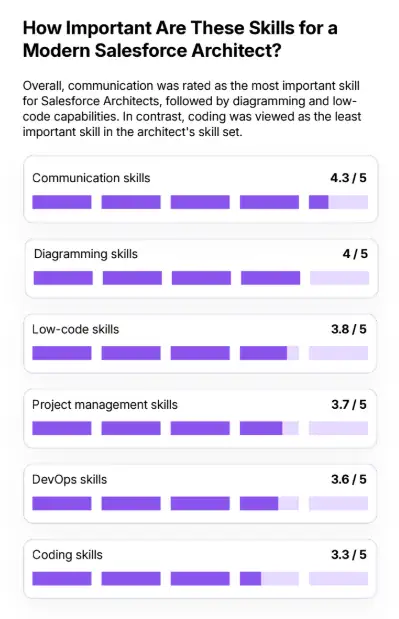
The most effective architects are communicators, facilitators, and strategic thinkers, not just technical experts. That being said, according to our own data, 92.2% of architects still report doing hands-on work, either regularly or to some extent. A very small minority (7.8%) indicated that they do not engage in any hands-on activities.
So, does the future really just belong to a ‘BA with vibe-coding skills’? There certainly is a case for that profile.
Jack of All Trades?
Kristin Langlois, Chief People Officer at 10K, says that, as AI automates routine work, Business Analysts are emerging as the “bridge between human decision-making and intelligent systems”, recommending that BAs strengthen their AI literacy, data fluency, and understanding of Salesforce automation.
“The future of Salesforce talent will belong to professionals who connect business goals and technology, defining how human judgment and AI work together to create impact,” Langlois said in 10K’s predictions for 2026.
Remember those important supply and demand figures from earlier. BA supply rose 33% compared to just 9% in demand – while admin supply rose even faster. Technical Architects represent just 1% of global supply, but demand was up 27%.
An experienced architect who becomes skilled in discovery, commercial thinking, stakeholder management and process analysis is simply strengthening a profile which is already very much in-demand.
A Business Analyst who can prompt an AI to produce Apex has certainly improved their skill set, but is hardly equivalent to someone with a deep knowledge of integration patterns, distributed systems, data architecture, governor limits, security boundaries and years of hands-on enterprise software experience.
Deep Expertise Becomes More Valuable – Not Less
If code becomes cheap to generate, organizations can produce even more software, automations, integrations and agents. While this might mean that entry-level developers feel the squeeze, it also means that there are even more things which require architecture, governance, testing and maintenance. Bad news for junior developers – good news for architects, just like the 10K data bears out.
Salesforce itself makes the argument – in an article arguing that AI “isn’t replacing the Salesforce Developer role” – that the developer career path will reward those who pair deep platform knowledge with architectural judgment. System design, quality engineering, and cross-system thinking will be valuable skills to have – rather than just being the fastest coder, according to Salesforce.
Google’s DORA research also claims that AI’s main role in software development is that of an amplifier, which “magnifies the strengths of high-performing organizations and the dysfunctions of struggling ones”.
So, vibe coding creates fast code, but it doesn’t remove the need to know whether that code is good – or even if it should have been generated in the first place.
The Verification Premium
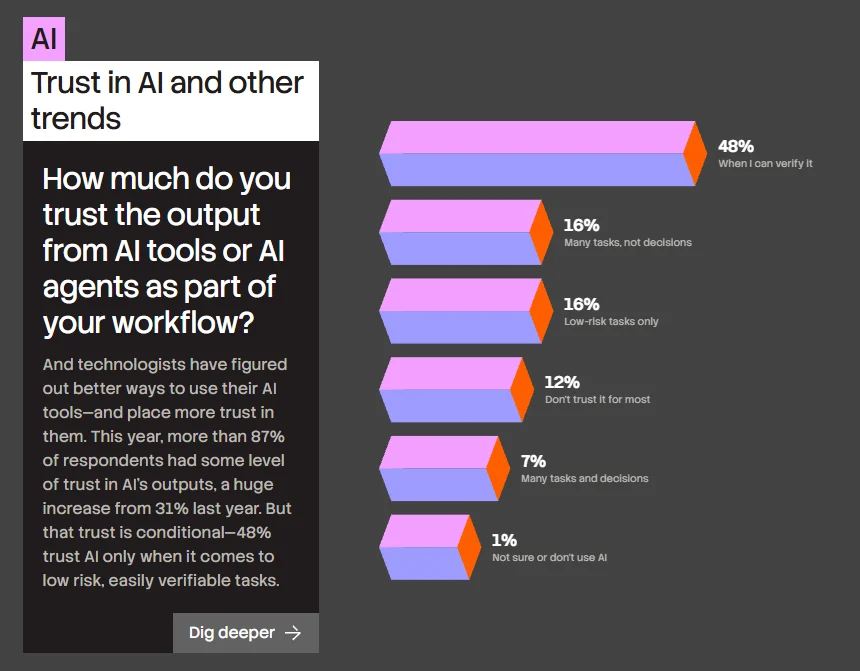
The 2026 Stack Overflow Developer Survey, which gathered more than 30,000 responses across 169 countries, reveals an important detail about this discussion: the value of verification.
When asked about how much they trust the output from AI tools or agents as part of their workflow, the most popular answer by far (48%) was ‘When I can verify it’. The joint second closest answers were ‘Many tasks, not decisions’ and ‘Low-risk tasks only’ on 16%.
Just 7% selected the most enthusiastic answer, ‘Many tasks and decisions’, which was behind ‘Don’t trust it for most’ (12%).
Only 1% selected ‘Not sure or don’t use AI’.
There is an interesting contrast here between the use of AI (and enjoyment of its use) and trusting AI. According to the survey, developers are using AI more than ever before in their daily work, with 80% of respondents using artificial intelligence tools for at least an hour per day. Along with that, more than 60% of respondents now have a favorable attitude towards AI tool use in their work.
This paints an interesting picture for how AI tools are being perceived by tech sector professionals – as something which is inarguably useful, but which cannot be trusted, at least at face value.
In other words, AI has reduced the value of knowing how to create something, but increased the value of knowing whether the produced thing is correct. Once again, this is borne out in the 10K data – a decrease in demand for developers; an increase in demand for architects.
Senior professionals are seeing significant boosts to their careers due to the growing need for technical expertise. While a junior developer’s differentiator might once have been, “I can write this Apex class”, a senior professional’s differentiator has become, “I can tell you whether we should have an Apex class at all”, which is harder to automate.
AI skills might just be table stakes at this point. According to the 2026 SF Ben Architect Survey, AI adoption has surged to 96.7%, with confidence levels improving across multiple measures.
At the same time, the LinkedIn Skills on the Rise 2026 report found that “people skills matter more than ever”, with abilities such as team management and mentorship increasingly in demand, along with skills around executive and stakeholder communication. “As technology becomes a bigger part of everyday work, the ability to communicate with clarity through uncertainty – with skills like Public Speaking and Cross-Functional Coordination – has become critical,” the report’s authors write.
So, which should a senior Salesforce professional prioritize?
Final Thoughts
It is simply not the case that technical knowledge has been rendered unimportant by AI tools. What AI has done is take away a lot of work which more junior professionals used to handle – but at the same time, create a greater need for oversight, responsibility, and expertise.
So, if you’re already technically senior, it might be worth putting more of your incremental development effort into business skills – but not because technical knowledge is becoming unimportant.
The idea that technical skills won’t matter because AI can code is simply not borne out by the data. But the idea that business skills will become much more valuable, relative to writing code manually, has some strong evidence behind it. The biggest winners will likely be those who can combine senior technical judgment with business understanding.
In other words, a Business Analyst who can vibe-code a solution won’t be nearly as well-positioned as a Technical Architect who understands business logic.