




There was once a time when Silicon Valley CEOs seemed determined to convince us that they were nothing like politicians. They wore hoodies, talked about changing the world, and presented their business as movements, rather than lumbering corporate institutions. While Marc Benioff was never the hoodie-wearing type, he has long promoted his own brand of the Silicon Valley ideal: optimistic, progressive, and unconventional.
That image is becoming harder to reconcile with the Salesforce of 2026. The company is increasingly embedded in government, defense, and national security contracts, while the CEO seems more conscious than ever of the political realities surrounding running a tech company in the AI era. Salesforce has arguably always been more than just a software company, building an unusually distinctive identity around ideas like equality, sustainability, trust, and ‘Ohana’.
But Salesforce is in a different kind of era now, and it shows in its aesthetics: a little less California, a little more Washington D.C.
Dreamforce ‘26 and Benioff the Politician
Dreamforce is the biggest event of the Salesforce year, and CEO Marc Benioff always kicks things off with a keynote speech to set the tone for the three-day conference in San Francisco.
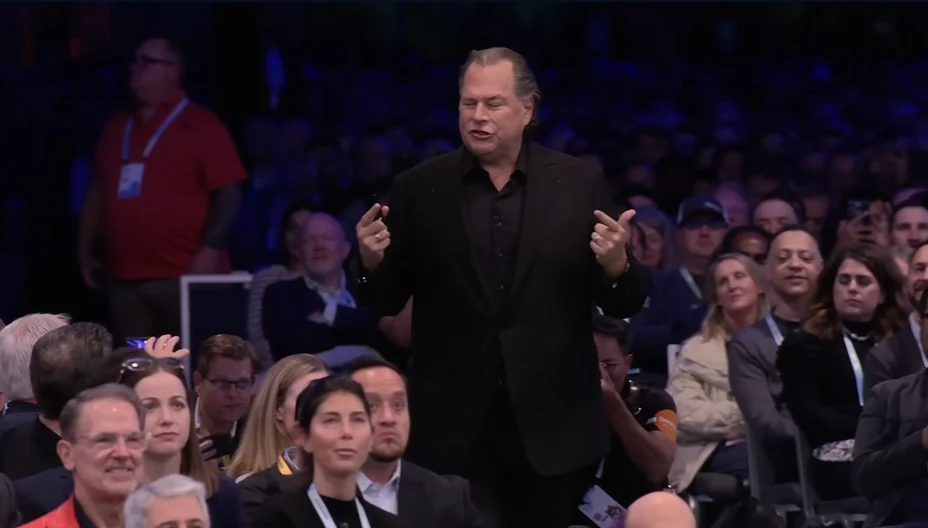
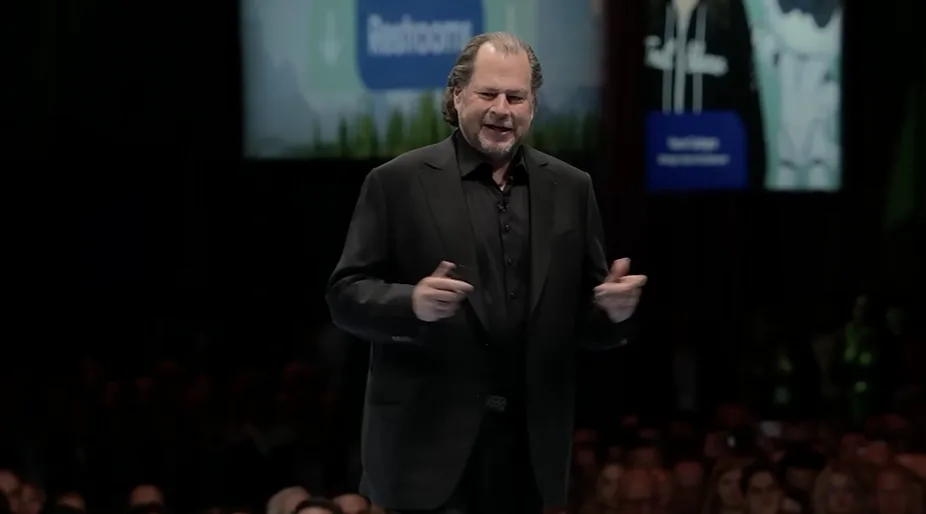
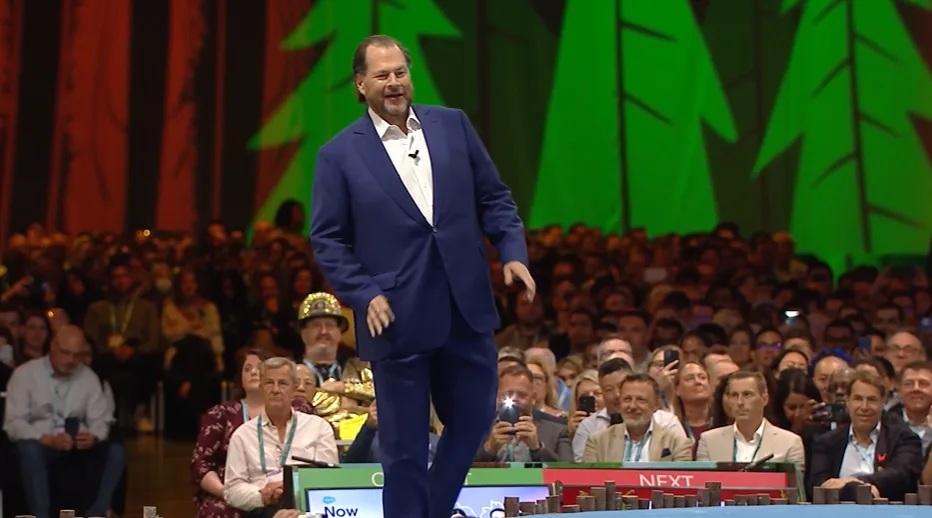
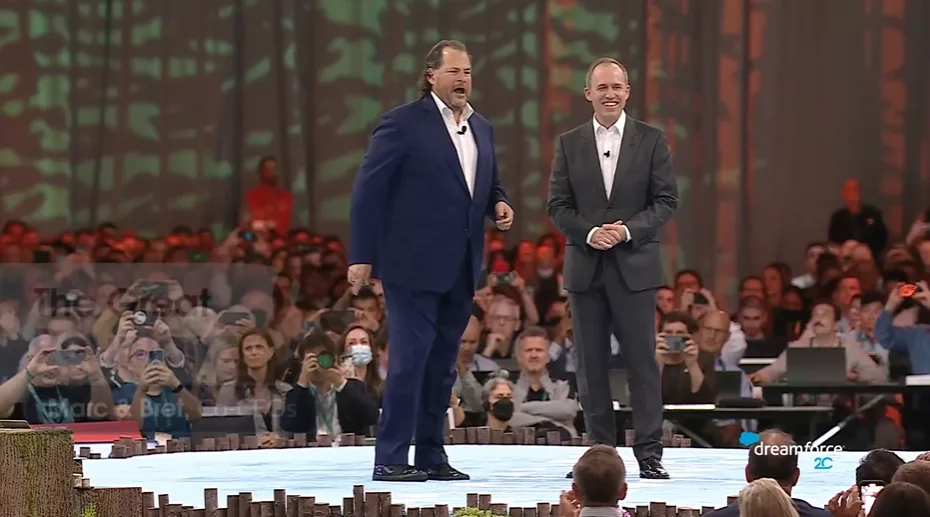
In previous years, Benioff typically went for a more casual look. In 2022 and 2023, he wore a light shirt with an open collar, paired with a blue suit. The following two years, as the company entered its Agentforce era, it was a black suit and shirt – still with the open collar.
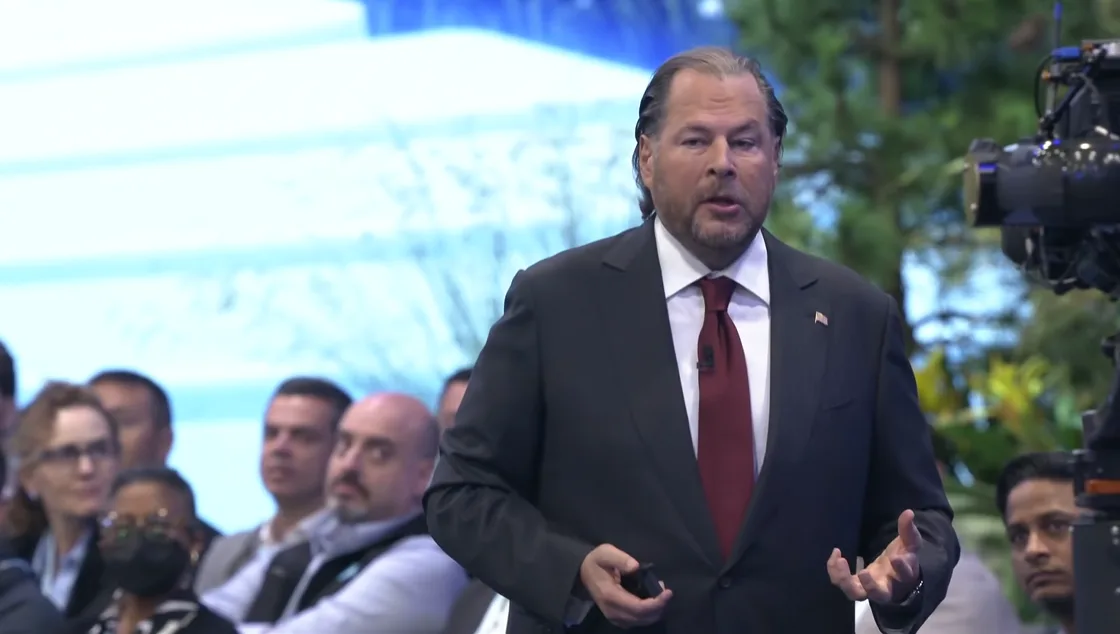
This year, Benioff seemed to be doing his best impression of a U.S. presidential candidate: black suit, white shirt, red tie, and American flag lapel pin.
These are superficial changes, and, by themselves, do not really mean much. But anyone who has been paying attention to the Salesforce ecosystem over the past few years might think them somewhat emblematic of a shift in Salesforce’s messaging, mission, and culture.
Customer Zero… And Customer One
Salesforce’s ‘Customer Zero’ policy means it tries out its own software internally before releasing it to clients. It’s a sound marketing strategy – telling your customers that you believe in your own technology so much that you run it yourself. After all, why wouldn’t you run your own software if you believe it’s the best?
In late 2024, when Agentforce was just getting started, Benioff solidified this reasoning when he took a swipe at Microsoft by, firstly, reminding the audience of the time he compared the Windows company’s Copilot AI to “Clippy 2.0”.
Secondly, he added that when you visit Microsoft’s website and look for Copilot or try to see how they’re automating their support, “you can’t find it… it’s exactly the same as it was two years ago”. Salesforce was, by comparison, using Agentforce on help.salesforce.com, Benioff said, driving home the idea that Salesforce was “eating their own dogfood”, as the cliché goes.
Salesforce is its own ‘Customer Zero’. So who might ‘Customer One’ be?
In September 2025, Salesforce launched its AI national security unit, ‘Missionforce’. Kendall Collins, the CEO of Government Cloud, said at the time that the new initiative would “harness the power of AI agents to transform U.S. defense, intelligence, and aerospace” while driving “efficiency” and delivering savings to the taxpayer.
“The goal is simple: to help our warfighters and the organizations that support them operate smarter, faster, and more efficiently,” Collins added.
While Salesforce is no stranger to government deals – having worked across the U.S. Army, Navy, and Air Force before – it did come at an interesting time for the tech industry.
Like my colleague Sasha Semjonova wrote last year, Salesforce is now competing for government deals, and Benioff even went on record to talk about Salesforce’s “tremendous success” against Palantir by winning a U.S. Government contract over them.
“The announcement of Missionforce might very well be another competitive action from Salesforce, showing investors that they have a keen focus on their government contracts and perhaps solidifying that their proprietary AI Agentforce has some credible use cases,” Sasha wrote in 2025, and that vision seems to be coming to fruition.
At the start of this year, Salesforce secured a $5.6B US Army Contract, and in July won a $1.6B, three-year Agentic Enterprise License Agreement (AELA) with the US Department of Veterans Affairs.
In short: it’s a lucrative time to be a big player in the GovTech space. Governments are looking for AI solutions, and multi-billion dollar contracts are up for grabs. Companies like Palantir, OpenAI, and Salesforce need to make themselves as appealing as possible to the U.S. Government if they want to secure these deals.
So, what does that have to do with Marc Benioff’s suit?
Silicon Valley Enters Its Corporate Era
Salesforce is a major corporation, and has been for years. The actions which major companies like Salesforce take are “corporate”, by definition, so it might sound redundant to say that a major corporation has “become corporate”.
That being said, major Silicon Valley businesses have typically tried to maintain an impression of being vibrant, diverse, energetic, and frankly, progressive. Benioff himself has historically been one of the louder tech sector voices on issues of equality, famously spearheading a campaign against an Indiana law allowing discrimination against LGBT people on religious grounds in 2015. He has also spoken publicly about equalizing pay for women.
This makes sense, from a business perspective, when you’re trying to attract the best tech sector talent – which is still overwhelmingly left-leaning. Of Salesforce’s five ‘core values’ – trust, customer success, innovation, equality, and sustainability – at least two of those can be said to have a progressive flavour to them (the last two). Salesforce also boasts of its ‘Ohana’ culture, emphasizing how employees, customers, partners, etc are bound together as a kind of ‘family’.
This is a kind of corporate culture. It has its defenders and its detractors, but in any case, it has a distinct Silicon Valley flavor to it, influenced by the political and cultural norms of the San Francisco area and of tech workers generally.
But Silicon Valley isn’t just crafting its culture to appeal to attract tech sector talent. It’s now competing to win the attention of the United States Government.
There is an obvious disparity in politics between the Trump administration and your average software developer. Now that tech companies need to appeal to both, what happens?
Mark Zuckerberg – who co-founded a group which previously called mass deportation of illegal immigrants “absurd” – goes on the Joe Rogan Experience wearing a gold chain to talk about ‘masculine energy’ and martial arts, and claiming that the Biden administration pressured Meta to remove information around Covid vaccine side-effects. This appearance took place in January 2025 – just as Trump’s second term was starting.
OpenAI CEO Sam Altman, who was once a major Democratic Party donor, declares himself “politically homeless”, writing on X (formerly Twitter): “I’m not big on identities, but I am extremely proud to be American.” OpenAI would go on to strike a deal with the recently renamed Department of War – shortly after President Trump said the government would not work with AI rival Anthropic.
Anthropic had reportedly been trying to negotiate the terms of its contract, wanting assurances that its models would not be used for fully autonomous weapons or mass surveillance of Americans.
Marc Benioff makes a joke about ICE at the start of the year, and at Dreamforce drops his casual look for something a Republican Congressman might wear.
So what does this mean for the ecosystem?
Final Thoughts
Salesforce is becoming laser-focused on AI, trying to get a foothold in this lucrative and reasonably secure area. This makes sense, because Salesforce has saturated a huge number of private sector industries – while Government industries have been slow to move to the cloud, making them ripe targets.
We can’t say what the true beliefs of Benioff, Zuckerberg, Altman et al really are, but we certainly can notice a pattern of behaviour from tech CEOs – which aligns with a new set of incentives.