


Salesforce Marketing Cloud has had a significant run since it officially launched in 2013. It is a product that has come a long way from its roots, now made up of several different marketing tools, including Marketing Cloud Account Engagement (formerly Pardot), Marketing Cloud Intelligence, and more.
Marketing Cloud Engagement – Salesforce’s flagship, legacy product in this space – has served as the foundation for Marketing Cloud for many years. But as the cloud continues to falter, will Marketing Cloud Next be enough to save it, or does Salesforce have other plans?
The Evolution of Marketing Cloud
Salesforce Marketing Cloud is the culmination of three high-profile acquisitions: Radian6, Buddy Media, and ExactTarget (purchased for nearly $3.5B total). Since these acquisitions came together in 2013, more companies have been thrown into the mix, including Everage and Datorama.
In 2022, Pardot, the marketing automation segment of the cloud, was renamed to Marketing Cloud Account Engagement. Although it was due to an effort to make Salesforce’s extensive product suite easier to understand, it has often been regarded as a strange choice, given the wordiness of the new name. It does have the tendency to get confusing when trying to distinguish between Marketing Cloud Engagement and Marketing Cloud Account Engagement, for example.
Since then, it has arguably become even more confusing to keep up with the advancements of Marketing Cloud. In 2024, Salesforce introduced Marketing Cloud Growth (MCG), a new tool designed for small and mid-sized businesses (SMBs) built natively on Salesforce Core. Later that year, at Dreamforce, the company announced Marketing Cloud Advanced (MCA), which offered more features than MCG.
In 2025 came the release of Marketing Cloud Next, a culmination of what Salesforce has been working towards to converge the other products listed. It’s built on their flagship architecture of the Core Platform, Data 360, and Agentforce, and means that rich marketing agent activity can interact more easily across all of the Salesforce product suite – not just confined to marketing.
A Faltering Cloud
Since 2024, Marketing Cloud’s revenue growth has been anything but consistent. In Q1 FY24, growth for Marketing & Commerce – which is what Marketing Cloud is a part of – sat at 7.4%. By Q2, it had reached double-digit growth, coming in at 10.4%, before falling for the rest of the year.
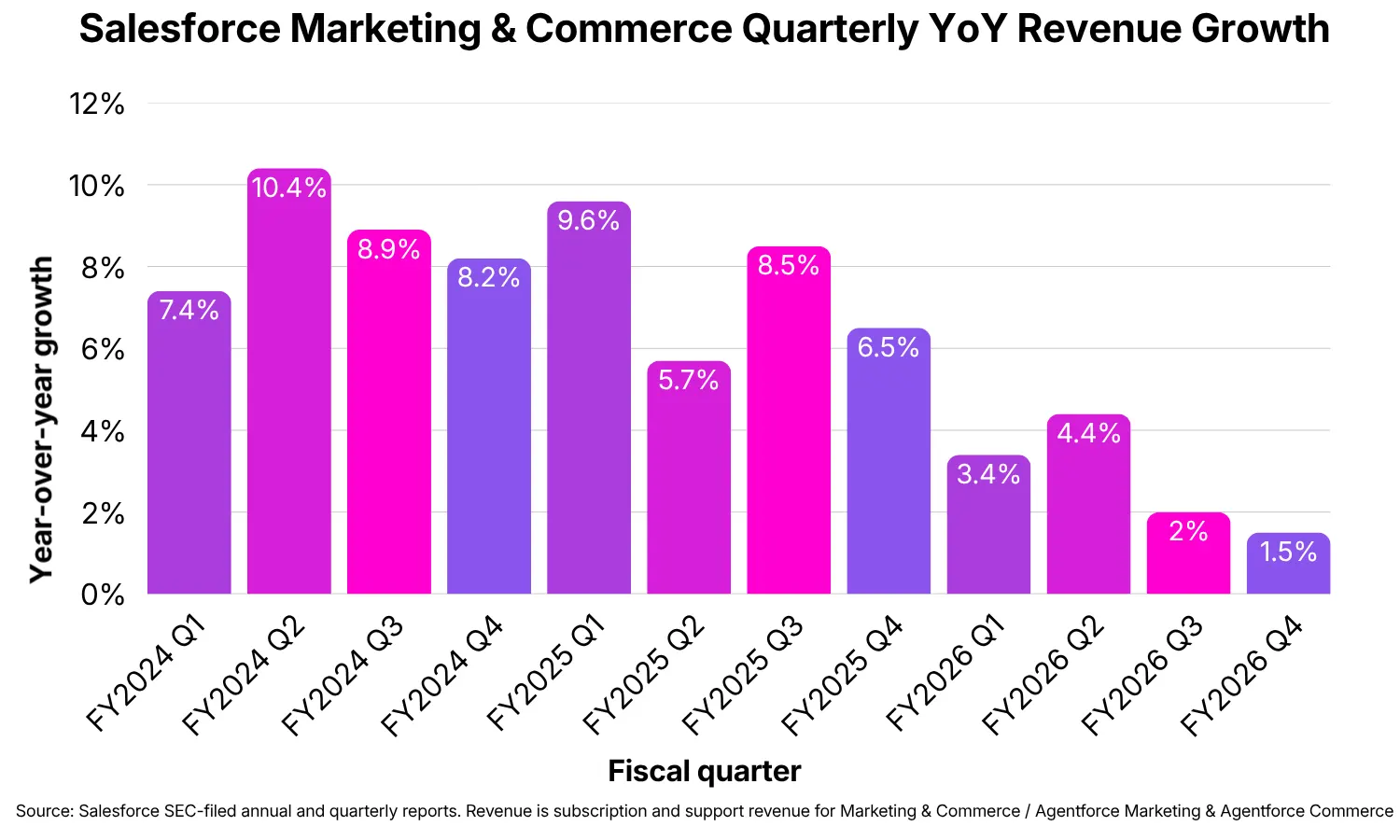
The growth has not reached double digits again since, with the closest peak coming in at 9.6% in Q1 FY25. By Q3 of that year, it had dropped and perked up again to 8.5%, before experiencing a jagged drop to the present day. Come Q4 FY26, growth had plummeted to just 1.5% – a far cry from the cloud’s former glory days.
Note: Salesforce renamed its service offerings in Q3 FY2026 to reference Agentforce, but said there was no change in revenue allocation from that rename.
In Salesforce’s latest earnings report, the situation seemingly became less rosy. This time around, Salesforce changed its reporting structure, which means it no longer breaks out Marketing & Commerce as its own revenue line; instead, it groups Agentforce Sales, Service, Marketing, Commerce, Slack, and Flex Credits into Agentforce Apps.
This, in turn, does mean that we cannot directly verify a standalone Q1 FY27 Marketing & Commerce decline from the new filing, but we can discern that management said Q1 performance was “partially offset by softness in commerce,” and that FY27 guidance assumes “ongoing weakness in marketing and commerce.”
It is natural for marketing budgets to tighten first in uncertain conditions – that’s less of a product trend and more of a macro pattern. In those scenarios, the right marketing product will act as a differentiator in the market, especially if it can deliver personalization at a level that solutions can’t match. Salesforce does have the advantage of real-time, data-driven personalization at the individual level, so there is still plenty of opportunity to turn things around if the company can instill healthy value realization in its customers during this AI era.
It is also worth noting that on the commerce side – which Marketing Cloud is bundled into as a revenue category – Salesforce has been offering e-commerce agentic solutions to multiple high-profile customers, including Williams-Sonoma. When we explored the functionality of a couple of these agents last year, there was much more to be desired, but it is likely that by the time this year’s Dreamforce rolls around, we will likely be looking at much tighter capabilities.
What Is Happening to Marketing Cloud Engagement?
The situation recently came to a head when rumors began circulating that there were plans to stop investing in Marketing Cloud Engagement.
Salesforce has clarified that this is not the case and that it is actively investing in the product. New capabilities continue to be released, including Marketing MCP Server for MCE, and multiple bridges between MCE and Marketing Cloud Next that were released in Summer ’26, including shared sending domains, shared SMS short codes, shared consent, and AMPScript support across both platforms.
SF Ben understands that Marketing Cloud Engagement customers are keeping everything they have today, with the addition of agentic capabilities. This is largely done with Marketing Cloud Next, which brings the capabilities of Agentforce to Engagement customers. These customers now have access to like-for-like editions on the new platform with a clear path for growth.
Was the Release of Marketing Cloud Next a Sign?
Similar to many other Salesforce products, Marketing Cloud could not escape the AI advancements. These advancements were brought together to create Marketing Cloud Next, which Salesforce calls “the first full-funnel agentic marketing solution that turns every channel into a two-way conversation”.
Marketing Cloud Next feels like the next step in Marketing Cloud’s journey, tapping into both Agentforce and Data 360 to create a product offering that connects to the most invested-in parts of the platform. With Next in place, there will perhaps be no need for Engagement in the future – either entirely or in its current form.
Which Areas Could Be Next?
It’s also worth noting that, among Salesforce’s recent layoffs, Marketing Cloud was one of the affected teams. According to a regulatory filing in California, 86 employees across the Agentforce, MuleSoft, and Marketing Cloud teams were affected by this round.
In its Q1 ‘27 results, Salesforce released the latest figures for revenue growth trends in constant currency. The ‘Agentforce Marketing and Agentforce Commerce’ category saw negative growth for the past two quarters. It was the only category to see a shrinkage.
The ‘Agentforce 360 Platform, Slack, and Other’ category saw an impressive 43% growth. To add a sense of skepticism, though, the Informatica and Data 360 logos sit alongside Slack and Agentforce in that section, presumably meaning they are included in the (seemingly vast) category. While we can’t read too much into any of those categories from this data alone, it seems that being lumped into this grouping alone is a positive sign for these core services.
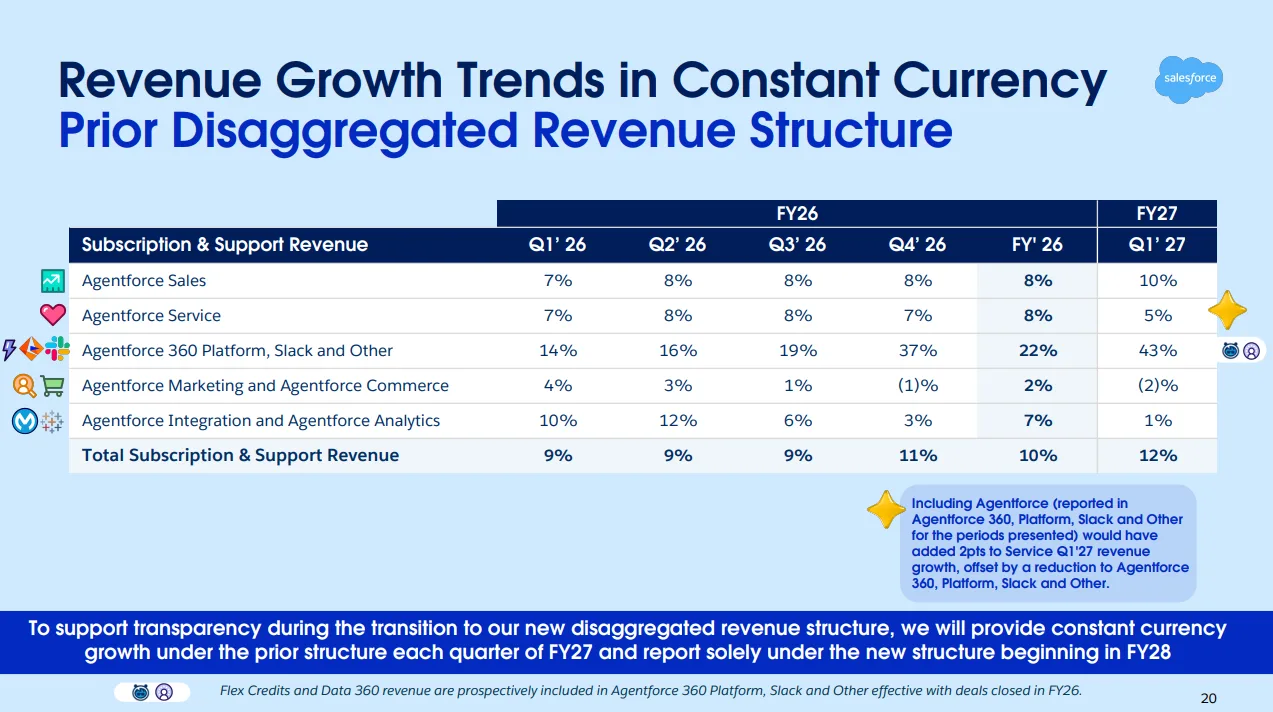
Agentforce Sales sat at 10% revenue growth in Q1 ‘27, while Agentforce Service sat at 5%. These two are mainstays of the Salesforce portfolio, and are not going anywhere soon – even if Service has seen a slight drop over the past few quarters.
But ‘Agentforce Integration and Agentforce Analytics’ stood at 1% in Q1, dropping steadily from its recent high of 12% in Q2 ‘26. While it seems unlikely that anything under the banner of ‘Agentforce’ will face that much internal scrutiny from Salesforce, it’s worth bearing in mind that some of those reported job cuts were for Agentforce.
Final Thoughts
Although Salesforce continues to invest in Marketing Cloud, there appears to be a disconnect between the investment and the returns.
Salesforce and its investors will be closely monitoring the ongoing Marketing Cloud situation, as its future performance will likely influence the way the cloud operates going forward.