
Salesforce has announced the general availability of Slackbot, which will be rolled out to Business+ and Enterprise+ customers through a phased period beginning yesterday, and continuing throughout January and February.
In a statement released on January 13, the CRM giant said the new version of Slackbot will be gradually rolling out to customers on certain plans, while Org Owners and Admins on Enterprise plans could set specific Slackbot access permissions (or restrict access to Slackbot entirely) until February 10. Let’s take a look at what’s new and what this means.
What’s New With Slackbot?
At Dreamforce ‘25, Salesforce said that, as Slack continued to evolve as the “Agentic OS” (Agentic Operating System), it was now the main workspace for humans and agents alike.
A reimagined Slackbot, which acts as a personal AI companion, summarizing threads, drafting messages, and surfacing Salesforce insights, was announced.
Using a new Model Context Protocol (MCP) – which is what enables multi-agent interoperability, allowing different AI agents to talk to each other – Slack would be able to connect with third-party AI tools like Anthropic and OpenAI.
During the Slack keynote, Parker Harris said Salesforce was “reengineering all of Salesforce to be Slack-first”, which was already evident through generally available features, including readily available Agent Employee Templates; a pre-built agent called Slack Channel Expert; and Salesforce Channels, which brings Slack conversations into Salesforce record pages.
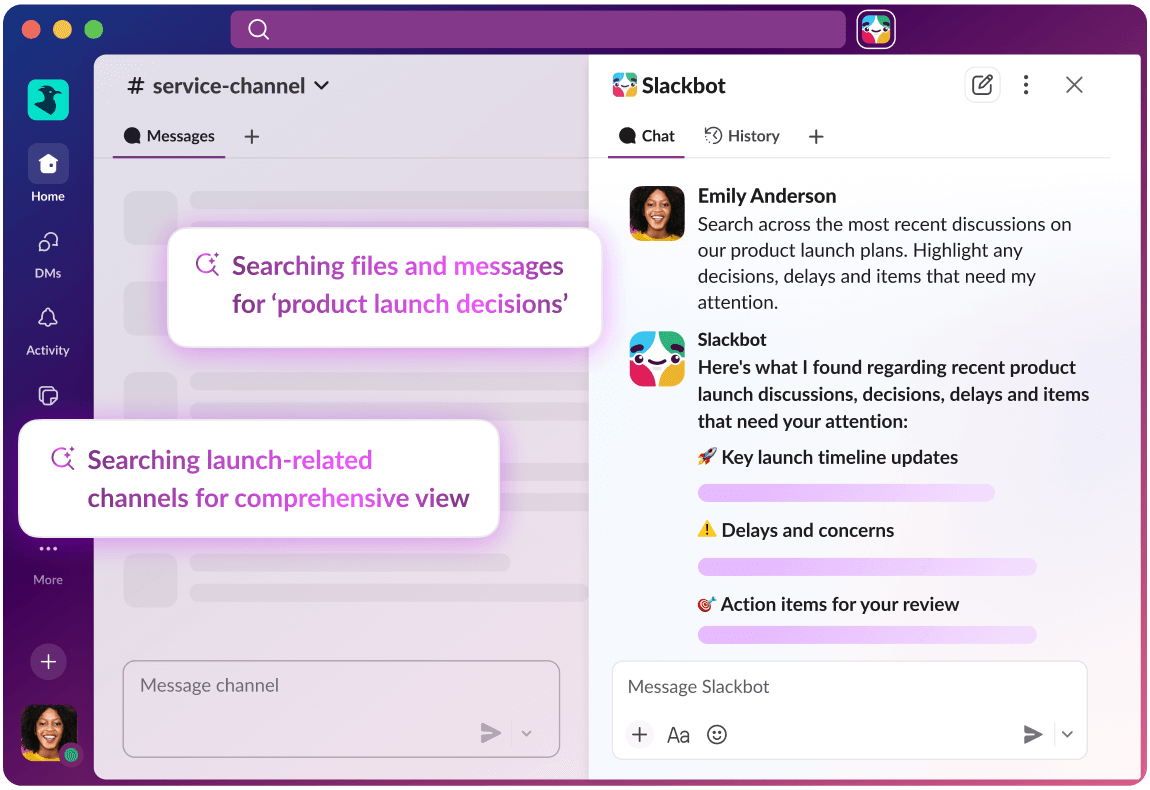
Slack had already been packed with AI functionality, with each paid Slack plan including AI features – which varied depending on your package – from the get-go.
But it was also revealed that Slackbot would become a personalized AI companion, grounded in all of your enterprise data and able to generate next steps, answer questions, and trigger actions.
“The idea is simple: Use Slack’s intuitive, familiar UI to connect every employee with reliable intelligence grounded in conversational data, customer data, and metadata, and deterministic workflows,” Salesforce said in a statement to investors on January 13.
“By bringing the full power of the Agentic Enterprise, where billions of workplace conversations already happen every week, working with enterprise-grade AI becomes as natural as talking to a coworker.”
Salesforce says that Slackbot is now a deeply personal agent for work, built directly into Slack, making use of the context you already have, and working with the tools and information you “already trust” in Slack, all while “always respecting” permissions and access controls.
It can help Slack users find answers, organize work, create content, schedule meetings, and take action – all without leaving Slack.
“There is nothing to install, nothing to learn, and nothing new to manage,” Salesforce says.
Of course, Salesforce also mentions that “soon”, Slackbot will be the best way to collaborate with Agentforce and third-party agents, with a simple, conversational UI triggering actions and orchestrating workflows, grounded in business intelligence and trusted data.
“Slackbot Already Knows You”
Whether AI can really be trusted to complete sensitive tasks has been a concern that has held back enterprise AI adoption, Salesforce admits.
The solution – or at least part of the solution – is context, the company says. The AI needs to understand what you are working on, who you are working with, what is important, and what is not, all while respecting permissions, protecting data, and not disrupting workflows.
Salesforce says: “Most agents fall short here. They live in separate apps, fragmenting attention as people constantly switch between tools. They start from zero context. They make you explain yourself over and over again. The capabilities may be impressive, but they do not earn your trust. Slackbot is different – built directly into Slack for every employee, with no setup or training required.
“Most importantly: Slackbot already knows you.”
This last line, which Salesforce highlighted in bold to emphasize, might be seen as a little disquieting by privacy-minded people. But, for the AI-forward enterprise, it does certainly seem like a benefit. If you’ve been working in Slack all this time, all of that data is now context for the AI assistant.
Slackbot is meant to understand your conversations, files, channels, and colleagues most relevant to your role, seeing what you can see, while Salesforce stresses, “always respecting your permissions and access controls”.
The built-in context makes Slackbot accurate, relevant, and useful for helping “real work” get done.
Parker Harris, Co-Founder, Salesforce & Chief Technology Officer, Slack, said: “Slackbot isn’t just another copilot or AI assistant. It’s the front door to the Agentic Enterprise, powered by Salesforce.
“This brings AI that is grounded in your company’s data, workflows, and Slack conversations, right into the flow of work. It is the crucial step to realizing the future we’ve been building toward – bringing Agentforce 360 to life with an intuitive, conversational interface, and elevating every human with enterprise-grade AI.”
Christine McHone, Global Enterprise TMT Leader, Slalom, said: “Slackbot is like a brilliant colleague who is always available and already understands our business. Instead of switching between apps and losing my train of thought, I can stay in Slack and keep moving. It has completely changed how efficiently I work.”
Final Thoughts
In a long feature piece outlining how people at Salesforce are using Slackbot, the company writes that the product “just works, with no setup needed”. This is quite a bold phrase, and techies might remember it as a favorite of Steve Jobs when talking about Apple products. It could be said to be tempting fate somewhat, because, even when cases of it not working are minor and infrequent, it can be quite embarrassing for a company to admit that, yes, sometimes, it doesn’t just work.
It is a phrase perhaps akin to a scene in the movie Titanic when a character insists, “It is unsinkable, God Himself cannot sink this ship”. If life were a movie, saying something “just works” would be foreshadowing. But reality lacks these narrative arcs, and sometimes, things do just work. Let’s hope Slackbot just works.