






One of the most significant selling points of artificial intelligence is its ability to replace or automate work. Perhaps more significant is its potential to replace or automate – the knowing that what may not be possible today could be possible tomorrow.
By now, we’ve seen arguments over whether AI can replace jobs, teams, workflows, and even entire software programs, but in the world of Salesforce, there is one tool for which the replacement question remains unanswered. That tool is Flow Builder.
Has Flow Already Met Its End?
There is no denying the impact that Flow has in the realm of Salesforce automation. With nearly 15 years of advancements, upgrades, and new capabilities under its belt since Spring ‘12 when Salesforce first released the first Flow “builder” (Cloud Flow Designer), it’s safe to say the tool has some history.
Since Spring ‘19, the tool has officially been known as Flow Builder, and it has been a well-loved tool in any admin’s toolkit. But with time comes change, and there has been no bigger change in the last seven years than the mass introduction of AI.
When Salesforce announced Agentforce in September 2024, the company’s trajectory changed forever. Salesforce was no longer just a CRM – it became an agentic platform capable of unifying existing processes and workflows with more connected data and smarter functionality.
Its existing automation capabilities, albeit still largely impressive, were somewhat overshadowed by the goliath presence that was Agentforce and its shiny suite of AI tools.
As Agentforce navigated its hype-not-hype cycle, it became increasingly apparent that Salesforce professionals wondered where a tool like Flow fit into the mix. It is not like Salesforce forgot about it – in fact, Flow has received its own set of new agentic upgrades in the last few release cycles – and it is clear that Flow is not going to be replaced by Agentforce anytime soon.
That being said, although Flow may not necessarily be replaced by Agentforce or any of Salesforce’s own AI tools, does that mean it is also safe from replacement by other AI tools or vendors? That is a much bigger question to examine.
Watch Out For the AI Vendors
When tech leader Logan Bartlett shared his and his team’s findings on the current state of the software market, one insight stood out from the rest: Salesforce automation is allegedly the most at-risk category of replacement by AI-centric vendors out of any enterprise software workflow or process.
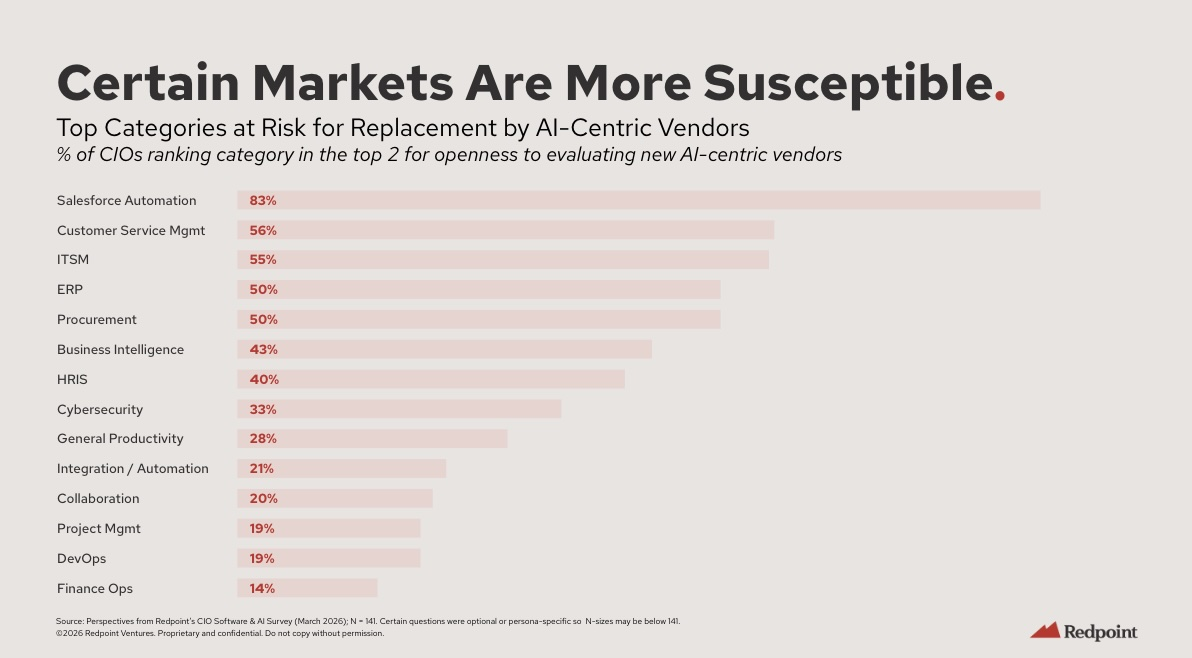
According to data from Redpoint, AI-native companies are growing faster and more efficiently than traditional software companies implementing AI, and the traditional software sector is also down 20% year to date, making it the worst-performing sector in the S&P 500.
“CIOs want to stick with their current vendors,” Bartlett wrote. “They WANT to buy AI solutions from the incumbents. The problem is their solutions suck.
“The categories most open to AI displacement, Salesforce automation at 83%, customer service management at 56%, and ITSM at 55%, aren’t random. They’re the categories where AI can do the work, not just assist it.”
Salesforce’s saving grace thus far has been that it remains a notoriously sticky software. The SaaS giant is aware that its customers will be drawn to buying its AI add-ons if for no other reason than that many of them are locked into multi-year contracts. After all, it has been the most successful CRM on the market for years – it has the advantage of meeting its customers where they already are. This is probably what has encouraged 60% of Q4 Agentforce bookings coming from expansions.
However, if another vendor can offer the same or similar solution for a better price, then the cost effectiveness will naturally be reconsidered; this is something that was explored at this year’s True to the Core session at TDX.
Not only that, but a business choosing to use AI software from a leading market vendor like OpenAI rather than Salesforce could mean that it benefits from tools and capabilities that work better for them. At that point, can Salesforce even compete?
Answering the Flow Question
So, Salesforce automation as a whole may be more at risk of replacement by AI vendors. However, this still doesn’t answer the pressing question: Is Flow in particular at risk?
Tim Combridge, a renowned Salesforce Flow expert, does not seem to think so. In his detailed post on Flow and AI skills from last year, he puts it well: “AI is evolving rapidly, but that doesn’t necessarily mean that it will rip everything that existed before it out and replace it.
“I do believe Flow is being leveraged by Agentforce, just like any other tool, if not more,” he clarified. “Salesforce is pushing it heavily, but Flow has underlying issues that many developers don’t like, and rightly so. The output is XML, which is totally unique to Flow in the Salesforce grand scheme.
“With LLMs giving users a whole new ‘UI’, so to speak, for Apex and LWC development, it does beg the question… is Flow the best technical solution, under the sheets?”
Beech Horn, a Salesforce Technology Engagement Manager and Architect, said he believes Flow isn’t even competing with AI, let alone at risk of being replaced by it.
“In Salesforce’s own Marketing Cloud Next architecture, a highly agentic, relatively new architecture, the execution layer sitting beneath the entire platform is powered by the Flow Runtime Engine,” he told SF Ben. “Not agents. Flow. AI is not replacing Flow. It is giving Flow more to do.”
He also highlighted the importance of needing to have strong Flow skills to be able to build successful agents, and those skills are “transferable from the board room to the prompt and the flow in-between.”
“Flows are the mechanism that gives agents reliable, repeatable actions to take in the world,” he said. “Weak flow-building means limited agents, regardless of which model powers them.”
Final Thoughts
When people say we haven’t had a technology like AI since the invention of the internet, I don’t think they’re exaggerating. In fact, its incredible impact is what makes the “to replace or not to replace” conversations all the more important, as we all know how widespread AI could become eventually.
However, it seems that at least for the moment, Flow remains fairly safe from replacement by other AI vendors. This will not stop some customers from trying out other automation options from other vendors, but it’s clear that Salesforce has not stopped investing in Flow, meaning that it will likely have an agentic edge that is continuously built upon for some time to come.
What do you think? Do you think this beloved tool is at risk? Let us know in the comments below.





Comments: