

The 10K Salesforce Talent Ecosystem Report has been released, with some fascinating insights into the ecosystem – and the state of the job market.
Salesforce consultancy 10k says that the Salesforce talent market seems to have “found its footing” after a few turbulent years, with “cautious optimism” returning following a steep collapse in demand in 2023 – and a partial recovery the next year.
Demand for Salesforce talent is “back in positive territory” following two years of steep decline, up 8% globally, but, as we explain below, it might be a little soon to be celebrating just yet.
Administrators
After a few years of slowing growth, administrator supply has now come surging back up 47% globally – the highest growth among all roles this past year.
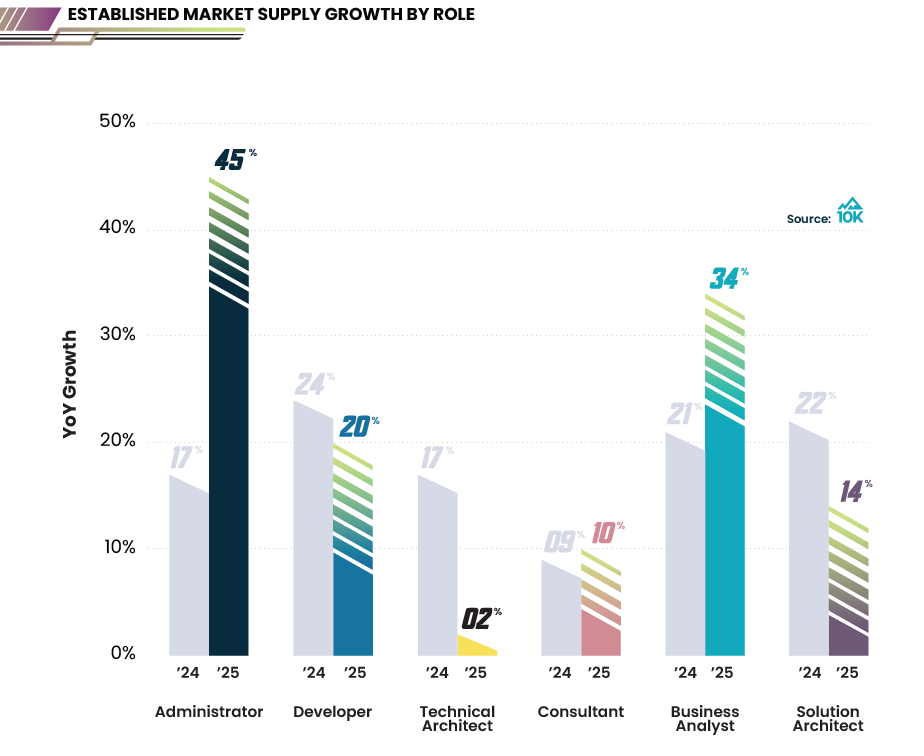
In established markets, admin supply grew 45% – compared to 17% in 2024.
North America still holds the lead in global administrator supply at 53%, but other regions are starting to catch up. Emerging markets saw exceptional admin supply growth at 63% YoY.
This year’s spike in admin supply might seem dramatic, but it reflects broader shifts in how people are entering the Salesforce ecosystem, according to 10k.
They write: “The admin role has long been the most accessible path in, and in today’s uncertain job market, it’s increasingly appealing to career changers. For many, Salesforce represents a stable, high-upside career move, and admin is the quickest path.”
Salesforce’s continued investment in free resources like Trailhead, along with a rise of boot camps, community-led study groups, and affordable certification prep, has made becoming a qualified admin more attainable than ever – but landing a job as one is a different story altogether.
Demand for the role lags behind, comparatively.
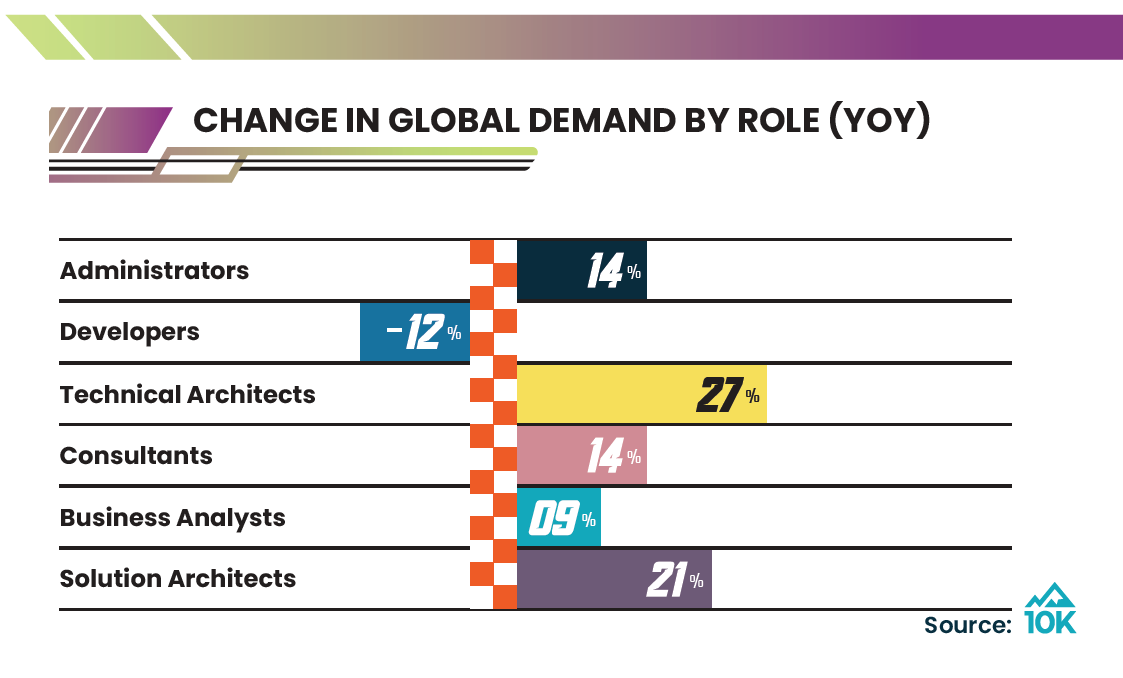
Administrator demand grew 14% globally – a welcome reversal after several down years – but hardly in pace with the 45% growth in supply.
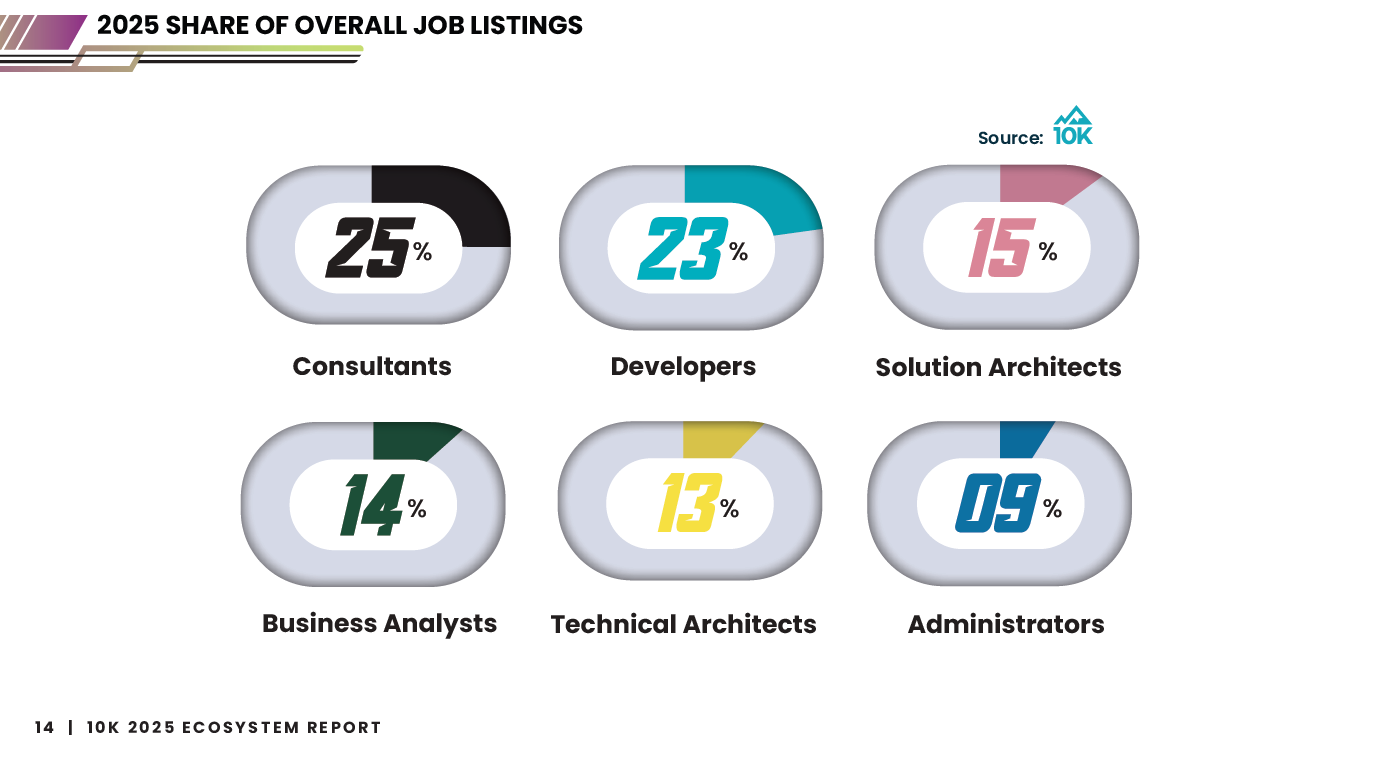
Admins account for the smallest share of job listings (9%) as the talent field continues to shift toward more specialized roles. This means that the small growth in admin demand is even less impressive in this context, as the share of jobs is dropping.
Where demand does exist, it is highly selective, with employers looking for experienced administrators who can handle complicated, multi-cloud environments. And the reality is that the role itself has grown far more complex.
As Salesforce Ben reported in a July 2025 article, the modern admin is no longer just a configurator.
The influx of new admins has outpaced the rebound in job creation, causing friction in the market. Even so, the straightforward path and brand power of Salesforce continue to attract new talent at scale.
And for admins – and other roles too – the influence of AI is unmistakable.
Salesforce’s aggressive push into AI – anchored by Agentforce – and the rapid evolution of AI tools that can write code and create metadata are already reshaping demand patterns.
Agentforce promises to embed AI assistants across the platform, changing how work is executed. While some repeatable developer and admin tasks are being automated, creating headwinds for demand in both roles, AI is simultaneously amplifying the need for strong architects, data strategists, and business analysts who can design and govern these new systems responsibly.
The 10k report features a foreboding sentence about what exactly this means for Salesforce professionals: “This makes us wonder if today’s traditional roles will still exist in five years – or will they morph into hybrid positions or new roles altogether?”
Developers
Developers maintained their lead as the largest segment of Salesforce talent, representing 44% of global supply, but that growth appears to be losing steam – down to 20% in 2025 from 24% in 2024.
While the role is growing overall, developer growth rates slowed in every market except for Asia (excluding India and China), where developer growth rates more than doubled to 41% YoY.
India continues to lead in developer supply, making up 42% of the total talent globally, with North America the next closest market for developers with 30%.
“India’s dominance reflects both the country’s strong technical education infrastructure and sustained investment in Salesforce development capabilities,” according to 10k.
But developer demand declined 12% globally. It is the only role that has seen decreased demand in 2025.
Whether the slowdown stems from AI coding assistance or oversaturation from previous years of hiring, devs still represent nearly a quarter of all job listings (23%), keeping their position as one of the most in-demand roles.
Technical Architects
Technical and solution architects are experiencing the highest demand growth, which reflects the complexity of today’s Salesforce programs and the need to rein in years of accumulated technical debt.
But these jobs remain “chronically undersupplied” – particularly technical architects, who make up just 1% of the global talent pool.
By contrast, the administrator and business analyst communities are growing at a record pace, fueled by accessible certification programs and a wave of career changers who view Salesforce as a stable, high-upside career path.
An imbalance between surging business talent and scarce technical leadership is one of the defining features of today’s ecosystem.
Technical architects (TAs) remain one of the rarest roles in the Salesforce ecosystem, making up just 1% of the global supply.
TA supply inched forward just 4% globally in 2025 – representing the lowest growth across all roles.
North America has historically (and still continues to) lead in TA supply concentration, saw its share drop from 40% in 2024 to 35% this year, underscoring the expanding footprint of TA talent, particularly in emerging markets.
While growth in established markets barely registered at 2%, emerging markets saw a significant 28% increase in TA supply, showing new pockets of talent for customers and partners to tap into.
Technical architects and solution architects were the roles with the sharpest demand, with gains of 27% and 21% respectively, highlighting a growing reliance on experienced talent to handle increasingly complex Salesforce programs.
Following years of incremental expansion and piecemeal projects, often without technical architectural oversight, a number of Salesforce orgs have become fragmented, inefficient, and difficult to scale.
The rise in demand for TAs indicates that organizations are finally recognizing the critical role architectural expertise plays in maximizing ROI and avoiding technical debt. After all, technical architect demand jumped 27% globally – the highest growth rate among all roles.
As Salesforce environments get more complex and more tightly integrated with enterprise systems – and as adoption of AI increases – the need for technical architects will likely only continue to increase.
But with supply growing just 4% globally, the imbalance for this role is extreme, creating ample opportunity for qualified professionals.
Consultants
Consultant supply held steady this year at 10% growth globally, increasing slightly from 9% in 2024.
It is interesting to note that consultant supply held steady, but the number of partners grew a lot – expanding by 25% to more than 3,700 firms, with the fastest growth coming from small, highly specialized partners.
This is arguably a result of layoffs in the industry and people joining smaller partners.
“As organizations continue to prioritize business efficiency and targeted transformation over full-scale implementations, the consultant role remains essential,” according to 10k.
But, its flat supply growth reflects a more measured pace, perhaps reflecting shifting career pathways, with more professionals transitioning into adjacent roles like business analysts or solution architects – or operating independently as on-demand experts rather than joining traditional partner firms.
As Salesforce customers keep seeking strategic guidance, 10k expects consultant supply to remain steady – though its structure and delivery may evolve further.
Consultant demand grew 14% globally, representing the greatest share of job listings (25%).
The role has evolved over time, with most opportunities now requiring deep specialization in specific Salesforce products or industries.
North America saw a 72% surge in consultant demand – the highest uptick by role and region. This spike happened at the same time as the rapid expansion of the Salesforce partner ecosystem, which added an estimated 40,000 new consultants and saw a 25% increase in the number of consulting partners.
“As new partners enter the market and existing firms scale, the demand for versatile, delivery-focused talent rises in parallel,” 10k writes.
“Consultants are the cornerstone of these teams – trusted to implement solutions, provide strategic guidance, and bridge the gap between business goals and technical execution.”
Business Analysts
The business analyst (BA) role saw the second-fastest growth rate after administrators, with supply surging 33% globally.
“We suspect the business analyst role has gained traction as a natural progression for administrators, and indicates a renewed focus on requirements gathering and process optimization,” 10k says.
For admins who want to boost their impact without diving into code, the BA path offers a natural next step.
The rise in business analyst certifications and more visibility of the role in partner delivery models likely contributed to this sharp increase in supply.
Globally, business analyst demand grew 9%, with the role occupying 14% of all job listings – the same share as in 2024.
This is a significant turnaround from last year’s 34% drop in global demand, suggesting an increased recognition that successful Salesforce projects need strong business analysis capabilities.
As businesses aim to better align technology solutions with outcomes, the business analyst role is gaining traction as a critical function.
Solution Architects
Solution architects (SA) saw 16% growth in global supply – a minor downshift from 2024’s 22% rise in global supply.
The role saw growth across both established markets (14%) and emerging markets (33%), with the latter showing significantly stronger expansion.
According to 10k: “Though SAs only represent 1.4% of total supply, they play a mission-critical role in large-scale implementations and complex integrations, especially via consulting partner organizations.
“This role is also a potential stepping stone into the technical architect role, so we’re watching growth here closely to see how it will affect TA supply growth in coming years.”
Demand for solution architects grew 21% globally – the second-highest increase after technical architects.
This growth follows a sharp 41% drop in 2024, putting SAs back in the running.
Solution architects now represent 15% of all job listings, an increase from 13% in 2024.
As companies restart or re-imagine stalled initiatives, they are understanding that tactical execution alone isn’t enough.
Solution architects bring the strategic oversight needed to align Salesforce capabilities with broader business goals – making sure solutions are scalable, integrated, and designed for long-term success.
Analysis
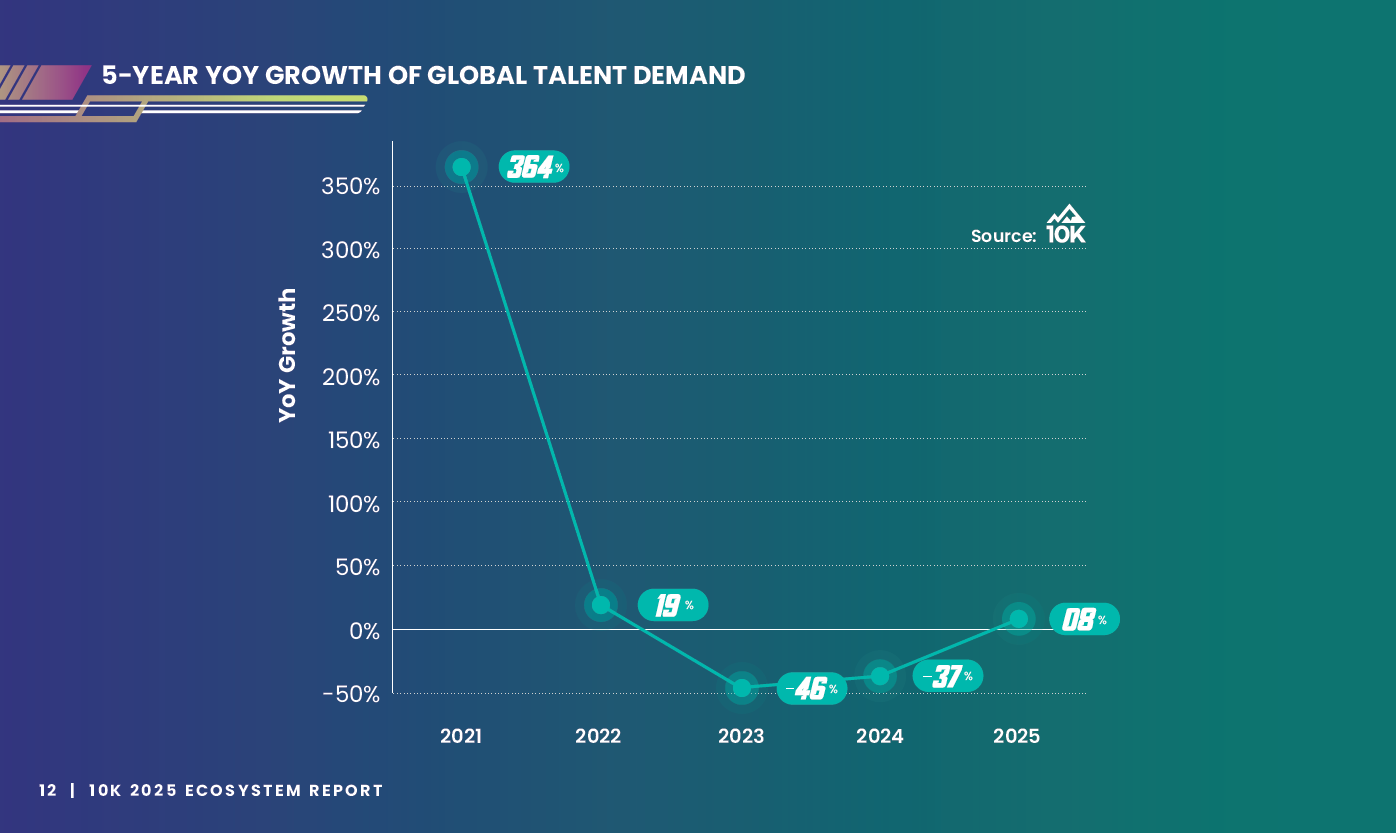
Global demand for Salesforce talent returned to positive growth this year, increasing 8% YOY.
This seems low compared to the explosive growth rate of 2021 (364%), but 10k argues it is a course correction from the steep drop-offs in 2023 (-46%) and 2024 (-37%).
It might be a signal of renewed investment in Salesforce initiatives, but it is still worth bearing in mind that the 8% growth is YOY growth – meaning, 8% up from the previous year.
So, while going back into positive figures is a good sign, it is still a far cry from those booming days of the coronavirus pandemic.
And it’s also worth bearing in mind that the recovery was not uniform across all markets and roles. Nonetheless, the breadth of improvement suggests “underlying strength rather than temporary relief”, according to 10k.
Both established and emerging markets had somewhat similar growth rates, with established markets making up 84% of the total global demand.
The demand recovery is also arguable evidence of a maturation in how organizations approach Salesforce hiring.
“Instead of the widespread hiring of previous boom cycles, companies are being more deliberate, focusing on specific roles that deliver clear ROI and fill critical capability gaps,” 10k says.
Final Thoughts
While this does represent some cautiously optimistic good news for the Salesforce ecosystem, for the most part, we must still take this with a heavy pinch of realism.
An optimist might be happy to see a headline of administrator demand growing 14% globally, but, again, next to a 45% growth in supply, it’s hardly worth cracking the champagne out at this point.
Developers, too, have reason to be slightly pessimistic, with demand declining 12% globally. Some might lay this at the feet of AI tools handling a lot of junior developer tasks. Still, an increase in demand (overall) is good news, nonetheless.