

Most Agentforce projects won’t fail because of the technology. They’ll fail because organizations underestimate what it actually takes to operationalize AI agents within their business. The question, then, is: How can organizations adapt their people, processes, platforms, and data to fully capitalize on Agentforce?
What makes an Agentforce project successful? Or better yet, what separates a production-ready Agentforce solution from one that isn’t? These are the kinds of questions that keep me up at night as a lead marketing and AI architect. Ultimately, a POC or pilot program will be judged on its tangible business outcomes, and those outcomes won’t materialize if agents never make it into production.
While researching and writing A Complete Guide to Agentforce, one theme kept resurfacing across projects and conversations with practitioners: successful Agentforce adoption has far less to do with technical capability than organizational readiness.
In this piece, I will share 10 best practices for successful Agentforce adoption.
1. Headless Agents: The Hidden Power of Agentforce
Back in 2025, I envisioned a headless future for Agentforce, and lo and behold, since TDX ’26, Salesforce has shifted its platform firmly in that direction. Headless, meaning the decoupling of the user interface (“head”) and the logic (“body”), is not a new concept, but when applied to agentic AI, it takes on new meaning.
I’m not exaggerating when I say that headless agents may ultimately become the most important architectural pattern in Agentforce.
One team I worked with in the past tried to automate lead qualification using deterministic Flow logic and custom metadata. Over time, the process became unmanageable as qualification criteria kept changing across regions, business lines, and campaigns. Having the option for a headless agent back then would have saved them significant technical debt and prevented a loss of user trust.
Replacing rigid branching logic with a headless Agentforce agent would have dramatically simplified the architecture. Instead of hardcoding every scenario, the agent could reason dynamically based on account context, engagement history, and pipeline signals.
2. Measure Business Value, Not Agent Activity
Agentforce projects often measure activity instead of impact. Teams obsess over conversation counts, response accuracy, and user adoption. While that isn’t wrong in itself, it misses the bigger picture. The real question is: How is Agentforce helping our business achieve its strategic goals?
There is a distinction between a strategic KPI and an operational metric. Both are needed, but they occupy different roles in an Agentforce project. A KPI should be tied to a measurable business benefit, such as cost savings, efficiency gains, or customer experience improvements. Operational metrics, on the other hand, look at the individual agents and the project as a whole, and consist of things like agent reliability and backlog quality.
In the book, I expand this into a full Agentforce governance and measurement framework, including implementation scorecards, operational metrics, and architectural assessment templates.
3. Data Quality Matters, Actionability Matters More
One client I spoke with had experimented with Agentforce, but their enterprise architect pulled the plug before the agent reached production. The reason was that he wasn’t comfortable handing an AI agent access to the required data. This example highlights an important reality: data quality isn’t enough.
Data, even high-quality data, is not useful if it isn’t readily accessible and understandable to an agent.
This brings me to the point that data actionability is far more relevant for Agentforce than simply quality. Based on my research, expert interviews, and professional experience, I recommend the following steps to ensure Agentforce data readiness:
- Focus on the data that truly matters for your use case, not everything available.
- Prioritize usable data over perfect data – actionability beats completeness.
- Eliminate obvious quality blockers like duplicates, gaps, and stale records.
- Give agents just enough access to act, never more than they need.
- Treat compliance and privacy as design constraints, not afterthoughts.
- Invest in clear, descriptive metadata; agents reason through context, not raw fields.
- Understand where your data comes from to maintain trust in outputs.
- Improve data incrementally; enrichment and harmonization are ongoing, not one-off.
4. Use Case Quantity Precedes Quality
Most organizations adopting Agentforce don’t have a use case quality problem – they have a quantity problem. This may sound counterintuitive, but hear me out. Say you have enthusiastic business stakeholders and a team of developers ready to go. The instinct is to ideate five to ten quick wins and hit start.
That’s exactly where teams go wrong.
The first 20 use cases you come up with are almost always the obvious ones. They feel safe, sensible, and easy to justify, but the order in which ideas surface has little to do with their actual value. More often than not, it’s the opposite: the truly imaginative, exceptional ideas only emerge after the obvious ones have been exhausted.
5. Build a Compelling Story to Secure Commitment
Most Agentforce projects die out long before the first agent is ever deployed. Nearly every expert interviewed identified poor change management as the reason promising initiatives fail before they even begin. Successful projects, by contrast, always start with organizational buy-in.
And from years of digital transformation experience, one thing is clear: nothing drives stakeholder buy-in like a compelling story.
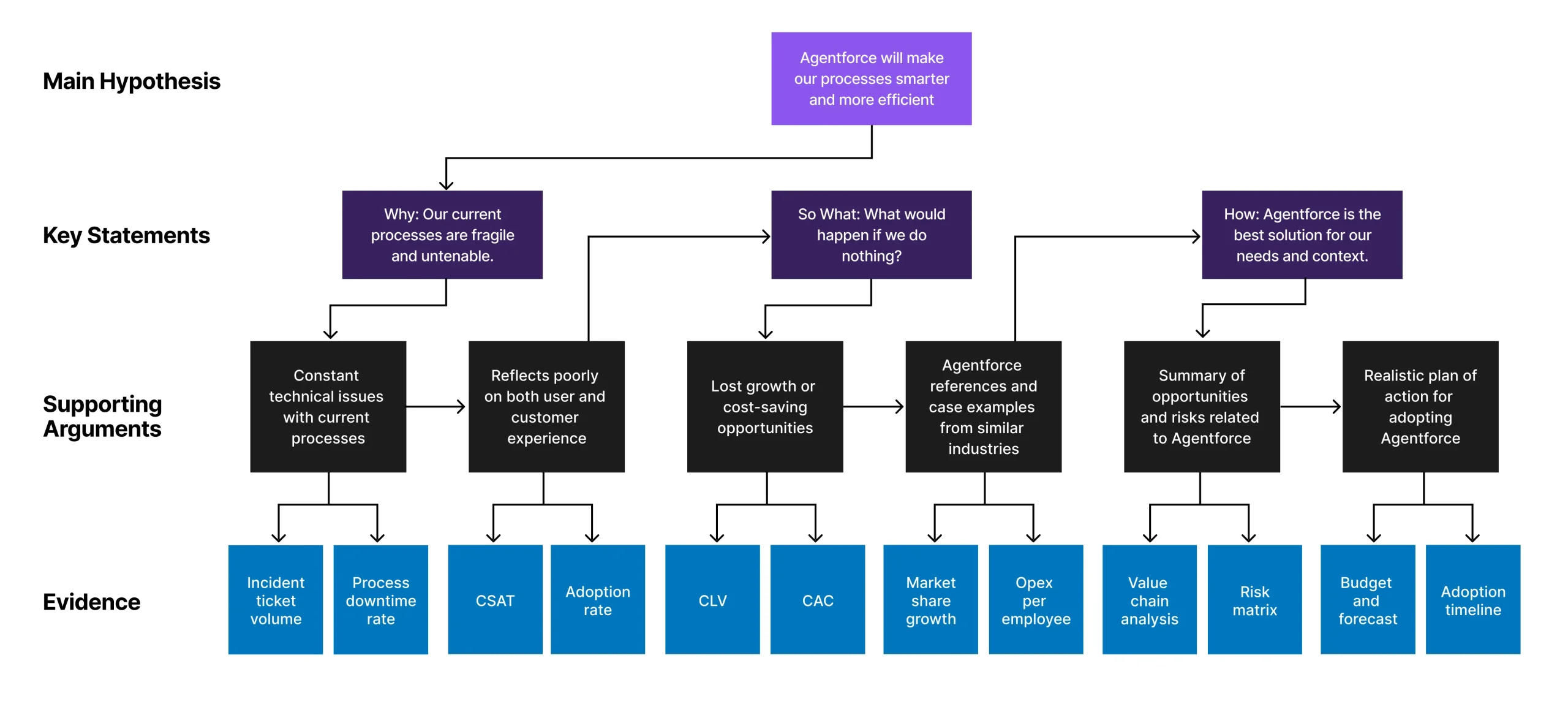
Rather than reinvent the wheel, I’ve borrowed a proven framework from business consulting and applied it to Agentforce projects: the Minto Pyramid. It offers a structured way to move from a high-level hypothesis to key statements, all the way down to facts and data. I’ve found that a simple Post-it exercise goes a long way to ensuring budgetary commitment.
Executives don’t fund an Agentforce project because of technical architecture diagrams. They fund it because they believe in the business narrative behind the transformation.
6. Ask the Right Questions Before Jumping In
Most teams immediately jump into building agents because demos create the illusion of readiness. But in practice, the difference between a successful adoption and an expensive experiment often comes down to the questions you ask before anything gets built. Too many teams start with “What can we automate?” when the better question is “What decision or outcome are we trying to improve?”
That shift may seem subtle, but it changes how you design your agents, moving from isolated automations to measurable impact.
Other questions matter just as much. Where does human judgment still need to play a role? What data will the agent rely on, and how trustworthy is it in reality? How will success be measured beyond simple activity metrics? Taking the time to ask the right questions forces clarity, and clarity is what ultimately turns Agentforce from a technical capability into a business asset.
7. Simplification: the Most Crucial Design Principle
Architecting Agentforce is ultimately about tradeoffs. At a conceptual level, you’re constantly balancing consistency (determinism) against adaptability (non-determinism). At the same time, you’re navigating competing priorities such as speed versus accuracy, depth versus scalability, and access versus security. Underpinning all of these decisions is one principle that matters more than anything else: simplification.
With Agentforce, simplification has to happen at the system level.
You might offload decision-making from Agent Script to Flow or Apex, but if agent actions turn into a tangled web as a result, little has been gained. The challenge only intensifies at scale, where tradeoffs become unavoidable. Do you design a small number of broad, flexible agents, or a larger set of tightly scoped ones? There’s no universally right answer, but overcomplicating the system is always the wrong one.
8. Latency is Your Worst Enemy
Before Agentforce, latency was often a minor nuisance, something you learned to live with as long as the automation did its job. There were exceptions, of course, such as high-volume screen flows, but latency was rarely the primary factor that broke a process.
With agents, latency becomes a constant battle you can’t fully win. Nothing destroys trust in an AI agent faster than waiting. Users have learned to cope with occasional AI mistakes surprisingly well. What they won’t tolerate is uncertainty combined with delay.
As agents mature, latency tends to creep in. Even without changes to configurations or actions, performance can degrade over time, for example, as data volumes grow. That’s why monitoring latency needs to be continuous and multi-layered, covering load times, response times, action execution, and more. Ignoring it is often the first step toward eroding trust in your agents.
9. Recurring Testing is Key
Before Agentforce, a linear testing strategy served development teams well. You would start with unit tests, move on to system integration testing and UAT, run final regression tests, deploy, and finish with a quick round of smoke tests to confirm everything worked as expected. That approach was predictable, structured, and, more often than not, sufficient.
Agentforce exposes the limits of that model. Based on my experience across multiple client environments, the reality is that no matter your level of agentic maturity, a linear testing strategy simply doesn’t hold up anymore.
Agents don’t behave consistently enough for one-and-done validation – their outputs can shift based on context, data, and even subtle changes in inputs. Keep in mind that large language models themselves get frequent updates, which affects agentic reasoning. Testing becomes continuous rather than sequential, and confidence comes not from a single test cycle, but from observing behavior over time and re-running automated tests in regular intervals.
10. Don’t Just Manage Risk; Plan for Contingencies
Salesforce makes a big deal about agent guardrails, and rightly so. One of the main reasons to choose Agentforce over connected Claude or Gemini agents is access to a full arsenal of out-of-the-box and custom-built guardrails. The Einstein Trust Layer, with its range of data protection features, combined with a least-privilege access approach, already takes you a long way. Add layers of monitoring, testing, and auditing on top, and you further strengthen your overall risk governance.
The unfortunate fact is that risk management is also subject to the law of diminishing returns.
At some point, adding more controls and processes yields progressively less value and can even start to slow you down. This is where adopting Murphy’s Law as a guiding principle becomes useful. Assume your agentic solutions will fail, because at some point, they will. The question is what happens next. What’s the potential impact, who is affected, and how quickly can you contain the damage?
Final Thoughts
Agentforce is still early enough that many architectural patterns, governance models, and implementation best practices are being invented in real time. That’s precisely why practitioners need more than feature documentation or AI hype. They need practical guidance grounded in real implementation tradeoffs.
That was my goal with A Complete Guide to Agentforce: to create the kind of resource I wished existed when I first started architecting agentic systems on Salesforce. If you’re actively planning or scaling Agentforce solutions, the book goes significantly deeper into the frameworks, patterns, and delivery lessons introduced throughout this article.
Agentforce is rapidly expanding beyond the Core CRM Platform into the broader Salesforce ecosystem, already playing a key role in Slack, MuleSoft, and Tableau. It’s on track to become a necessity rather than an add-on. This is precisely why you want to ensure that your team has both the technical expertise and operational readiness to adopt it effectively.
You can order the book as a hard copy or eBook from Springer Nature or through your preferred retailer.