








The most talked-about thing in the tech space right now is AI. Salesforce has been very active in this wave, with release after release improving on Agentforce features and making AI more accessible to the everyday admin. While we can all agree that building more knowledge and skill around AI and Agentforce seems like the smartest investment right now, what gets lost in that conversation is that you won’t be able to maximize Agentforce just on its own.
Arguably, a stronger grasp on automation (particularly Flow) is one of the best things you can do for your Agentforce journey. It can be both the engine underneath as well as the hands that carry out what your agents are built to do. And according to the 2026 SF Ben Salesforce Admin Survey, less than 60% of admins feel fully confident using it.
In this article, we’ll look at what the data actually says about where the community stands with Flow Builder, why it’s significant in a world that’s moving toward Agentforce, and what skills you’ll want to build to close that gap.
A Closer Look at the Numbers
The survey asked over 1,100 Salesforce professionals how confident they feel designing and building flows, and 56.8% said they were confident or very confident.One quick look tells us that’s the majority. But when you break that number down by experience level, it becomes more interesting and gives us a sharper picture of the current situation.
Looking at advanced admins in particular, 76% feel confident with Flow Builder. As for intermediate admins, only 36% can say the same, and an even lower number of entry-level respondents (20%).
This makes sense because the majority of the survey respondents are actually experienced admins. Intermediate and advanced levels make up nearly 90% of respondents combined. The headline confidence stat is a ceiling that only a specific tier of the community has reached.
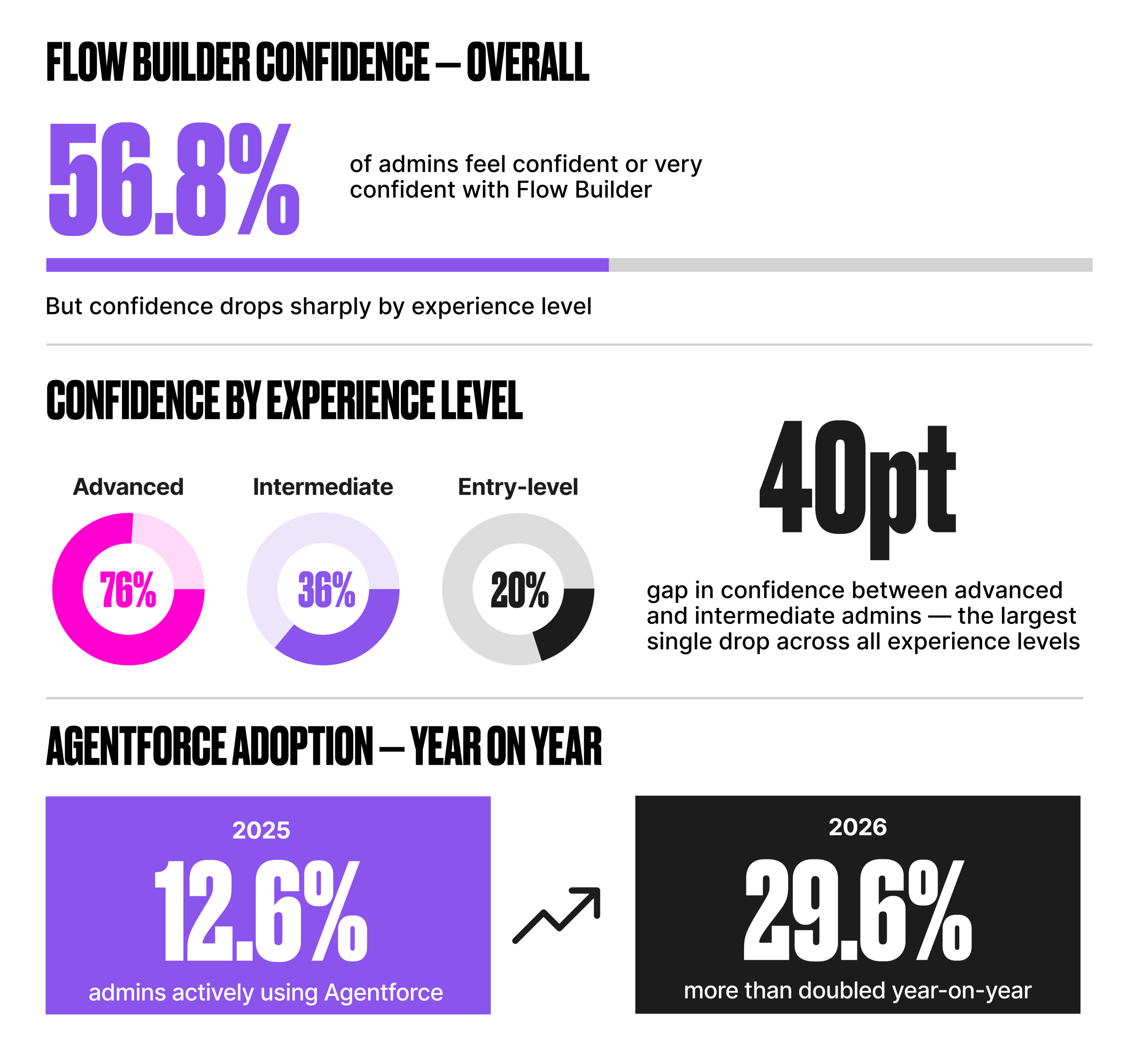
Meanwhile, Agentforce adoption among developers has more than doubled year-on-year, climbing from 12.6% to 29.6% of admins actively using it. This shows demand for the skill is accelerating rapidly, but the confidence in the foundational tool it depends on is not really keeping pace.
Why Flow Builder Is Non-Negotiable for Agentforce
When you hear Agentforce, I’m sure the first things that come to mind are AI, agents, prompts, autonomous actions – basically everything agent-related. Flow seems a bit far off, sitting on the traditional automation side of things. But neither is manual in any shape or form, and Agentforce does relate to and rely on Flow more than most people realize.
Why? Because Flow shows up on both sides of the Agentforce equation.
On one side, agents are orchestrated through flows. When a process needs to work through a sequence of steps, like multiple agents making decisions, branching logic, and coordinating what happens next – Flow is what strings all of that together.
You can say it’s the engine underneath. This year’s TDX even had a full session on orchestrating agents with Flow. On the other side, when an agent needs to actually do something, it can also call a Flow as an action. Your flow now becomes the agent’s hands.
So when you think about it, Flow Builder skills don’t just affect one part of your Agentforce work. A skill gap in Flow limits both how well you can design agentic workflows and how much your agent can actually execute.
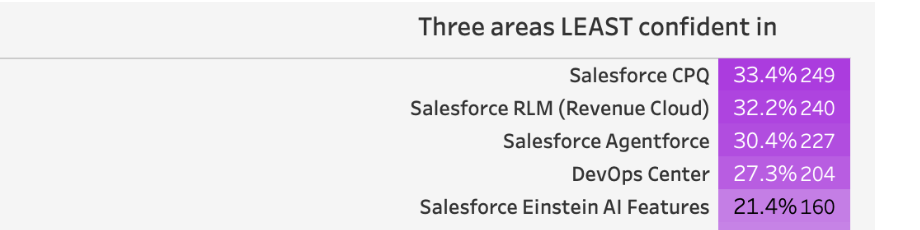
The 2026 survey data reflects this. Agentforce has already entered the top three areas admins feel least confident in (30.4%), knocking DevOps out of that position from last year. That’s understandable, as Agentforce is new enough that most people are still finding their footing.
But Flow Builder? Flow has been around for years – well before the retirement of Workflow Rules and Process Builder – and a meaningful chunk of the community still hasn’t fully gotten there.
A closer look at the data shows Flow Builder ranks as the second area admins feel most confident in across the entire platform, and yet fewer than 60% feel fully confident using it. This seems like a contradiction, but that’s exactly the problem. The skill the community has invested in most still has significant room to grow, and Agentforce is about to make that very visible.
The Actual Flow Challenges
The main point in the survey is the confidence level, but in an attempt to dig deeper, it also asked what specifically makes Flow hard. The top three challenges were:
- Debugging errors (34%)
- Understanding complex logic (32%)
- Ensuring maintainability (30%)
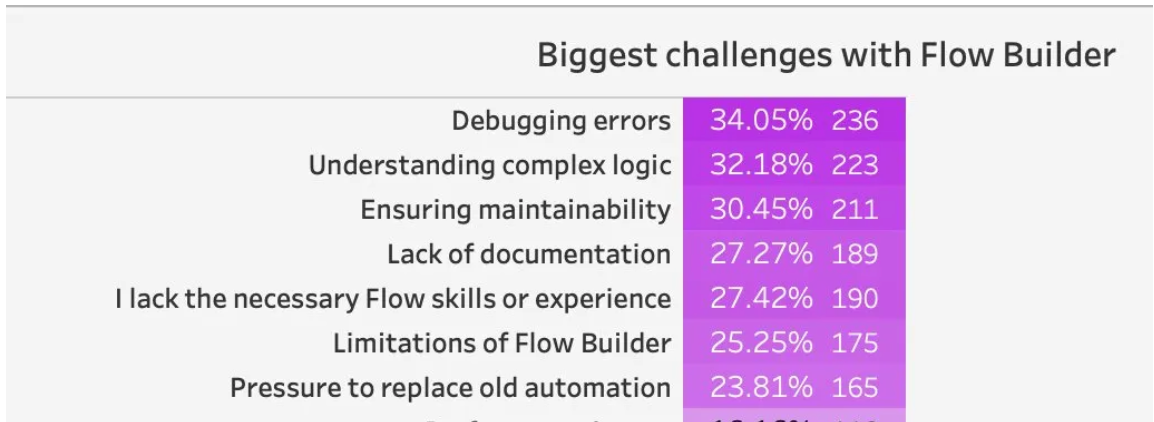
There’s a common denominator I’ve noticed here, and it’s not related to the actual building or even figuring out where to start. The real challenge appears to be further downstream, coming after the main build – experiencing issues, and then not being able to fix them or sustain the flow as it scales.
These skills are also precisely the skill profile Agentforce will stress-test. Agents are far less predictable in behavior (yes, even with Agent Script). They may trigger flows in ways that are harder to predict and harder to debug than a standard record-triggered automation.
Your Flow Skills Gap Assessment
If you’ve come to this part and are not sure where you sit, I’ve put together a checklist to go through. It’s a quick way to think about your Flow-Agentforce expertise across four tiers:
- Foundation: The basics, such as flow types and elements. You can build a working flow from scratch for a straightforward use case.
- Intermediate: You’re comfortable with using subflows, collection variables, loops, and establishing fault paths. You’ve built screen flows as well as understand error handling well enough to build it intentionally.
- Advanced: You can expose a flow as an Agentforce action, design input/output variables with AI consumption in mind, and write flows that are testable, maintainable, and bulkification-safe.
- Agentforce-native: You’re integrating flows with Prompt Builder, defining agent action metadata, and thinking about how automation chains together across the full agentic loop.
Most of the admin community is somewhere between Foundation and Intermediate. Between Intermediate and Advanced is where the smooth connection between Flow and Agentforce sits.
Where to Go From Here
Once you know your tier, the next move is pretty straightforward. It’s time to lock in and close the distance between where you are and where Agentforce needs you to be.
Trailhead is genuinely the best and most beginner-friendly starting point here ), and the good news is that Salesforce has already built resources specifically around Flow and Agentforce working together.
Note: You may also want to explore our 90-day Flow Learning series to get you acquainted with Flow basics in just under three months!
If you’re at intermediate level, Make Your Flows Agent-Ready lets you discover best practices for designing effective flows for agent actions. From there, Add a Flow as an Agent Action gets you hands-on with attaching those flows to an actual agent. If you’re ready to go deeper and test yourself properly, the Advanced Flow for Agentforce Superbadge can become your ultimate proving ground.
On the SF Ben side, we’ve been covering Flow consistently through the years, and there’s a lot to dig into. Our resident Flow expert Tim Combridge’s Complete Guide to Salesforce Flow is a solid reference if you want to pressure-test your Foundation knowledge, and if you want to see where Flow is heading with each release, the Summer/Winter/Spring release Flow features breakdowns are worth going through to keep yourself updated with everything Flow-related that Salesforce has shipped in these past releases.
And if you haven’t already, it’s also worth looking into the Agentforce Specialist certification. The 2026 survey shows 32.4% of admins have already taken it, and another 26.8% are planning to, with the primary reason being – you guessed it – futureproofing.
Wise to pair that cert path with genuine Flow depth so you’re not just checking a cert off your list, but actually building on what the cert is supposed to represent.
Final Thoughts
The admin survey gave us plenty of insights, painting a picture of a community that’s self-aware and knows how important Flow Builder is, but hasn’t quite kept pace with how crucial it’s actually become.
Agentforce isn’t going to wait for confidence levels to catch up. Some orgs are already looking into it, while some others are already adopting it, with their admins already being asked to build with it. What sets you apart as someone who will thrive in that environment isn’t necessarily the amount of certs you have or whether or not you’re an Agentblazer – it’s taking Flow skills seriously enough to get genuinely good at it. If that’s not you yet, it’s not too late! There’s an opportunity to catch up, but the window to close it before it becomes a career constraint is narrower than it looks.