








Tech sector giants including Amazon, Microsoft, ServiceNow, and Google have reported a range of hot and cold Q2 results this year – with interesting implications for Salesforce.
The mothership will be taking an interest in how their rivals and partners are doing, and those of us in the ecosystem would likely benefit from knowing which way the wind is blowing too. Here’s what the Q2 tech results mean for us.
Amazon: Stocks Drop Despite Steady Growth
While Amazon’s Q2 earnings met expectations from Wall Street, painting a generally decent picture overall, investors are reportedly concerned about Amazon Web Services (AWS) – the tech giant’s cloud division, which is partnered with Salesforce.
AWS’s revenue rose 17.5% YOY to $30.9B – an impressive figure at first glance, and in line with its 17-19% result in recent quarters.
But in recent quarters, Google Cloud grew 32% to $13.6B, and Microsoft Azure grew by 26% to $29.9B, Yahoo Finance reports.
A five-day view of Amazon’s stock price, from July 30 to August 5, shows an 8% drop to $213.06, down from $231.61.

Tom Forte, an analyst for Maxim Group, said that Microsoft is capturing a considerable share of the generative AI market through its OpenAI partnership, but it was still important to consider that Amazon has the larger business, so it’s “not surprising” that Microsoft has a faster growth rate.
Microsoft: A Rosy Picture for Salesforce Rival
While Salesforce and Amazon have something of a partnership going, the mothership’s relationship with Microsoft is a little less rosy.
Salesforce CEO and Founder Marc Benioff has been somewhat vocal about his disdain for Microsoft’s Copilot – which he compared to Clippy 2.0 last year.
In December, Benioff also called out Microsoft for not utilizing Copilot on its website, implying they are not quite “eating their own dogfood” to the same degree as Salesforce is with Agentforce – which is on help.salesforce.com.
Given the CEO’s prodding of Microsoft, he may be somewhat dismayed at their blockbuster Q2 earnings.
A snapshot of the results shows:
- Revenue increased $7.6B (12%), driven by growth in Intelligent Cloud and Productivity and Business Processes.
- Intelligent Cloud revenue increased, driven by Azure.
- Cost of revenue increased $2.2B (11%), driven by growth in Microsoft Cloud, partly offset by Gaming.
- Gross margin increased $5.4B (13%), driven by growth across “each of our segments”.
- Microsoft Cloud gross margin percentage decreased to 70%, driven by “scaling our AI infrastructure”.
- Operating expenses increased $815M (5%), driven by investments in cloud engineering.
- Operating income increased $4.6B (17%), driven by growth across each segment.
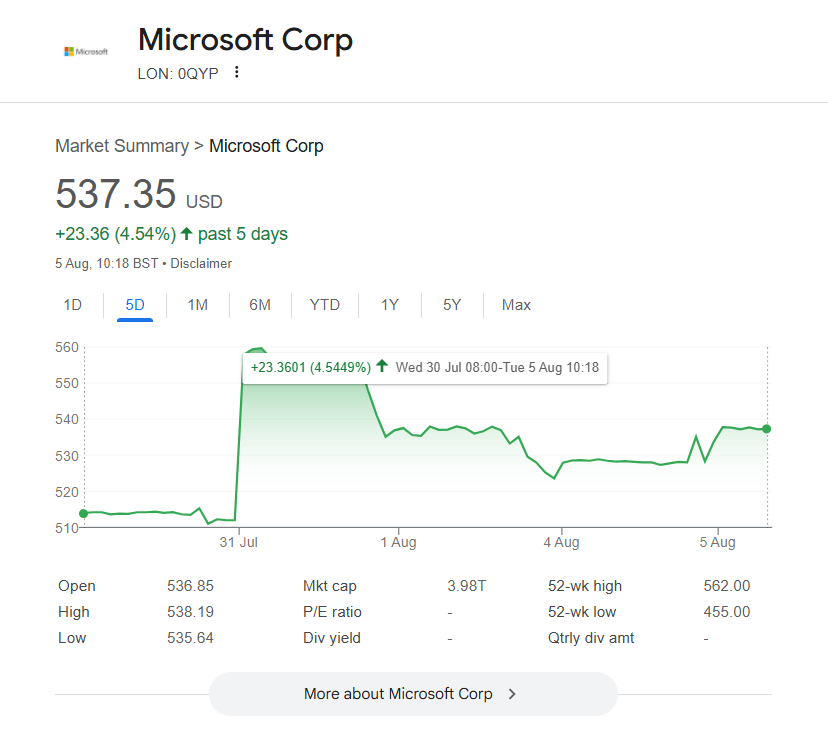
Microsoft’s stock rose 4.5% to $537.35 in the five days from July 30 to August 5.
ServiceNow: Another Rival Doing Well
In late July, ServiceNow revealed an impressive set of second-quarter financial results, due in part to a boost from artificial intelligence.
The ITSM platform reported total revenues of $3.2B – representing 22.5% year‑over‑year (YOY) growth, or 21.5% in constant currency (CC).
The company also increased its annual subscription revenue forecast to between $12.78B and $12.80B – exceeding prior expectations of between $12.64B and $12.68B.
Chairman and CEO Bill McDermott told MarketWatch that AI had underpinned the recent results, with artificial intelligence deals up 50% sequentially in the second quarter.
Driving the point home somewhat, he said: “The AI revolution is in full flight and knows no boundaries.”
Google: More Bumper Results
Earlier in July, Google’s parent company, Alphabet, reported second-quarter profits of $28.2B – on $96.4B in revenue. The tech giant’s figures topped expectations, with artificial intelligence said to be bolstering every part of its business.
Google is also reportedly planning to spend $10B more than it previously had intended this year on capital expenditures as it makes investments to meet increasing demand for cloud services.
Alphabet Chief Executive Sundar Pichai said: “We had a standout quarter, with robust growth across the company. AI is positively impacting every part of the business, driving strong momentum.”
Features like AI Overviews and the recently launched AI mode are “performing well”, according to Pichai, with revenue from search growing by double digits in the quarter, AFP reports.
Alphabet said that ad revenue at YouTube continues to grow, along with the video site’s subscription services, while the company’s cloud computing business is on pace to bring in $50B over the course of the year.
Pichai said: “With this strong and growing demand for our cloud products and services, we are increasing our investment in capital expenditures in 2025 to approximately $85B and are excited by the opportunity ahead.”
Analysis: What This Means for Salesforce
Salesforce is its own beast, but senior figures at the company will no doubt be watching the results of rival tech giants – particularly in areas like AI and cloud technology – with great interest.
Salesforce’s ‘Hyperforce’ project saw it move away from private data centers into a partnership with public cloud infrastructure providers like Amazon Web Services (AWS), helping ensure full compliance with local security and data storage regulations, so customers worldwide can store data according to regulations specific to their industry, geographical location, or company.
So, the slower growth of AWS, when compared to Google and Microsoft – arguably some of Salesforce’s fiercest rivals – could arguably prove to be something of a hindrance for Salesforce’s cloud scaling strategy, moving forward.
Salesforce partners with Amazon in a number of ways, including through Amazon Eventbridge – an event integration service which lets customers build applications that subscribe to events from any participating SaaS product without having to write undifferentiated connection code.
But while customers want to make sure the basket holding their eggs, so to speak, doesn’t have its bottom fall out, it might be that one quarter’s results are not enough of a warning signal to really be worth noting.
And, ultimately, if results continue to be less than ideal, it is arguably worse news for Amazon than it is for Salesforce – which always has the option of strengthening ties to other partners.
The success of AI and cloud-focused rivals like ServiceNow and Microsoft could mean fiercer competition for Salesforce in the long run.
Microsoft specifically mentions its cloud services as driving its growth, while ServiceNow CEO Bill McDermott quite pointedly mentioned an “AI revolution” in comments made following his company’s strong results.
With such intense competition, Salesforce could well be feeling the pressure soon in terms of enterprise deals.
We could also see a renewed vigor from Salesforce to prove that its own AI capabilities – namely Agentforce – are yielding similar results, not just in terms of what the agents can do, but how this product is affecting the company’s bottom line.
Salesforce is slated to announce its fiscal Q2 2026 earnings results on August 27.
Final Thoughts
At first glance, it may seem like bad news for Salesforce, with their biggest rivals performing so well, but it’s important to bear in mind that there is another side of the coin.
A boost for AI and cloud services among its rivals could be a strong signal that there is significant growing demand for these areas – and Salesforce might well capitalize on this even more than its competitors.
We will be keeping a keen eye out for Salesforce’s next quarterly results which will be a strong indication one way or the other as to whether they are doing everything they can to capitalize on the apparently fierce demand for services they provide.