

Most CRM implementations, like Salesforce, are excellent at digitizing how contracts are created, approved, and stored. But the moment a contract is executed, the process becomes remarkably manual again, or scheduled reports. Renewal dates are tracked in spreadsheets, SLA (service level agreement) deviations are discovered weeks late, and pricing adjustments require human intervention.
This disconnect between contract intent and business execution is where organizations lose revenue, compliance lapses occur, and operational risk grows.
A modern enterprise cannot depend on static document-only CLM (contract lifecycle management) models. Instead, the CRM/CLM architects are moving toward event-driven and AI-enabled contract lifecycles wherein contracts are modeled as intelligent systems that listen, interpret, and act in real time.
This article outlines the practical framework for transforming CLM using AI agents and EDA (event-driven architecture) in a way that contracts no longer sit idle in storage but actively drive automation across the CRM, such as Salesforce.
Why Traditional CLM Fails After Signature
Classic CLM tools do a solid job on the front half of the lifecycle. This includes:
- Building from templates and clause libraries.
- Routing for approvals.
- Managing redlines.
- Capturing signatures.
- Storing final versions.
The problem is the back-half – post-signature execution. Here’s what usually happens:
- SLAs are checked through monthly reports.
- Pricing changes are implemented manually.
- Compliance tasks sit in email threads.
- Obligations are tracked in Excel or personal to-do lists.
- Renewals depend on calendar reminders.
From an architectural point of view, CLM is out of sync with the rest of the stack. CRM/Salesforce, MuleSoft/ESB, and the surrounding landscape are real-time – contract execution is not. That gap is where revenue leaks, risk increases, and customers feel friction.
A New CLM Paradigm: Event-Driven and AI-Enabled
To fix this, we need to stop treating a contract as “that PDF attached to a record” and start treating it as a set of rules and conditions that can be evaluated by software.
Think of a contract as a bundle of:
- Renewal rules (dates, notice periods, auto-renewal conditions).
- Pricing rules (tiers, indexes, volume triggers, rebates).
- SLA definitions (uptime, response time, penalties).
- Compliance triggers (reports, submissions, certifications).
- Milestones (deliverables, dates, volume commitments).
Once those are expressed as structured data, they can plug directly into an event-driven architecture:
- Events happen (e.g. usage goes up, uptime drops, a date passes, or a file changes).
- AI agents evaluate those events against contract rules.
- Salesforce automations run the right workflows.
At that point, the contract stops being a dead document and becomes a living system.
The Framework: CLM With AI Agents and Event-Driven Design
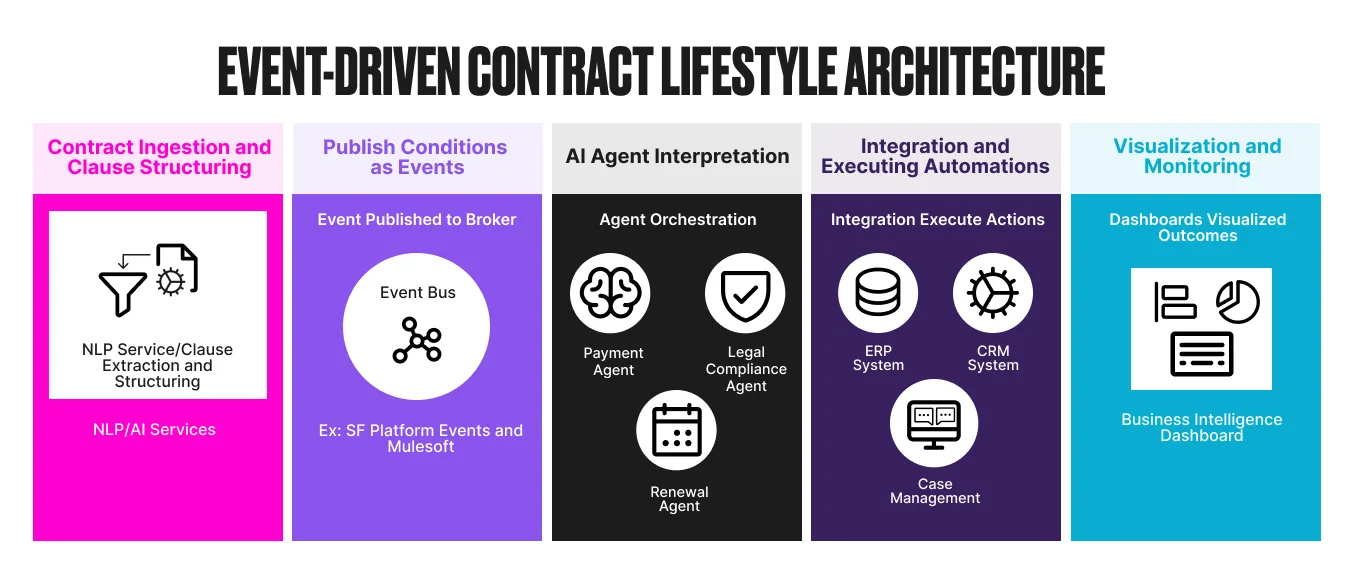
Below is a practical framework you can adapt to your own Salesforce architecture.
1. Contract Ingestion and Clause Structuring
First, we need contracts to be something a machine can understand.
Typical steps include:
- Use NLP (or tools like Einstein, external AI services, etc.) to extract:
- Renewal terms
- Notice periods
- Pricing clauses
- SLA rules
- Compliance obligations
- Store these as structured data in:
- Custom “Obligation” / “Rule” objects
- JSON fields on Contract records
- Related metadata-style records
The goal isn’t to model every line of legal text. It’s to capture the parts of the contract that actually drive system behavior. This also means ensuring data interoperability – the extracted terms must align with the structured data fields in connected ERP, CRM, and financial systems to be actionable.
Architectural Outcome
Contracts move from unstructured documents to structured, queryable data.
2. Expressing Contract Conditions as Events
Next, translate those rules into events and triggers your stack can react to.
Examples of event concepts:
- RenewalWindowOpen
- SLABreachDetected
- UsageThresholdPassed
- PriceIndexUpdated
- ComplianceDeadlineDue
On Salesforce, this often means using:
- Platform Events for contract-related triggers
- Scheduled jobs / time-based events to emit “renewal window” or “deadline” events
- Change Data Capture to watch for data changes that impact contractual rules (e.g., usage, accounts, entitlements)
Architectural Outcome
Contract rules are no longer hidden in text; they’re represented as events the system can publish and subscribe to.
3. Connecting the Enterprise via Event Brokers
Many contract-relevant signals don’t originate in Salesforce at all:
- Usage and billing in ERP.
- Uptime metrics from monitoring tools.
- Order status in logistics systems.
- External compliance or certification feeds.
This is where MuleSoft or another event broker typically comes in:
- Ingests events from multiple systems
- Normalizes and enriches the data
- Routes contract-relevant events into Salesforce (e.g., via Platform Events or APIs)
For example: ERP sees usage crossing a volume threshold → MuleSoft publishes an event → Salesforce receives it → AI agent checks the contract → CPQ prepares new pricing.
Architectural Outcome
Your event-driven CLM framework sees the full picture, not just what lives inside Salesforce.
4. AI Agents Evaluating Contract Logic in Real Time
Now we add the “brains”. To ensure reliability and manage coordination, this is often handled by an Agent Orchestration Layer (or Control Plane). This layer monitors the individual agents, ensures fault tolerance, and maintains a consistent, auditable decision-making process.
An AI agent in this context is not sci-fi – it’s simply a service (in Salesforce, MuleSoft, or externally) that:
- Reads the structured contract rules.
- Listens for relevant events.
- Evaluates whether a condition has been met or violated.
- Decides what should happen next.
- Explains itself via logs and fields (for audit and trust).
Example:
- Event: SLABreachDetected with uptime and duration details
- Agent logic:
- Find SLA clause for the affected service.
- Check if downtime exceeds the allowed threshold.
- Calculate penalty or credit if applicable.
- Outcome:
- Create a case in Service Cloud.
- Log the breach against the contract.
- Notify the account team.
The logic can start as simple rules and gradually incorporate more advanced AI (for risk scoring, anomaly detection, or recommendations). Crucially, for high-stakes decisions (e.g., auto-redlining, termination notices), the agent must incorporate a Human-in-the-Loop (HITL) safeguard, routing its proposed action for mandatory human review and approval before execution.
Architectural Outcome
Conditions are evaluated automatically instead of relying on human interpretation each time.
5. Running the Response Through Salesforce Automations
Once the AI agent decides what should happen, Salesforce does what it does best: automate. The agent’s decision launches the appropriate workflow, which may include a step for human review and final approval for critical actions (the Human-in-the-Loop).
Typical downstream actions include:
- Creating Renewal Opportunities.
- Initiating CPQ quotes with pre-applied pricing rules.
- Opening Service Cases for breaches or escalations.
- Launching Flow Orchestration for multi-step processes.
- Sending Slack/email notifications.
- Updating billing or entitlement records.
- Logging risk or compliance actions.
All of this can be wired through:
- Platform Event subscribers (Apex, Flows).
- Record-triggered Flows.
- Orchestrations that span multiple objects and clouds.
Architectural Outcome
Contract intent is executed by the platform, not held in someone’s inbox.
6. Reporting and Auditability
Finally, none of this matters if people can’t see what’s happening or prove it later.
On the reporting side, you want dashboards that surface:
- Upcoming and at-risk renewals.
- SLA performance and breaches.
- Actions taken automatically by the system.
- Pricing changes driven by contractual rules.
- High-risk or high-value contracts.
On the audit side, you need:
- Logs that show which event triggered which rule.
- Fields that capture AI agent decisions and timestamps.
- Clear links from contract → event → action → outcome.
Architectural Outcome
CLM turns into a transparent, audit-ready system that the business and compliance teams can trust.
Why This Framework Really Matters
This approach is useful in almost any organization that wants to move beyond “sign and store” CLM – but it’s especially important in complex, regulated industries, such as:
- Life sciences/biotech
- Healthcare
- Financial services
- Public sector and government contracting
In these environments, contracts carry more than commercial terms. They encode:
- Compliance and reporting obligations.
- Rebate and pricing logic.
- Safety or service-level commitments.
- Conditions tied directly to regulatory risk.
A missed renewal, late submission, or misapplied price break isn’t just an operational hiccup; it can lead to significant financial, legal, or even patient-impact consequences.
By combining AI agents with event-driven design, organizations in these industries can:
- Monitor obligations continuously instead of relying on manual checks
- Trigger compliance and pricing workflows the moment conditions change
- Maintain a clear, auditable trail of how each contractual rule was enforced
In other words, contracts become active control systems, not just reference documents – exactly what complex, regulated industries need to stay accurate, responsive, and audit-ready.
Final Thoughts
Most CLM projects stop at “we have a repository and an approval process.” That’s a good start, but it doesn’t unlock the real value of contracts. By applying this framework:
Contract Ingestion → Clause Structuring → Events → AI Agent → Automation → Reporting
You move CLM into the same real-time, event-driven world as the rest of your Salesforce architecture. You’re no longer asking, “Did someone remember to check that contract?”
You’re designing a system in which the platform continually enforces the logic of a contract.
That’s the shift where risk drops, revenue leakage shrinks, and CLM finally feels like part of your modern, intelligent architecture – not a legacy attachment to it.