

Across financial services and other regulated industries, capturing meaningful customer or member feedback remains a persistent challenge. Surveys are often managed through external tools, insights arrive too late, and results rarely influence operational or strategic decisions in a timely way.
In a large, regulated organization operating on Salesforce, I led an initiative to modernize how feedback was collected and operationalized, without introducing new vendors, integrations, or licensing costs. The solution was a strategic use of Salesforce Surveys, a native capability already embedded in the Salesforce platform.
The result was a scalable, secure feedback engine that now informs service execution, operational improvements, and product discussions using tools already in place.
Native Salesforce Surveys as an Enterprise Capability
Salesforce Surveys are frequently treated as a lightweight feature, but when implemented with intention, they can serve as a core enterprise feedback mechanism.
Because the capability is native to Salesforce, survey responses can be directly associated with standard objects such as Accounts, Contacts, and Cases. This creates immediate context around feedback by linking responses to specific interactions, service teams, and business processes.
For organizations operating under strict governance and compliance requirements, this architectural simplicity reduces risk while improving visibility and accountability.
Delivering Value with Zero Additional Cost
Cost is often the primary barrier to launching or expanding a feedback program. Third-party survey platforms typically require licensing, procurement approvals, integrations, and ongoing maintenance.
In this case, Salesforce Surveys were already included in the existing Salesforce environment. That allowed the organization to deploy a production-ready feedback capability without expanding the technology footprint or operational overhead.
From an enterprise perspective, this demonstrated how existing platforms, when leveraged thoughtfully, can unlock new capabilities without additional spending.
Automated Post-Case Feedback
The most impactful use of Salesforce Surveys came from embedding feedback directly into case management workflows.
When a service case was closed, an automated survey was triggered and sent to the customer or member. The timing ensured feedback was captured while the experience was still recent, and the case association provided immediate context for analysis.
This approach transformed feedback from an occasional activity into a continuous operational signal that was tightly integrated with service delivery rather than detached from it.
Note: This article focuses on the functionality and business value of automated surveys. If you’re looking for a full admin‑level setup guide, check out this step-by-step guide.
Real-Time Dashboards and Trends
Survey responses were directly integrated into Salesforce reports and dashboards, providing near real-time visibility into sentiment and experience trends.
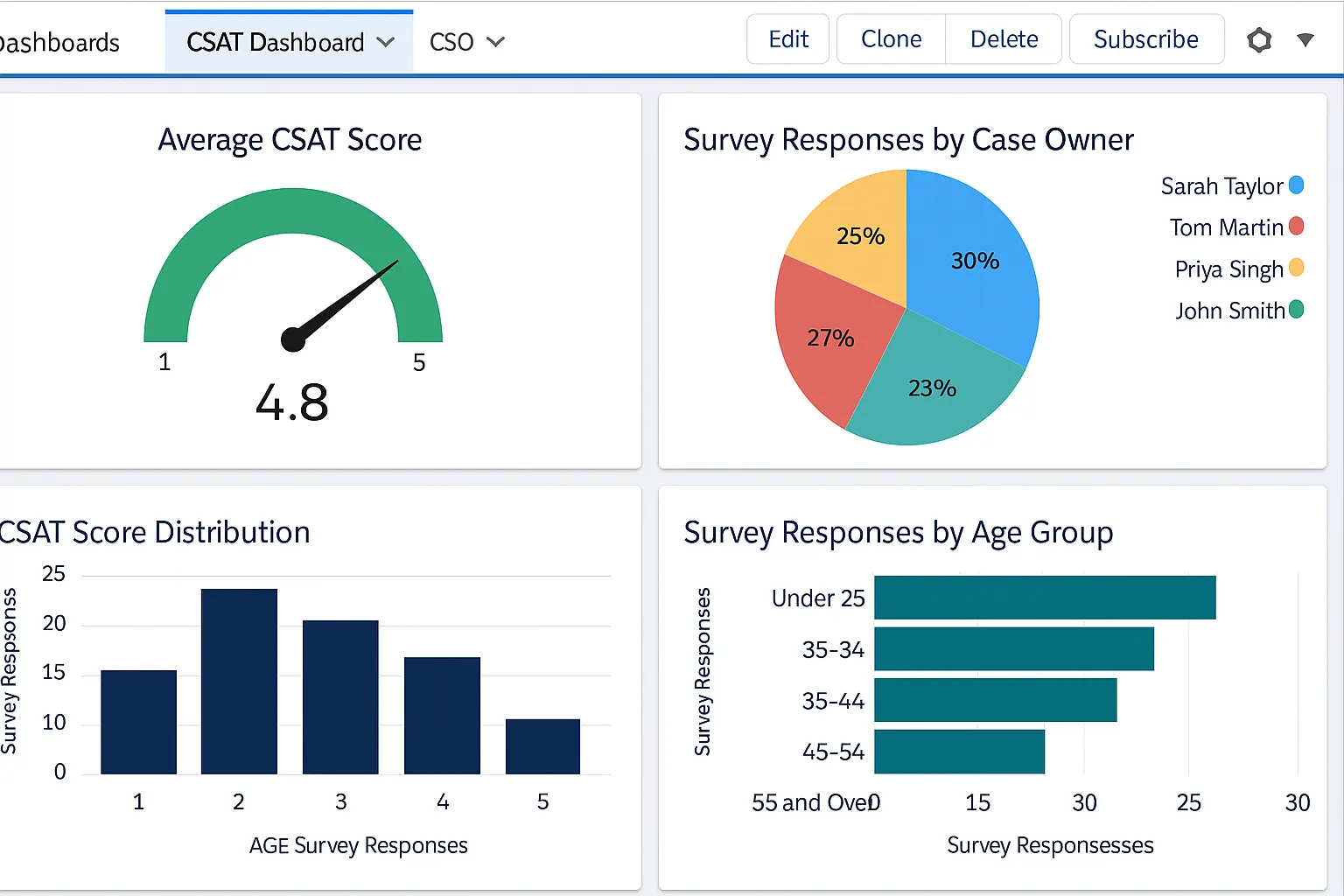
Operational teams and leadership could review feedback across service categories, resolution types, and recurring themes without waiting for quarterly summaries or manual analysis. Over time, trend analysis helped surface systemic issues, training gaps, and process inefficiencies that were not visible through traditional performance metrics alone.
This visibility elevated feedback from passive data to an active management input.
Actionable Insights Across Service, Operations, and Products
The most significant outcome of the feedback program was its influence on decision-making.
Survey insights were used to refine service workflows and case routing, improve internal knowledge content and response consistency, inform operational improvement initiatives, surface recurring product-related questions and friction points, and enable relationship and service teams to conduct more informed follow-ups.
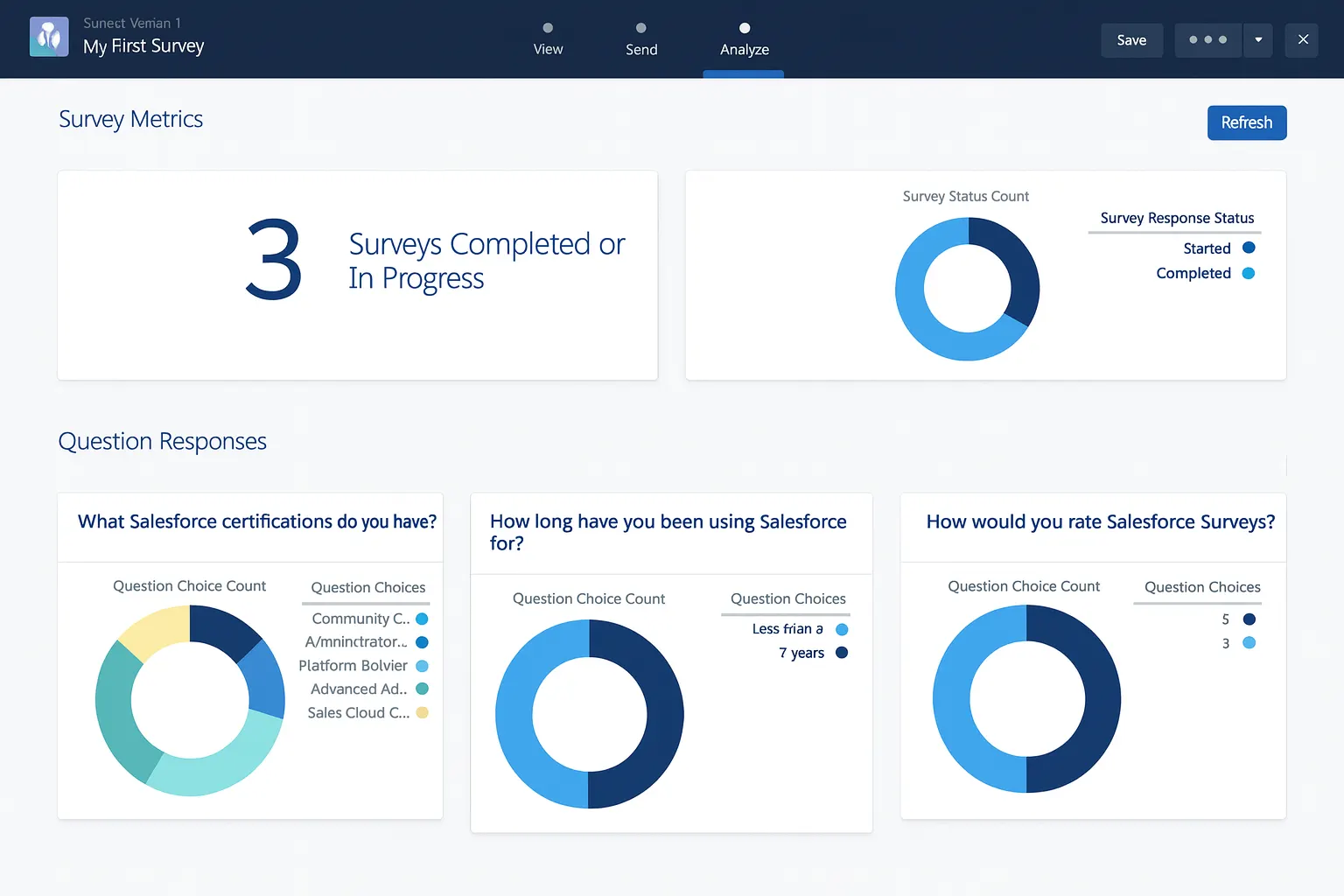
Because feedback lived inside Salesforce, insight-to-action cycles shortened significantly. Teams could move directly from observation to improvement without switching systems or reconciling data.
Broader Implications for the Salesforce Ecosystem
This approach illustrates how Salesforce Surveys can be elevated from a basic feedback tool to a strategic enterprise capability.
For organizations already operating on Salesforce, particularly those in regulated and cost-conscious environments, the model demonstrates how native features can be orchestrated to deliver measurable business value without expanding the platform stack.
More broadly, it highlights the importance of system design, governance, and intent in realizing the full potential of enterprise platforms.
Pro Tip: You don’t have to send surveys manually. You can fully automate the process by using Salesforce Flow to trigger survey invitations based on specific events, such as a Case being closed or an Opportunity reaching a certain stage. For a step-by-step guide on setting this up, check out this walkthrough.
Final Thoughts
Salesforce Surveys may not be one of the platform’s most visible features, but when implemented thoughtfully, it can serve as a powerful feedback engine that drives continuous improvement.
By embedding surveys into operational workflows, leveraging real-time analytics, and aligning insights with decision-making, organizations can strengthen customer or member relationships while maintaining fiscal and architectural discipline.
Sometimes, innovation is not about adding new technology. It is about using what already exists in a more impactful way.