






Managing technical debt is the single largest pain point for Salesforce Admins today.
Nearly a third of admins say their org’s tech debt is high, and executives seem not to fully grasp the risks posed by it. All the while, unclear requirements are actively creating more problems, with rushed, under-specified builds still becoming the clean-up projects of tomorrow.
It’s time to address this problem: Salesforce Admins are drowning in technical debt. Why is this, and what is to be done about it?
Many of the statistics cited above and below come from the 2026 SF Ben Admin Survey, which you can download here.
Technical Debt Is Too High: The Evidence
The most challenging task in Salesforce Administration at the moment is managing technical debt. When asked what the most difficult part of the job was, 56.3% of respondents to our SF Ben Salesforce Admin Survey selected this option.
And technical debt isn’t low in most orgs, either. Nearly one in three admins describe their org’s technical debt as either ‘high’ (20.7%) or ‘very high’ (10%). 46.6% of admins said they have ‘moderate’ technical debt.
Admins also told us that executive support is fragmented at best. Just 19.5% said they consistently receive strong executive support to tackle technical debt. The remaining 80.5% say support is inconsistent, unclear, limited, or completely absent. According to our figures, there appears to be a significant misalignment between where admins are feeling the pain and where the attention of leadership is directed.
Our next statistic might go some way towards explaining this. According to our data, just 18.5% of admins feel their executives clearly understand the consequences of unaddressed technical debt. 31.8% say that executives have a ‘general understanding’ but might not grasp all the details. 23.9% said their understanding is ‘limited or inconsistent,’ 15% said executives ‘only have a vague idea’ of the risks, and 10.9% said they ‘do not understand the risks.’
The issue is not simply addressing problems created by previous generations of admins, either. Technical debt is being generated right now.
Nearly two-thirds of admins said they are ‘always’ (17.2%) or ‘often’ (44.7%) asked to build something without clear or complete requirements. Only 2.1% of respondents said this ‘never’ happens, while 8% said it ‘rarely’ happens.
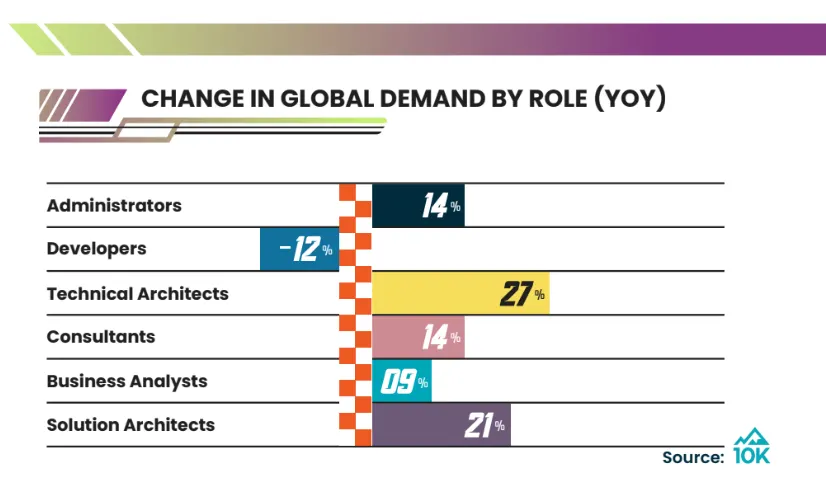
It’s not just our own internal data that paints this picture, either. According to the 2025 10K Salesforce Talent Ecosystem Report, high technical debt is one of the reasons behind significant growth in demand for technical and solution architects, experiencing the highest growth in demand (27%) among any role. This, the report’s authors say, reflects the complexity of today’s Salesforce environments and projects and the need to rein in years of accumulated technical debt.
“After years of incremental expansion and piecemeal projects, often without technical architectural oversight, many Salesforce orgs have become fragmented, inefficient, and difficult to scale,” the authors write.
“The rise in demand for TAs (Technical Architects) suggests that organizations are finally recognizing the critical role architectural expertise plays in maximizing ROI and avoiding technical debt.”
It’s Not Just Salesforce
Stepping outside Salesforce for a moment, and looking more broadly, in 2025, software mapping and intelligence technology company CAST released the report, ‘Coding in the Red: The State of Global Technical Debt’. Its data was based on 10B lines of code, drawn from 47,000 applications across 3,000 companies operating in 17 countries.
They found that nearly half the world’s code (45%) is deemed ‘fragile’, and susceptible to failure when it faces unexpected conditions, 32% of code suffers bloat, driving up costs that companies pay for compute resources, and 31% of code is ‘too rigid’, slowing businesses’ ability to make changes to their software.
Greg Rivera, Head of Product at CAST, said when the report was released in September: “Tech debt is a sinkhole, and we’re all trying to build the future on top of it. Even if the world’s 25M developers worked on nothing but this problem, it would still take nine years to solve. That’s not happening.
“Companies will need more visibility into their own code to prioritize their debt, or they’ll keep sinking.”
The problem is not recent, either. According to an STX Next report from 2023, more than 90% of global CTOs saw technical debt as the biggest challenge facing them. CEO at STX Next, Ronald Binkofski, said at the time: “Overwhelmingly, technical debt and refactoring are the most pressing concern for CTOs, perhaps brought on by the skills shortage leading to sub-optimal solutions being implemented to save time and money.
“Although driven by necessity in many cases, these short-term fixes will no doubt place strain on businesses as they require more work in the long run.”
And as recently as March 2026, Deloitte analysis suggested that technical debt accounts for 21% to 40% of an organization’s IT spending. Technical debt is a generational problem that isn’t going away – and it’s not just a Salesforce problem, either.
What Can We Do About It?
Nick Spencer, a 12x Certified Salesforce Application Architect, told SF Ben that admins should question the “why” behind every build, and treat technical debt like an invasive weed that should be continuously controlled, rather than ignored, but which cannot really be fully eliminated.
“Technical debt comes up everywhere and it’s impossible to avoid,” Nick said. “It’s a bit like Japanese knotweed: all you can do is try to control the damn stuff. You’re never going to get rid of it, but it’ll be there and if you don’t try to keep on top of it, it will take over.”
Nick said that user stories with clear acceptance criteria can reduce technical debt. His recommendation is for admins to consistently populate description fields within the org to maintain documentation.
Hitting system limits, like those for Apex or object field caps, is one main indicator of underlying technical debt, he says, adding that the Salesforce Health Check page is a valuable tool for identifying these warning signs.
We mentioned our statistics, which show that most admins report feeling unsupported by executives regarding the time and resources needed to tackle technical debt, and Nick said that debt management is rarely viewed as “sexy” work by leadership.
Salesforce Admins should advocate for dedicated time, like Friday afternoons, to perform maintenance, Nick says. Without taking the time to address it, the “gremlin” of technical debt leads to larger, more difficult system issues in the future.
He said: “The good husbandry that goes with looking after Salesforce is never going to be sexy… Whoever controls your time as an admin, you just have to make sure that they are willing to give you that bandwidth to handle technical debt, and try to keep it under control.”
Final Thoughts
Admins are being buried in technical debt. What’s more, they tell a story of being starved of executive support, working with leaders who do not fully grasp the risks, all while being asked to build in ways that all but guarantee that more debt is coming.
A self-destructive cycle is being perpetuated, and admins are crying out for better support and understanding around the issue of technical debt.





Comments: