

Many Salesforce professionals eventually reach a point where the platform feels familiar, but the architecture remains just out of reach. This article aims to bridge that gap by translating enterprise-architecture thinking into practical, Salesforce-friendly patterns.
After more than twenty years working across enterprise architecture, one thing has always stayed the same: tools and platforms evolve, but the way we reason about design does not. When I stepped into the Salesforce ecosystem, everything looked different – metadata-driven configuration rather than code-heavy systems, declarative automation rather than complex orchestration engines, and release cycles that moved far faster than traditional governance processes.
But the longer I worked with the platform, the more I recognized something familiar. The architectural instincts I had relied on for years still mattered – perhaps even more than before. Salesforce didn’t eliminate the need for architectural thinking; it simply gave me a different canvas on which to apply it.
This article is for Salesforce professionals – admins, developers, consultants, analysts – who feel they are standing at the edge of that same transition. If you’ve found yourself asking, “How do I start thinking like an architect?”, this is written for you.
Why Enterprise Architecture Thinking Still Matters in Salesforce
Salesforce moves fast, but speed doesn’t replace structure. Architectural principles like abstraction, modularity, scalability, governance, and intentional design are present throughout the platform – just expressed differently.
- Abstraction becomes reusable flow actions and modular components.
- Separation of concerns becomes cleaner data boundaries and layered integration.
- Scalability becomes Large Data Volume (LDV) planning, governor limits, and async patterns.
- Governance becomes decision logs, naming conventions, and architecture review.
Once you start seeing these patterns, Salesforce stops being a list of features and becomes a system with architecture at its core.
Translating Architectural Principles to a Metadata-Driven Platform
Salesforce brings architecture into the hands of people who may not have traditional EA backgrounds. But the underlying design principles never left – they simply changed shape.
- Metadata is your infrastructure: Instead of provisioning environments or deploying servers, you shape the system through configuration – objects, fields, page layouts, permissions. Metadata is what defines the structure, behaviour, and boundaries of the platform.
- Automation is your orchestration: Flows, triggers, and orchestration tools replace workflow engines and BPM layers. The logic that once sat in application servers now lives inside metadata and automation frameworks.
- Identity is your trust boundary: In a cloud platform, identity is the new perimeter. Profiles, permission sets, SSO, OAuth scopes, and login flows determine not only who can see what, but also how trust flows between systems. Identity architecture becomes a first-class design concern.
- Integration is your nervous system: Every meaningful process touches something outside Salesforce – data lakes, core systems, customer apps, partner ecosystems. APIs, events, and integration patterns become the connective tissue that holds the enterprise together.
- Data is your shared language: The Salesforce object model isn’t just a database. It’s the structure that business teams, integration layers, analytics, AI, and external platforms all depend on. A good ERD is as important as any automation.
- Limits are your performance guardrails: Traditional infrastructure has CPU and memory constraints. Salesforce has governor limits. They’re not obstacles – they’re signals that guide you toward scalable, predictable designs.
Why These Translations Matter
Once you see Salesforce architecture through this lens, the platform stops looking like a collection of features and starts feeling like a complete architecture discipline – just expressed through metadata instead of code and servers.
And when those principles guide your designs, you don’t just build solutions. You build systems that last.
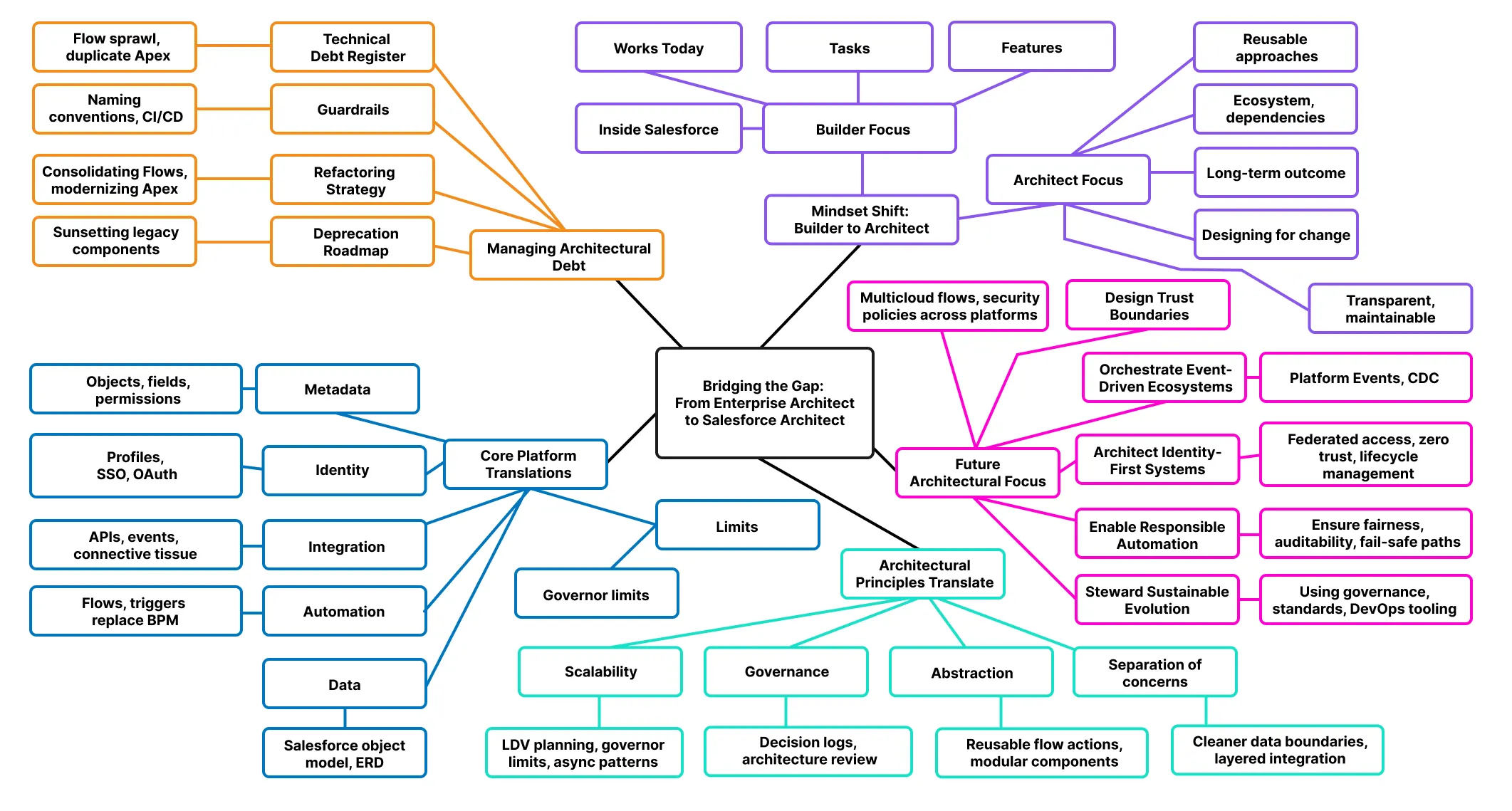
This mind map brings together the core architectural themes explored in this article, showing how traditional enterprise thinking translates into Salesforce’s metadata-driven world, and where mindset, governance, and future responsibilities fit into the bigger picture.
Mapping Enterprise Architecture Artifacts to Salesforce
Traditional architecture artifacts don’t disappear in Salesforce – they simply translate.
Core Architecture Artifact Mapping
| EA Artifact | Purpose | Salesforce Expression |
|---|---|---|
| Architecture Overview Diagram (AOD) | Visualize ecosystem, trust boundaries, integrations, actors. | System Landscape: Salesforce Clouds (Sales, Service, Experience, Data Cloud), key integrations (REST/SOAP APIs, MuleSoft, Platform Events, CDC), AppExchange apps, Experience Cloud, external systems, identity/SSO patterns, org/licensing model, mobile. |
| Logical Architecture | Define capabilities, modules, and system responsibilities. | Capability-to-Object Mapping: business capabilities mapped to objects, automation, identity, and integration touchpoints. |
| Data Architecture | Define entities, semantics, relationships, ownership. | ERD & Object Model: objects, junctions, relationships, sharing/OWD, ownership, Large Data Volumes (LDV) strategy, indexing, data classification. |
| Identity Architecture | Define authentication, authorization, lifecycle. | Identity Architecture Patterns: SSO (SAML/OIDC), OAuth flows, Connected Apps, SCIM/JIT, MFA, Login Flows, Profiles, Permission Sets/Groups, Role Hierarchy. |
| Integration Architecture | Show how systems exchange data and coordinate processes. | Integration Architecture Patterns: API-led (MuleSoft, REST/SOAP/Composite APIs), Platform Events, CDC, Salesforce Connect vs replication, ETL/ELT, event-driven patterns, error handling & idempotency. |
| Deployment / Technology Architecture | Environment topology and operational structure. | Org & Sandbox Strategy + CI/CD Architecture: sandbox tiers, branching model, packaging, automated testing, deployment sequencing, DevOps maturity. |
| Non-Functional Requirements (NFRs) | Ensure performance, scale, security, reliability. | Salesforce NFR Design: limits evaluation, concurrency, LDV approach, Shield (encryption/monitoring), async patterns (Batch, Queueable, PE), API throughput. |
| Assessment of Architecture Options | Evaluate patterns, trade-offs, and fit. | Pattern Assessment: Flow vs Apex; External Objects vs replication; CDC vs Platform Events; sync vs async; Orchestrator vs custom automation; identity/sharing options. |
| Architecture Decision Records (ADRs) | Document rationale, constraints, and impact. | Decision Log (Well-Architected aligned): context, constraints, options, selected pattern, trade-offs, security/performance implications, technical debt impact. |
| Transition Architecture / Roadmap | Plan phased evolution to target state. | Capability Roadmap & Release Plan: Experience Cloud waves, Data Cloud rollout, integration cutovers, org changes, technical debt retirement. |
| Architecture Governance Framework | Maintain standards, compliance, design quality. | CoE + Design Authority Governance: naming standards, metadata governance, CI/CD quality gates, review boards, integration contracts. |
| Technical Debt Register & Remediation | Identify and reduce architectural risk. | Technical Debt Strategy: Flow consolidation, Apex modernization, permission refactoring (PSGs), PB/WF deprecation, unused metadata cleanup, preventive guardrails. |
Technical Debt Minimization and Remediation
Technical debt is not just a development concern in Salesforce – it’s an architectural one. Because the platform evolves quickly and metadata grows across objects, automation, and integrations, debt can accumulate faster than most teams realize. Without a clear approach, it gradually erodes stability, performance, and the ability to change the system confidently.
In practice, technical debt manifests as overlapping Flows, duplicate Apex logic, inconsistent permission models, unused fields or objects, and legacy components that persist long after the business has moved on. Architects help bring structure and intention to how this debt is identified, tracked, and resolved.
Here’s how traditional EA practices translate into the Salesforce environment:
| Traditional EA Practice | Purpose | Salesforce Expression |
|---|---|---|
| Technical Debt Register | Create visibility into risks and accumulated work. | A structured backlog capturing Flow sprawl, overlapping automation, duplicate Apex logic, unmanaged triggers, unused fields, and inconsistent permission models. |
| Architecture Review & Rationalization | Periodically assess the health of the landscape and identify weak points. | CoE reviews of automation layers, sharing models, integration patterns, identity configuration, and metadata hygiene. |
| Refactoring Strategy | Improve clarity, consistency, and future maintainability. | Consolidating Flows, adopting trigger frameworks, modernizing Apex, externalizing rules into CMDT, and simplifying record types or page layouts. |
| Deprecation Roadmap | Retire components that no longer align with how the business works. | Sunsetting legacy workflows and Process Builder automations, removing redundant objects or fields, and cleaning up stale integrations. |
| Standards & Guardrails | Prevent new debt from accumulating. | Naming conventions, branching strategies, design patterns, CI/CD validation, and architectural review gates. |
| Lifecycle Governance | Ensure ongoing change does not reintroduce avoidable risk. | Pull request reviews, automated regression tests, documentation updates, and clear approval paths for high-impact decisions. |
Good architecture doesn’t eliminate technical debt – it makes it manageable and intentional, ensuring the platform remains coherent and adaptable as it grows.
The Mindset Shift: From Builder to Architect
Most people in the Salesforce world start as builders – admins who know every corner of the platform, developers who can solve problems quickly, consultants who translate business needs into working solutions. Over time, many of them feel the pull toward architecture. But the fundamental shift isn’t about learning new features or earning a certification. It’s about changing how you think.
As a builder, the focus is usually on “What do I need to deliver?” As an architect, the question becomes “How will this decision hold up over time?”
That’s the difference, and it shows up in day-to-day habits.
1. From Features → Capabilities
Builders naturally focus on the immediate task: a screen, a flow, a field.
Architects look at the bigger capability behind it—the long-term outcome the business is trying to achieve. That capability becomes the anchor for every design choice.
2. From Tasks → Patterns
It’s easy to design something that works once.
What architects try to understand is whether the pattern will work again—and whether the next team can reuse it without starting from scratch.
3. From “Works Today” → “Works When It Grows.”
Architecture is really the art of designing for change.
A feature may work now, but architects ask how it behaves three releases from now, or when the data volume doubles, or when five new integrations appear.
4. From Inside Salesforce → Across the Enterprise
Builders often think within Salesforce.
Architects think about where Salesforce sits within the broader ecosystem — identity, data sources, integration dependencies, security boundaries, and failure points.
Seeing the bigger picture is what makes designs resilient.
5. From Clever Solutions → Clear Solutions
Builders may default to what feels elegant or efficient.
Architects lean toward what is transparent, maintainable, and predictable — even if it’s not the flashiest option. Clarity always wins in the long run.
6. From Answering → Questioning
One of the most significant shifts is learning to ask different questions:
- What problem are we really solving here?
- Who owns this data — and who should?
- Where do identity and access boundaries sit?
- What’s the failure path if this goes wrong?
- How does this behave when the business scales?
Good architecture usually starts with good questions.
Mentorship Insights: How People Successfully Transition
The strongest emerging architects I’ve mentored tend to:
- Ask “why” as often as “how.”
- See connections across systems.
- Embrace governance
- Understand data’s central role.
- Think about the long-term consequences of design.
These habits matter more than titles or certifications.
Looking Ahead: What Future Salesforce Architects Must Design For
Salesforce is entering a new era – Data 360 (formerly Data Cloud), AI, event orchestration, and agentic automation are transforming how systems behave. These capabilities expand an architect’s responsibility.
Future architects will design:
- Trust boundaries: With AI, multi-cloud flows, and external decisioning, trust is no longer a single perimeter. Architects will define how identity, data access, and security policies travel across platforms and clouds.
- Building Clear Decision Frameworks: As automation becomes more autonomous, organizations need a way to evaluate decisions consistently. Architects will shape the guardrails – when to automate, when to involve humans, and how to ensure transparency.
- Architecting Identity-First Systems: Identity is becoming the anchor of connected experiences. Architects must design for federated access, consent, zero trust, step-up authentication, and lifecycle management across apps and channels.
- Orchestrating Event-Driven Ecosystems: Eventing isn’t a pattern anymore – it’s the backbone of modern Salesforce solutions. Platform Events, Change Data Capture, real-time integrations, and streaming architectures demand thoughtful choreography rather than point-to-point messaging.
- Enabling Responsible Automation: AI and agentic systems can amplify value – or amplify risk. Architects must ensure automation respects guardrails: fairness, accuracy, auditability, security, and fail-safe paths when confidence drops.
- Putting Guardrails Around Change: With faster release cycles and greater automation, architects become stewards of sustainable evolution rather than blockers. Standards, governance, branching strategies, DevOps tooling, and metadata patterns will matter more than ever.
Where This Leaves Us
Tools will continue to evolve, but architectural thinking is what endures. The future Salesforce architect isn’t defined by what they build, but by how intentionally, responsibly, and scalably they shape the systems around them.
This next era belongs to architects who can combine enterprise thinking with platform fluency – and design with both the present and the future in mind.
Final Thoughts
This article grew out of conversations with professionals eager to advance their craft. Many were already halfway there – they simply needed a lens that connected their experience to architectural thinking.
If you’ve ever paused in a design session and thought, “There must be a clearer way,” you’ve already begun the journey. Salesforce simply offers a modern canvas for architectural thinking.