
TrailblazerDX 2026 was all about one thing: how we actually build in the agentic era. If Dreamforce ‘25 introduced the vision, TDX ‘26 showed us the reality. This was less about selling AI and more about operationalizing it.
In this article, we’ll unpack the biggest announcements, themes, and takeaways that matter most for developers, admins, and architects navigating Salesforce’s next chapter.
From Deterministic to Probabilistic: A Fundamental Shift
One of the clearest messages from TDX ‘26 is that software development has fundamentally changed. We’re moving away from deterministic systems, where the same input guarantees the same output, into probabilistic systems, where outcomes can vary based on context – a shift that underpins everything.
In the past, building meant precision. Now, building means iteration. Tools like Agentforce Vibes can generate a working product quickly, but getting it production-ready takes time. The traditional 80/20 rule has flipped. What used to be 80% building and 20% refining is now the opposite.
For architects and admins, this introduces a new challenge: how do you maintain trust, governance, and consistency in systems that are inherently less predictable? Salesforce’s answer lies in hybrid control. Tools like Agent Script allow teams to define where strict logic must apply and where agents can reason freely. It’s not about choosing between automation and control, but instead blending both.
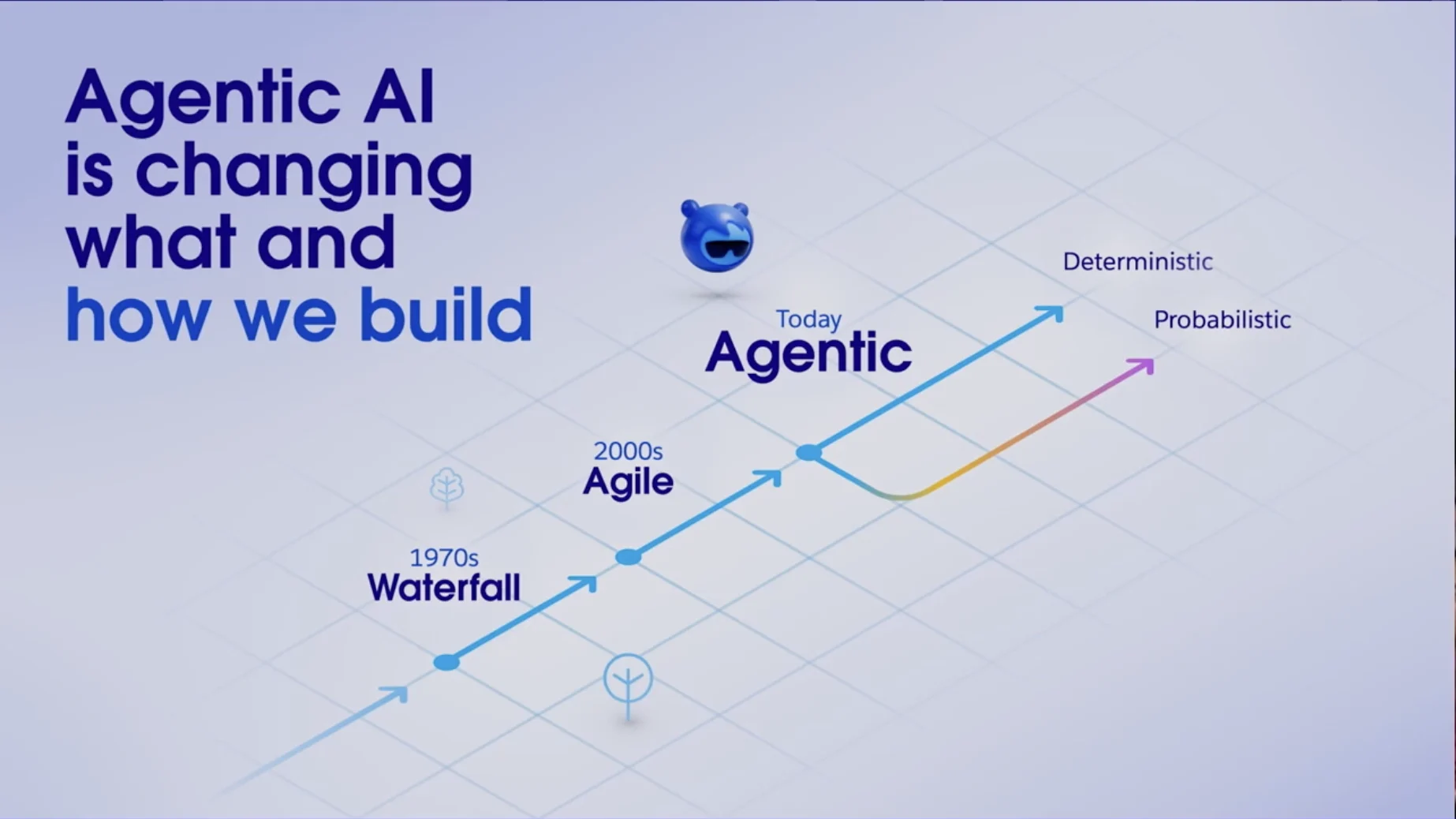
If you’re confused by this new terminology, let’s break it down. In a deterministic system, the rules are fixed. If you give it the same input, you will always get the same output. No surprises.
A simple example:
- You press “2 + 2” on a calculator
- You always get 4
Or in software:
- “If a customer clicks this button, send this exact email”
- It will happen the same way every single time
It’s rigid, reliable, and predictable. Like following a recipe step by step.
Now compare that to a probabilistic system. Here, the system is making decisions based on context, patterns, and probabilities. That means:
- The same input might produce slightly different outputs
- The result depends on interpretation, not just rules
Example:
- You ask an AI: “Write a follow-up email”
- You might get a different version each time
- All versions could be correct, just phrased differently
Introducing Headless 360
The headline announcement from TDX ‘26 was Headless 360, and it’s a big one.
At its core, Headless 360 decouples Salesforce’s capabilities from its user interface. In simple terms, you no longer need to “use Salesforce” to use Salesforce. Everything, from data to workflows to metadata, can now be accessed through APIs, MCP tools, and CLI commands.
This means developers can build using tools they already love, while still tapping into the full power of the platform.
Salesforce is positioning this as “build any way you want”, and for once, that claim feels justified. With over 60 new MCP tools and 30 prebuilt coding skills, agents can now interact with Salesforce data and logic directly, without being constrained by its traditional UI.
It also introduces a new way of thinking about integrations. Instead of rigid, point-to-point connections, we now have modular “skills” that agents can dynamically use. It’s more composable, more flexible, and far more aligned with how modern systems are evolving.
Still scratching your head about what “headless” means? That’s ok, I was too. Traditionally, when you use Salesforce, you log into the platform and interact with it through its interface, clicking buttons, navigating pages, and using its built-in screens. That interface is the “head”. Headless means removing that head.
In a headless setup, Salesforce still does all the powerful work behind the scenes, like storing data, running workflows, and enforcing rules, but you don’t have to use its interface to access it.
Instead, you can:
- Connect to it from other apps
- Use code or automation tools
- Let AI agents interact with it directly
So rather than going into Salesforce to do something, Salesforce comes to wherever you’re already working.
Why the Platform Still Matters
However exciting this all sounds for developers, for admins, it can feel a little unsettling. These changes move us away from the familiar “clicks not code” world that so many admins rely on today, and into something that feels less predictable at first glance.
With all this talk of headless access, it’s natural to wonder whether the Salesforce platform still matters. After all, admins have always been empowered by its point-and-click setup. That’s what made it possible to build powerful solutions without needing to write code.
According to Salesforce, the platform doesn’t just still matter; it matters more than ever.
AI agents on their own aren’t enough. Intelligence without context is just guesswork. What makes Salesforce so valuable is everything behind the scenes: your data, your workflows, your permissions, and your governance.
When AI agents run inside Salesforce, they don’t start from scratch. They already understand how your business works. They know your processes, your rules, and who should or shouldn’t have access to certain things.
That’s the real difference. It’s not just about having an AI that can generate something. It’s about having an AI that understands your business well enough to get it right.
Agentforce Vibes 2.0
Agentforce Vibes is back, and it’s had a serious upgrade.
Agentforce Vibes 2.0 builds on the original concept of vibe coding but expands it into a true AI development partner. It now supports multiple models, including GPT-5 and Claude Sonnet, and integrates deeply with the new MCP ecosystem introduced in Headless 360.
The result is a more powerful, more context-aware coding experience.
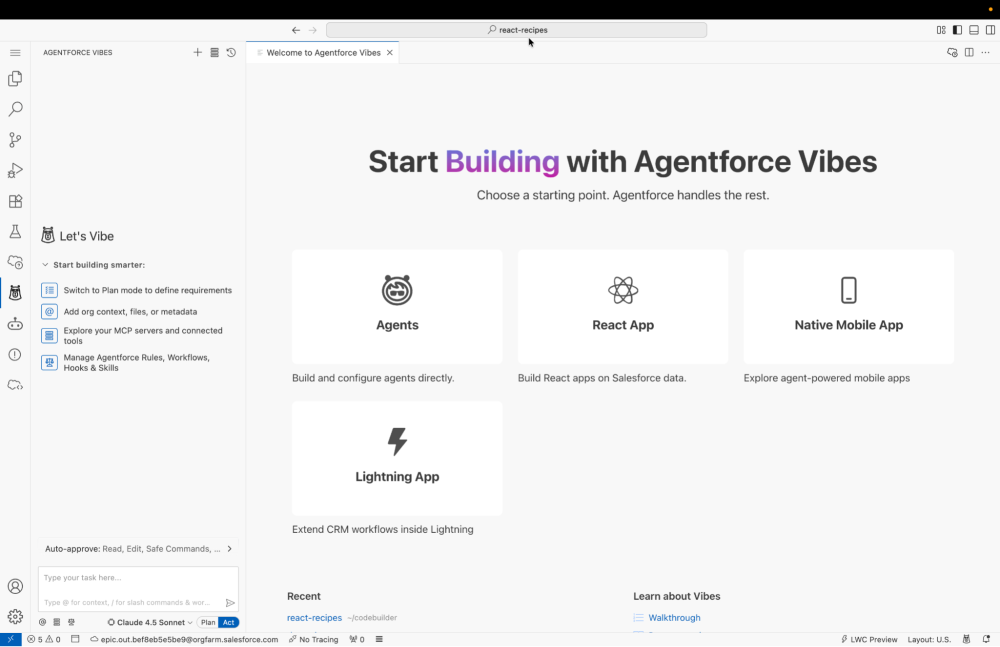
One of the standout additions is the data model visualizer. Anyone who has spent time clicking through Setup or deciphering XML will appreciate this. It provides a clear, visual way to understand your data structure, which is especially valuable when working with AI-generated configurations.
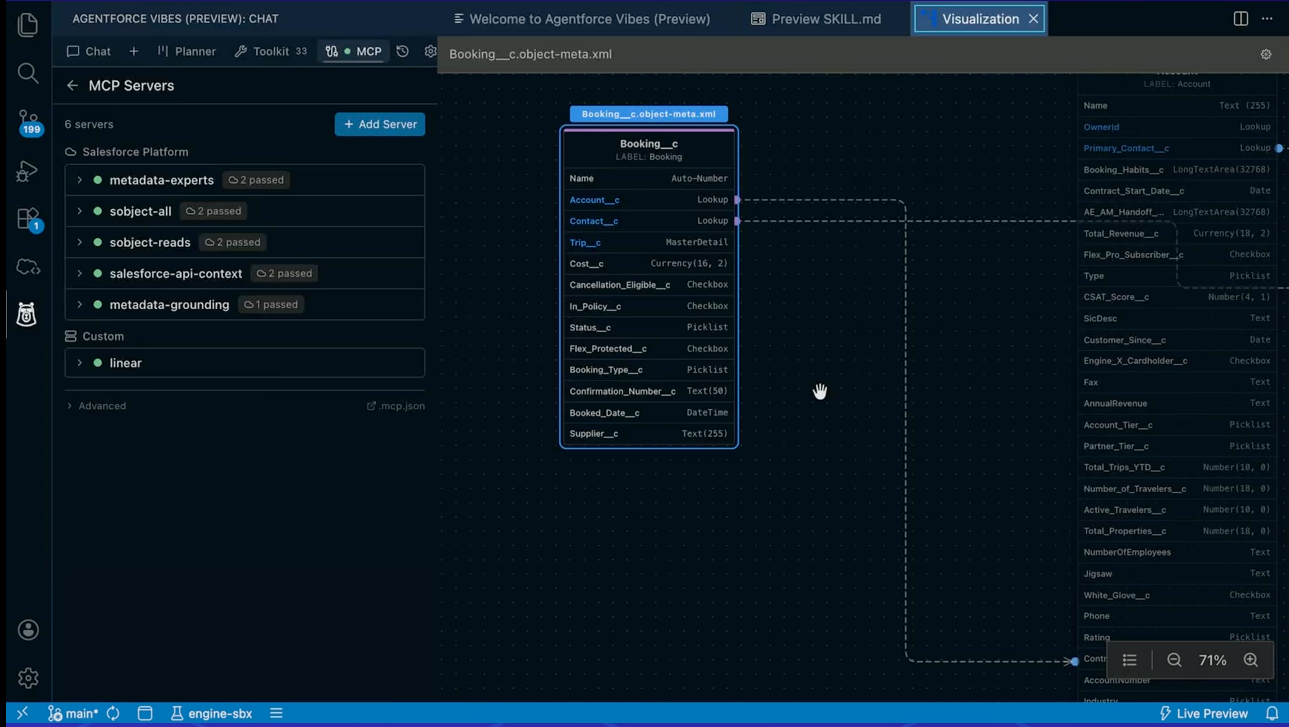
Vibes 2.0 also introduces an “agent harness”, allowing developers to safely use third-party coding agents while staying within Salesforce’s trust layer. It’s a subtle but important detail, reinforcing that experimentation doesn’t have to come at the cost of security.
The Agentforce Experience Layer
If Headless 360 is about how things work, the Agentforce Experience Layer is about how they appear.
This new UI abstraction layer separates what an agent does from how it is presented. Developers can define an experience once and render it across multiple platforms, including Slack, mobile, ChatGPT, and more.
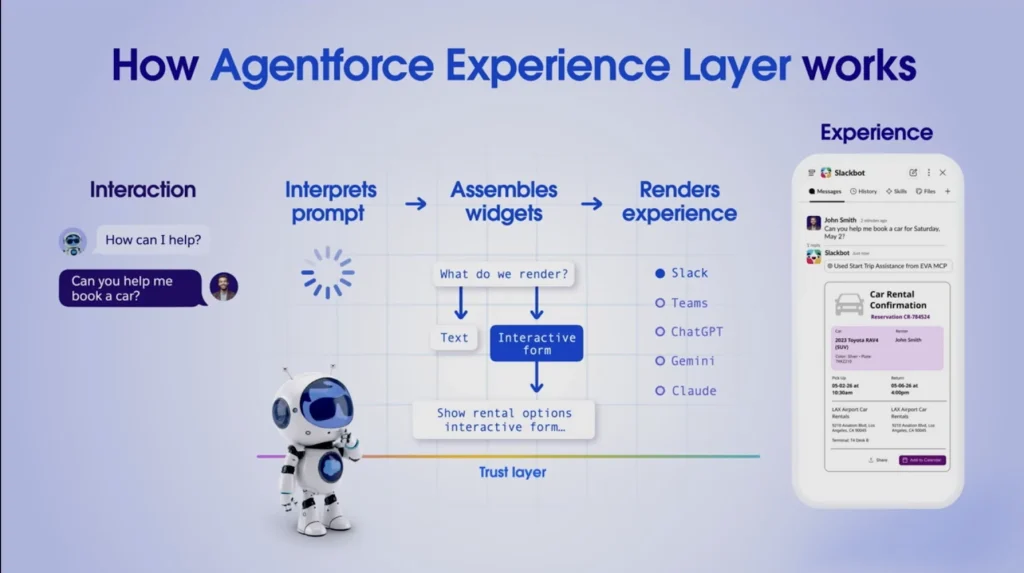
The phrase Salesforce used was simple: build once, render everywhere.
This is a major shift. Historically, delivering multi-channel experiences meant duplicating effort across platforms. Now, a single agent-driven experience can adapt to wherever the user is working.
It also reinforces Salesforce’s broader strategy of meeting users where they are, rather than forcing them into a single interface.
Slack continues to evolve into the central hub of the agentic enterprise. Custom AI agents on Slack have grown significantly, and Slackbot is now positioned as the primary entry point for interacting with Salesforce-powered agents. Conversations are becoming the interface.
This aligns closely with the Experience Layer. Together, they create a world where users don’t navigate systems. They interact with them conversationally.
Testing, Observability, and Control
With probabilistic systems comes a new reality: you need much stronger oversight. To support this, Salesforce introduced a full suite of tools designed to manage the entire agent lifecycle, from development through to production.
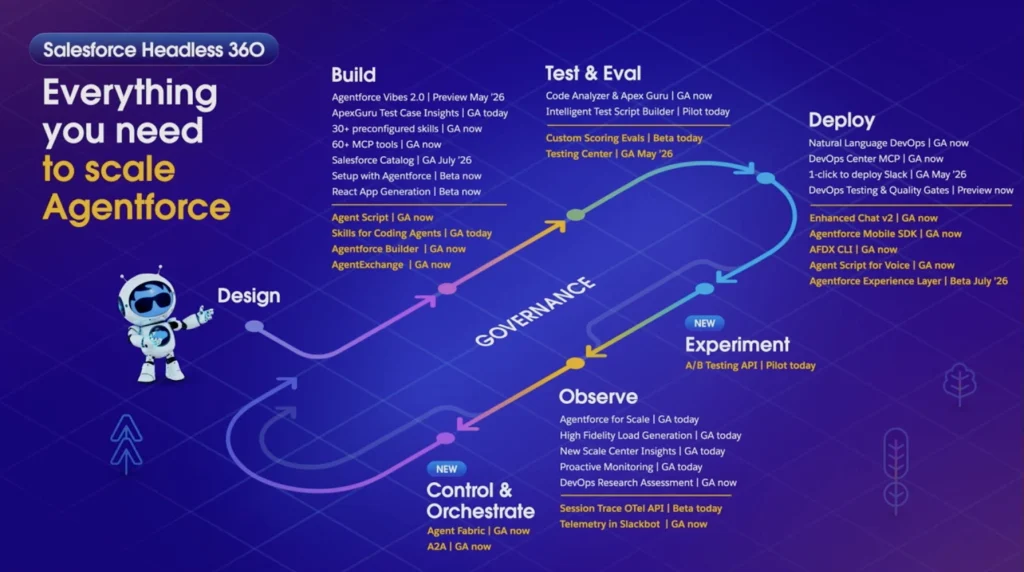
The new Testing Center helps teams catch logic gaps and policy violations before anything goes live. It also introduces custom scoring, so you can define what “good” actually means for your business, not just in terms of outcomes, but in how decisions are made.
Once agents are live, observability tools give you a clear view into how they behave. Session tracing shows exactly why an agent made a particular decision, making it far easier to troubleshoot and refine over time.
There’s also built-in A/B testing, which lets you compare different versions of an agent in real-world scenarios before rolling out changes more widely.
All of these point to a bigger shift. Building agents is only half the job. Managing, monitoring, and improving them is where the real work begins.
For me, the changes to testing in this new probabilistic world were particularly eye-opening. We need to rethink not just how we test, but what success actually looks like.
In a probabilistic system, the same input can produce slightly different outputs. That also means the same test can return different results. Instead of expecting one fixed answer, we need to start thinking in terms of ranges, quality, and consistency over time.
Agent Fabric and Multi-Agent Orchestration
Another key theme from TDX ‘26 is that the future is not a single agent. It’s many.
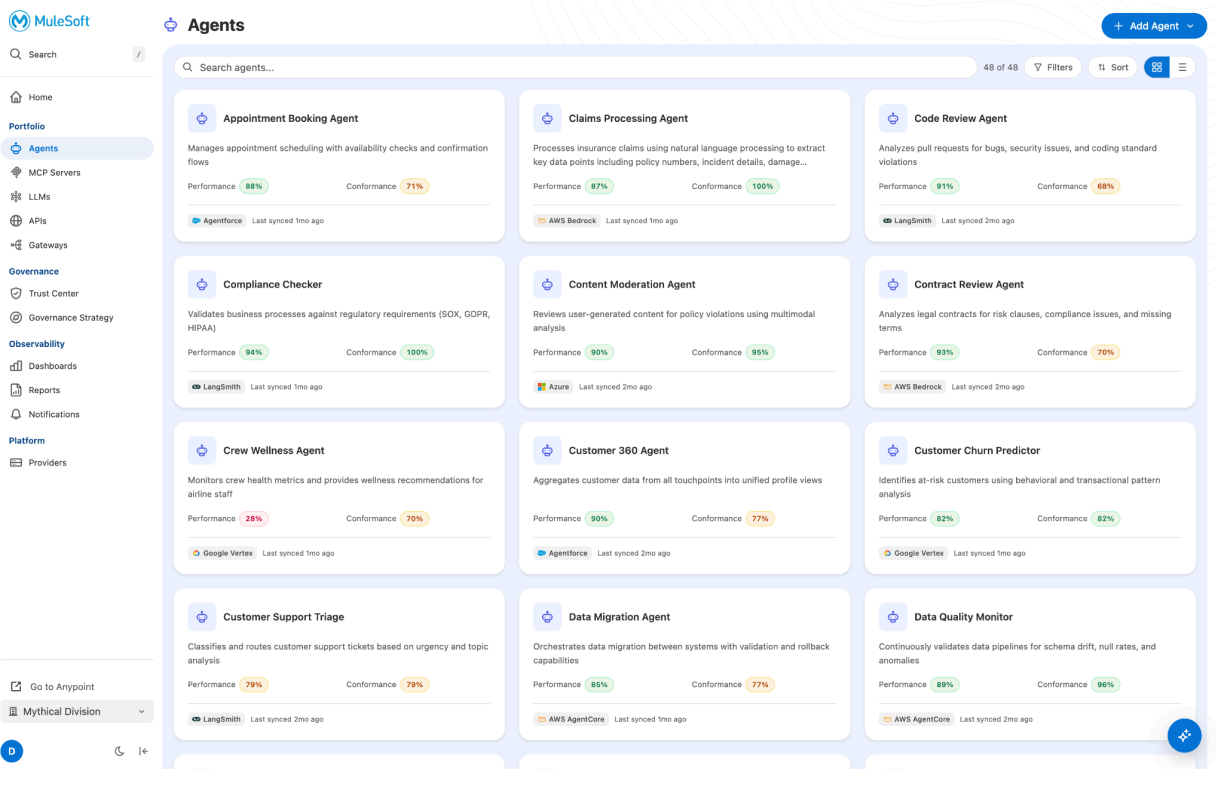
Salesforce formally introduced Agent Fabric, a control plane designed to orchestrate multiple agents across platforms and vendors. It brings governance, coordination, and visibility into one place.
This is particularly important as organizations begin to adopt agents from different ecosystems. Without a unifying layer, things can quickly become fragmented.
Agent Fabric ensures that, even in a multi-agent world, control remains centralized and consistent.
AgentExchange
Now, stop rolling your eyes, this is not just another renaming of a product! Salesforce is essentially pulling together a lot of moving parts and putting them into one much smoother experience called AgentExchange. Instead of jumping between AppExchange, Slack Marketplace, and Agentforce, everything now sits in one place.
That means more than 10,000 apps, 1,000 pre-built agents, and thousands of Slack apps can be discovered and used without the usual platform-hopping headache. The big idea here is smarter discovery, too, with new semantic search powered by Data 360 helping people find tools based on what they are trying to do, not just the exact words they type.
It also starts to feel more like the tools are meeting you where you are working. Inside Agentforce Builder, relevant agents and tools pop up as you build, and Slack is turning into a kind of command centre where you can find apps, automate tasks, and eventually even ask Slackbot for recommendations in plain language. Buying and setting things up is getting faster as well, with private offers, unified billing, and automatic provisioning designed to cut out a lot of the usual back and forth.
Underneath all of this, Salesforce is clearly trying to make trust and control feel less complicated, not more. Admins still get full oversight on permissions and access, but the experience is meant to be simpler for everyone else. And to push the ecosystem forward, Salesforce is putting $50M behind partners building on AgentExchange, which should mean more AI tools and integrations showing up quickly.
Some features are live now, while the more conversational, AI-driven discovery upgrades are rolling out through 2026.
Agentforce Labs
Salesforce quietly slipped something interesting into TDX that you might have missed: Agentforce Labs. It is not a finished product or something you deploy straight into production. Instead, it is more like a playground for AI agents where admins and developers can poke around, test early ideas, and see what is coming next before it ever becomes part of the core platform. Think of it as Salesforce opening the doors a little earlier so you can look behind the curtain while things are still being built.
Inside Agentforce Labs, you will find experimental tools, prototypes, and research projects from Salesforce’s engineering teams. The fun part is that these are not just theory pieces. You can actually try them, explore real use cases, and even start shaping your own ideas with them.
It also works as a feedback loop, so Salesforce gets to learn what clicks, what does not, and what deserves to graduate into Agentforce proper. In other words, it is part sandbox, part sneak peek, and part suggestion box for the future of AI agents.
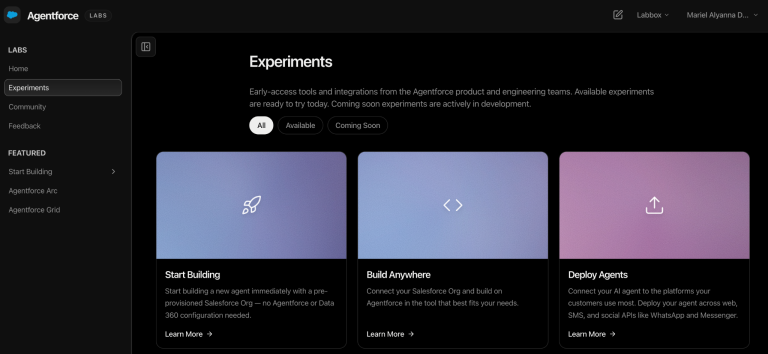
It is also worth saying this is not the same as Agentforce itself. Agentforce is the polished system for building and running AI agents, while Labs is where those ideas are still figuring themselves out. Access is free, and all you need is a Trailblazer login, so there is not much standing in the way of having a look.
You do not need to be a hardcore developer either, although it definitely helps if you are comfortable trying things that are still evolving. Salesforce is clearly leaning into a more open, experimental way of building, and Labs is where that shift becomes very real.
Sneak Peeks Are the Business
There were several new types of experiences at TDX ‘26. I spent all of Thursday morning in “sneak peek” sessions, and let me tell you, they are awesome. Sneak peeks go far beyond the standard roadmap presentation. Designed as repeatable, theatre-style sessions, they give you early access to features still in development, while also inviting you to question, challenge, and engage with the thinking behind them. The real value isn’t just visibility; it’s the opportunity to influence what comes next.
It was in a sneak peek that I learned about Salesforce’s new App Studio. Salesforce App Studio, previewed at TDX ‘26, introduces a new, AI-driven way for admins to build apps using natural language, essentially bringing “vibe coding” into an admin-friendly experience. Instead of manually configuring tabs, objects, and components, admins can simply describe what they want, even uploading images for design inspiration, and an agent will generate the app for them across Salesforce and Slack.
While still a forward-looking concept, App Studio combines speed and flexibility with strong governance, allowing admins to review, control, and deploy changes while leveraging existing data, permissions, and business logic. It also opens the door to “citizen builders” contributing to app creation, though final approval remains with admins, making it a potentially powerful but carefully controlled evolution in how apps are built on the platform.
My colleague Peter Chittum was also a big fan of the sneak peek sessions; his favourite was hybrid visual editing. Hybrid Visual Editing (HVE) is a new concept for building user interfaces that blends drag-and-drop tools, code, and AI-driven “vibe coding” into a single, seamless experience. Think of it as an evolution of tools like Experience Cloud Builder, where you can generate a UI using natural language or even images, refine it visually with familiar controls, and then instantly sync those changes back to clean, usable source code.
Designed for both admins and developers, HVE aims to make collaboration between humans and AI smoother, with features like reusable component updates and multi-modal inputs. While still an early-stage idea, it signals Salesforce’s direction toward more flexible, AI-assisted development, combining the ease of low-code with the power of traditional coding, all while rethinking how we design and interact with enterprise software.
Final Thoughts
TrailblazerDX ‘26 didn’t just introduce new features. It reframed how we think about building on Salesforce. The shift to probabilistic systems, the rise of headless architecture, and the focus on multi-agent orchestration all point in the same direction. We are entering a new phase of enterprise software.
If Dreamforce ‘25 was about the promise of the agentic enterprise, TDX ‘26 was about making it real. And if there’s one clear thing, it’s this: the future of Salesforce isn’t just AI-powered. It’s builder-driven.