

As the Salesforce ecosystem continues to expand, the conversation around diversity remains more important than ever. In particular, the proportion of female developers is a vital indicator of how inclusive and representative the technical community has become.
Drawing on data from both the 2024 and 2025 Salesforce Developer surveys, this article explores how the landscape is shifting, where progress is most visible, and where challenges persist.
Gender Representation Among Salesforce Developers
In 2024, female developers accounted for 20% of respondents to our Salesforce Developer survey, compared to 76% identifying as male and 1% as non-binary, with 3% choosing not to disclose their gender.
One year later, the picture shows a small but positive movement. Female representation has risen to 22.7%, while the proportion of male respondents has dipped slightly to 71.8%. The shift is modest, but it reflects steady, incremental progress that aligns with broader trends across other technical roles in the ecosystem.
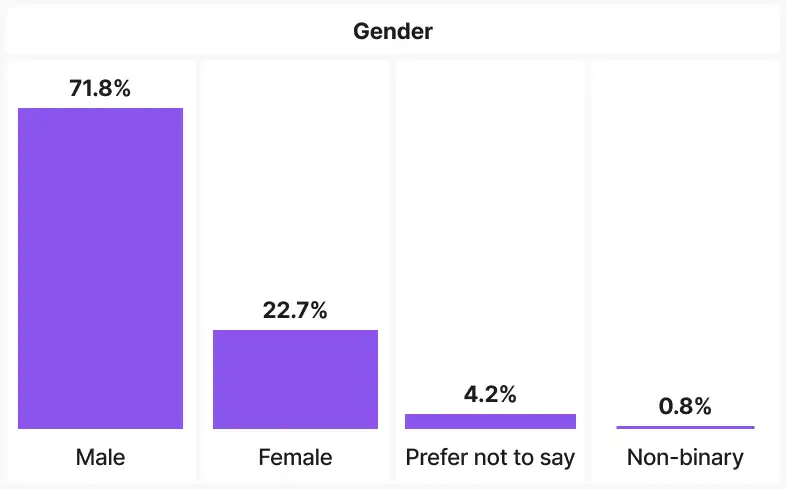
Looking beyond developers helps place these numbers in context. Salesforce Architects in 2025 reported a similar gender breakdown, with 72.4% male and 23.5% female respondents.
Meanwhile, Salesforce Admins remain the most gender-balanced group within our survey data, with 47.4% identifying as female and 49.3% as male. Together, these comparisons highlight that while development and architecture roles continue to show pronounced gender disparities, the admin pathway demonstrates that greater balance is achievable within the ecosystem.
“Salesforce has cracked the code for attracting women into admin and consultant roles – but development is still lagging… If Salesforce replicates its success from other roles, we could reset the standard for the whole tech sector.” Ellie Matthewman, Lead Salesforce Engineer, LendInvest
Age and Early Career Trends
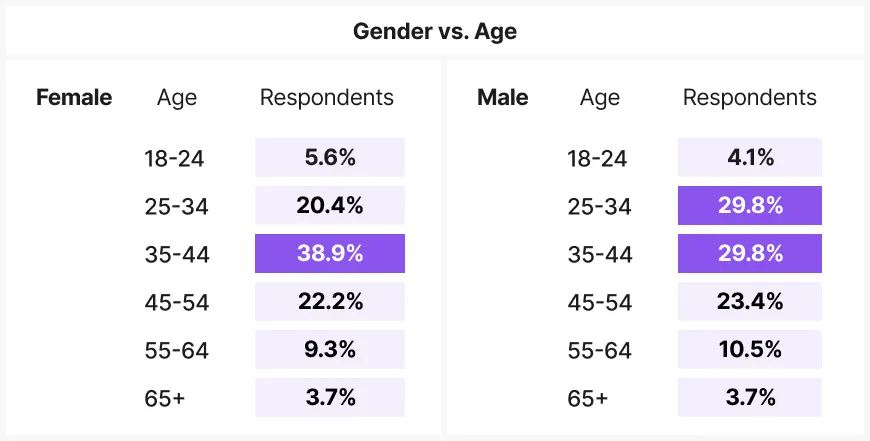
Age distribution offers insight into the future trajectory of gender diversity. In 2024, 44.4% of female developers fell within the 25-34 age bracket, slightly higher than the 35% of males in the same range. Female representation was also marginally higher in the 18-24 category.
By 2025, the picture has evolved further. A larger proportion of female developers are now in the 35-44 age bracket at 38.9%, suggesting that more women are not only entering but also staying and progressing within the ecosystem.
Salesforce Architects show similar patterns. While most respondents reported between 2 and 10 years of experience, female architects were more concentrated in the 1-2 year range. This early-career clustering indicates that more women are joining senior technical pathways such as architecture, suggesting that improvements in gender representation are likely to continue.
“We are witnessing a critical maturation in the ecosystem. The data signals that we have moved beyond just getting women in the door; we are now seeing them stay, upskill, and confidently step into senior technical pathways like Architecture.” Nadina D. Lisbon, Salesforce CTA, Technical Solutions Engineer, AgentSync
Remote Work Patterns
Remote work continues to shape the professional experience of Salesforce developers. In 2024, 58% of female developers worked fully remotely compared to 51% of male developers. Only 6% of women held full-time office roles, suggesting that remote work was both accessible and widely adopted by female developers at this point in time.
The 2025 data presents a more complex picture. While the percentage of female developers working fully remotely increased to 61.1%, the proportion working full-time in an office also rose sharply to 16.7%. This contrasts with male developers, only 7% of whom reported working exclusively in an office. Men were more likely to hold hybrid roles at 37.8%, compared to 22.2% of women.
These results reinforce a recurring pattern: female developers are more likely than their male peers to work fully remotely. However, the sharp increase in women working entirely on-site raises important questions. It may indicate that, for some women, fully remote roles remain a preferred or more accessible option, especially when balancing personal or family responsibilities. At the same time, the rise in full-time office requirements for women could point to uneven access to flexibility or even workplace expectations that differ by gender.
The contrast suggests that while remote work can support greater gender diversity in technical roles, accessibility to flexible arrangements may not be evenly distributed. The data hints at a potential divide in choice versus obligation: some women appear to benefit from remote-first cultures, while others may be required to be on-site more frequently than their male counterparts. This dynamic deserves closer attention as organizations continue to define their long-term work models.
Skill Level and Confidence
Self-assessed expertise levels among developers highlight another dimension of the gender gap. In the 2025 survey, 60.5% of male developers identified as advanced compared to 40.7% of female developers. Half (50%) of female respondents described themselves as intermediate, while 35.5% of males selected the same category. At the entry level, 9.3% of female developers placed themselves in this bracket, compared to 4.1% of males.
While these results may partially reflect the growing number of early-career women entering the ecosystem, they may also point to well-documented differences in how men and women evaluate their own skill levels. Many studies across the wider tech sector suggest that women tend to be more modest in their self-assessments and may undervalue their expertise even when performing at an equivalent level to their male peers.
Taken together, the data suggests a dual reality: more women are joining Salesforce development at earlier career stages, but confidence and self-perception may also influence how female developers rate their proficiency.
“Many women in technical roles tend to underrate their own skills – I’ve seen intermediate and advanced developers label themselves as beginners. Modesty plays a part, but as leaders we have a responsibility to give clear, constructive feedback and reinforce their strengths so their confidence can match their capability.” Bhavana Singh, CEO & Founder, Three Moons Consulting
How Salesforce and Employers Can Improve Accessibility for Women
With the removal of DEI programs across significant parts of the United States, companies must be more intentional about creating environments where women can access and thrive in Salesforce careers. The absence of formal DEI structures does not remove the need for equity. Instead, it places greater responsibility on organizations to build inclusive cultures through practical, sustainable actions.
“As the first Black female Salesforce CTA, I stand here to be a beacon of hope, but I do not want to be the last. The removal of formal DEI structures cannot become an excuse to close the doors we have worked so hard to push open. Accessibility means ensuring that my journey is not an anomaly, but a blueprint for the women rising behind me.” Nadina D. Lisbon, Salesforce CTA, Technical Solutions Engineer, AgentSync
One of the most effective steps is expanding flexible and remote working options, which the data shows are especially valued by female developers. Employers can also reduce barriers by offering clear, supported entry paths such as sponsored certifications, paid training time, and structured technical apprenticeships. These programs create opportunities for women who may not have traditional computer science backgrounds but have the capability and interest to succeed in Salesforce roles.
“Remote and flexible work schedules open access to an incredible pool of highly skilled women who might otherwise be excluded by rigid structures. Flexibility isn’t a perk – it’s a catalyst for bringing more talented female developers into technical roles.” Bhavana Singh, CEO & Founder, Three Moons Consulting
Visibility and mentorship remain critical. Women are more likely to advance when they can see others like them in technical and leadership positions. Encouraging female speakers at community events, supporting women-led user groups, and pairing early-career professionals with mentors can make a measurable difference. Companies hiring Salesforce professionals should also focus on transparent job descriptions and skill requirements to prevent self-selection out of roles, something women statistically are more likely to do when they do not meet every listed requirement.
Salesforce itself can play an influential role by amplifying community programs that support women entering the ecosystem. Initiatives that expand access to Trailhead, provide vouchers for certification exams, and spotlight diverse success stories can help counterbalance the loss of DEI infrastructure in corporate spaces. As the ecosystem grows, accessibility will depend less on policy labels and more on consistent, deliberate action that welcomes women into technical careers and supports them as they advance.
Final Thoughts
Although progress remains steady rather than rapid, the Salesforce ecosystem is undoubtedly seeing an increase in female participation, particularly in early-career roles and among younger professionals. The rise in female architects with fewer years of experience and the changing age brackets for developers both point toward a longer-term shift.
Remote work continues to be an important factor in attracting and retaining women in technical roles. At the same time, differences in self-reported expertise underscore the importance of mentorship, visibility, and inclusive learning pathways. There is more work to be done, but year over year, the direction of travel remains promising.