





Highlights
- Salesforce is changing the format of its release notes for the Winter ‘27 release.
- The new release note format is more chronologically focused, with a grouping of changes by month.
- There has been increasing pressure on companies like Salesforce to deliver more value more frequently, due to the rise of AI-assisted development.
If you’re like me, the first thing you noticed when opening the Salesforce release notes for Winter ‘27 was the new section on the first page entitled “Changes to the Release Notes”. We all knew that change was coming, but I don’t think most people were expecting the format of the release notes themselves to change.
Then again, this is something that came up on Episode 17 of The Picklist Podcast back in May 2026. The thrice-annual Salesforce release is the most well-known frequent of updates to the Salesforce platform, but it isn’t the only one. Could this be a sign of things to come?
What’s Changed?
Salesforce began the Winter ‘27 release notes with a section that pointed out that not only was the platform changing, but so too were the release notes themselves. There were four bullet points that you can see in the screenshot below.
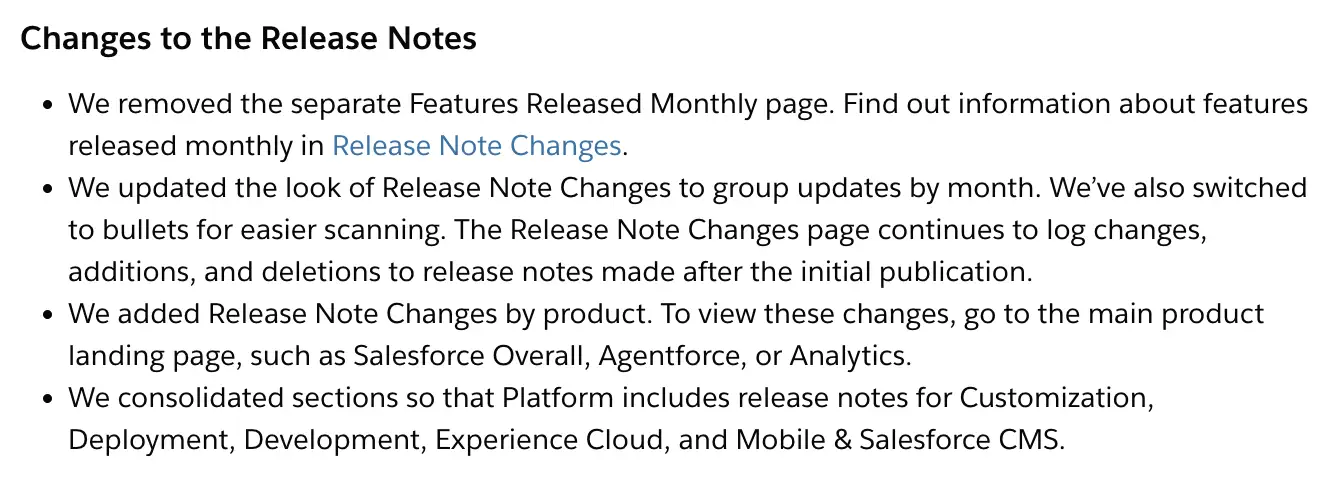
The first three points all refer to changes to the Release Notes Changes section. This section is where you can find information about anything that changed in the release notes from the point in time where they were first published.
This section is beneficial given the fact that the release itself is not set in stone, but evolves over time. New features may be added or removed to the release, and the release notes updated as a result. The Release Notes Changes section is where you can go to see what has changed from the first drop to the final release.
In summary, the first three points say that Salesforce has rolled the Features Released Monthly section into the Release Notes Changes section, and grouped it by month as well. They also changed the format to be easier to view by product.
The fourth point mentions that Customization, Deployment, Experience Cloud, and Mobile and Salesforce CMS all fold under the Platform section now.
Given that Salesforce has grown from a cloud-based sales CRM to a behemoth of a cloud company offering a tool for almost every aspect of enterprise software, it makes sense that things will evolve and change over time. That said, I wonder if some of these points allude to some larger changes coming to the release frequency in the future.
Speculating the Reasons for the Change
We discussed this in The Picklist Podcast almost three months before the Winter ‘27 release notes were published. Salesforce’s core product operates on a thrice-yearly release cycle, but not every product that they offer does. The Salesforce CLI, for example, gets updates all the time!
Christine Marshall questioned if Salesforce could move away from the three releases per year model, and noted that with the speed of AI accelerating and the security impacts of that, it may be likely that this happens in the near future. She and I flagged that there would be some potential negative impacts of this, namely that it would be harder to keep track of major features if done too frequently and that end users don’t like change.
Peter Chittum then called out that Salesforce has actually been making hundreds of changes per year for a long time. While a majority of these smaller releases were extremely minor and most users didn’t even notice them, he then pointed out the fact that the Salesforce CLI and other developer tools have been getting weekly updates since conception.
The conversation then moved on to some of the positives and negatives of the more frequent releases across various tools, but the core idea was this: It wouldn’t be abnormal for Salesforce to start doing more frequent major releases – in fact, many other software companies do. The three releases per year model is unique, and while it may have worked well in the past, that was for a very different Salesforce.
Salesforce today is a cloud giant that operates far more than a handful of products like they did in the past. They’re a leader in the enterprise AI space, and with that comes the requirement to move faster in response to the ever-changing AI landscape. The three releases per year model may be more of a hindrance than a help at this point.
Could this be why we’re seeing more of a focus on the monthly changes to release notes, and Salesforce playing with the formatting to make it easier to read and digest the chronological view? Perhaps, and it may be a stretch. But it’s something to think about, and moving to a more frequent major release schedule could also be something that Salesforce is considering.
What’s Next?
It’s not clear what’s coming next for Salesforce, but there are many things that nod to the idea that Salesforce may eventually move to a more frequent major release schedule. As I said earlier, the AI landscape is very different from the cloud software landscape that Salesforce grew up in. Delivering several major features to a smaller number of products worked for the last 25 years, but it won’t be enough to keep Salesforce ahead of the competition for much longer.
AI is accelerating development for everyone, Salesforce included. While initially, companies like Salesforce thought that the biggest benefit of AI would be to reduce their overheads in terms of headcount, it turns out the greatest benefit of AI is that it can help human beings do bigger and better things with more powerful tools. Software engineers can spend less time writing code, and more time orchestrating the architecture of their applications while AI assistants write the raw code for them.
It may soon be the case that three releases per year simply isn’t enough to allow Salesforce to inject the value they want into their products. I know that it sounds super optimistic, but I believe we’re going to soon see development velocity skyrocket to the point where Salesforce, and other vendors like it, could push a new release every month or two instead.
Final Thoughts
It may be a long shot, but Salesforce’s changing of the format of their release notes could be a sign that they’re looking to move to a more frequent release cycle in the near future. There’s pressure to do more in the era of AI, and it may be that Salesforce is planning to respond to this demand.
What are your thoughts? Am I totally off the mark with this one? Do you think having more frequent releases is a good idea for Salesforce, or do you think it would be too difficult to stay on top of? Let us know in the comments below.





Comments: