

A lot of Salesforce professionals at the moment are still navigating the complexities of agentic AI and how to adopt it by learning from both the past and the present. As I was catching up on recent Trailhead content, which included modules that distinguished chatbots from agentic service, I found myself reflecting on how familiar these concepts felt – not just theoretically, but personally. The timing was uncanny. Shortly after completing the training, I encountered a real-world customer service experience that perfectly illustrated the gap between efficient automation and truly effective, agentic service.
This article references my lived experience to suggest an alternative, agentic approach. If you are an Agentforce consultant or an employee, I hope this service story can serve as an example for your blueprint for how agentic experiences can be designed.
Consumer Perspective: A Missed Moment of Service
Like many consumers, I began my journey on my phone. I was researching a special-occasion trip – something more complex and personal than a simple flight or hotel booking. I already knew how to self-serve for basic travel needs. This time, I was intentionally looking for a higher-touch, more curated experience.
Given my long-standing relationship with American Express, AmEx Travel felt like the right place to go. After all, the brand promises premium experiences and trusted partnerships. I found relevant destination content and confirmation that they worked with regional travel providers. Encouraged, I logged in to provide more details. However, the experience quickly began to fragment.
Perhaps because I was using the mobile browser rather than the app, the flow shifted. I initiated a chat, explained that I was planning a special trip with specific dates and a destination, and was promptly connected to a human agent. That agent informed me I would need to be transferred to a travel consultant. I agreed, but a minor UI interaction caused the chat to disappear entirely.
Wanting to continue, I switched approaches. This time, I logged into the AmEx app first and started a new chat. There was no trace of my earlier interaction. I repeated myself. Again, I was transferred, only to be told that I would need to call another team during business hours.
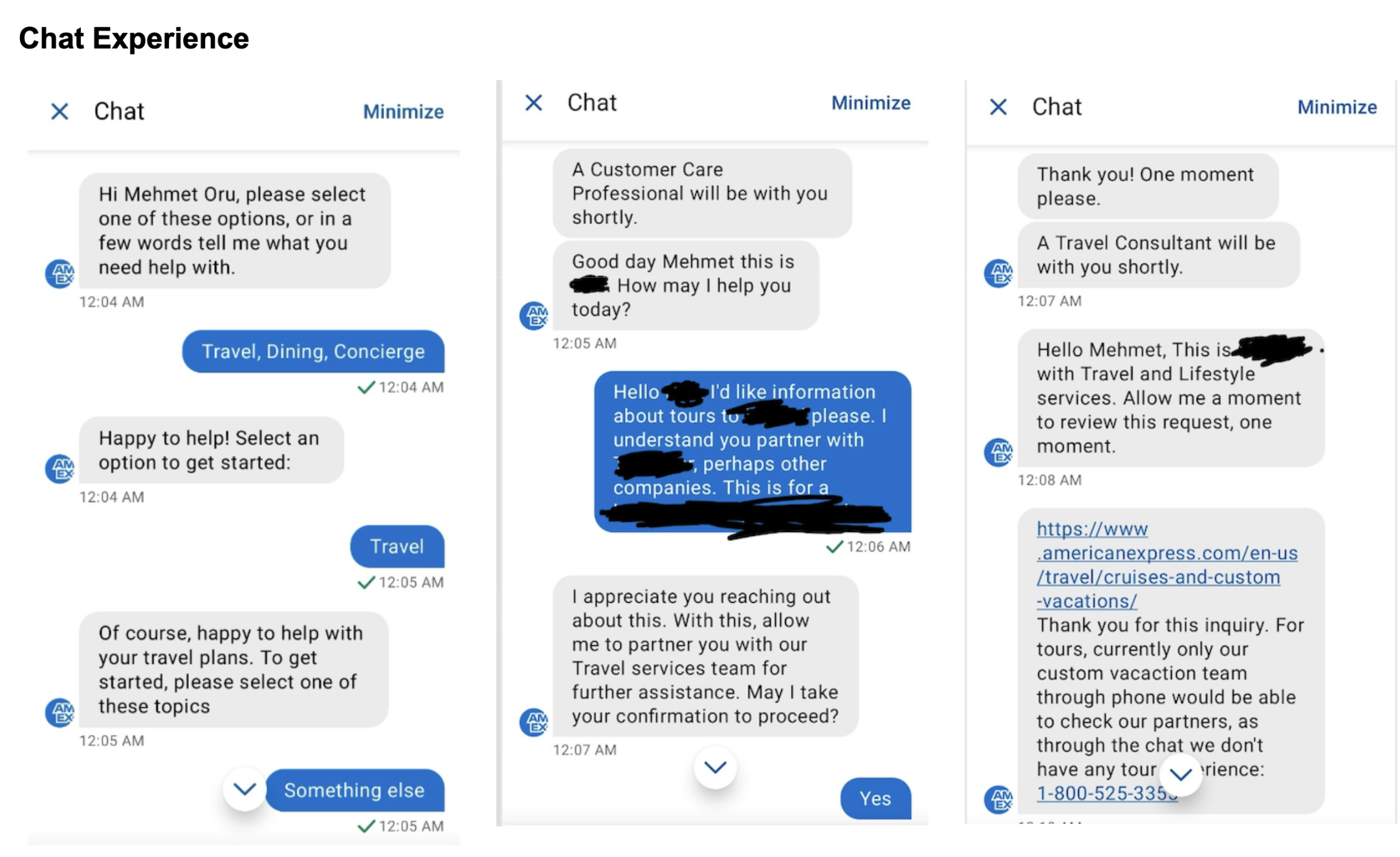
At this point, the experience felt oddly familiar, like watching a demo of what not to do. Everyone I interacted with was polite and efficient. But no one acknowledged the context of my request, the occasion, or the intent behind it.
I tried one final path: filling out a form. I selected from predefined categories, budget ranges, dates, and preferred contact method (email). I submitted the request. I received no confirmation, no acknowledgment of the occasion, and no sense of what would happen next.
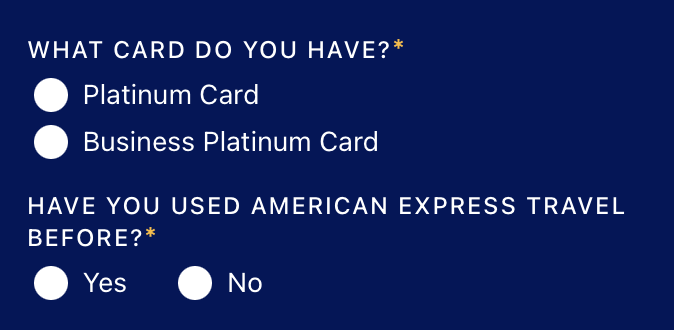
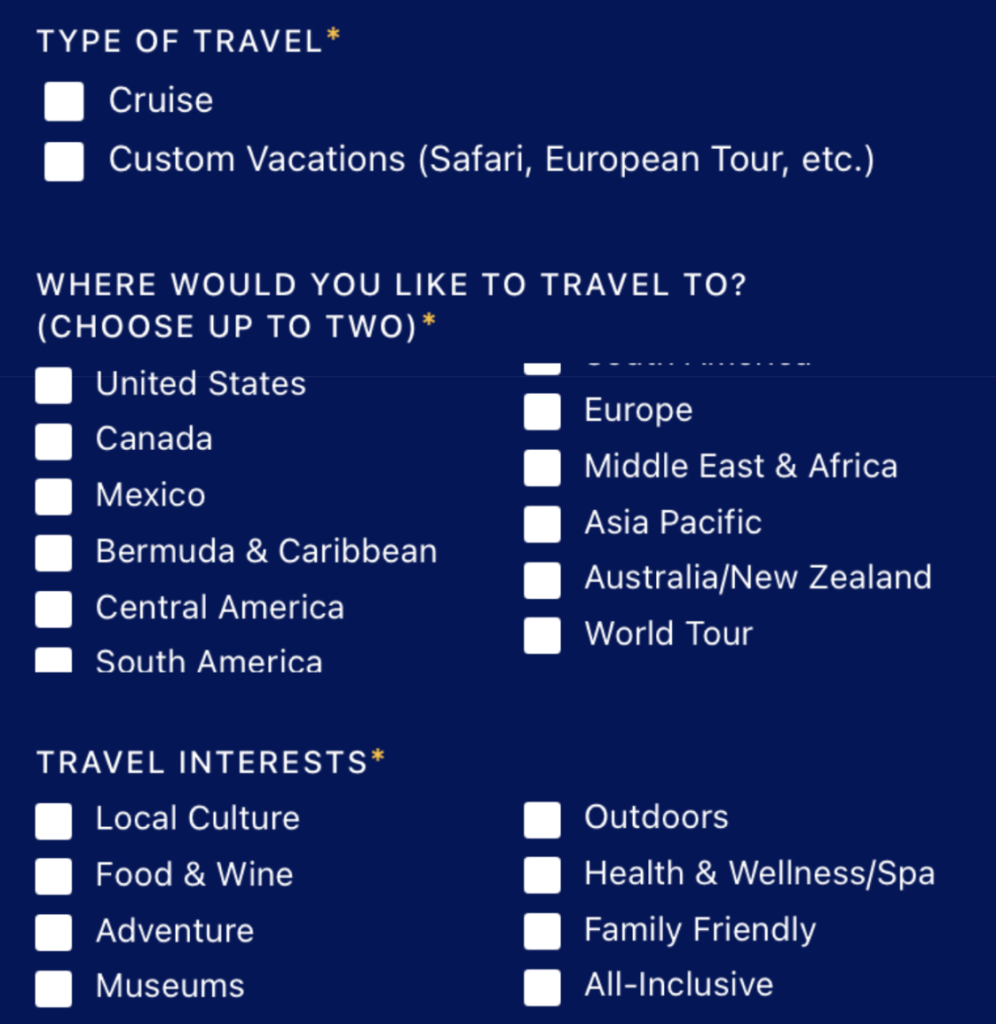
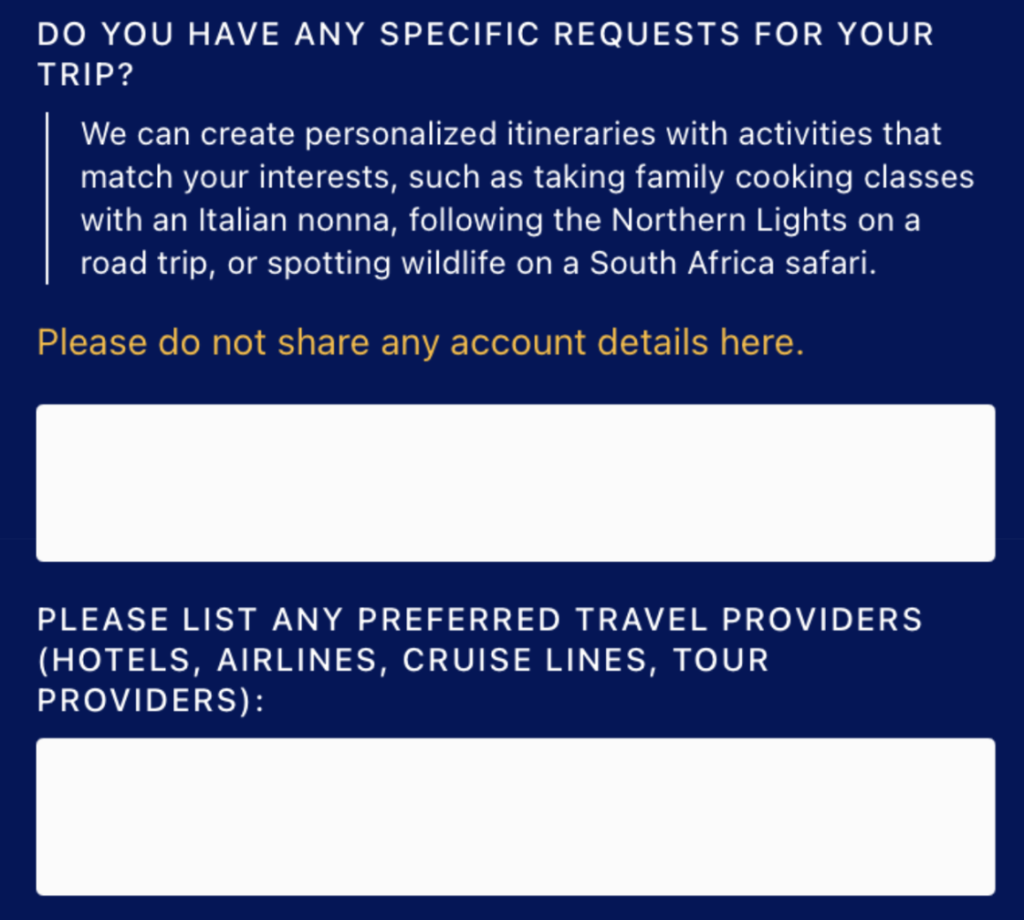
Below were some steps in my form process, and what I believe could have been done better to improve the user experience.
Recommended Improvements
I am already logged in. The system should already know whether I have an existing and active consumer or business card. The system should also know whether AmEx travel was used before.
Recommended Improvements
While (I assume) this form is intended for US-based cardholders, the checklist is limited, while requiring a lot more consumer UX action. It should ask consumers what type of experiences they’d like to have and what locations they may want to visit – whether it is a continent, country, city, or specific venues.
I’d rather be interviewed to share what I want included or excluded, where a cruise experience can be part of a holistic experience.
Recommended Improvements
What could have been the beginning of an interaction was instead a short text box of potential requests.
It should also maintain a list of my or other consumers’ preferred travel providers and retrieve status automatically, whether it is an airline, hotel chain, or cruise line. For example, I have a lifetime status with a number of travel providers. I’d rather not specify this every single time.
I received a reply within 48 hours. I was disappointed by the lack of acknowledgement of the special occasion I had described – no congratulations, no contextual reply based on the location I had expressed interest in. A simple, courteous, non-personal note. This wasn’t bad service, but it wasn’t the service I was seeking. It felt like a lost opportunity.
So I kept doing what most consumers do these days. I started iterating on ideas with ChatGPT. I started making my own bookings. I decided I would share my itinerary with AmEx travel, but many of my bookings – thus their business and impact opportunity – felt fleeting.
I shared our tentative travel ideas, organized in a spreadsheet with the agent by email. After a week of no response, I emailed them to check in (mostly because of this article!). The exact same table’s image in ChatGPT gave us as consumers much more information and ideas, including the type of experience AmEx travel could have facilitated, rather than informing us about any special perks they may have.
At this stage, it’s unlikely I will use them for this trip. My goal in highlighting this is to ‘throw down the gauntlet’ as a consumer, as it’s important to highlight the systematic issues in order to drive business change urgency.
Travel Consultant Perspective: Reducing Waste, Augmenting Expertise
As an architect and past consultant, I seek to put myself in my target personas’ shoes. While I can be disappointed as a consumer, I can also empathize with travel consultants, who are often inundated with brief, incomplete consumer requests, many of which lead to dead ends.
Their goals are clear: deliver meaningful experiences, drive revenue, and make the best possible use of their time. What makes this difficult today is not a lack of expertise, but a lack of context and effective engagement opportunities at the moments that matter.
When requests arrive fragmented across channels, stripped of intent, or reduced to form fields, consultants are forced to reconstruct the story before they can add value. This increases ramp-up time and reduces the number of opportunities they can engage with deeply.
An agentic experience that augments the consultant’s role can change that dynamic. By preserving the consumer’s narrative, summarizing intent, and classifying requests before handoff, consultants can spend less time deciphering and more time advising.
The result is not only better recommendations, but higher-quality interactions that benefit both the customer and the business.
Business Executive Perspective: Higher Operational Costs and Reduced Revenue Opportunity
For business executives, consumer experiences like this signal a clear need to address both rising operational costs and missed revenue opportunities.
- Each handoff, repeated explanation, and channel restart increases service effort without increasing conversion.
- High-intent moments – especially those tied to special occasions or complex purchases – represent outsized revenue opportunities that can easily slip away when friction appears.
In this case, the consumer did not abandon the journey entirely, but was redirected. By continuing independently, using alternative tools, and finalizing bookings outside the service flow, value is lost that may never be fully recovered.
For leaders, this is often the key takeaway that drives sponsorship of agentic pilots and, ultimately, scaled adoption: poor service experiences don’t always result in churn – they result in revenue leakage, reduced share of wallet, lower lifetime value, and diminished differentiation at the moments that matter most.
Once the business case is clear, the next step is translating intent into a repeatable, scalable process. This is where business analysis becomes critical.
Business Analyst Perspective: What the Experience Needed
From a business analysis standpoint, the disconnected consumer experience highlights a familiar gap between siloed process efficiency vs. customer outcome goals.
AmEx Travel, like many premium service providers, serves two primary audiences: business travelers and customers seeking curated or luxury experiences. Both groups share a critical trait – they are busy, intentional, and expect to be understood quickly.
Regardless of whether a request arrives via chat, app, browser, email, or phone, the goal should be the same: provide a coherent, continuous experience that respects both the customer’s time and intent.
After authentication, several key questions should shape the journey:
- Is this customer new to travel services or already familiar with them?
- Are they inquiring about an existing booking, an urgent trip, or something new?
- Is the request simple and transactional, or complex and exploratory?
In the case of special-occasion travel, acknowledging the occasion itself matters. These requests often benefit from conversation, not checkboxes. While structured data is necessary, it shouldn’t replace interviewing the customer to understand preferences, constraints, and expectations.
If a request can’t be fulfilled immediately, the customer should still leave the interaction feeling heard. That means:
- A clear summary of what was captured.
- Transparency around next steps and response time.
- Confidence that a travel consultant will receive the full context, not just form fields.
User Story 1: Consumer
As a consumer planning a complex or special-occasion trip, I want to describe my travel needs once – in my own words – and have that context preserved across channels, so that I feel understood and can receive meaningful guidance without repeating myself.
As for the travel consultant, success depends on clarity. A concise summary, relevant data points (dates, destinations, budget sensitivity), and classification of request type dramatically reduce ramp-up time and improve outcomes.
User Story 2: Travel Consultant
As a travel consultant supporting high-intent inquiries, I want to engage the consumer from the moment they express interest through order placement and the travel experience itself – even when agents assist with intake –
so that opportunities aren’t lost, the value of my services is consistently visible, and each inquiry can translate into revenue, repeat engagement, and referral opportunities.
When experiences break down, it may be tempting to jump straight into technology discussions. However, to truly understand the opportunity and guide implementation, business analysts describing the desired process – using a UPN or BPN diagram, for example – can be incredibly powerful.
This approach creates shared alignment between business sponsors and solution architects, enabling teams to pilot and scale agentic solutions with clarity and intent.
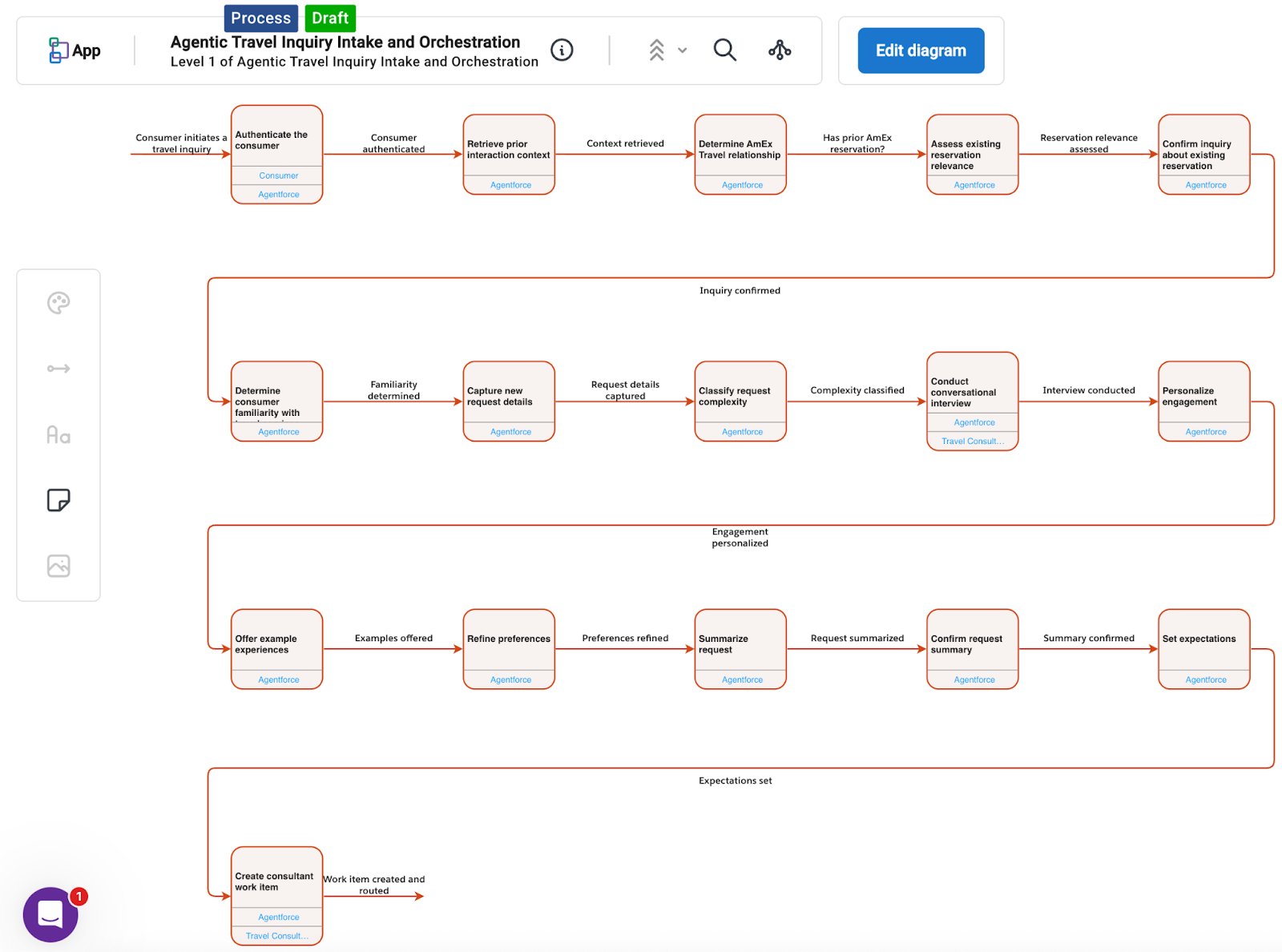
While the consultant’s engagement spans the full lifecycle, the UPN process above intentionally focuses on the entry point where intent is captured, context is preserved, and the opportunity is either protected or lost.
Scoping this work narrowly, where immediate value can be realized, is key to executing quickly and iterating continuously.
An Architect’s Perspective: Why Chatbots Aren’t Enough
Architecturally, my experience – like that of many consumers – reflects the natural limits of traditional chatbots and form-driven service flows. Chatbots are typically:
- Stateless
- Channel-bound
- Rigid in topic navigation
- Optimized for deflection, not discovery
Forms, while structured, often strip away context and emotion, especially for high-value, complex requests. Agentic service enables a fundamentally different approach.
An agentic architecture treats the interaction as a journey, not a transaction. Once a customer engages, the system should preserve memory across channels, summarize intent, and adapt the flow based on what the customer is trying to accomplish.
Instead of funneling users into predefined prompts, agents assess familiarity and urgency, distinguish simple requests from complex ones, conduct conversational interviews when needed, offer examples to refine understanding, and confirm shared understanding before handoff.
For architects, the opportunity is not to replace chatbots or forms overnight, but to guide an evolutionary transition from today’s fragmented experiences toward measurably better outcomes.
Working closely with the business sponsor and business analyst, the architect’s role is to translate intent and process clarity into phased solutions that improve continuity, reduce friction, and preserve optionality – without overengineering or overcommitting early.
From an architectural standpoint, this is also where purpose-built platforms matter. While general-purpose GPTs or custom-built solutions can generate responses, they often lack native support for trusted access to first-party data, multi-channel continuity, governance, and workflow orchestration.
An agentic platform such as Agentforce is designed to operate within enterprise boundaries – respecting permissions, preserving context across channels, and integrating with existing service workflows – making it better suited for scenarios where trust, scale, and operational consistency are critical.
From a practical delivery standpoint, a few principles matter:
- DO start by instrumenting the current experience before introducing change.
- DO establish a baseline by measuring abandoned or redirected interactions across chat, form, and phone channels, such as chats that end in handoff without resolution, authenticated sessions that result in channel switching, or form submissions that do not lead to follow-up engagement.
- DO NOT try to rearchitect the entire as-is process all at once.
- DO start with targeted agentic pilots, e.g., to focus on high-intent or complex scenarios.
Architects can help define success criteria that go beyond adoption, such as higher conversion rates for assisted journeys, reduced time-to-handoff for human consultants, or fewer repeated explanations per request. On the cost side, improvements may appear as reduced handling time or fewer internal transfers; on the revenue side, as a higher share of wallet, improved conversion on complex purchases, or increased lifetime value.
A Hypothetical Pilot: Reimagining High-Intent Travel Inquiries with Agentic Service
For this business use case, a meaningful agentic pilot would not attempt to overhaul every travel interaction. Instead, it would focus narrowly on high-intent, complex travel inquiries, such as special-occasion trips, multi-component itineraries, or curated experiences, where today’s chatbots, forms, and handoffs consistently fall short.
The pilot scope should begin with a single intake journey: authenticated consumers initiating a new, non-urgent travel request that does not map cleanly to a simple flight or hotel booking.
Rather than replacing existing chat or form interfaces immediately, the pilot would introduce an agentic intake layer responsible for capturing intent once, preserving context across channels, and producing a complete, consultant-ready request artifact.
To keep the pilot tractable, the data scope should remain deliberately limited. One to three data sources – such as customer profile, prior travel history, and loyalty or preference data – are typically sufficient.
Within each source, three to five core objects or datasets (for example: past bookings, preferred providers, and contact preferences) allow the agent to personalize the conversation without overengineering identity resolution or enrichment upfront.
Success metrics should reflect the exact failure points observed in the current experience. On the operational side, teams could measure reductions in abandoned or restarted inquiries, fewer repeated explanations per request, and decreased time spent by consultants reconstructing context.
On the revenue side, teams might compare assisted conversion rates for complex travel requests, engagement depth during intake, or downstream booking value against existing chat- or form-led journeys.
Finally, the pilot should be intentionally time-bound and learning-oriented. A short, active pilot – measured in weeks – allows teams to observe how consumers respond when they are interviewed rather than routed, when intent is summarized rather than lost, and when expectations are set clearly instead of deferred.
While redesigning consumer-facing UIs across web and mobile channels may take longer, validating the agentic workflow itself can move faster, providing the evidence needed to justify broader rollout and deeper integration.
Summary: Design for Consumer Intent and Efficiency
Consumers want to feel understood. Businesses want higher conversion and more effective use of human expertise. Architects and consultants want to design systems that scale without sacrificing trust. Business analysts remain essential in translating intent into outcomes.
The experience described here wasn’t a failure of people or effort – it was a failure of holistic consumer experience design, shaped by processes that reflected what technology supported at the time rather than what is possible today. As Salesforce professionals, we need to optimize both consumer and employee experiences for outcomes, recognizing that siloed interactions are costly: every handoff increases service effort, while quiet redirection often results in lost revenue or reduced profitability.
Agentic service succeeds when intent is captured once, preserved across channels, and acted upon intelligently.
For executives, this is about protecting revenue and differentiation. For business analysts, it’s about defining better processes before technology decisions are made. For architects, it’s about guiding an evolutionary transition – piloting agentic patterns, measuring impact, and scaling what works without disrupting everything at once.
Disclaimer: I do not have a commercial relationship with American Express Travel as an employee, supplier, or consultant. The example shared reflects my personal experience as a consumer, informed by my background as a Salesforce solution architect, and is intended to illustrate design considerations rather than critique specific individuals or teams.