
This year’s theme for Dreamforce centered around “Hey AI, Meet the #1 CRM,” and Marc Benioff opened the keynote by calling it “an interface revolution”. So if last year was all about convincing you that agentic AI was here to stay, this year the agenda was to prove it actually works.
In this article, I’ll unpack the biggest themes, launches, and announcements from Dreamforce ’26 and what they mean for you as a Salesforce professional.
The Headliner: AIforce
Last year’s big reveal was Agentforce 360, while this year Salesforce seems to have moved the spotlight away from all the “360” branding for a bit and moved on to an interface-first pitch built around AIforce.
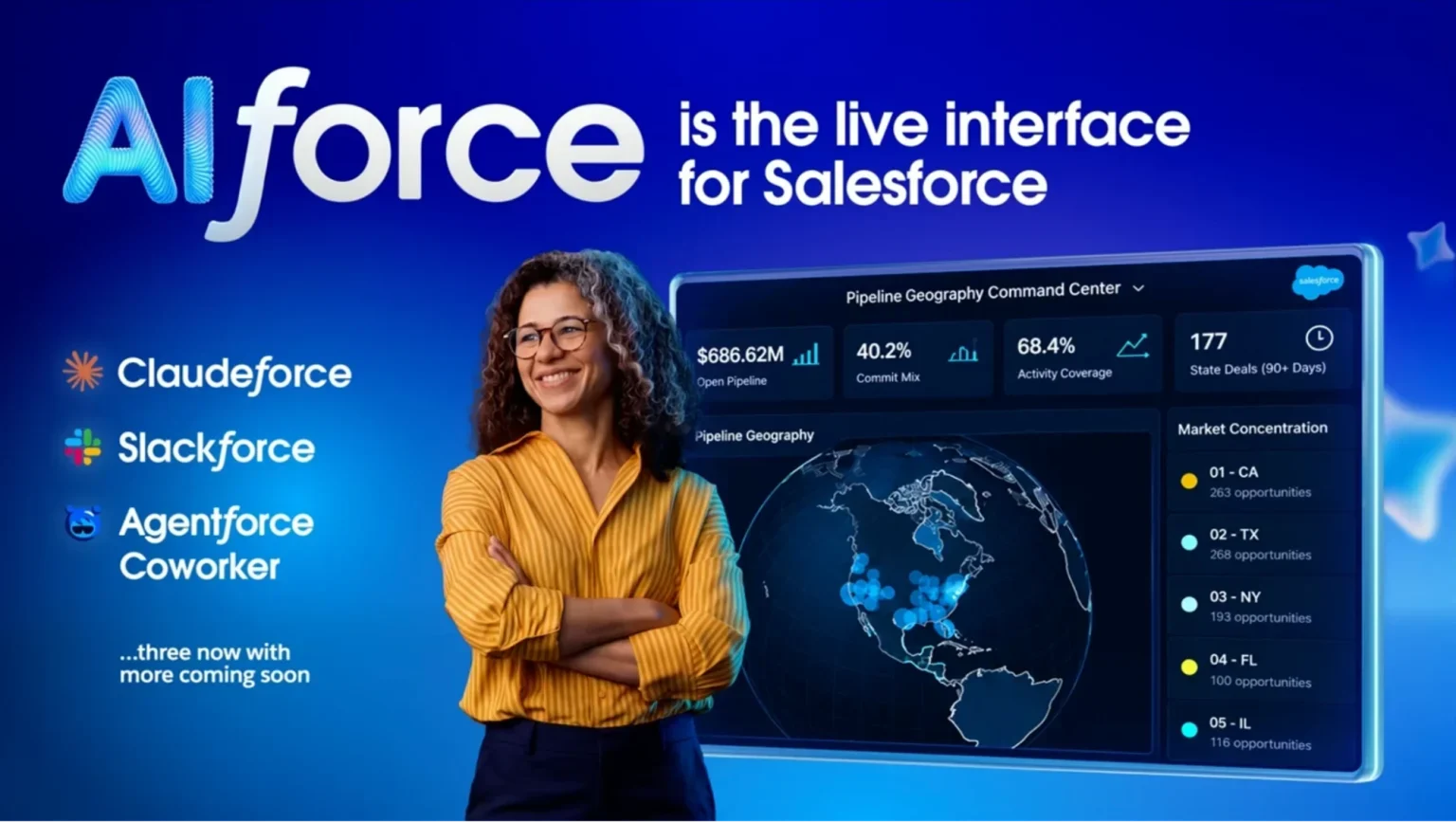
AIforce is a new interface layer that sits above Data 360, Customer 360, and Agentforce, and it lets your data, workflows, and permissions get used from wherever people already work (not just inside Salesforce). It’s basically a continuation of all the Headless 360 talk from this year’s TDX.
Benioff framed it like this: “Other software companies think their product is the UI. That’s not what we think at Salesforce. At Salesforce, our product is the trust that our customers put in us to hold their data, their workflows, their business processes, their permissions, their security rules.” AIforce, in his words, is what happens when you plug that trust into an entirely new, agentic interface going beyond what a traditional UI can offer.
The concept pitches a workflow where employees who’ve never logged into Salesforce can now update records, trigger workflows, and ask questions from Claude or Slack without ever having to open a separate Salesforce tab. AIforce launches with three surfaces:
- Claudeforce – Salesforce inside Claude.
- Slackforce – Salesforce context inside Slack.
- Agentforce Coworker – an AI teammate inside Lightning itself.
And if you’re worried about security and data privacy, Salesforce also stressed zero data retention here. Business data apparently will only be used to answer questions, but will not be kept by the model provider.
Claudeforce
The Anthropic partnership that’s been simmering since the summer officially moved into open beta at Dreamforce, launching with the tagline “the #1 AI meets the #1 CRM”.
Claudeforce puts your CRM inside Claude itself, with 37 ready-made sales skills covering everything from prospecting to close, and Claude understands the permissions in your org – it knows what each person is already permissioned to see.
All this new talk about Claudeforce makes everyone think, what happened to Agentforce then? Isn’t that Salesforce’s top AI solution? Isn’t this redundant? I’ve seen that meme on LinkedIn about Salesforce seeing Claudeforce as the new baby and Agentforce drowning in the background (made me giggle). But no, it does not make Agentforce obsolete, but we can agree that it does push it a bit into the back seat.
Claude is only one (or probably the most significant) of the many new partnerships Salesforce has unveiled, which I will mention further down in this article. Interesting times indeed, and it makes you wonder about the future of Salesforce. Questions about Salesforce possibly being acquired are there, but there’s also the other side of the coin with Salesforce making more than a dozen acquisitions since the start of 2025 alone, chasing every piece of the agentic puzzle.
With its stock down roughly a third since that buying spree began, and Agentforce adoption still sitting at only around 12% of customers as of earlier this year, it seems the partnerships and the acquisitions keep stacking up, but so does the pressure to show they’re actually paying off.
Slackforce Surfaces
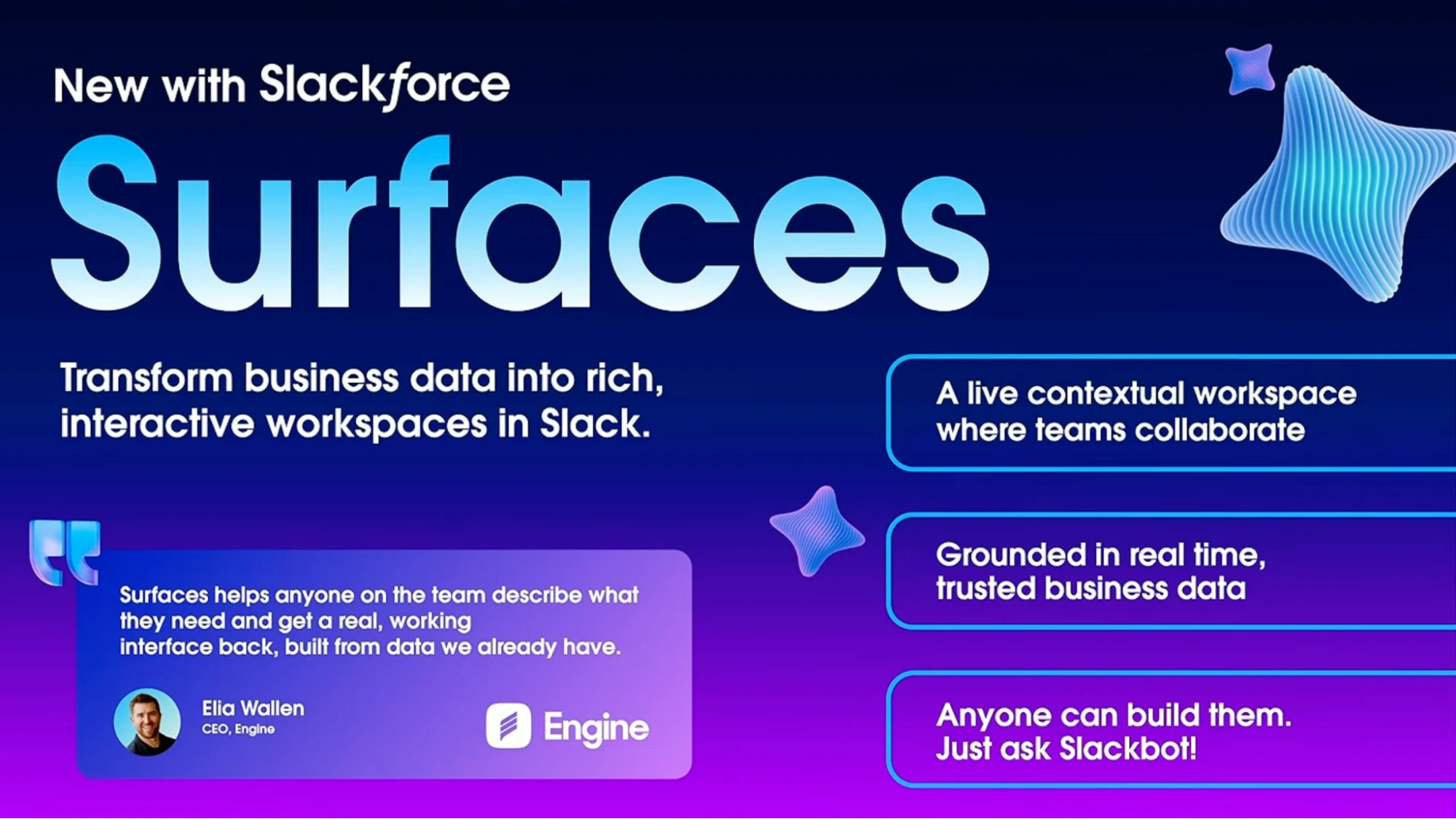
Slack’s evolution from simply an “Agentic OS” to the actual front door continues. Slackforce Surfaces was unveiled at Dreamforce this year as a way to bring Salesforce context and visualizations directly into Slack conversations. It basically solves the problem of a rep or manager needing another tab to get an answer.
What’s more is that this keeps the whole team looking at the same live data in the same thread, instead of everyone pulling their own screenshot or export and comparing notes after the fact. It’s less flashy than AIforce or Claudeforce, but is another step towards having people stop treating Slack and Salesforce as loosely connected tools.
Agentforce Coworker
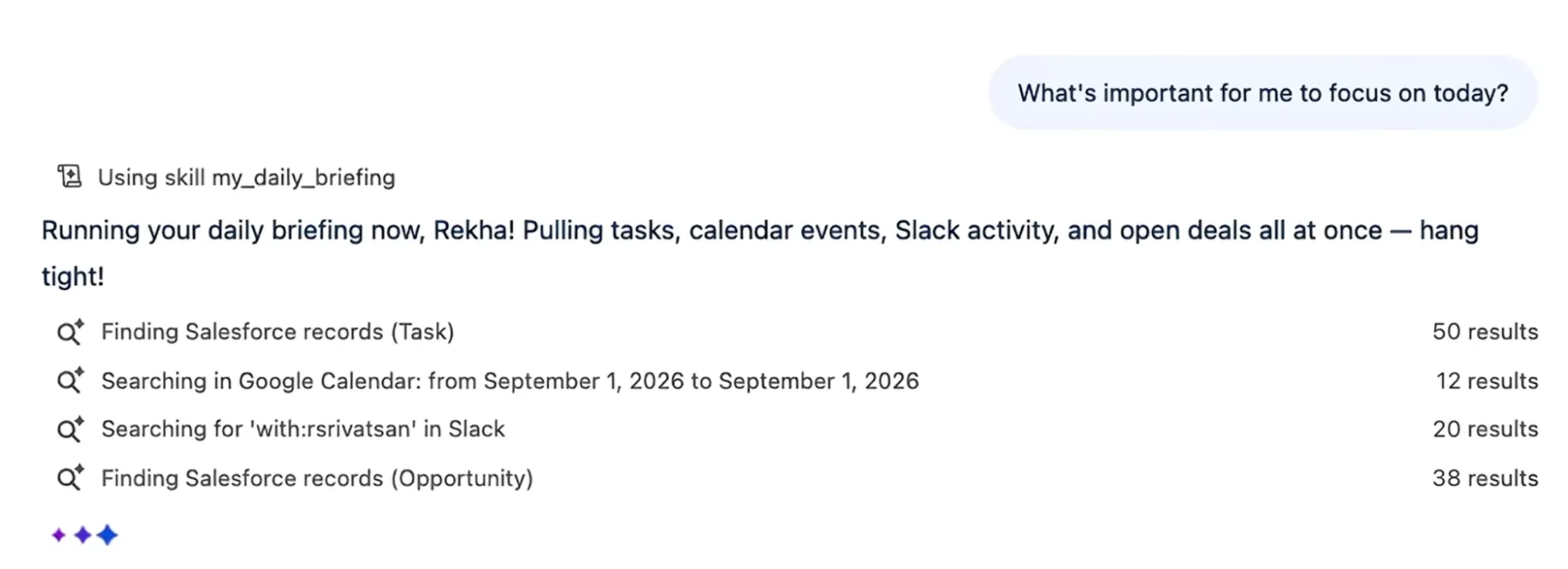
Of the three AIforce surfaces, Coworker was announced back in May and is the only one generally available right now. Think of it like an AI teammate that lives inside the platform and handles natural-language search, who can also hand off to specialized agents when a task needs more firepower. It’s literally that – a coworker!
The demo Salesforce used was a familiar morning routine: bouncing between Salesforce, email, calendar, and Drive just to piece together what needs attention that day. Ask Coworker “what’s important for me today,” and it pulls from all of those sources at once, then surfaces not just a task list but the reasoning behind it.
The main idea is that you don’t need to know which tool or agent to call – just say what you’re trying to do, and Coworker should figure out the routing, whether you’re in Salesforce, desktop, mobile, Teams, ChatGPT, or Claude.
Meet Koa, Salesforce’s Own Reasoning Model
Didn’t see this one coming if I’m being honest! Salesforce built its own CRM-specific reasoning model named Koa. This was developed by post-training NVIDIA’s Nemotron 3 Super on a synthetic dataset built from nearly 30 years of CRM deployments across 14+ industries.
The idea is that Koa handles the CRM-specific reasoning (which includes checking credit limits, routing cases, and sequencing multi-step workflows, for example) while general-purpose models like Claude or GPT handle everything else.
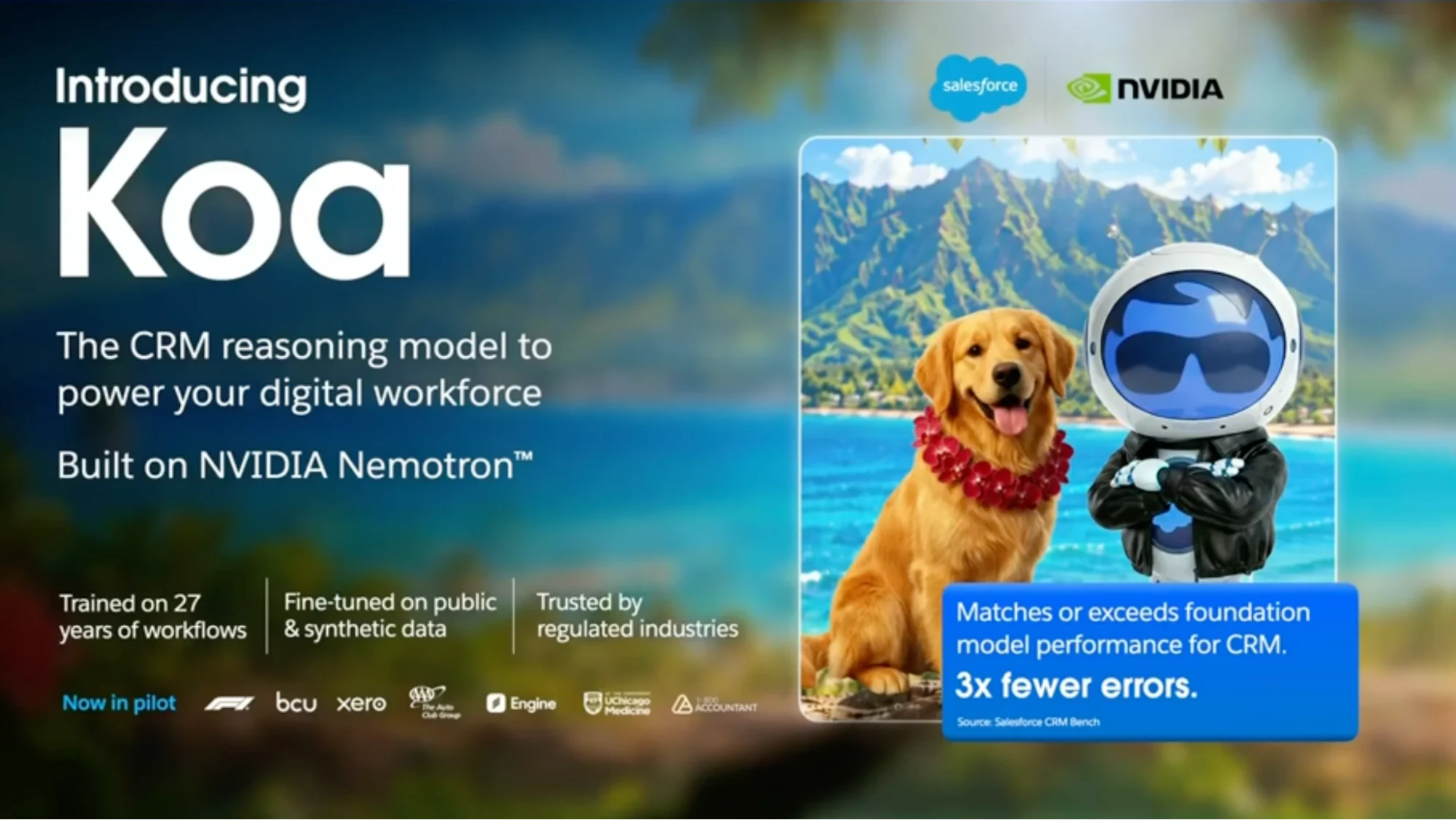
Salesforce claims Koa makes three times fewer errors than leading models on its own CRM benchmark. This is in pilot now, with general availability expected in winter of this year in US regions. Nvidia’s Jensen Huang joined Benioff on stage for this one, and the collaboration also extends into Missionforce (specialized business unit designed for defense, intelligence, aerospace, and government operations) for government and regulated customers running in air-gapped environments.
The Trusted Enterprise AI Harness
This was announced just before Dreamforce, and it really does paint a clearer picture of the direction where Salesforce is headed. “AI harness” is actually a generic term, just like “headless”. Salesforce’s Trusted Enterprise AI Harness, though, is described as bundling six “trusted capabilities” (Context, Agency, Action, Governance, Security, and Models) alongside a new AI Control Plane for discovering, registering, and monitoring agents across the enterprise (including third-party ones).
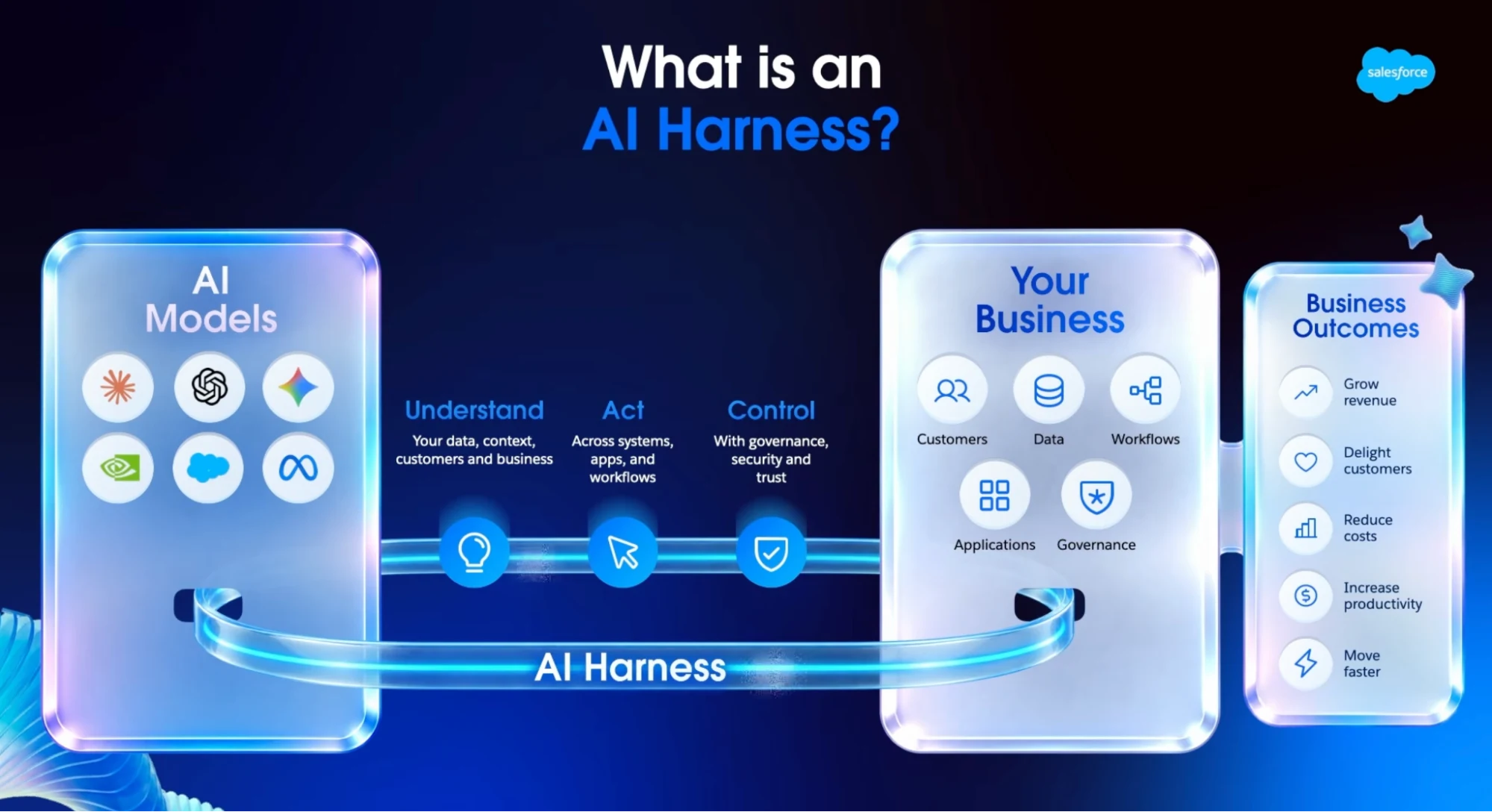
It’s not exactly a shiny new feature or something to enable, but more of Salesforce giving a name to the architecture it’s already been building toward. Admins should treat this as the new mental model for processing everything else to be announced moving forward.
Your Friendly Neighborhood Agents
Remember when every Agentforce demo felt like it was describing a hypothetical? Your support agent was simply a help agent, or your sales assistant was simply a sales agent. This year, Salesforce gave its job-ready agents actual names and job titles:
- Casey – customer service (formerly just “Help Agent”).
- Paige – IT and HR service.
- Carter – shopper agent for commerce and checkout.
- Marshall – supply chain and back-office orchestration agent.
- Piper – inbound pipeline and lead qualification.
- Fin – customer agent, folding in the Fin platform Salesforce finished acquiring on September 10.
- Hunter – outbound sales, currently in pilot with GA planned for November.
I talked a little bit about Casey here, but Hunter is another interesting one technically. It’s the first agent built on a new long-horizon runtime, meaning it can hold a goal across days or weeks instead of resetting after every interaction. It can use memory and has the ability to course-correct as circumstances change!
New (AI) Friends in the Ecosystem
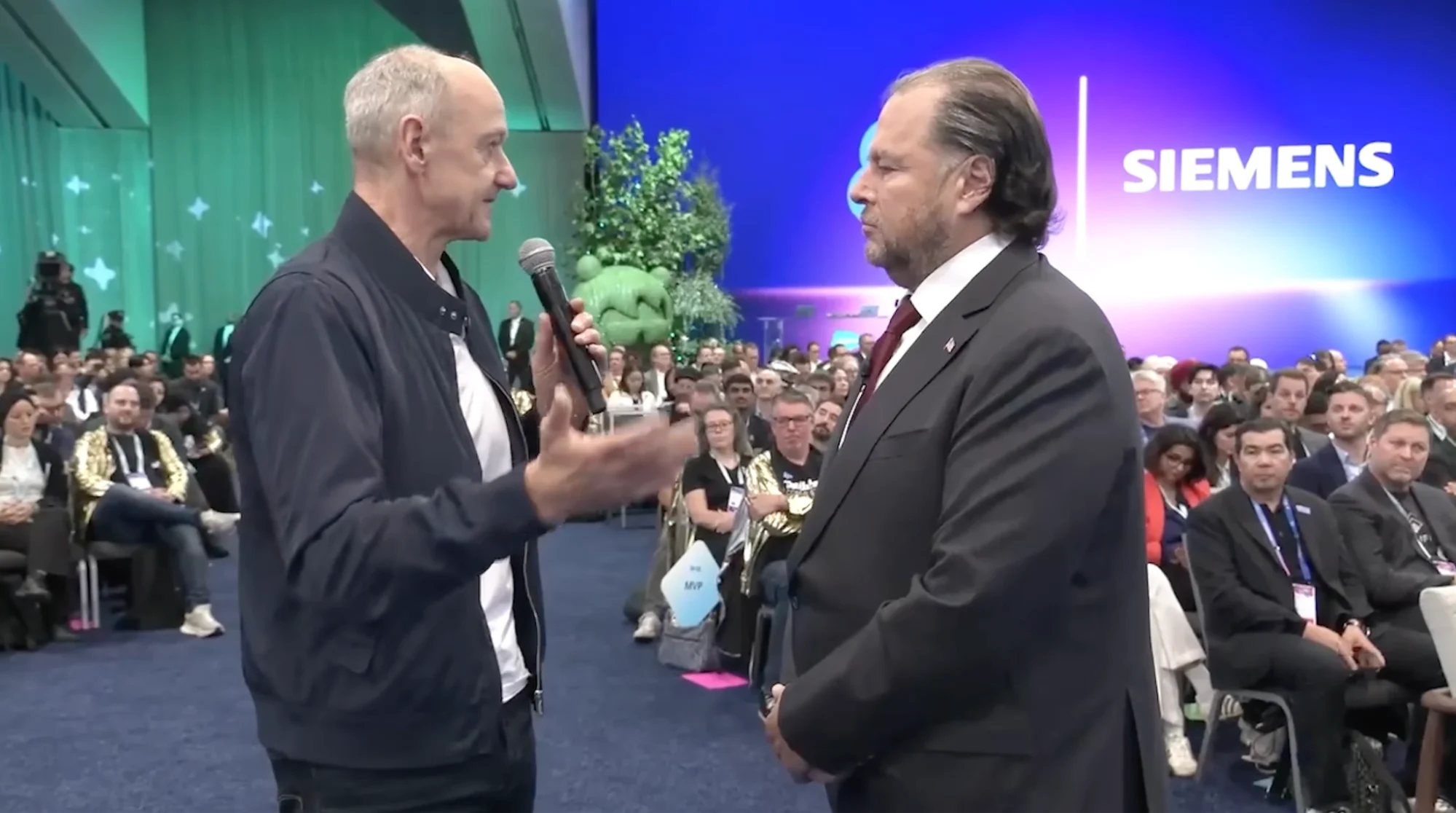
Salesforce spent a good chunk of stage time on partnerships this year: an expanded Google Cloud deal (Hyperforce running on Google infrastructure, plus Gemini Enterprise now GA inside the Reasoning Engine), AWS (Amazon Quick and Bedrock access), NVIDIA (as mentioned above via Koa), and a new Siemens partnership.
Siemens’ own team described the appeal as “probabilistic AI meeting a deterministic industrial world”, where, as they put it, hallucination simply doesn’t work on the shop floor. They’re running a family of Agentforce agents together across the business, tied back to Salesforce as the backbone for product and service data. Salesforce also committed $27 million toward AI education. Seems like Benioff’s all-in on this AI transformation.
Final Thoughts
Salesforce has spent most of 2026 fending off “SaaSpocalypse” headlines predicting AI would gut the traditional software business, so it was no surprise Benioff addressed it head-on in his opening remarks. He specifically said: “This isn’t the end of software, it’s the end of software that makes humans do all the work.”
And I do agree. The traditional definition of Salesforce as we know it is changing at a rapid pace.
Everything announced at Dreamforce, from AIforce to Koa to the newly named agents, is really an argument for the reframe that the software isn’t disappearing, but finally doing more of the work itself.
Whether that argument is taken positively by customers who are still asking questions about ROI is a separate conversation, one that’s really just getting started now that Dreamforce is over.