

Picture this: you wake up on what you think is a regular workday, but as you open your emails, you see one at the top of your inbox that reads something like “Your Job Has Been Impacted”. Impacted. Your company won’t say it explicitly, but you know what it means. You’re locked out of your workspace. Your Slack has been deactivated. If you’re lucky, you’ve got a call in your calendar with your boss and HR, whom you’ve likely never met before now. “Your job has been part of a layoff,” they tell you. That’s it – severance talk comes later.
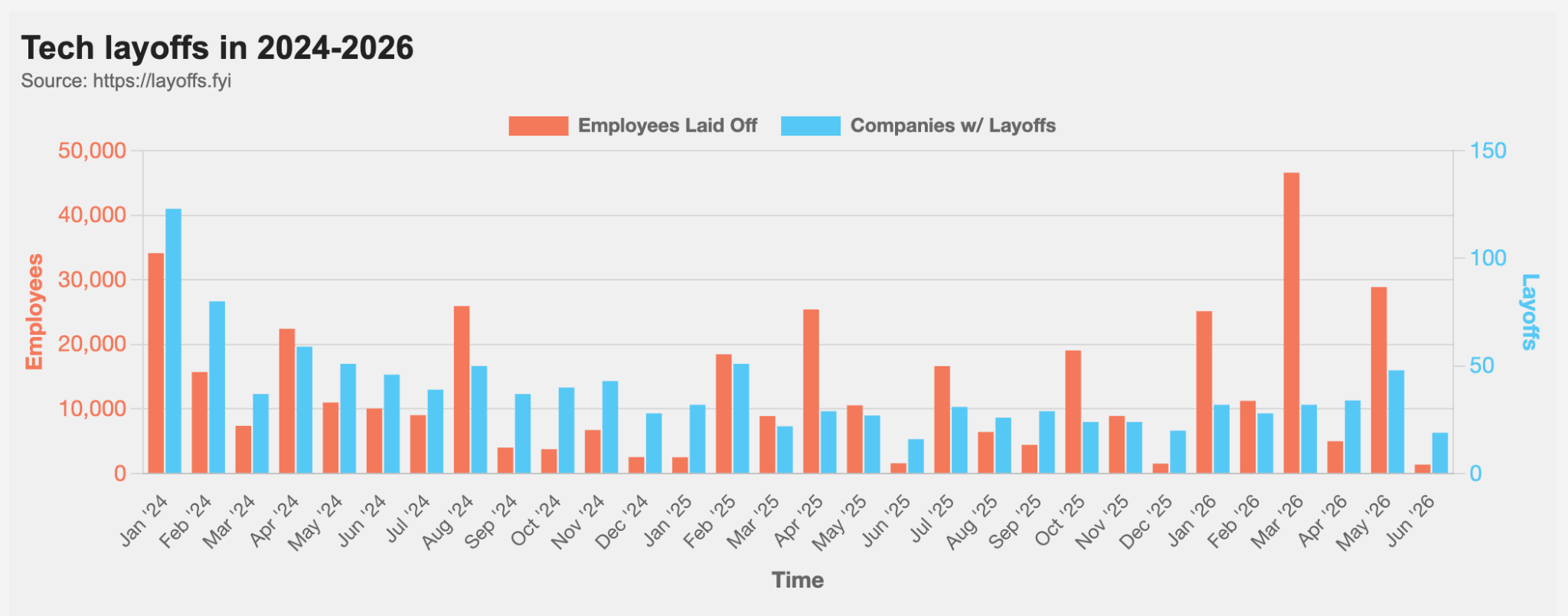
This was the reality for nearly 120,000 tech professionals just this year. Over 180 tech companies have instigated layoffs this year, including some of the biggest names in the industry, such as Salesforce, Oracle, and Meta. Now, 2026’s layoffs are on track to surpass those of 2025 and could be on track to hit 1M since 2022. But has this effort from these tech companies actually translated into any form of gains, or should we expect them to come around with their tails between their legs by the end of the year?
Over 100,000 Layoffs By Mid-2026
At the time of writing, there have been 119,862 tech layoffs this year. In 2025, the year finished with 124,636 layoffs. We’re already 95% of the way there, which means we could potentially outnumber 2025’s total layoffs by mid-July.
Now, it must be noted that 2026 isn’t the worst year for layoffs in the last five years. In 2023, the total number of cuts reached 264,320 across 1,193 companies, likely caused by a period of intense fat trimming after extensive COVID overhiring. However, this trend of accelerated layoffs does indicate several things, including the health of the market and insights into the dominating force behind everyone’s favorite buzzword: restructuring.
“Companies are changing the shape of their businesses,” Mat Roche, the Founder of recruitment agencies Third Republic and AI Republic, told SF Ben. “In 99% of these cases, all of these businesses are still hiring in other areas.”
“I can’t see a single case of big tech making redundancies and having a hiring freeze. People are hyping up tech layoffs as a crisis, but the tech industry is growing, and the companies making layoffs are still hiring and growing. Salesforce, [for example], has not shrunk its size despite all of the hype around layoffs.”
Alecia Wall, a Senior Industry Analyst at Keenan Vision, agreed, encouraging anyone worried to fully consider the bigger picture.
“I’d gently push back on anyone reading this as the industry is shrinking,” she told SF Ben. “Step back, and the broader picture is almost the opposite of the headline: overall US layoffs are actually down this year. Tech is the outlier moving the other way, and it’s now leading every sector in announced cuts.
“So this isn’t a recession washing over tech; it’s tech specifically repricing what it pays humans to do.”
Revisiting AI as the Culprit
Earlier this year, I answered a question that so many of us were asking: Are all these tech layoffs actually due to AI?
Even though I published this article in March, I feel like we have already reached a new place of understanding when it comes to this topic. Back then, I surmised that a lot of these tech layoffs were AI-influenced rather than AI-driven, meaning that the advancements of artificial intelligence had a part to play in companies’ restructuring, but it wasn’t necessarily the entire reason.
Now, AI was the most-cited reason for layoffs across every industry for the third month running, according to outplacement firm Challenger, Gray & Christmas. However, the scrutiny around this should still remain.
Not every tech employee has been laid off because of AI; this much is obvious. When Salesforce laid off nearly 1,000 employees at the start of the year, AI wasn’t the reason – it was a company-wide restructuring. Earlier in June, ServiceNow laid off hundreds of employees, once again, not explicitly mentioning AI.
Mat said that AI and cost-cutting are clearly the “disruptors”.
“AI isn’t replacing people at all yet, but it is changing how companies spend money, which departments need investment, and working out how to pay – cutting other departments,” he said.
Alecia added that a mix of budget and priority shifting is likely working hand in hand.
“As share keeps moving to AI-native technologies, that becomes both a leading and a lagging indicator of consumer preference in the enterprise, not just for which software and services get procured, but for where top-tier talent wants to go,” she said. “There’s almost a hype cycle around recruiting into the new ecosystems right now, the Anthropic and OpenAIs of the world.”
However, going forward, even if layoffs aren’t tied to AI in any way (at least publicly), perhaps we should operate with the mindset that it has a part to play, even as an undercurrent. Nearly every tech company has a new or renewed AI focus, and in this AI-driven market, that is going to influence nearly every decision.
These layoffs may not be because of AI, but I’m willing to bet that AI will influence most, if not all, major restructuring efforts in tech going forward.
Has This Actually Been Good For Companies?
When making a business decision as disruptive as cutting large numbers of staff, you have to have ROI in mind. But have these tech companies actually seen any viable returns so far?
A report by Gartner suggests that the answer is no. According to the research firm, 80% of companies admitted to trimming their human staff to make investments in AI, but they say they had no idea if AI would actually generate any benefits. They were simply buying into the promise of automation via AI.
Not only that, but execs who slashed staff to invest in AI have seen the same financial gains as those who held onto their employees. Gartner experts predicted that 50% of responding companies “that attributed headcount reduction to AI will rehire staff to perform similar functions” by 2027.
This is perhaps the most significant point of discussion in the entire AI layoff discourse. Not only are companies not observing substantial or even evidential ROI, but companies that have made cuts are reportedly no better off. Although this could change in the future, it should send a warning to executives. Whether they see this warning as not jumping the gun or just thinking twice before you slash teams, laying off staff will not necessarily provide the expected gains.
You could argue this is just business, and there is some truth to that. But on the human side, it sends the most important message of all: you are not a commodity, and if you have recently had your job cut, it has likely not even positively affected your company’s financials. Some might revel in that – that is up to you.
What’s Going to Happen Now?
The biggest question surrounding tech layoffs is whether or not we should expect them to continue. For Mat, the answer is unfortunately yes.
“Yes, and it will probably accelerate,” he told SF Ben. “But hyping up layoffs as an industry crisis is totally incorrect because these businesses are not shrinking; they are still hiring.”
There is plenty of evidence to support this, too. At the time of writing, Salesforce is currently hiring for 1,479 roles, ServiceNow is hiring for 408, and Oracle is hiring for 1,613. That restructuring buzzword may not just be a buzzword; does this mean we should get used to it now?
The ‘Learn AI’ Messaging ‘Won’t Save Anyone’
Interestingly, Alecia told SF Ben that we shouldn’t be examining the rate of the layoffs so closely; we should be looking at the composition.
“The durable move is away from raw production and toward the people who sit between what the tech can do and what a business actually needs,” she said. “I’ll be straight with your readers, because the fear is legitimate; ‘learn AI’ as a bumper sticker won’t save anyone; at the entry level, that premium is almost nothing.
“What holds up is pairing AI fluency with a real foundation and genuine exposure to business pain, becoming the translator.”
As we’ve covered before, learning AI isn’t some magical solution to not being laid off – AI teams are also being impacted. However, understanding exactly what these tech companies want in terms of the AI skills of the future is important, and it might just be the difference between standing out to an employer versus not.
Final Thoughts
As big tech continues to grapple with the implications of heightened layoffs, it appears that companies are perhaps not gaining as much as they hoped.
Of course, this is subject to change. But as companies continue to make their cuts, it is becoming more apparent that they are doing so in the name of redeployment, highlighting the importance of transferable skills.
I am not suggesting that if you have been laid off, you run back to that company and apply for a more in-demand open role. But I am asking you to consider that if you do find yourself in that unfortunate position, consider where the pulse currently is. What transferable skills do you have? What can you learn that’s new and relevant? How can you bounce back from this and even potentially get yourself to a better position than before?