

For some zealous writers and analysts, 2025 has been the year of the recession. With more than one million job cuts in the US, as well as October ranking as the worst month for tech layoffs in more than 20 years, it’s easy to see why – on the surface at least.
However, end-of-year data from Layoffs.fyi show that the situation may not be as dire as suspected. In fact, there have been approximately 20% fewer layoffs this year compared to 2024, illustrating that although layoffs have been significant, they have also provided a clear picture of the inner goings-on of the Salesforce ecosystem and beyond.
The 2025 Layoffs Scene
If any sector has been feeling the looming presence of layoffs this year, it has been the technology sector. Up against shifting budgets, back-to-office orders, and the rapid advancement of artificial intelligence, the messaging for tech workers has been clear-cut: show your worth or risk being replaced by a lower-cost alternative.
As of the time of writing, just under 123,000 tech employees across 257 companies were laid off in 2025, across some of the biggest names in tech, including IBM, Amazon, Microsoft, and Meta.
However, 2024’s end-of-year outcome was actually worse than what we are experiencing today, despite how the current job market climate may seem. At the end of 2024, more than 152,000 tech employees across 551 companies were laid off – nearly 20% more than this year.

Although some months this year were worse for layoffs – such as October and July, compared to October and July in 2024 – 2024 was a much more arduous year overall.
In the Salesforce ecosystem, the landscape of layoffs is not as transparent. This year, Salesforce laid off approximately 5,000 roles, with more than 1,000 in February, and then announced later in the year that they had cut 4,000 support roles. However, it’s unclear as to when these took place exactly.
The Reasons Behind the Cuts
Tech layoffs this year have come with a surprisingly consistent storyline: “AI made us do it.” How true is this? It’s hard to say.
It’s the perfect corporate scapegoat – futuristic enough to sound strategic, vague enough to resist scrutiny, and exciting enough to distract from less glamorous truths like margin pressure, post-pandemic overexpansion, and slowing demand. AI is real, of course, but in a lot of earnings calls, flashy conferences, and internal memos, it’s also doing a lot of PR heavy lifting.
Because, at its innermost core, is AI really powerful enough to be laying off employees in the thousands? As I explored earlier this year, there is no denying that AI is impacting job markets, tech hiring, and role cuts. However, it is arguably still not intelligent enough to replace entire employees or teams as frequently as it would need to to correlate with these layoffs.
Although talks of developments such as virtual employees have been spearheaded by analysts like Vernon Keenan, we are not yet at this stage of deployment. It is very possible that AI advancements have been impacting work by reducing the need for certain roles, but entire wipeouts are not commonplace. So what gives?
Trimming the Post-COVID Fat
Thought leaders such as Nick Damoulakis have summarized the more plausible reasons behind these layoffs quite succinctly: “Old-school revenue pressures.”
With stakeholder demands more monstrous than ever, tech companies – including Salesforce – will be eagerly chasing the next “big thing”. SaaS sits in the shadow of its former glory days. Neighboring tech companies scramble every week to create the most resilient AI and the most effective agent.
Even Marc Benioff, Salesforce’s CEO, who proudly pioneered the cloud company of all cloud companies, does not have the word ‘cloud’ in his vocabulary anymore.
However, the discussion does not stop there. AI and flaky financial results only form two-thirds of the equation; another frequently cited reason is the natural consequences of COVID-19 overhiring.
During the pandemic, when virtual working became the new reality, the pressure to develop the way workforces interacted built quickly. Companies had to consider how to keep productivity and efficiency high without physical boots on the ground, facing unprecedented levels of digital demand, with the world pivoting all of its processes online.
Due to this, a tech sector hiring spree took place in an effort to meet demands. When the pandemic ended, however, and working conditions slowly returned to normal, these same companies were left with a problem. What do you do with all these extra employees?
According to IBM’s CEO, Arvind Krishna, the wave of layoffs recently observed in the tech sector can be attributed to solving this overhiring problem, rather than AI, calling it a “natural correction.”
“I think people gorged on employment,” he said in an interview with The Verge. “Some of the displacement is just people saying, ‘I don’t need so many people because I went up 30, 40, 50, 100% from 2020 to 2023.’”
The Lowest Number of Layoffs In Nearly 5 Years
The overhiring and post-pandemic correcting excuse has legs. Digital innovation isn’t such a hot topic for businesses anymore, and largely, the world has gone back to operating on the hybrid in-person and online model we’ve come to be familiar with.
However, it both answers some questions and prompts others, especially as in 2025, we’ve had the lowest total number of tech layoffs since 2022.
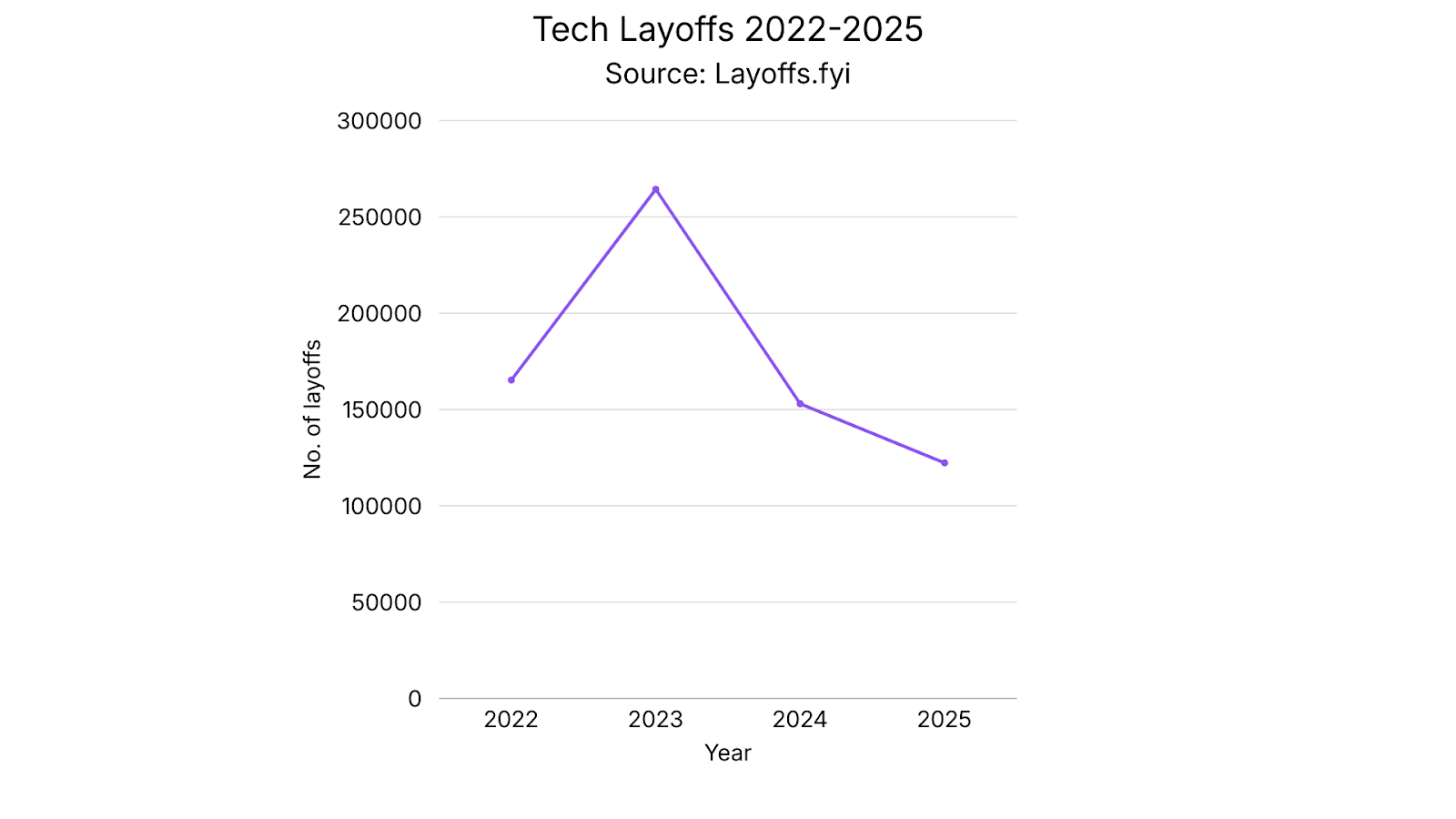
Interestingly, 2023 was the worst year, with just under 265,000 tech employees laid off, but the year following, the number was just over half of this. If anything, this suggests that 2023 was the tipping point for the COVID overhiring saga, not 2025.
2023 was also the year that Salesforce announced it would be cutting roughly 10% of its entire workforce, with COVID overhiring being directly cited as the reason.
How Has Salesforce Fared?
Speaking of Salesforce, 2025 has not been an entirely uncomplicated year for the CRM giant. Compared to 2024, Salesforce’s total layoffs count was higher, with approximately 5,000 layoffs this year compared to 1,000 the year before.
Not only that, but this year pushed many ecosystem members to scrutinize CEO Marc Benioff in perhaps a harsher way than before, especially as in August, he insisted that Salesforce’s AI would not lead to mass layoffs.
Three weeks later, news of Salesforce’s AI agents driving the cuts of 4,000 support positions came out, and suddenly it seemed like Benioff was eating his words, not even a month after his comments.
Following that, this year’s Dreamforce conference further stoked the AI-driven layoffs argument, but it also shed light on Salesforce’s perspective for perhaps the first time.
Parker Harris, Salesforce’s Co-Founder, laid it out bare: “If we don’t go all in, we’ll go obsolete.” It was one of the first times that Salesforce had admitted it heard the frustrations of the community regarding AI and Agentforce, but this was the way forward. At least for the company, there was no other choice, and it wouldn’t be taking an alternative path anytime soon.
However, perhaps most importantly, this year has been one where the ecosystem has had to navigate the shifting attitudes of Salesforce as a company, driven by Marc Benioff.
Over the years, although Salesforce has made positive strides in multiple areas, it has raised concerns in others, with the most notable this year being the evolving approach to digital labor.
As a for-profit company, we can expect an element of cutthroat attitude. However, when a CEO refers to the “rebalanced” employees this year in an interview as “heads”, questions of disconnect arise, and they arise fast.
Looking Into 2026 and Beyond
For Salesforce, like many other companies in this space, AI can be used as a credible narrative for cutting roles in places where work can be automated or deflected. Next year, if AI adoption keeps lifting productivity and leadership keeps emphasizing “efficiency + optimized structure,” layoffs become the ultimate consequence, especially in functions where agents reduce volume, shrink backlogs, or remove layers of coordination.
This is not to say that further layoffs should be expected, but rather seen as a general plausibility. If AI advances fast enough to convince businesses like Salesforce that the more cost-effective way forward is with an automation tool, or it can be used as a scapegoat, then the story almost writes itself.
If you’re an employee worried about the status of your current job or the future of your career, there are numerous reports and predictions out there outlining which roles are the “safest” against AI and how you can adapt your skills.
Recruitment giant Indeed, for example, shared data that says the four top roles that have been cut once companies engage in AI restructuring are software engineers and developers, quality assurance engineers, product managers, and project managers.
Given the intense focus on AI, companies are increasingly forming dedicated AI teams, even if their direction or structure isn’t yet fully defined. A crucial component of these teams will invariably be data specialists, as the effectiveness of your AI is directly tied to the quality of your existing data.
Network and cybersecurity skills are projected to be the second-fastest-growing skill category worldwide, with the Information Security Analyst role ranking as one of the top 15 fastest-growing professions globally through 2030.
Final Thoughts
As 2025 draws to a close, the final numbers are counted. There were indeed fewer tech layoffs this year. In fact, it was the lowest number of layoffs in just under half a decade, possibly signalling the start of stabilization within this industry.
What is different, however, is the attitudes behind layoffs. We may never truly know the real reasons behind laying off employees, and reducing it to just one is not the right approach. We should question these companies, especially if they announce record profits, deeper community bonds, or shiny C-Suite bonuses.
Whatever 2026 holds, we will be reporting on it all, questioning, observing, and uplifting the people behind the numbers.