

For anyone working in a services organization like consulting, IT services, or software implementation, the daily reality often involves constant firefighting. Projects get delayed. Scopes creep. Key team members go absent unexpectedly. Any one of these can derail a well-planned timeline in an instant, creating scrambles that pull focus from the real strategic work that serves customers.
Thankfully, AI agents are turning this challenge into an opportunity. With the fast growth of Agentforce and a wave of AI agents coming from Salesforce ISVs on the AgentExchange, we are moving into a new era of practical in-platform agents that solve these everyday time-sucking problems, handling the routine work so your experts can focus on what they do best: building relationships and delivering exceptional customer value.
Building Blocks of Effective Salesforce-Native Agentic AI in Services
An AI agent’s value comes from both the quality of the data it can access and its ability to take secure, meaningful action on that data. For professional and embedded services organizations, building an effective AI strategy requires several core components working together.
It all starts with a single source of truth. For any business running on Salesforce, this is the ideal data foundation. It’s the unified customer record that can manage nearly every aspect of a company’s relationship with its customers. This is what makes Agentforce-built agents the gold standard. They don’t need fragile integrations to understand this rich customer history. They’re built right on top of it.
That data also needs services-specific context. The customer record is critical, but for AI agents to solve specific delivery challenges, they also need to understand the interplay of projects, resources, skills, and financials. This is where a purpose-built Professional Services Automation (PSA) solution becomes the essential services orchestration engine. When running natively on Salesforce, it can create a deep, operational data layer that allows an agent to understand not just the customer, but the deployable resources, financials, and the very work itself.
Finally, with that data foundation and orchestration engine in place, you need a trusted platform to find and deploy agents with confidence. That’s the role of Agentforce and its marketplace, AgentExchange. They provide an ecosystem of pre-built, secure components, open connectivity through standards like Model Context Protocol (MCP), and observability with tools like the Agentforce Command Center, giving leaders the enterprise-grade control needed to scale an AI workforce.
Putting Agents into Practice: Two Real-World Examples
The first wave of real-world Agentforce agents for services organizations is here. Let’s look at two examples that help them work faster, deliver better project outcomes, and scale their operations.
From Staffing Fire Drills to a Simple Conversation
Imagine you are a resource manager at a large consulting firm. You just got word that a key consultant is suddenly out for two weeks, and their billable work must be reallocated immediately to prevent delays to their projects. This typically kicks off a frantic, manual search for assignments and qualified replacements. On a good day, it’s a process that can take hours.
With a Staffing Agent, this fire drill becomes a simple conversation. You can ask the agent to find all billable assignments for the unavailable team member. From there, you can select an assignment and ask the agent to find a match. The agent evaluates options in real-time, presenting a shortlist of colleagues with the right skills and capacity. You make the final decision, and the agent handles the reallocation. A task that used to take two hours is now resolved in two minutes.
Scale Your Coverage, Not Your Workload
Now, suppose you’re a customer success manager (CSM) for a large enterprise SaaS provider. CSMs in pooled models are especially under constant pressure to cover more accounts with less time. When a CSM is assigned to an inquiry with no prior context on the account, that person has to spend valuable time digging through history and notes just to get up to speed.
A Customer Success Agent automates this entire preparation process. With a single prompt, the agent can chain together a series of actions: summarize the account and the inquiry, draft an introductory email, and create and update all necessary tasks in a playbook. It automates the administrative work so you can get up to speed in seconds and focus on what matters: engaging with the customer and delivering value.
The Future Is Agentic (and Salesforce-Native!)
The launch of these Staffing and Customer Success Agents is a signal of a much larger shift. Service delivery is being reshaped by an ecosystem of specialized agents working alongside your teams, freeing them from routine work to provide the strategic oversight and complex relationship management that drives high-value outcomes. That future is arriving faster than ever, thanks to platforms like Agentforce and marketplaces like AgentExchange.
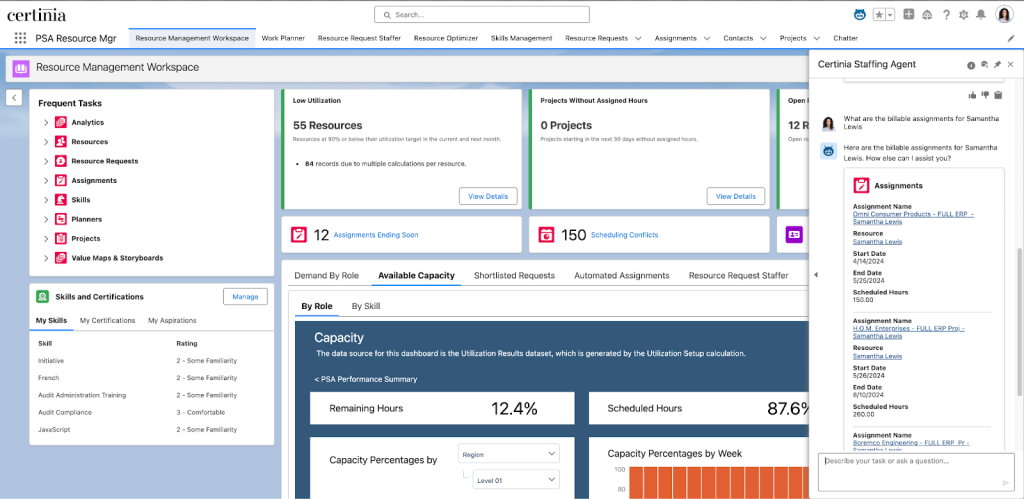
Turn staffing fire drills into a simple conversation. With this Agentforce-built Staffing Agent, what used to take hours of manual searches can now be resolved in minutes. 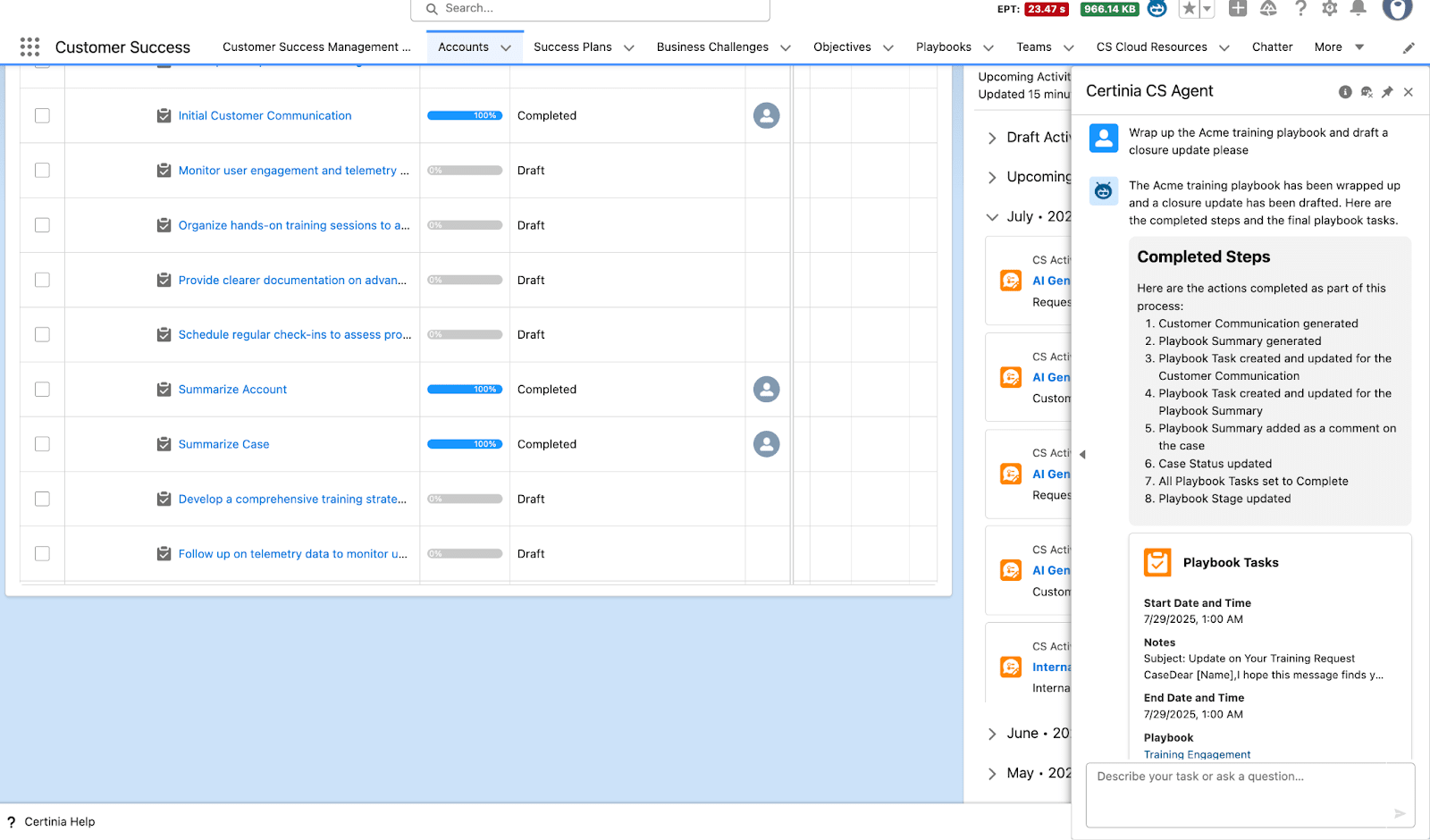
This is what scaling customer success looks like. This new Customer Success Agent automates administrative prep work, so your CSMs can spend less time on manual tasks and more time building relationships.
Final Thoughts
For a deeper look at the Staffing and Customer Success Agents discussed in this article, read my recent post on the Certinia blog: Certinia Introduces Its First AI Agents for Staffing and Customer Success.
Headed to Dreamforce? Certinia is hosting four days packed with insightful expert-led sessions, 1:1 consultations, hands-on demos, and plenty of networking opportunities to help you get the most out of your Dreamforce experience. Learn how you can connect with Certinia at Dreamforce 2025!