
Anthropic has launched Claude Academy, a free learning platform for Claude, AI fluency, and building with Anthropic’s models.
If you’re familiar with Salesforce, you might immediately think of Trailhead. And there are certainly similarities: structured courses, quizzes, badges, and plenty of product-specific learning. But Claude Academy is doing something slightly different. Alongside teaching you how Claude works, Anthropic is trying to teach people how to work effectively with AI in the first place.
What Is Claude Academy?
Claude Academy is Anthropic’s education platform, bringing together courses, tutorials, and use cases covering Claude and AI more generally. The platform is free and is designed to cover everything from getting started with Claude to building applications using the Claude API.
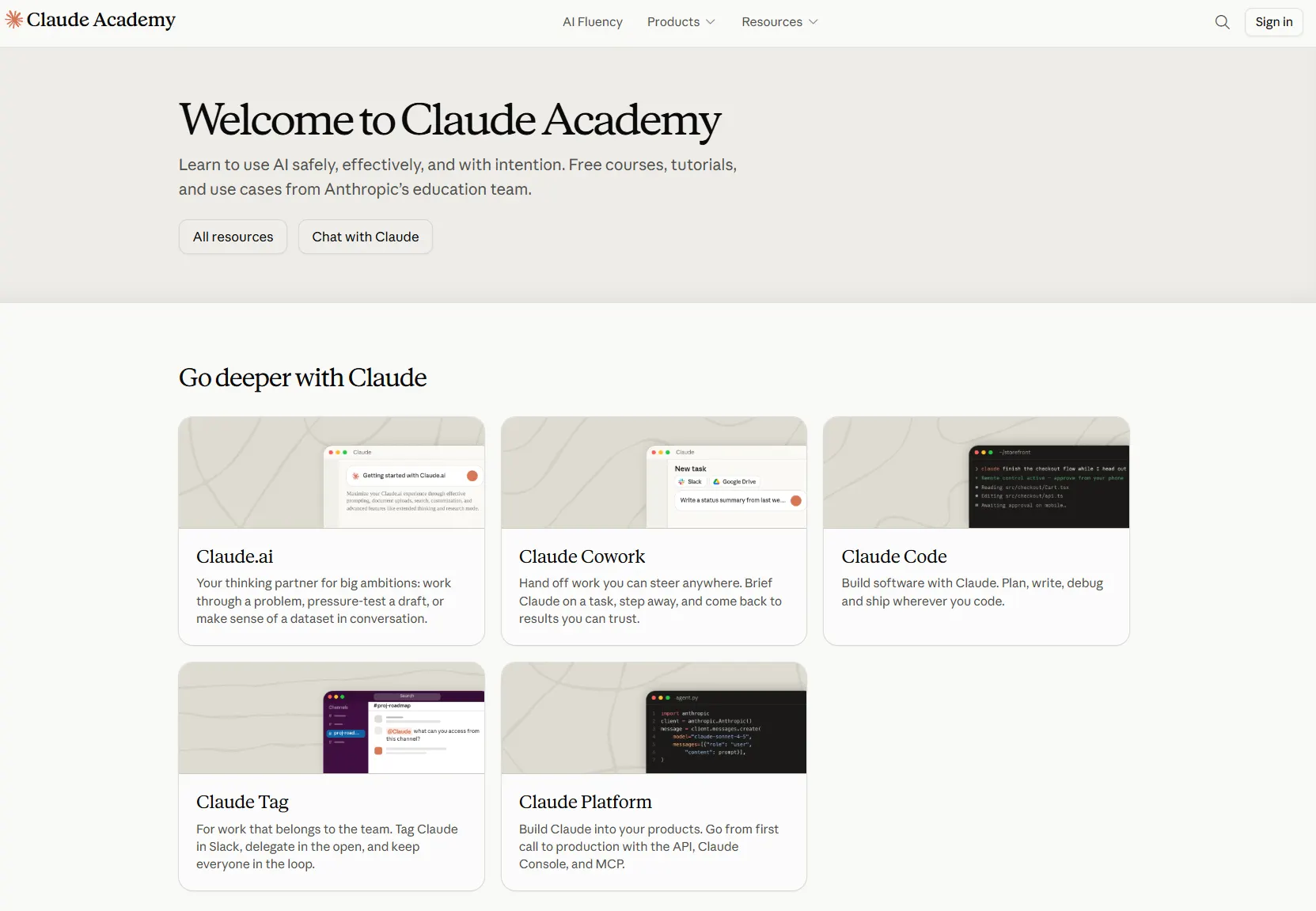
The easiest way to understand the Academy is as several different learning paths sitting under one roof: learn Claude, build with Claude, or develop the skills needed to work effectively with AI.
For someone relatively new to Claude, there are introductory courses such as Claude 101, which covers everything from your first conversation through to prompting, Projects, Artifacts, Skills, and connected tools.
There are also courses for specific parts of the Claude ecosystem, including:
- Claude Code: for developers building and working with code.
- Claude Cowork: for using Claude to hand off and manage work.
- Claude Platform: covering the developer platform.
- Model Context Protocol (MCP).
- Subagents and agent skills.
- The Claude API: including courses for using Claude through Amazon Bedrock and Google Cloud’s Vertex AI.
So, if you’re looking for the equivalent of a “learn this particular product” course, there is plenty here. But that isn’t actually the part I find most interesting.
It’s Not All About Learning Claude
One of the biggest differences between Claude Academy and a traditional product training platform is the emphasis Anthropic puts on AI fluency.
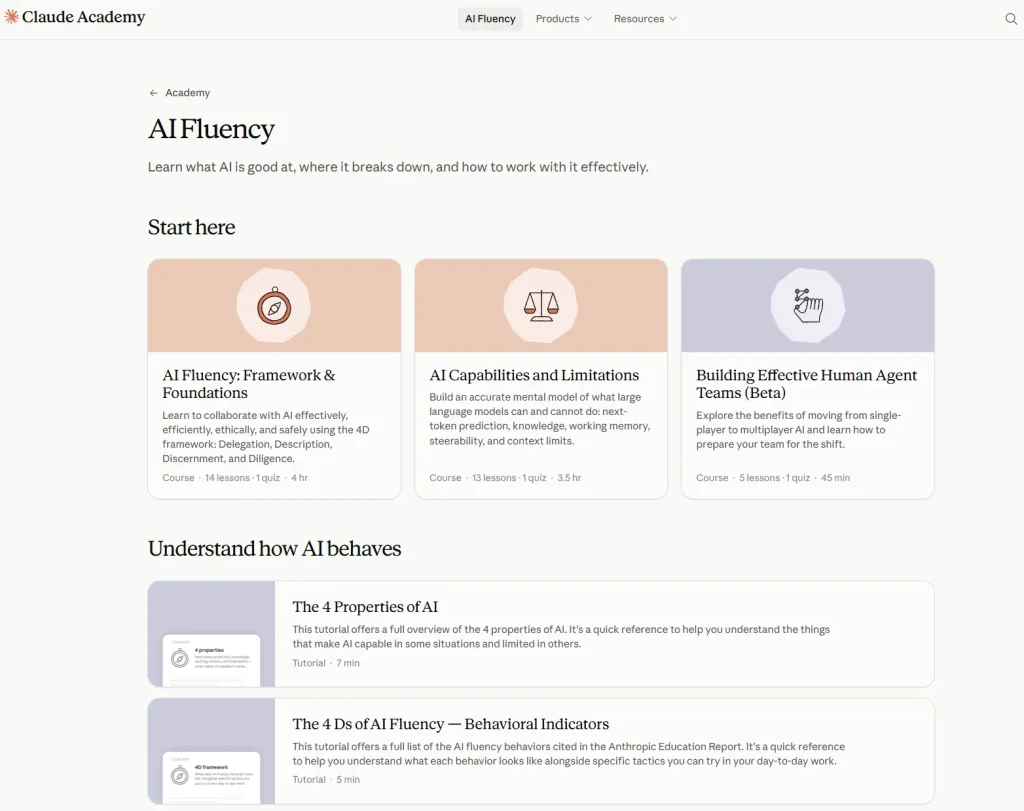
There is an entire section of the Academy dedicated to developing the skills and mental models needed to work effectively with AI. Its flagship AI Fluency: Framework and Foundations course introduces Anthropic’s 4D framework: Delegation, Description, Discernment, and Diligence.
This is where Claude Academy starts to move beyond simply teaching you how to use Claude. The idea isn’t just: “Here’s a prompt. Copy it and hope for the best.” Instead, the courses focus on questions such as:
- What should you actually delegate to AI?
- How do you give AI enough context to do a useful job?
- How do you evaluate the output?
- When should you keep a human involved?
- How do you use AI effectively without handing over responsibility for the outcome?
In other words, the important skill isn’t necessarily knowing how to ask Claude a clever question – instead, it’s knowing what you should ask Claude to do in the first place.
That feels like an increasingly important distinction as AI moves from being a chatbot we occasionally ask questions to something that can carry out more substantial work.
“I personally appreciated that it offered multimodal learning. Text, video, and then also I took the opportunity to put what I’d learned into practice. This trio is the most effective way to learn new things fast.
Tim Combridge, Technical Content Writer
“I combined all of this by working with Claude to come up with some demo project ideas so that I could think outside the ‘golden rail’ training path, and really test and expand my knowledge fast.”
What Types of Courses Are There?
One of the things that stands out about Claude Academy is the breadth of the content. It isn’t designed solely for developers, or even solely for people who already know their way around AI.
There are dedicated AI Fluency courses for builders, creative professionals, educators, nonprofits, and students, alongside the broader foundational course. The idea is that while the underlying principles of working with AI are similar, how you apply them can look very different depending on what you’re actually trying to do.
For example, AI Fluency for Builders goes beyond simply teaching people how to get Claude to generate code. It covers things such as defining acceptance criteria before asking AI to build something, translating a user need into precise instructions, and evaluating AI-generated work for correctness, quality, fit, experience, and responsibility.
That feels quite different from the traditional approach to product training: here are the features, here’s how they work, now go and use them.
The AI fluency courses are just one part of the catalogue. At the introductory end, Claude 101 is designed for people who want to get to grips with using Claude for everyday work. At the more technical end, there are courses such as Building with the Claude API, which currently contains 67 lessons and eight quizzes.
In between, there are courses covering Claude Code, MCP, Claude Cowork, subagents, agent skills, and other parts of the Claude ecosystem, alongside shorter tutorials and practical use cases.
This means you don’t necessarily have to commit to a multi-hour course every time you want to learn something new. You can dip into a short tutorial when you need to solve a specific problem, or work through a structured course if you want a deeper understanding.
The Academy currently brings together hundreds of resources across courses, tutorials, and use cases, so there is plenty to explore.
“My experience was great so far, and I appreciated the courses’ structure, the option to select specific products to dive into, peruse available use cases, and also the possibility to chat with Claude directly.”
Andreea Doroftei, Technology Director
If you’re wondering whether there is a badge at the end of all this, the answer is yes. Many of the structured courses offer a completion badge, which makes the experience feel reassuringly familiar to anyone who has spent time collecting Salesforce certifications and Trailhead badges. Although, thankfully, you probably don’t need to start thinking about where you’re going to display 400 Claude badges on your LinkedIn profile just yet.
It’s Not Just Courses
I think it’s really important to make it clear that Claude Academy has more than courses – it also has tutorials, webinars, and my favorite, use cases.
I think the use cases are one of the most helpful parts of Claude Academy. One of the hardest things about learning AI isn’t necessarily working out how to use a particular feature. It’s understanding what’s actually possible in the first place.
The scope of AI is so broad that a blank chat window can be surprisingly intimidating. A good use case gives you a starting point: “Oh, I could use AI for that”.
For example, Build an ‘Ask the Company’ that turns Claude into something like an internal company knowledge assistant. Rather than searching through Confluence, GitHub, data warehouses, and various internal documents separately, employees can ask questions in plain English and have Claude find the answer across those systems.
It can answer questions such as how to get a staging API key, who owns a particular database table, or why a metric has changed, while citing its sources and pointing users towards the right person or team when it isn’t confident. It’s a good example of where AI can be genuinely useful at work: not because it magically knows everything, but because it can help people navigate the enormous amount of information their organization has already accumulated.
Is This Trailhead for Claude?
Sort of. But not really.
The comparison is useful because both platforms bring structured learning, courses, and assessments together around a technology ecosystem. But I wouldn’t describe Claude Academy as simply Trailhead for Claude.
Trailhead is heavily focused on learning how to use and configure the Salesforce platform, while Claude Academy has a broader remit. Yes, it teaches you how to use Claude products and developer tools, but it is also trying to teach people how to think about working with AI.
You don’t necessarily need to be a developer to benefit from understanding concepts such as context, delegation, evaluation, and AI limitations. In fact, as AI becomes embedded into more jobs and more software, those skills are likely to become increasingly useful regardless of the particular AI tool you’re using.
Final Thoughts
Claude Academy is a great new addition to Anthropic’s learning resources. I really like the intuitive, clean interface, the broad course catalogue, and the fact that it puts as much emphasis on how to use AI effectively and responsibly as it does on learning the technology itself.
The practical use cases are another nice touch, giving you an easy way to see how Claude could be applied to real-world problems without having to work it all out for yourself.
Perhaps controversially, I also really like the fact that Claude Academy is refreshingly un-gamified. There are no mascots, elaborate graphics, or mountains of points and digital badges begging to be collected, and I don’t find myself missing them. The whole experience feels clean and straightforward, with the learning content very much taking center stage.