






With all the pricing changes and updates from Salesforce lately, credit-burn concerns are one of the biggest talking points in the ecosystem right now, and not just with Salesforce. But here specifically, people tend to ask: why is it so easy to burn through Flex Credits without getting much back?
The Trusted Enterprise AI Harness keynote at this year’s Dreamforce actually gave a surprisingly concrete answer: much of the burn comes from the context your agent has to wade through before it can do anything useful. In this article, we’ll walk through what the demo showed, how bad context drives up consumption, and what you can start doing about it now.
43,000 Tokens to Get the Wrong Answer
The demo at Dreamforce followed Maya, a sales rep behind on her Q3 number. She asks Claude which customers to focus on to close the gap, and Claude is connected to enterprise data.
With no harness, Claude burned 43,000 tokens and still provided an answer that was wrong. It recommended a frozen customer, flagged a renewal that was already in the pipeline, and didn’t know what “Q3” meant at Salesforce (fiscal Q3 ends in October, not September). At this point, you’d be frustrated, but Salesforce made it clear that this wasn’t Claude’s fault. While it had the data it needed, there was no context, and therefore no understanding of the business.
This is what the harness is for. When the same question was reran with the properly configured harness, Claude pulled the real pipeline from Sales Cloud, used a semantic layer to learn what Q3 meant, and drew on memories from past customer interactions. It then finally gave a more reasonable answer and even explained why. This whole interaction ended up using just 7,000 tokens instead of 43,000.
It’s understandable that this demo does not directly answer our Flex Credits question, as it measured tokens instead. But it is a good illustration of what happens when bad context forces an agent to figure out the business on its own.
The Pricing Conversation
People are already thinking hard about how AI gets billed. Outside the ecosystem, AI models like Claude and ChatGPT charge based on the number of tokens used, so a bloated prompt will definitely cost you a lot more.
In Salesforce, we’re already in the era of outcome-based pricing, which only holds up if the AI model keeps a high success rate. But what if it doesn’t? What if users end up consuming plenty of tokens without ever reaching a resolution? The demo on 43,000 tokens above shows that problem on a smaller scale.
Pay-per-resolution does protect you from that in a way, but only for the Help Agent, where you’re charged when it resolves an issue on its own. Everywhere else, the meter keeps running whether or not the answer is any good.
The other, more recent meter is Salesforce preparing to charge Flex Credits whenever a registered agent successfully makes an MCP or API call into the platform. This is essentially what Salesforce calls a Headless Platform Interaction. As of writing this, there is no published multiplier yet, and metering hasn’t started. Salesforce promised 30 days’ notice before it does, though. The number of interactions charged depends on how the agent behaves, so consumption varies with the harness and prompt implementation.
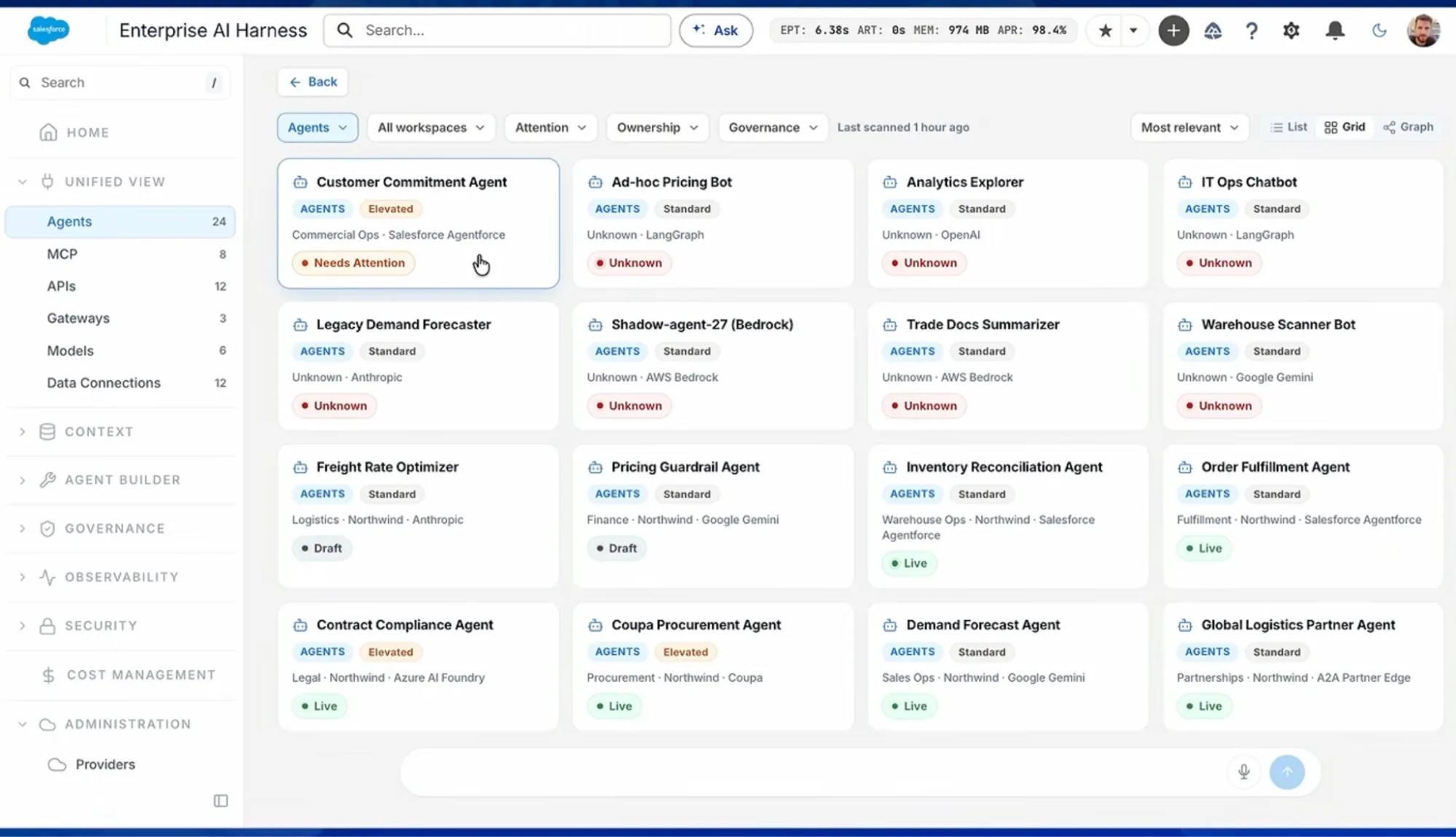
Salesforce clearly knows cost is on people’s minds. Rohan Kumar, President and Chief Platform and Engineering Officer at Salesforce, said early in the keynote that IT leaders will have to manage and govern agents, which includes cost control. Every agent can run through a single gateway, so admins see which models cost what.
The Effect of Bad Context
Context helps not just AI, but humans as well. And it isn’t only applicable to Salesforce. Anything relayed without context is likely to get the wrong answer.
The demo gives us clues on what the agent tripped over on its way to the wrong answer. It had to guess which customers were off the table, and it took Q3 to mean a calendar quarter. It also missed what was already in motion in the pipeline. In that case, some of the context that shaped the right answer wasn’t even in the CRM at all!
A customer’s preference for fulfillment before revenue promises, for example, is data that is not in a field. It is inferred from past conversations, and the harness turned it into a fact the agent could use. Without that, the agent is left to guess, and guessing is expensive.
With that said, more context isn’t automatically the answer either. You wouldn’t want to overwhelm an agent with 50,000 old documents, hoping all that would give enough context for any request. The main idea behind harness’s context packs is that you describe in natural language what a given agent needs, and it gets only that subset. So the goal is the right context, not all of it.
What Can We Do Now?
The demo was visionary, and Rohan even described the harness as the future of the platform. The concept is actually amazing, but pieces of it aren’t available yet as of today. What we do have now are Data 360 with its new ACE (Agent Context Engine) for context, Agent Builder, Agent Fabric as the AI control plane with cost optimization, and Guardian for agent security. Informatica was even mentioned for data cleansing. The thing is, this isn’t a thing we can fully switch on yet, but this is also proof that the groundwork is already in our hands.
In the meantime, small habits now cost far less than untangling a messy org later. Here’s where you can start for now:
- Pick the one or two objects your future agents will lean on most and document them properly by making sure field descriptions are filled out, active picklist values are actually important, and the object has an owner. Basically, clean up anything that would leave an agent guessing.
- Write down definitions people in your org may be confused about or have different views about, and include the obvious ones like what your fiscal quarters mean.
- Clean out stale, frozen, and duplicate records in those objects first, to avoid an agent recommending one of them.
- Ask whether a step needs an agent’s reasoning at all. You can control exactly what happens before and after the reasoning step, so if something needs a definite answer, a plain Flow can give that without having to spend any tokens.
In addition to these, start watching your consumption now. A baseline before the meters get more complicated will make every future conversation about AI spend easier.
Final Thoughts
Nobody knows yet how much a Headless Platform interaction will cost you, so nobody can budget properly for it yet. But the Dreamforce demo already showed something useful by giving us clues on a major thing that drives AI spend. It’s amazing how the same model and question can consume 43,000 tokens against 7,000, and the only difference was how well the agent understood the business.
Salesforce will set the price in the near future, that’s for sure, but it’s up to you to decide how much your agents have to work out on their own. At this stage, it’s looking like tidy context is going to be the cheapest way to walk into it prepared.