








You may know Salesforce as a CRM company. You may know Salesforce as an AI company. You may also know Salesforce as the company that is caught somewhere in between a CRM provider and an AI company.
However, if you’ve been in the ecosystem for the last few years, you’ve probably felt the shift away from its foundational CRM offerings to full-steam-ahead with AI. That’s why I wanted to see how this really translated – are we all exaggerating? Has Salesforce changed that much? I decided to count every time anybody mentioned the word “CRM” in the last five Dreamforce keynotes, to get a feel for just how much the company has evolved.
The Last Five Dreamforces
Salesforce, much like any other tech giant out there right now, has changed a lot over the last five years. In this time, the company lost its Co-CEO Bret Taylor, released several AI products and tools, including Agentforce, faced layoffs, exec reshuffles, and political backlash, and still persevered in earnings, stock performance, and, largely, reputation.
It’s a company that has been reshaped both literally and figuratively. It had to adapt to the overhiring it committed during the pandemic and a surge in supply whilst demand couldn’t keep up. Most recently, it chose to pivot all its operations to pursue AI, eager to win the AI race, rub shoulders with AI giants like OpenAI and Anthropic, and prepare a new generation of digital workers.
Dreamforce has always been the biggest stage for Salesforce – a place where it could share its latest developments and products. With the sudden shift into AI, you might expect this to reflect in the Dreamforce content, and you would largely be right. You just have to ask anyone in the community who has been going to Dreamforce for a few years whether they’ve noticed the difference; I can promise you the answer will be yes.
So, how many times did Salesforce mention CRM over the past five Dreamforce keynotes?
The Data Shows…
Note: For this analysis, I specifically focused on Dreamforce keynotes over the past five years, including any mention of “CRM” or “Customer Relationship Management Software”.
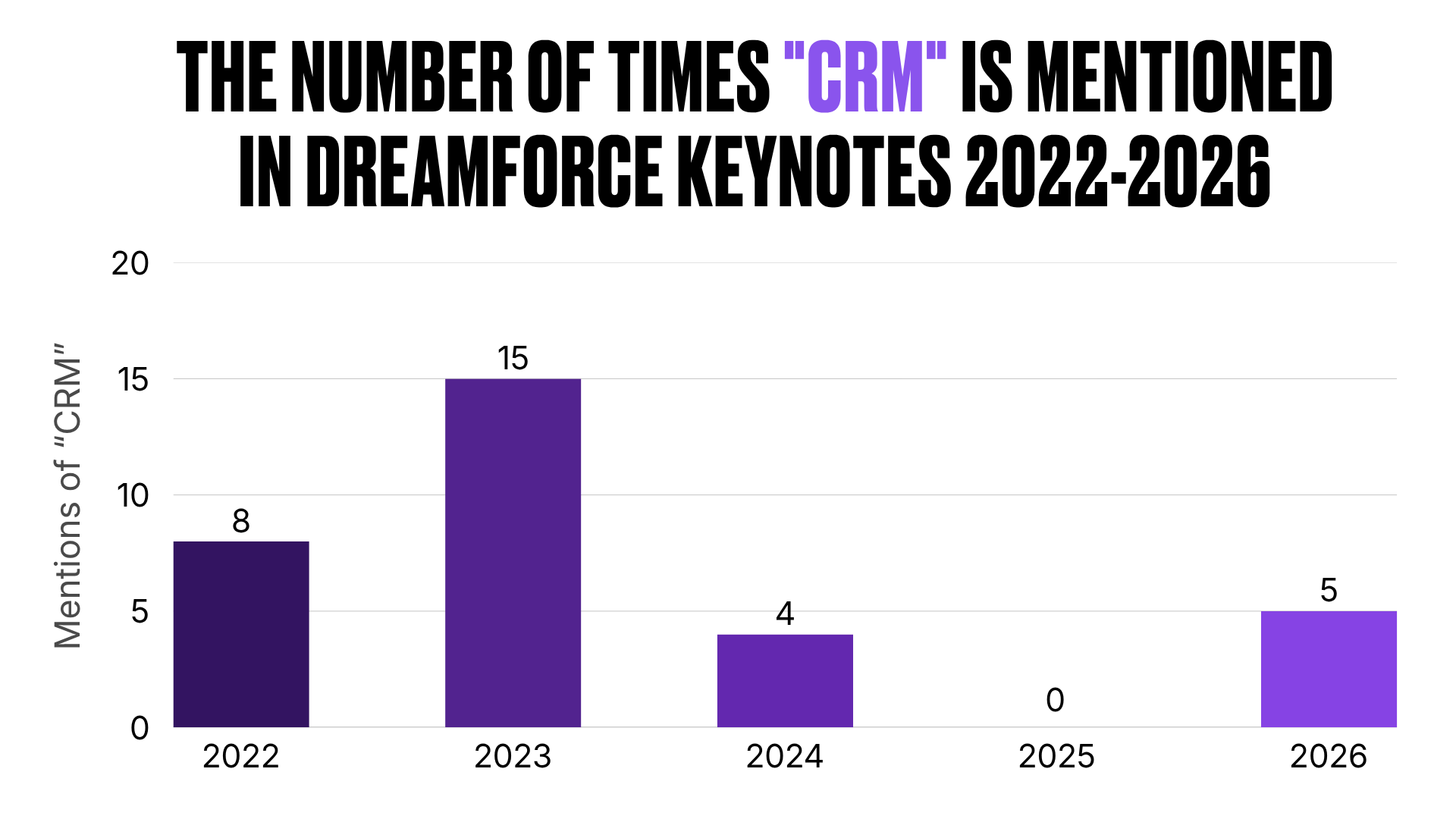
In 2022, Salesforce mentioned CRM a total of eight times during the keynote. This keynote was just over an hour and a half long. This jumped to 15 times in 2023 – the highest figure in the last five years. This was the year that Salesforce’s “AI + Data + CRM + Trust” messaging was at its strongest.
By 2024, the total had dropped to just four times. This particular keynote was almost entirely about Agentforce, as it was released that year.
In 2025, Salesforce did not mention CRM once. This time around, language choices that came up again and again included “Agentforce 360”, “Customer 360”, and the “Agentic Enterprise”. This is likely around the time Salesforce began dropping the CRM label in parts of marketing.
This year, I was surprised to see the number jump back up to six. At the time of writing, Salesforce’s own website only mentions “CRM” in links at the bottom of the page and in the browser tab, not anywhere in the website’s main copy. However, during the latest keynote, Salesforce described itself as the “number one AI CRM”, and CRM in general was much more of a focal point this year, connecting AI to CRM business needs more clearly.
Why Is This Important?
Although this particular exercise alone is just a funny way to show the change in Salesforce’s priorities, combined with the feedback from the community, Salesforce’s own comments, and its overall performance, it paints a clear picture of where Salesforce is going.
Ultimately, I think a lot of us have been asking: what does Salesforce think it is? How a company names itself on its biggest stage tells you which story it believes will win customers and investors that year. This particular metric shows Salesforce repositioning itself in the market, not just changing its priorities.
For two decades, “CRM” was the identity: the number one CRM, the company that put CRM in the cloud. In 2023, CRM was one leg of the pitch, alongside data, AI and trust. By 2025, it had disappeared entirely in favour of “Agentforce 360” and the “Agentic Enterprise.” This year, CRM comes back in a specific framing: “the world’s leading AI models connected to the world’s number one AI CRM.” So after a year of downplaying the word, CRM returns as the moat; it isn’t the product anymore so much as the context that makes everyone else’s AI usable.
This is, of course, also key for the professionals who work with this technology and who have built their careers around CRM. When the keynote vocabulary shifts, so do the skills Salesforce promotes, the certifications it pushes, and the work partners get hired for. Keynote language is often an early signal of where investment, pricing, and attention will go.
Final Thoughts
As aforementioned, this particular metric is a fairly lighthearted one in the grand scheme of things. However, it does provide some unique insight into the kind of company that Salesforce sees itself as.
Did these figures surprise you? They certainly surprised me. Let us know what you think in the comments below.