






Salesforce has proven to be a lucrative and stable career for those with the ability to master it. But with a drop in demand following the COVID boom, sweeping layoffs across the tech sector, and disruption from AI leading to a supposed ‘SaaSpocalypse’, is that still the case?
Our 2026 Salesforce Salary Survey Results go some way towards illuminating what exactly the job market holds for Salesforce professionals – and how salaries have changed over recent years. We took this data and compared it with other data sets to get a decent picture of the state of Salesforce salaries in 2026.
The Big Picture
To get the broadest view, we pulled data from three sources – Mason Frank, Stott and May, and our own SF Ben Salary Survey 2026 data. Different sources use different methodologies. Tying together data from multiple sources, we see a few distinct patterns.
First, the career ladder is steep. Median pay roughly doubles or triples from admin (~$110,000) to technical architect (~$200,000), and the path is not linear. Technical/solution architect roles pay meaningfully more than consultant or BA roles, even at similar seniority, likely because they sit downstream of deep technical specialization.
Second, recruiter data runs consistently hotter than community survey data. Mason Frank and Stott and May figures are typically 10-20% above SF Ben’s equivalents at the same seniority level. This is most visible in developer and technical consultant roles. It’s worth noting this if you’re going to use our data to benchmark an offer: recruiter medians reflect candidates being actively placed, not the full working population.
Third, ‘technical’ roles still beat out ‘functional’ in almost every instance. Technical consultants out-earn functional consultants; Technical architects out-earn solution architects; and developers show wider upside than BAs at comparable seniority.
Despite the AI-driven “SaaSpocalypse” narrative, recent data still suggest that technical Salesforce skills have not lost their premium. If anything, the spread between technical and non-technical roles seems to be widening at the senior end.
Methodology
For SF Ben Salary Survey data, salary numbers were determined based on the survey responses of 2,316 Salesforce professionals. The figures represent median salary figures, meaning the halfway point of values in that segment. This is a departure from previous reports where an average (mean) figure was used.
Mason Frank uses ‘First Quartile’, ‘Median’, ‘Third Quartile’ and ‘Contract’ categories in its 2026 reporting. Stott and May, whose 2026 data we have cited, separates salaries into ‘Low’, ‘Median’, and ‘High’.
All data, from all sources, is for the United States.
Salesforce Admins
Salesforce Admins are the entry point to the ecosystem, and the data reflect that. It’s the only role where all three sources roughly agree on a $75,000 – $150,000 band.
Mason Frank’s 2026 median ($110,000) sits nearly precisely between Stott and May’s median ($120,000) and SF Ben’s senior figure ($109,000), suggesting a real convergence around six figures for experienced admins.
But the bigger story is the spread: Mason Frank’s first quartile ($75,000) matches our own junior figure ($78,000) almost exactly, meaning entry-level admin pay has stayed reasonably flat – but the ceiling has room to grow with certifications and specialization.
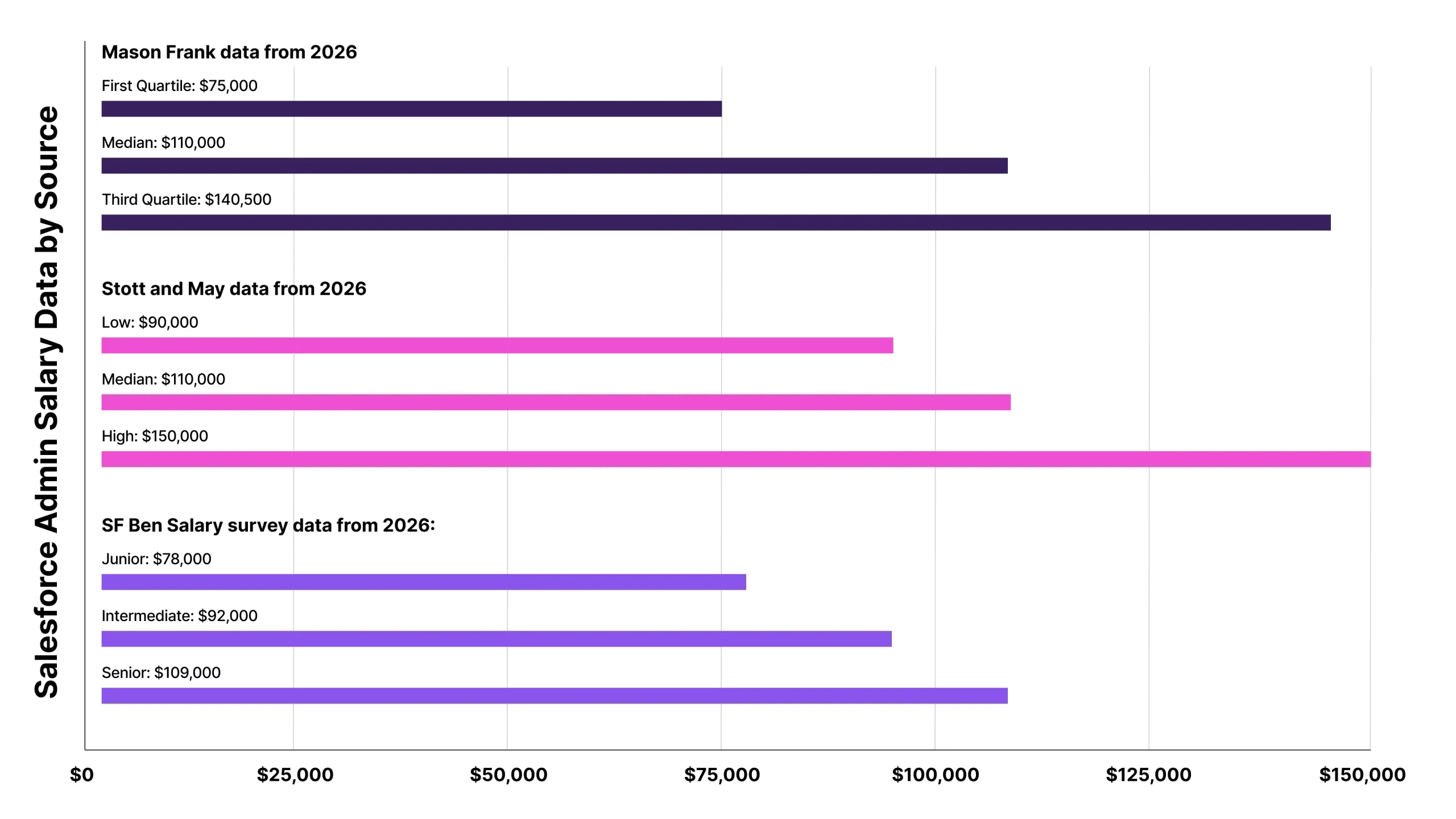
- First Quartile: $75,000
- Median: $110,000
- Third Quartile: $140,500
- Contract: $75 – $135 (hourly)
- Low: $90,000
- Median: $120,000
- High: $150,000
- Junior: $78,000
- Intermediate: $92,000
- Senior: $109,000
Salesforce Developers
Developers show the widest disagreement between sources. Mason Frank’s median ($150,000) is significantly higher than both Stott and May’s and SF Ben’s senior figure (both $140,000).
Mason Frank’s third quartile ($175,000) implies a much fatter right tail than the other datasets capture. This gap likely reflects sampling – Mason Frank and Stott and May are recruiting firms, meaning respondents skew towards candidates actively negotiating offers (which might include inflating figures), while our own survey data captures a broader cross-section of the community, including those not actively job-hunting.
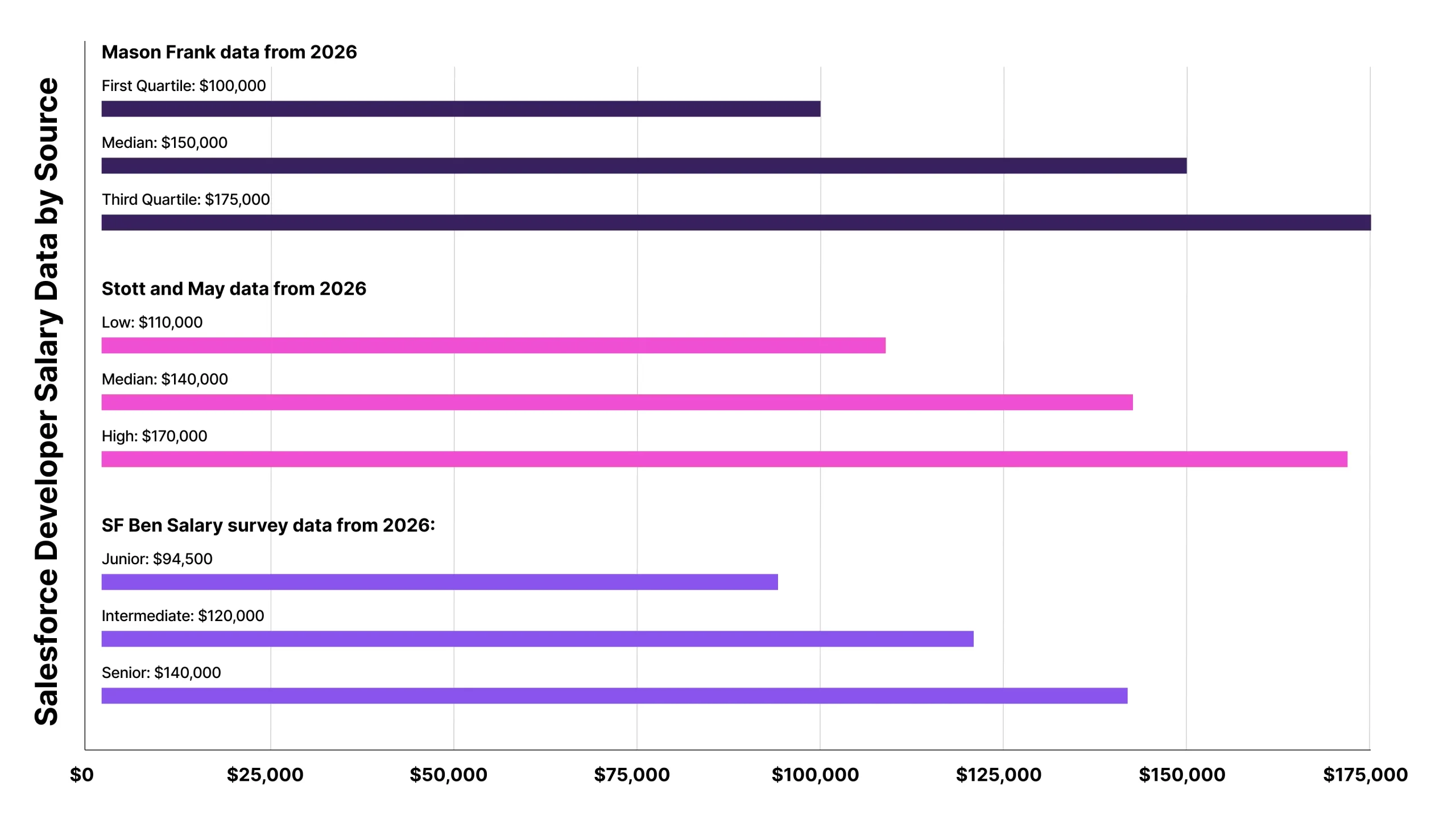
- First Quartile: $100,000
- Median: $150,000
- Third Quartile: $175,000
- Contract: $98 – $168 (hourly)
- Low: $110,000
- Median: $140,000
- High: $170,000
- Junior: $94,500
- Intermediate: $120,000
- Senior: $140,000
Salesforce Consultants
Fragmentation pops up here, largely due to the fact that ‘consultant’ isn’t one job – but for the sake of some data sets, they are lumped into one role, while others have them broken into ‘functional’ and ‘technical’.
For functional consultants, Mason Frank’s median ($130,000) and our more senior figure ($126,000) line up well.
Technical consultants see a premium at the top end. Mason Frank’s third quartile ($172,000) and contract rate ceiling ($185/hr) are the highest of any consultant category, while SF Ben’s senior figure ($145,000) is significantly above the functional consultant equivalent.
In broad strokes, “technical” consulting work can demand 10-15% more than “functional” work at the senior level.
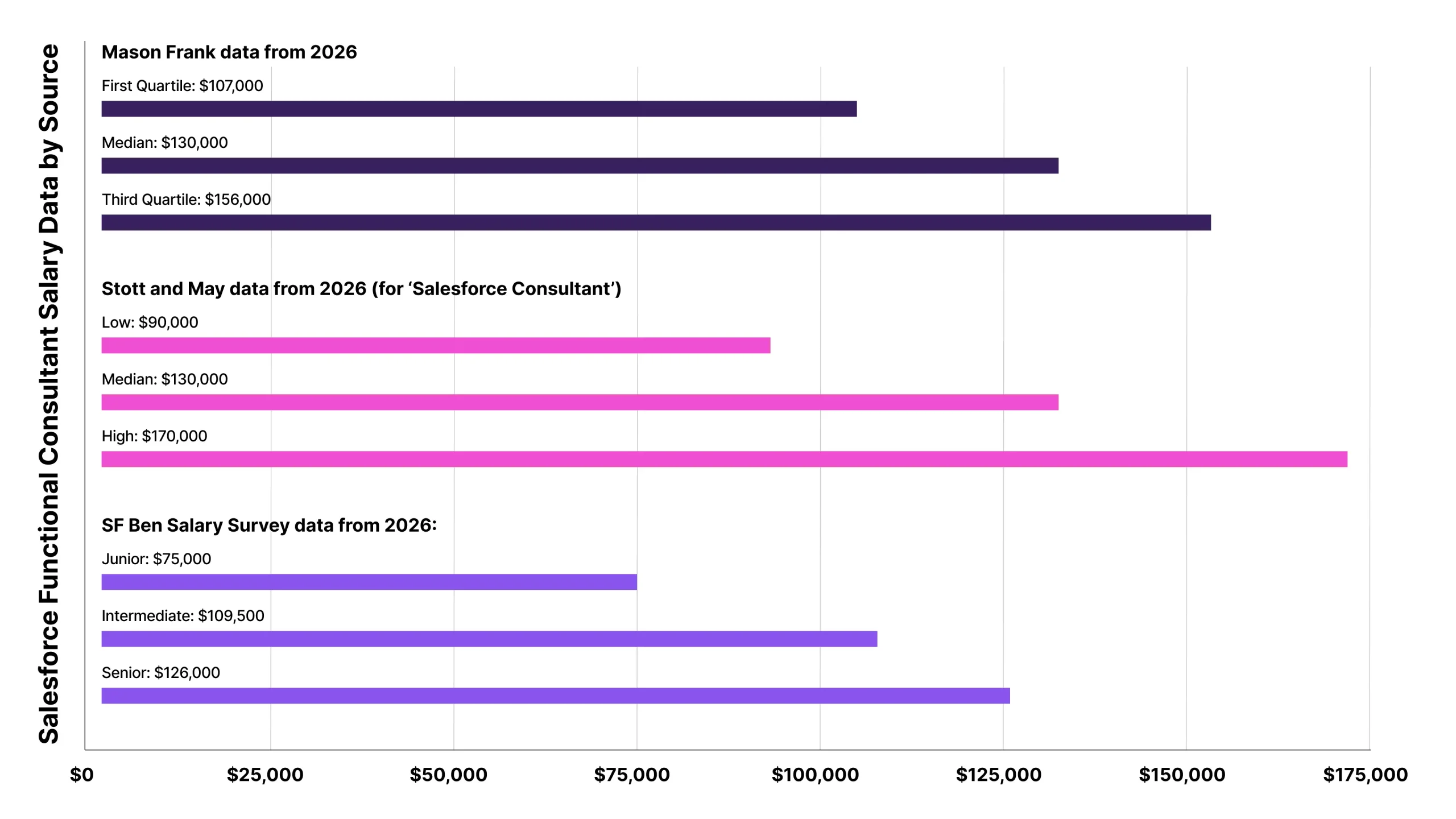
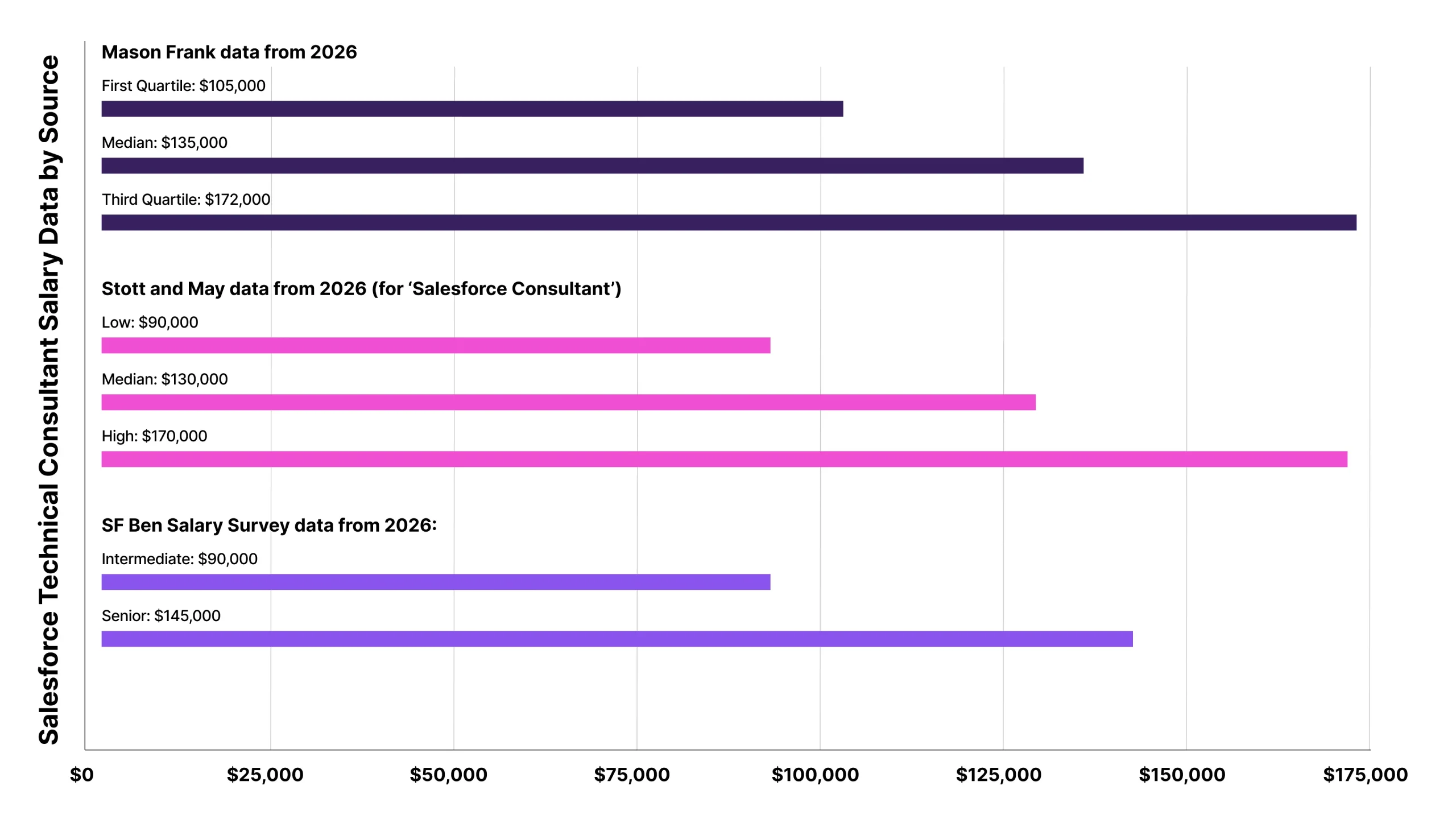
Salesforce Consultant
- Low: $90,000
- Median: $130,000
- High: $170,000
Functional Consultant
- First Quartile: $107,000
- Median: $130,000
- Third Quartile: $156,000
- Contract: $105 – $157 (hourly)
- Junior: $75,000
- Intermediate: $109,500
- Senior: $126,000
Technical Consultant
- First Quartile: $105,000
- Median: $135,000
- Third Quartile: $172,000
- Contract: $120 – $185 (hourly)
- Junior: N/A
- Intermediate: $90,000
- Senior: $145,000
Business Analyst
Business analyst pay seems very compressed, relative to other roles. Our own senior BA figure ($107,500) is barely above the intermediate functional consultant figure ($109,500) and below Mason Frank’s BA median ($125,000).
BAs also have the smallest junior-to-senior jump of the SF Ben tiers ($85,000 to $107,500, around 26% growth) compared to the significant growth developers see (~48% growth from junior to senior) or technical consultants (~61% growth from intermediate to senior).
This implies that the BA is either a flatter career track on its own, or – more likely – a common stepping stone people move out of before hitting senior-level pay ceilings elsewhere.
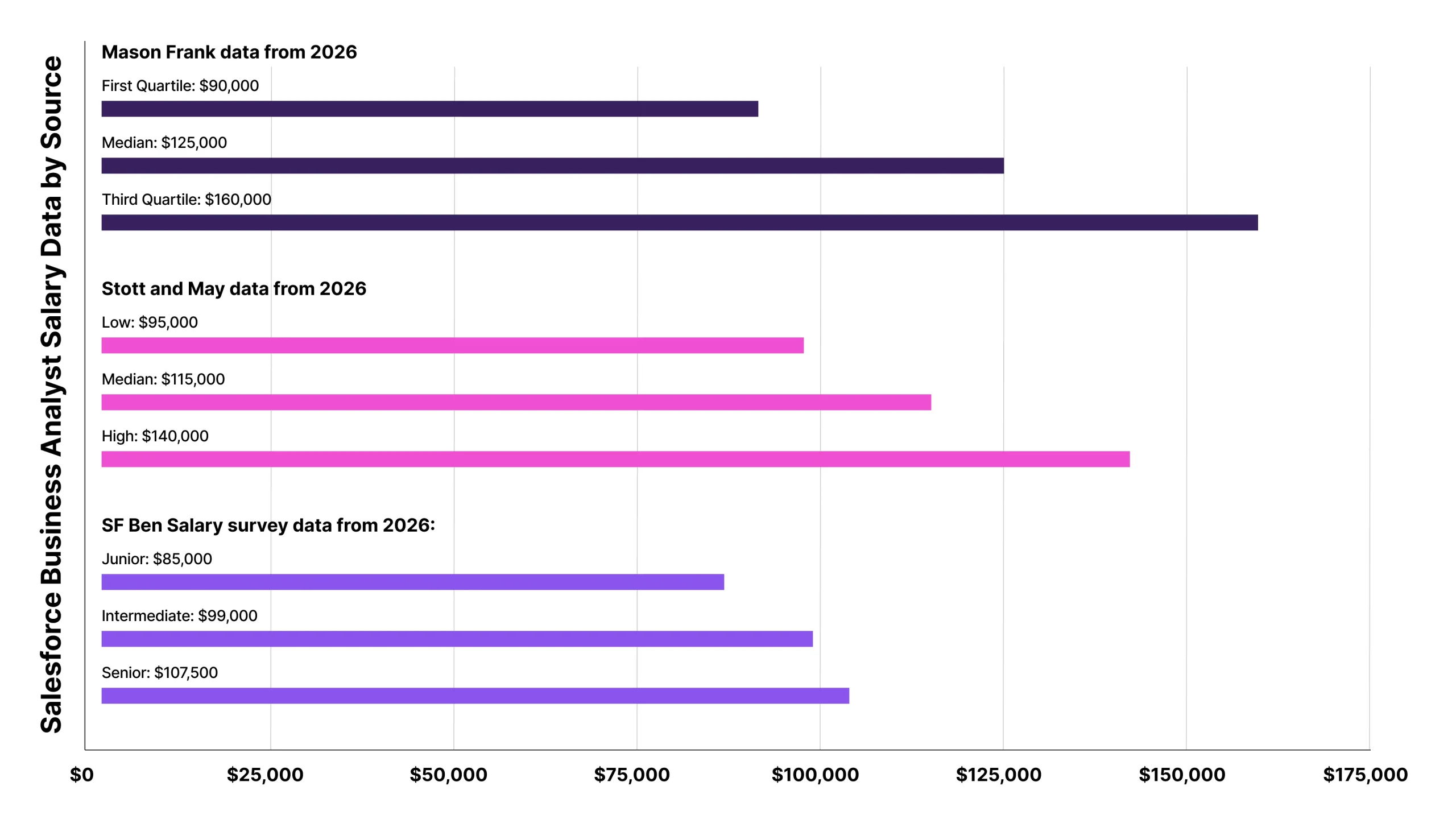
- First Quartile: $90,000
- Median: $125,000
- Third Quartile: $160,000
- Contract: $97 – $145 (hourly)
- Low: $95,000
- Median: $115,000
- High: $140,000
- Junior: $85,000
- Intermediate: $99,000
- Senior: $107,500
Solution Architect
This is the first role where all sources cross into the $150,000 range without exception. Stott and May’s median ($165,000) and SF Ben’s senior figure ($165,000) match precisely, and Mason Frank’s median ($170,000) is close behind.
The quartile spread from Mason Frank ($139,000 – $205,500) is wide, likely due to Solution Architect pay being significantly influenced by company size, industry, and, possibly, whether the professional in question holds pre-sales/client-facing responsibilities.
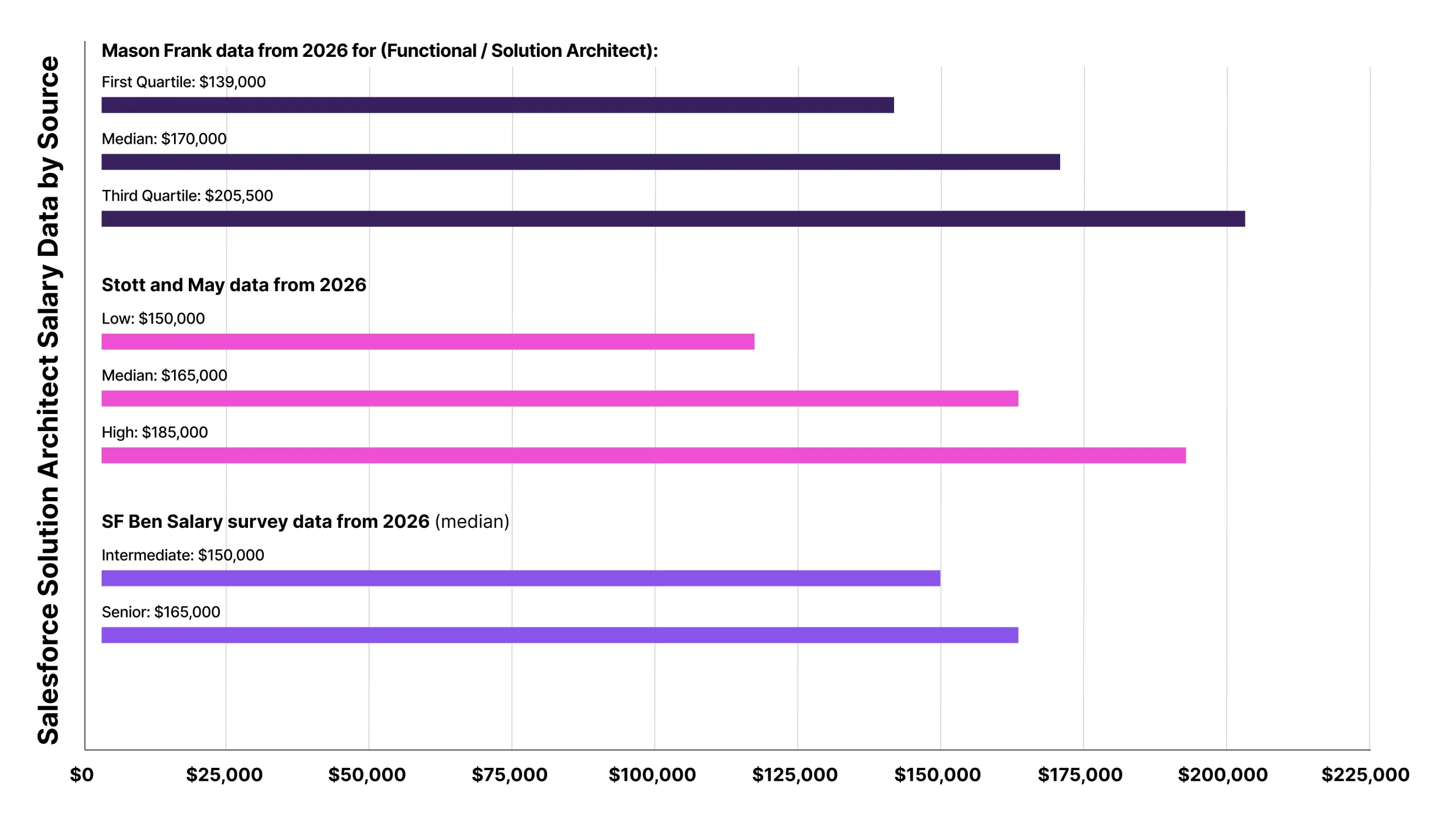
- Low: $150,000
- Median: $165,000
- High: $185,000
- First Quartile: $139,000
- Median: $170,000
- Third Quartile: $205,500
- Contract: $121 – $180 (hourly)
- Intermediate: $150,000
- Senior: $165,000
Technical Architect
Every source puts the median north of $180,000, while Mason Frank’s third quartile ($250,000) is the highest figure anywhere in the dataset – even above architect-level contract rates elsewhere.
The role is typically only reached after gathering years of experience in developer or Solution Architect positions, so it makes sense.
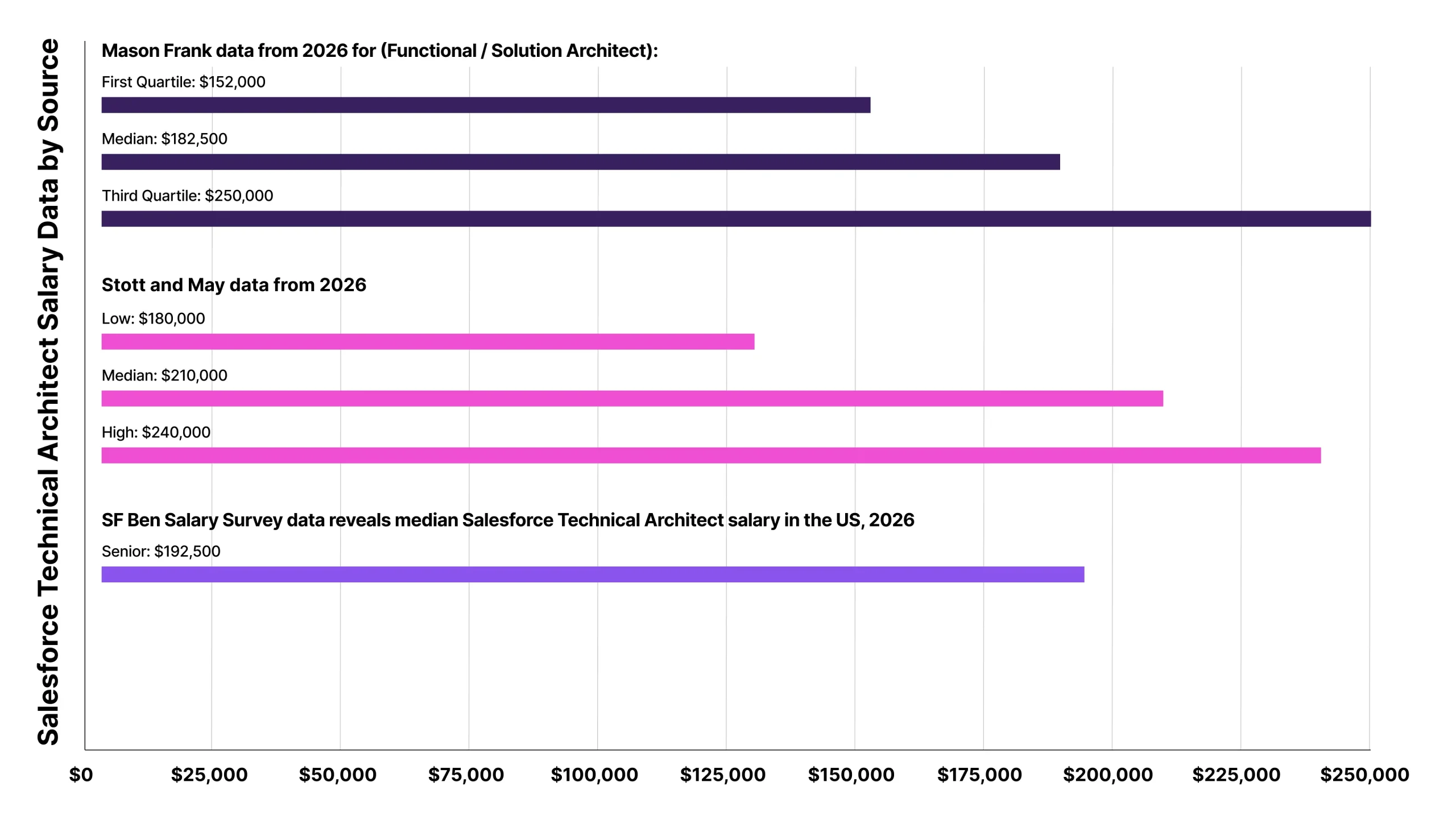
- Low: $150,000
- Median: $165,000
- High: $185,000
- First Quartile: $152,000
- Median: $182,500
- Third Quartile: $250,000
- Contract: $131 – $208 (hourly)
- Intermediate: $150,000
- Senior: $165,000
Final Thoughts
In their totality, this year’s figures argue against the so-called ‘SaaSpocalypse’ narrative impacting careers more than they support it. Or at least, the reality seems a little more complicated than simple ‘AI taking jobs’.
Technical architect medians are still high, and the gap between technical and functional roles is widening, not narrowing. Whatever disruption AI is causing, it does not yet appear to have translated into lower pay for the people building and architecting on the platform.
That being said, the story is not a purely positive one. Business analysts and junior-to-intermediate admins are seeing somewhat flat growth, with recruiter and community survey data lining up closely. This suggests less competitive tension in those markets than higher up the ladder. If there’s a segment of the workforce genuinely feeling squeezed, this data points there first – not the more technical roles.
Something important to note is that these figures do not account for job availability. High median pay tells us what people who currently hold these roles are earning – but it says nothing about how hard those roles are to land. While the job market is arguably becoming more competitive, it still appears to be the case that those dedicated (and fortunate) professionals who land Salesforce roles are still being compensated well enough for them.