

New industry research reveals a startling execution gap in professional services: while the vast majority of leaders agree that aligning Sales, Professional Services (PS), and Customer Success (CS) is critical for growth, very few are actually achieving it.
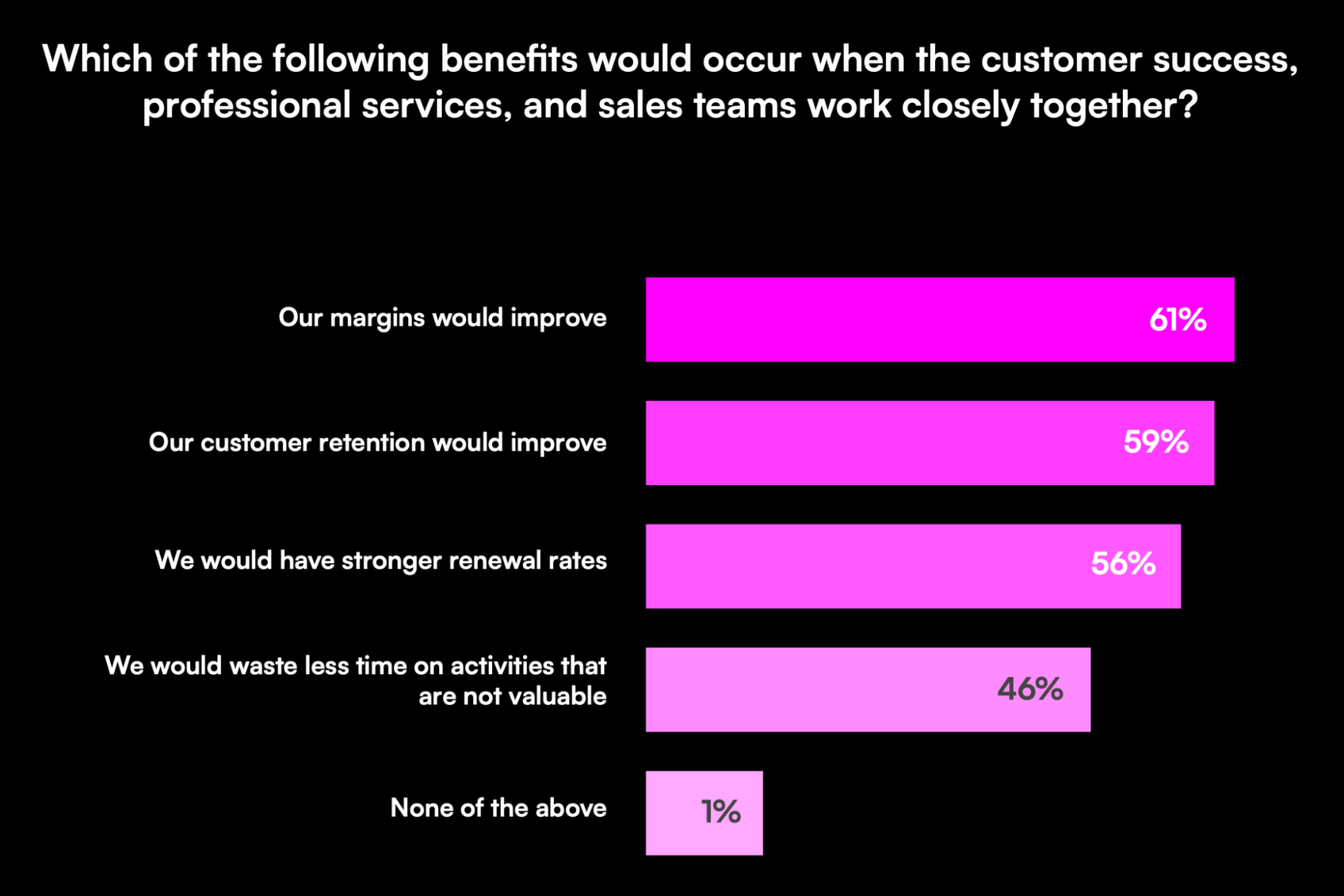
The 2025 Global Service Dynamics Report found that while 61% of service executives know this alignment would improve margins and 59% say it would boost customer retention, a mere 36% of their PS teams collaborate proactively with their cross-functional counterparts.
This gap is a direct result of the fragmented systems teams must work with, not a reflection on their effort. Nearly a third of those surveyed said that key information is often omitted when shared between the groups, turning collaboration into an uphill battle fought with disconnected data and manual effort.
If you’re a leader or owner of the Salesforce platform for your organization, this data offers a clear roadmap for driving value and a warning against a common integration trap you’ve probably had to clean up before.
The Real Source of the Execution Gap
Every services leader knows the pain. Sales is driven by revenue targets and speed to close. PS teams are focused on delivering scoped projects on time and under budget. CS teams zero in on long-term outcomes and renewals. Without a shared system of record, each team naturally optimizes for its own success, which can come at the expense of the other – and worst of all, the customer’s.
This fragmentation creates friction at every handoff, from the initial sale to the delivery of value and the long-term relationship. The absence of collaboration stems from a lack of embedded processes and systems that make cross-functional teamwork so challenging.
When your teams are working from fragmented tools and siloed data, a unified customer journey is simply impossible; in fact, a recent Forrester report found that 56% of services organizations still rely on a patchwork of spreadsheets and disconnected tools, with a top resulting challenge being a lack of visibility into project performance.
The Case for Going Salesforce-Native
So, how do you fix it? Data from the Global Service Dynamics Report shows a clear technology pattern: the most profitable PSOs have a markedly higher adoption of commercial Professional Services Automation (PSA) solutions (52% vs. the 40% average) and rely far less on spreadsheets.
But the key insight for platform owners goes deeper. Buying more software that claims to “integrate with Salesforce” isn’t the answer. The path to real collaboration and AI-readiness lies in building your application stack with native capabilities.
A patchwork of different tools with flimsy integrations often creates more problems than it solves. The headaches are all too familiar:
- They maintain separate, conflicting data models.
- They constantly introduce syncing errors and data latency.
- They fail to provide the single source of truth needed for your teams and, critically, for your future AI models.
In contrast, solutions built natively on the Salesforce platform share the same data core. This creates a reliable foundation for analytics and AI. As Alice Steinglass, EVP and GM of the Salesforce Platform, stated in the report, “The key is a unified AI-powered customer platform. When every service team draws from one connected customer view… Al can deliver its most transformative end-to-end service experiences.”
When Sales, Professional Services, and customer success teams work from the same data, in the same system of record, there’s no need to manually stitch together spreadsheets or deal with version mismatches. Everyone gets real-time access to the same information. That transparency nurtures shared accountability and keeps the entire team aligned and focused on the same customer outcomes.
Your Mandate as a Platform Leader
As the steward of your organization’s Salesforce platform, you are in the ideal position to champion this native-first strategy. The report’s findings give you the data needed to make a compelling business case for moving beyond a fragmented application landscape.
My advice is this: be the one in the room who scrutinizes the promise of “integration”. When a new solution is proposed, be the one who asks:
- Does this app share a data model with Salesforce, or are we creating another silo?
- What does ‘integration’ actually mean here—is it a real-time connection or a scheduled batch sync that can lead to frustrating errors?
- How will this tool feed our analytics and AI strategy without polluting our data?
Championing a Salesforce-native approach to automating the end-to-end services journey directly addresses the execution gap your business leaders are struggling with, guiding your organization toward greater profitability and building the resilient, AI-ready foundation required to win the future.
The strategic goal of solving the collaboration problem is to build a more resilient and predictable services business. The architectural choices you make today will determine your organization’s ability to compete and win tomorrow.
Final Thoughts
Achieving higher margins and better customer retention comes from providing teams with a unified platform where collaboration is the natural outcome. For Salesforce platform owners, this requires looking beyond superficial integrations and championing a native-first application strategy. Doing so ensures your data remains clean, your analytics are trustworthy, and your entire services lifecycle is connected from day one.
For the full data set, including benchmarks on operational health and AI adoption trends in the services industry, download the complete 2025 Global Service Dynamics Report.