






Salesforce delivery has always been limited by human bandwidth. AI throws those limitations out the window.
In the Salesforce ecosystem, the shift to AI tools has been particularly significant. Delivery teams are expected to move faster than ever, balancing speed with accuracy, while the complexity and breadth of Salesforce implementations continuously grow.
For years, the way to scale delivery was to get more hands on keyboards. But AI agents are changing that equation. These intelligent systems can interpret requirements, generate metadata, create automation, and even integrate with project-tracking tools – all of which shortens the path from idea to production. The result is faster speed-to-value for businesses and more meaningful work for the people who deliver it.
From Manual Effort to AI-Driven Collaboration
Salesforce teams know the reality: much of the work is repetitive. Creating fields, configuring objects, building validation rules, and wiring up Flows all take valuable time. These are essential tasks, but they’re rarely the most creative or strategic part of a project.
This is where AI agents come in. Rather than replacing developers and admins, AI agents collaborate with them, taking on the time-consuming “assembly” work or providing expert-level knowledge of how to configure or code in Salesforce.
The graphic below illustrates the division of labor between AI and human consultants in an AI-assisted delivery model. It breaks work into three main categories:
- Inputs: Consultants lead the way by providing accurate inputs. AI tooling can assist and add efficiencies here, but the foundation comes from human expertise.
- Outputs: AI takes the lead, generating most outputs once it has the right inputs from consultants. This is where the bulk of time savings and automation occur.
- Validation: AI can help with some testing, but consultants and their experience are essential to validate the results and ensure quality.
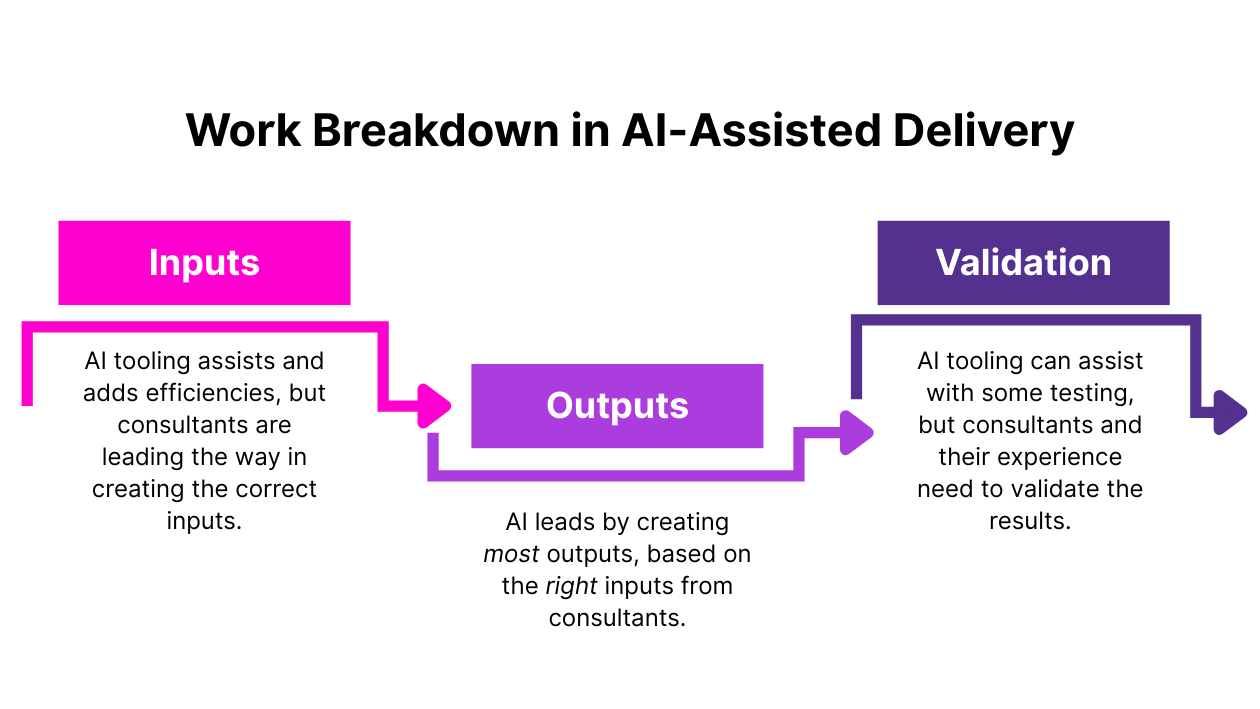
In other words, AI plays the heaviest role in producing outputs, while humans remain central in framing the inputs and validating the outcomes. This balance ensures speed without sacrificing quality.
Use Cases of AI for Salesforce Deployment
Flow Creation from Natural Language
Salesforce Flows are powerful, but can be daunting for those without hands-on experience. Specialized custom AI agents can lower that barrier by generating record-triggered Flows directly from user stories or process descriptions. This capability allows teams to move quickly from business requirements to automation without needing deep Flow expertise.
Automated Progression of Work
Project delays often occur during handoffs. AI can integrate with tools like Jira, detect when a story is marked “Ready for Dev,” and automatically begin execution. It updates the status to “In Progress,” completes the configuration, and moves the item to “Ready for QA.” If something goes wrong, it flags the issue and adds error context. This eliminates gaps in communication and introduces a level of AI autonomy that helps keep delivery cycles moving smoothly.
Intelligent QA and Validation
AI agents can also act as an automated QA partner. By validating the output of a configuration against expected results or best practices, they provide another safety net before human testers even begin. This improves both quality and consistency across teams.
What This Means for Salesforce Teams
The rise of AI in Salesforce delivery signals a major evolution in how projects are executed:
- Faster Delivery: Routine work takes minutes instead of hours.
- Higher Consistency: Metadata and automation are generated in accordance with best practices.
- Lower Barriers: Teams with fewer admins or developers can still deliver at scale.
- Better Developer Experience: Professionals spend less time on rote tasks and more time on creative, high-value work.
It’s important to emphasize: AI is not about replacing developers, admins, or architects. Instead, it’s a force multiplier – giving delivery teams the ability to do more, faster, while maintaining human judgment at the center of decision-making.
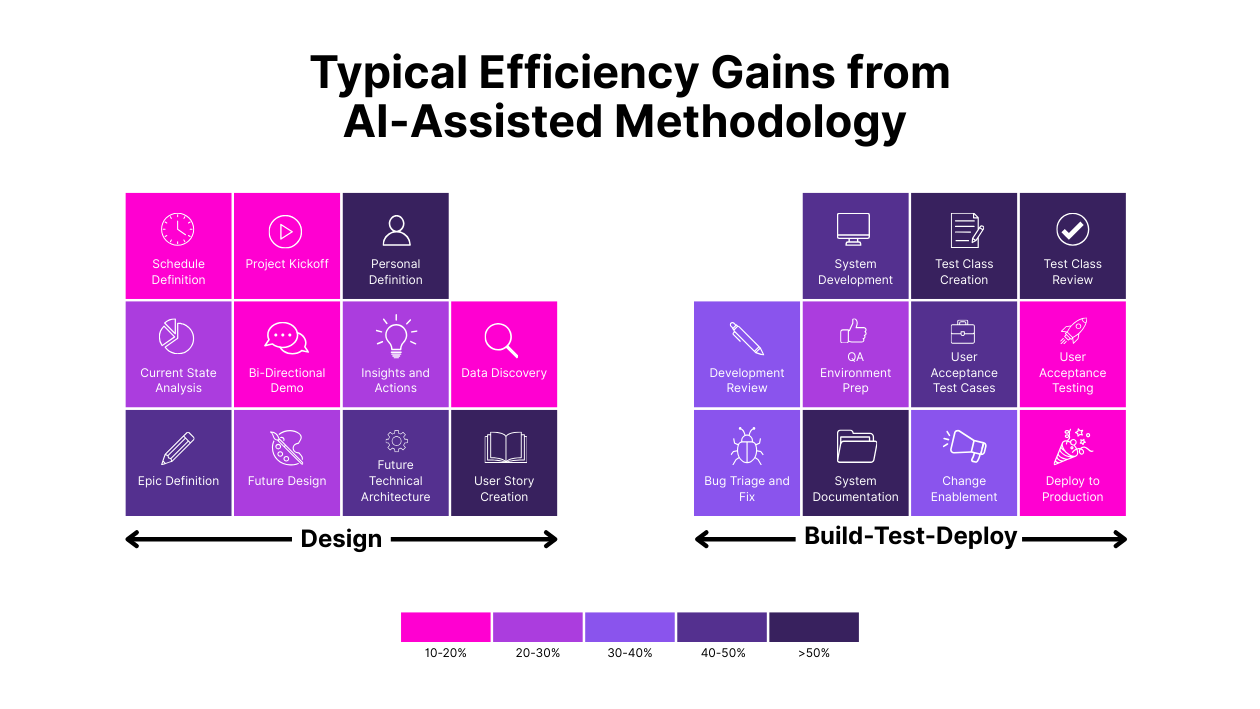
The chart below highlights where AI-assisted delivery can create efficiency gains across the Salesforce project lifecycle. Rather than focusing on a single activity, AI can support a range of tasks spanning design, building, testing, and deployment.
In the design stage, activities such as user story creation, future architecture planning, and data discovery can be accelerated through AI, cutting down the upfront time needed to move from requirements to actionable work. In the build and test stages, efficiency gains are often even higher – tasks like system development, test case generation, QA preparation, and bug triage can be partially or fully automated.
Finally, in the deployment stage, activities such as system documentation, change enablement, and production pushes can also benefit from AI support, improving speed while reducing human error.
Overall, efficiency gains typically range from 10–20% in early design work to 50% or more during build-test-deploy, depending on the task.
See AI-Assisted Delivery in Action
If you’d like to see how this works in practice, check out more about Andi, Atrium’s AI Consultant, and learn how it orchestrates specialized agents that autonomously execute Salesforce configuration tasks at scale.
For those attending Dreamforce 2025, we invite you to request access to the Atrium Lounge for live demos, exclusive perks, and a chance to engage with the experts behind the innovation.
Final Thoughts (and Where We Go Next)
AI is becoming a central part of how Salesforce work happens – by offloading repetitive tasks to intelligent agents, teams can accelerate continuous delivery, reduce errors, and focus on solving the complex challenges that matter most to their organizations.
TLDR takeaways:
- This shift to AI-assisted Salesforce delivery is already happening; it’s not a distant future state (or AI hallucination!).
- Intelligent agents can handle coding, configuration, automation, and QA tasks.
- It’s all about better enabling DevOps teams and accelerating their work – not replacing them.
- The outcome is faster speed-to-value for Salesforce customers and reduced burnout for delivery teams.