

In the last six months, Salesforce’s stock dropped 20%. Zoom out to the last year, and the drop increases to 30%. Look back even further, and you’re looking at a 8.52% decline – a stark juxtaposition with Oracle’s, Microsoft’s, and ServiceNow’s five-year growth figures.
Evidently, something in the realm of Salesforce spells trouble for investors. Confidence has waxed and waned, and more questions are being asked, even with the launch of new products like Agentforce and company-wide directional pivots. Is this a result of Salesforce failing to crawl its way back up the leaderboard, or a sign of something bigger in the SaaS space?
The Stock People Won’t Stay Quiet About
At the beginning of the year, all eyes were transfixed on the CRM stock. 2025 had been a fairly prosperous year for Salesforce, with its golden product, Agentforce, reaching its milestone first birthday. Salesforce also tackled multiple acquisitions and ended the financial year with “record” numbers.
However, when we first reported on Salesforce’s stock this year, the CRM giant was actively experiencing a 25% drop in just one year. The SaaS sector had had a wobbly year, facing increasing Wall Street and investor pressure to prove it was still a relevant sector in the face of growing AI advancements, and making companies scramble to prove they could marry up the two technologies in any kind of effective (and desired) solution.
Some companies within the sector appeared to have come out on top. Some would argue that Salesforce unfortunately didn’t.
A Near 9% Drop
Examining Salesforce’s stock’s five-year history paints a clear picture of something: In those five years, Salesforce as both a company and a stock experienced cyclical change.
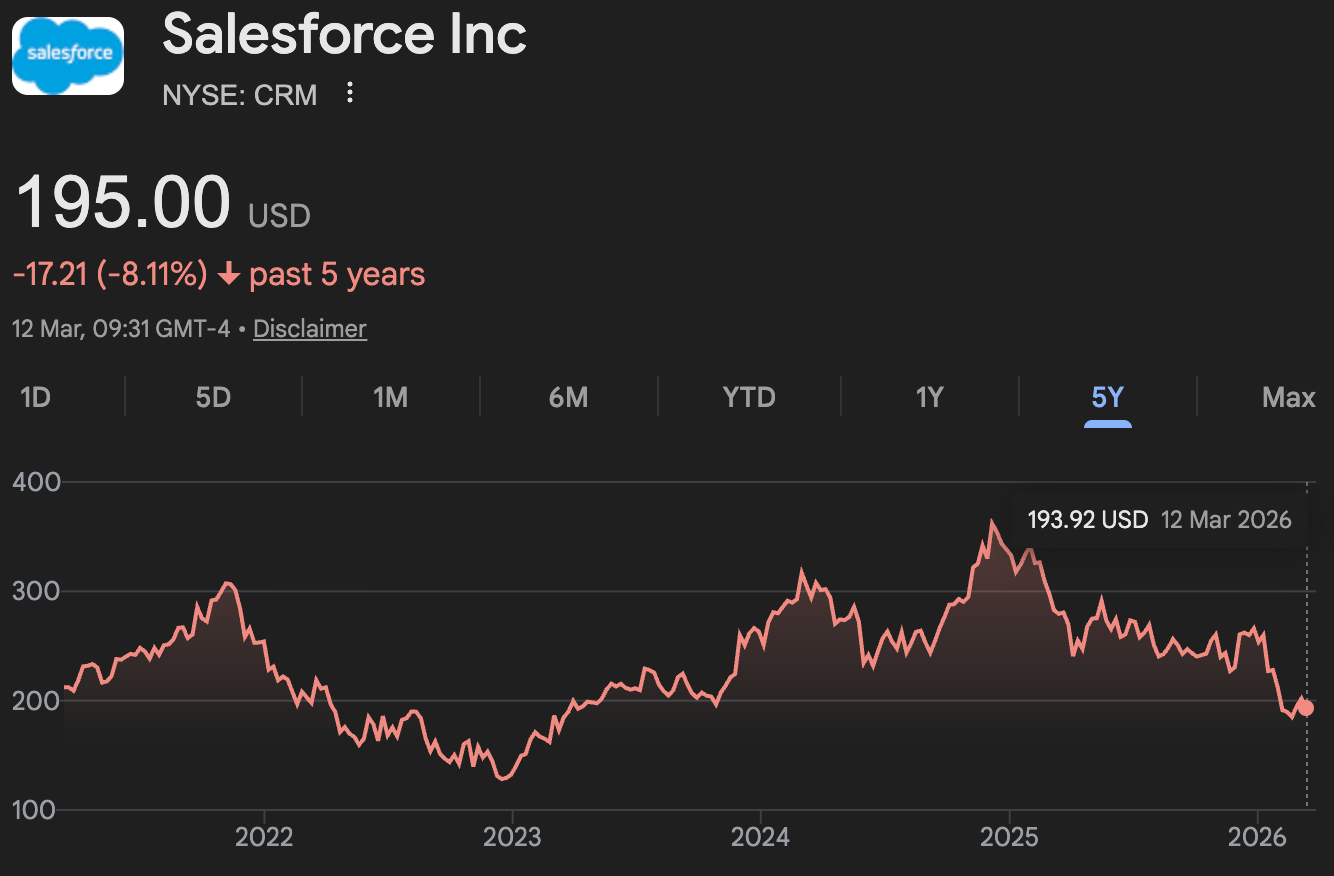
Rather than experiencing consistent growth or decline, Salesforce stock has shifted between four states: boom, correction, recovery, and pullback.
As the tech industry navigated the end of 2021, many companies were still feeling the benefits of the pandemic tech boom. However, come 2022, tech’s mass exodus or selloff meant that Salesforce’s stock price fell dramatically alongside many other high-growth tech stocks at the time. Specifically, rising interest rates and concerns about profitability pushed the price down to roughly $130–$150 at its lowest, marking the boom and subsequent correction phases.
2023-2024 was the period of recovery for the stock. Pressure from activist investors, cost-cutting and layoffs measures, and a stronger focus on margins and profitability moved the CRM stock away from a growth-at-all-costs model to more of a value model. By late 2024, shares reached a new high of about $350+.
Since the start of 2025, the stock has been facing a gradual decline. Its latest significant drop occurred in January-February 2026 when the stock crashed down to $185.16. At the time of writing, it is hovering around the $195 mark.
Facing Fierce Competition
It is true that the entire SaaS market has experienced varying levels of turbulence over the last five years. It is also true that in terms of stock performance, Salesforce has seemingly been battered a lot more than its competitors.
Take three of its biggest rivals: Oracle, Microsoft, and ServiceNow. Oracle’s stock has experienced a 142% growth over the last five years. Microsoft has seen a 72% growth, and ServiceNow has seen 19% growth.
Although different companies in many ways, all four navigated the same market. So what did the three competitors have that Salesforce didn’t?
Like many areas debated and discussed within the tech industry right now, a lot of it leads back to artificial intelligence and specifically AI positioning. For Microsoft and Oracle, their involvement in the AI space was much more direct. Microsoft became the primary cloud partner for OpenAI and embedded AI across Azure, Office, and GitHub. Oracle tapped into increased OCI (Oracle Cloud Infrastructure) demand as companies sought GPU capacity for AI training.
ServiceNow’s story was slightly different, but the ITSM provider has consistently shown margin expansion and efficient growth. Salesforce, on the other hand, has not reported unfavorable results by any means, but has spent years prioritizing growth through large acquisitions.
This led to criticism that Salesforce was less disciplined financially, which is why activist investors pushed for cost-cutting in 2023.
“Every Enterprise SaaS Company Is Facing the Same Challenges”
Although it appears that Salesforce’s stock performance has tanked compared to its competitors, Ian Gotts, Senior Research Fellow at Keenan Vision and Founder of Elements.cloud, insists that every enterprise SaaS company is feeling the sting.
“[They’re] facing the same challenges, combined with lower revenue growth as IT budgets are redirected towards AI,” he told SF Ben.
He explained that AI and agents are driving a fundamental shift in how organizations operate, which includes how they develop software. This, in turn, changes the dynamic of build vs buy decisions, driving uncertainty into the viability of every enterprise SaaS company.
“Salesforce is well-positioned as the database of customer data, but to really benefit from AI, it needs to also be the agentic platform,” he said. “The risk is that another vendor becomes the de facto enterprise agentic platform sitting on top of Salesforce and the other enterprise applications. That is why Salesforce is laser-focused on establishing Agentforce as the enterprise agent platform.”
Will Salesforce’s Buyback Scheme Save It?
All the biggest tech companies would like to convince you that they’re doing brilliantly, even if their feet are thrashing wildly under the surface. Salesforce is likely very aware of its stock performance and the weight of its investors’ boots on its neck, which perhaps inspired the introduction of the company’s new buyback scheme.
In Salesforce’s latest earnings call, the CRM giant announced a new $50B share buyback program, replacing all previously unused authorizations. As part of this, $25B of debt will be sold to fund this buyback.
This scheme will divert cash flow and work to make the stock more enticing, as well as show that the cloud giant is consciously thinking about how to get back into Wall Street’s good books. If the scheme succeeds, we could see the fruits of this labor sooner rather than later.
Final Thoughts
There is no sugarcoating the fact that the last five years have been bad for CRM stock. Although Salesforce as a company has seen a wealth of growth, development, and adaptation in that time, ultimately, investors have made their hesitancies known.
As SaaS and AI slowly become more synonymous with each other, the market is likely to become even more complex to traverse. This will mean investors and customers alike will expect more, and the fight to the top will become more cutthroat. Does Salesforce have the power to claw its way back up? The outcome remains uncertain.
For more Salesforce conversations and industry insights, check out the latest episode of the Picklist podcast below.