

Salesforce appears to be facing a very familiar series of problems with stock price dropping and activist investors buying up shares – amid negative headlines around data theft attacks.
A one-month view of CRM stock, captured on August 20, shows a dive of 6.53%, standing at $245.15. A six-month view of the stock shows a 23% drop, but the year-to-date (YTD) view is even more damning, revealing a fall of nearly 26%.
Recent weeks have been tough for the cloud giant – which is now having to tighten security around the use of connected apps amid a series of social engineering hacks on Salesforce customers.
And to compound matters, activist investor hedge fund Starboard Value – which publicly pushed for Salesforce to make changes three years ago – bought 50% more CRM stock as it dipped in value.
Sliding stock prices and activist investors might sound nostalgic for longer-time ecosystem members… So what exactly is going on?
SF Ben Note: The potential for compromised connected apps in Salesforce orgs is ongoing. We at Salesforce Ben strongly recommend that all admins and org owners prioritize auditing the connected apps currently in use in their orgs. This includes identifying the origin of all connected apps, removing any unused or unknown apps, setting permissions for access to remaining apps, and removing the ability for any user to add connected apps without approval. We’ve published this article to help.
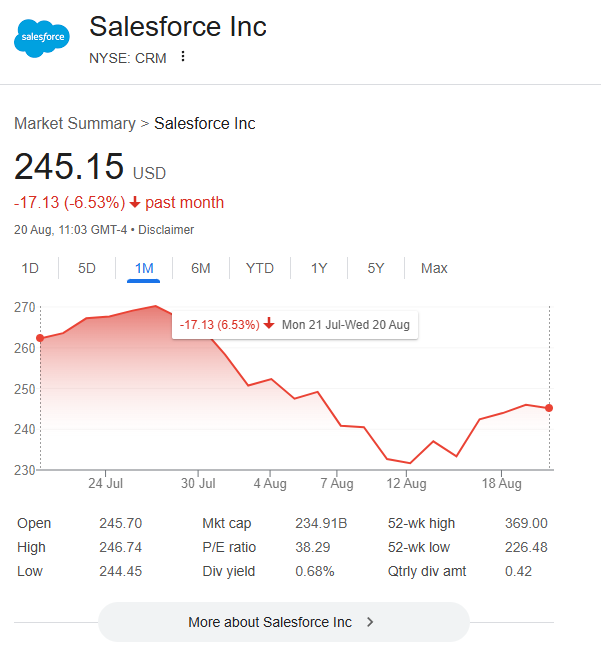
Pictured: A one-month, six-month, and YTD view of Salesforce stock, captured August 20, 4pm UK time. 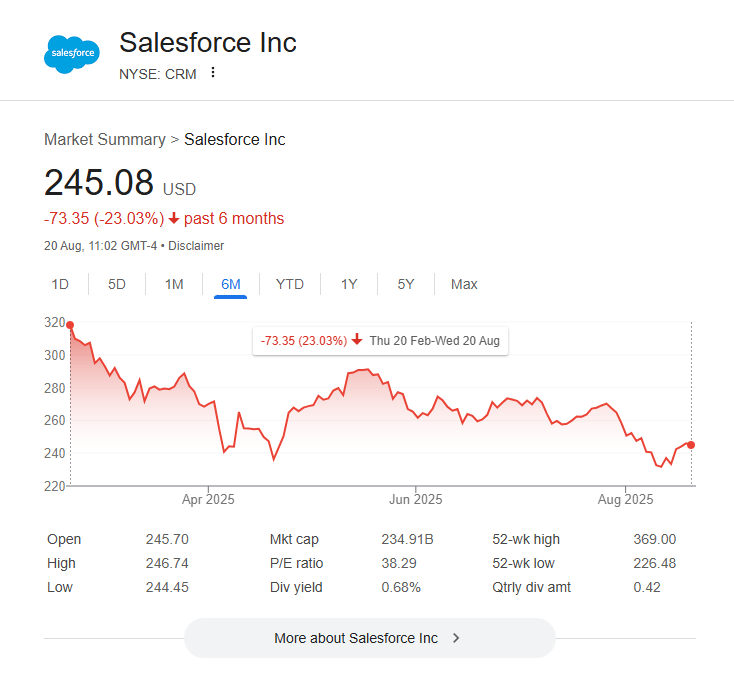
Pictured: A one-month, six-month, and YTD view of Salesforce stock, captured August 20, 4pm UK time. 
Pictured: A one-month, six-month, and YTD view of Salesforce stock, captured August 20, 4pm UK time.
Salesforce Data Hacks: Is That All?
As the social engineering attacks were revealed in recent times, Salesforce was encouraging customers to read up on best practices like enabling multi-factor authentication (MFA), enforcing the principle of least privilege, and carefully managing connected applications.
But, the company stressed: “The Salesforce platform has not been compromised, and this issue is not due to any known vulnerability in our technology.”
Earlier this month, the company revealed what appeared to be a series of countermeasures against the social engineering attackers’ tactic of targeting English-speaking Salesforce customers with voice phishing phone calls to get them to download a malicious replica of the Data Loader app, which compromises their data.
In a release set to arrive in early September, Salesforce will be enacting restrictions on so-called “uninstalled” connected apps – meaning connected apps that have been authorized by a Salesforce user, but have never been installed in the Salesforce org as a configuration.
The recent views of CRM stock reveal a general downward trend amid news of the hacks, which is perhaps unsurprising.
But, if we zoom out for a moment for a longer-term view, the year-to-date drop is the most severe of the three we have observed, perhaps indicating deeper issues than a few negative headlines in recent weeks.
According to Zacks.com, which provides stock research and investment information, Salesforce carries a Rank #3 (Hold) – using its scale where #1 means ‘Strong Buy’ and #5 means ‘Strong Sell’ – at the time of writing, August 20.
On August 11, it had stood at Rank #4 (Sell). In an article published on that date, Zacks described Salesforce as having “one of its worst years in recent memory” – with competitors like SAP, Microsoft, and Oracle seeing year-to-date increases of 18.7%, 23.9% and 50.1%.
When compared to these, it paints a very stark picture for Salesforce – but it gets a little fuzzier when we take an even deeper look.
CRM rival Monday.com stock dropped by 39% over one month, standing at $173.23 on August 20.
The company had issued some cautious guidance for Q3 of between $311M to $313M – slightly below analysts expectations at the midpoint, according to an August 11 post from Proactive Investors, which also revealed that revenue had beat Wall Street estimates, jumping 27% year-over-year (YOY) in Q2 to $277M, while earnings per share also outperformed estimates of $0.86, instead reaching $1.09.
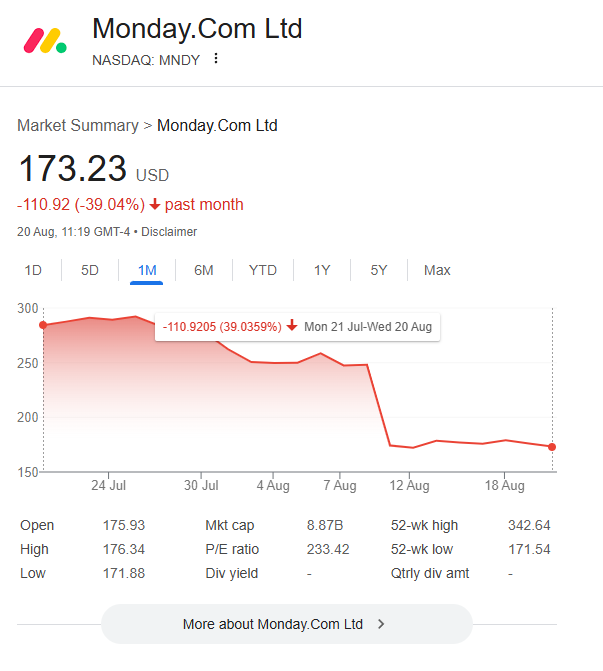
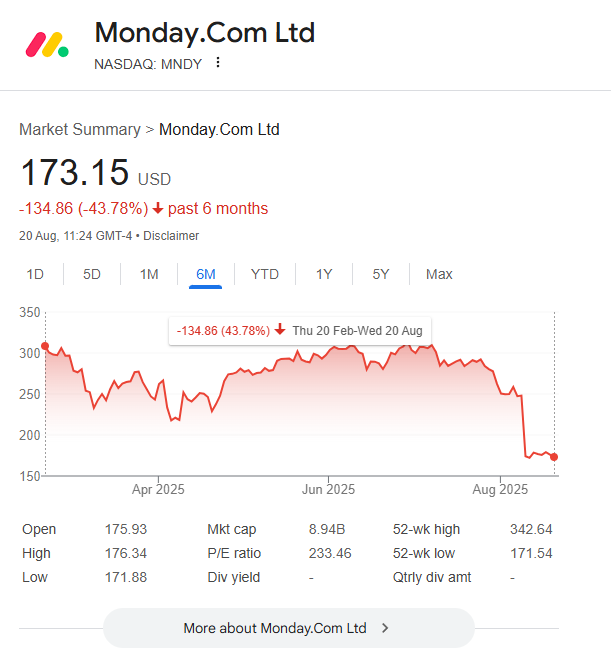
Despite the CRM company’s better-than-predicted Q2 earnings, stock has been dropping. A six-month view shows a 43% decrease, down to $173.15.
So, that’s two CRM companies suffering sharp drops in stock in recent days. Let’s take a look at a third.
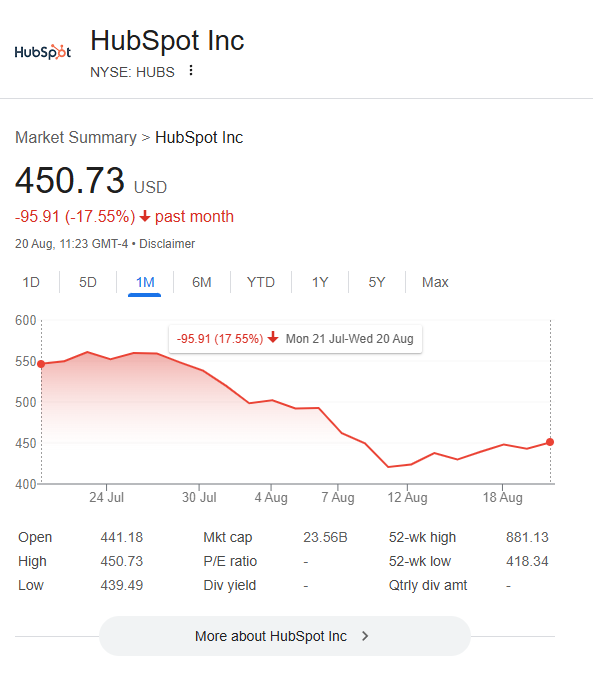
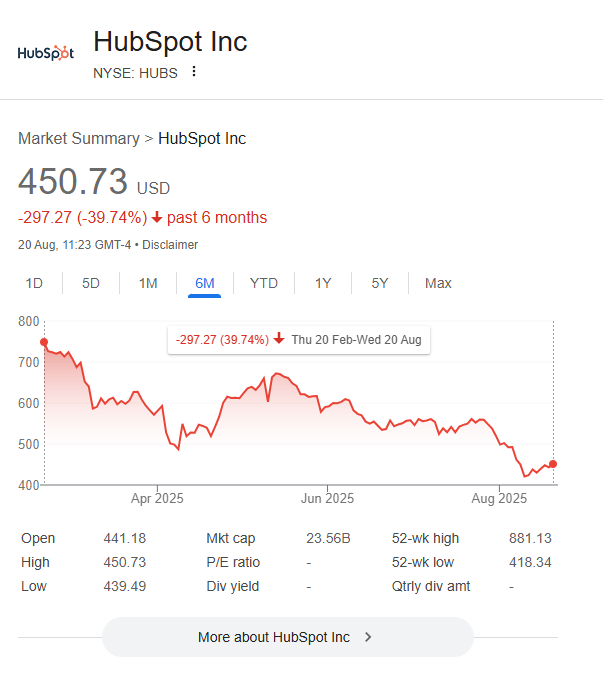
HubSpot, too, has suffered in recent months.
A one-month view of the stock, as of August 20, shows a drop of 17.55%, down to $450.73. Over six months, the stock has dropped by nearly 40%.
So, while negative headlines around Salesforce social engineering attacks likely aren’t exactly helping the software giant, can they really be blamed when other CRM platforms are seeing similar losses?
So, What is to Blame Then?
Even though the cloud giant’s own platform has not been breached, having big names like Google and Chanel appearing next to the words ‘Salesforce’ and ‘hacked’ in news headlines is far from ideal for the company.
Investors might interpret “Salesforce data breach” as a security weakness, despite the nuances of the problem – which are not down to any particular vulnerability of Salesforce as such.
Plus, the comparison with rivals like SAP, Microsoft, and Oracle – who can boast of positive YTD gains – means institutional investors could well rotate out of CRM and opt for alternative enterprise software bets.
HubSpot, Monday, and Salesforce have each suffered losses over a six-month period. The CRM sector as a whole might be suffering from macroeconomic factors like slower economic growth.
And, by their nature, CRMs often rely on upselling and seat expansion – which becomes a harder goal when clients are more financially conservative.
Plus, layoffs and reductions in hiring may have had a negative effect on the per-seat offerings.
Artificial intelligence products are consumption-based, too, and Agentforce is still getting up to speed. But Data Cloud – which is also consumption-based – was a significant success story in Salesforce’s Q1 results, with annual recurring revenue (ARR) for ‘Data Cloud + AI’ hitting more than $1B – a Y/Y increase of over 120%.
There may also be something of an unsuspected factor for the changes.
During Monday’s earnings call, Alex Zukin, from Wolfe Research, asked about the spending environment and whether anything was different with the linearity in the quarter.
Eliran Glazer, CFO of Monday.com, said that demand in general “remains very strong”, but he added: “We are seeing some softness within the down market due to the changes in the Google algorithm.”
He said that they believe this is “temporary”, and Monday they are already taking “proactive” actions to address this.
AI-generated answers taking the top spot of Google results has been something many in the publishing industry are dealing with right now, and it seems more and more industries are feeling the effects of it.
Final Thoughts
While it’s true that Salesforce stock is down, it appears to be suffering slightly less than other CRM platforms. Sector-wide weakness appears to be the culprit, rather than negative headlines about data theft.
Factors like tightening IT budgets may lead to more skeptical voices being raised when Salesforce – among other CRM platforms – goes in for the hard upsell.
As for the Monday.com CFO’s comments about Google AI overview affecting the industry, we’re still in early days, but this could well be one of the most significant shake-ups for the business world in modern times, with effects rippling out across many sectors – not just online media publishers (like Salesforce Ben).